



The first time someone introduced me as “the BIM manager”, I corrected them. I said I was a CAD manager who happened to look after some BIM software. They smiled kindly, and the client’s project director said something I have never forgotten: “Whatever you call it, you are the person we phone when the information is wrong.” He was right, and it took me a few more years to accept what that sentence meant. My job was no longer to keep software running. It was to make sure that a team of different people, in different companies, using different tools, produced information that fitted together, arrived on time and could be trusted.
That is BIM management. It is not a software skill, although software skills help. It is not a purely technical role, although technical credibility matters. It is a management discipline: setting direction, agreeing rules, assigning responsibility, controlling quality, managing risk and measuring whether it all worked. In many ways it resembles project management, but its subject is information rather than the works, and its time horizon is both the project and the life of the asset.
This guide is the hub for the whole BIM management section of this site. It explains what BIM management covers, how it differs from related disciplines, what a BIM manager actually does, how the work fits into the ISO 19650 process, which documents carry it and how to build the skills to do it well. It then points you to the detailed guides: the BEP, implementation strategy, roles, goals and uses, the responsibility matrix, planning, quality, risk, performance, day-one setup and project templates.
The Short Answer
BIM management is the planning, organization, control and improvement of how BIM is used on projects and in organizations: setting goals, defining processes and standards, assigning responsibilities, supporting teams, controlling quality and risk and measuring results.
It operates at two levels.
| Level | Focus | Typical owner | Typical outputs |
|---|---|---|---|
| Organizational | How the company uses BIM across all projects: strategy, standards, capability, tools, training | BIM manager, BIM lead, innovation or digital director | Implementation strategy, office standards, templates, training plans, performance reviews |
| Project | How BIM is used on one project: goals, uses, roles, processes, deliverables, quality, risk | Project BIM manager or lead appointed party’s information management function | BEP, responsibility matrix, MIDP, coordination procedures, quality reports |
In one sentence:
BIM management is making sure that the right information is produced by the right people, to the right standard, at the right time, and that the organization learns from the result.
BIM Management, Project Management and Information Management
These terms overlap, and the overlap causes confusion about who does what.
| Discipline | Primary subject | Primary question | Typical standard |
|---|---|---|---|
| Project management | The project: scope, time, cost, quality, risk, people | Will we deliver the project as agreed? | Project management standards and methods |
| Information management | Information containers and their lifecycle | Is the information correctly requested, produced, shared and kept? | ISO 19650 series. See BIM Information Management: The Complete Guide |
| BIM management | How BIM is applied: goals, uses, processes, roles, tools, quality and capability | Is BIM delivering what it should, and are teams able to work this way? | Organizational standards, execution plans, ISO 19650 as framework |
| BIM coordination | Integrating the work of disciplines | Do the models and information fit together? | See BIM Coordination: The Complete Guide |
| Design management | The design process and its outputs | Is the design progressing and coordinated? | Design management practice |
In real projects, one person may carry several of these. On a large project, they are distinct functions. What matters is that each is assigned. The BIM manager works with the project manager on programme and risk, with the information manager on the CDE and standards, and with coordinators on the models.
What BIM Management Actually Covers
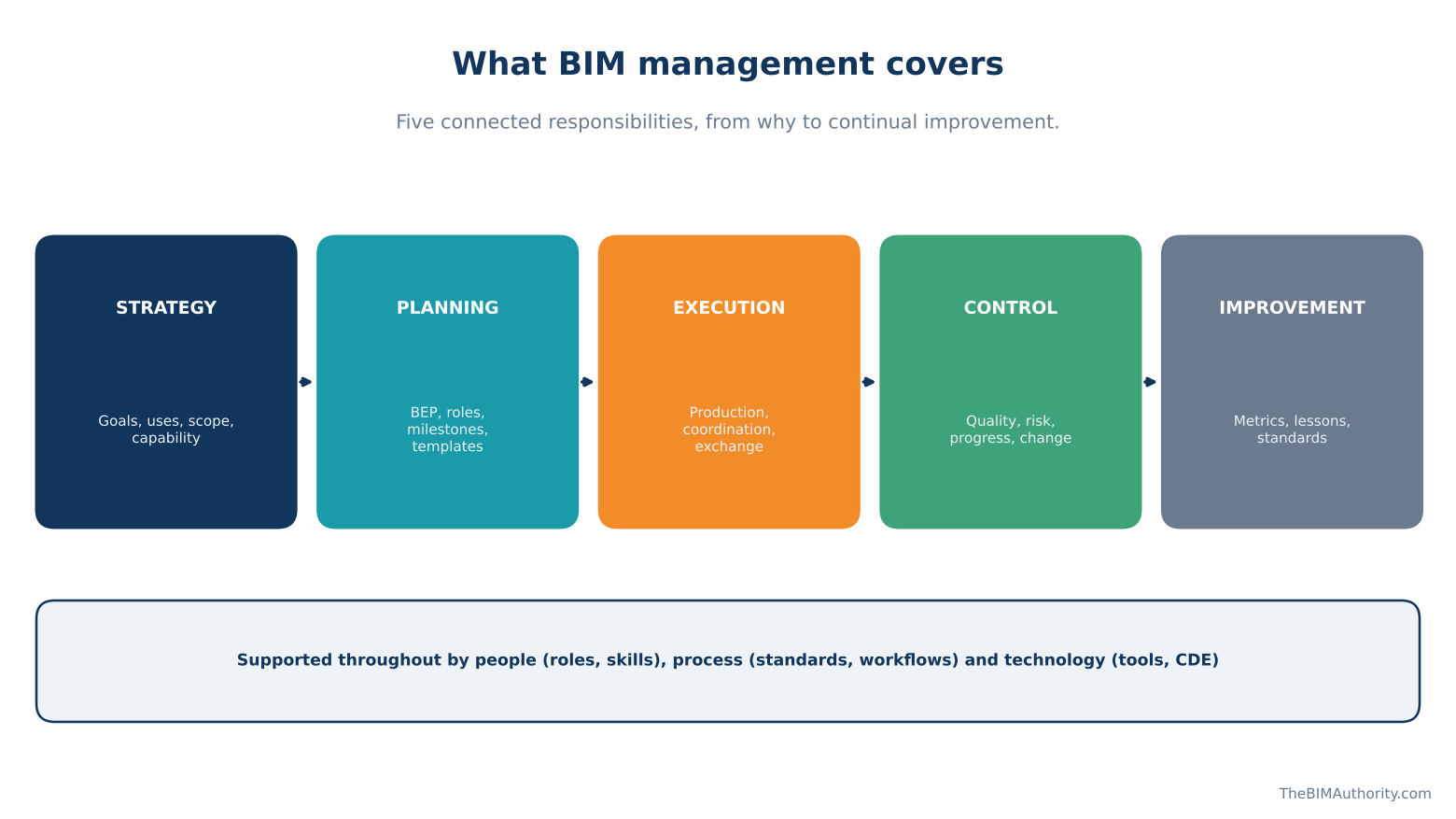
I describe it as five connected responsibilities.
1. Strategy: Why and How Far
Decide why BIM is used and for what. Define goals, BIM uses, scope and the capability needed. At organizational level, this is the implementation strategy; at project level, the goals and uses in the BEP. See How to Develop a BIM Implementation Strategy and How to Define BIM Goals, Uses, and Project Deliverables.
2. Planning: Who, What, When
Turn strategy into plans: the BIM execution plan, roles and responsibilities, the responsibility matrix, milestones and delivery plans, standards and templates. See BIM Execution Plan (BEP): How to Create and Implement One, BIM Roles and Responsibilities: Manager, Coordinator, Modeler, and Information Manager, How to Create a BIM Responsibility Matrix, and BIM Project Planning: Milestones, Deliverables, and Coordination.
3. Execution: Making It Happen
Support the production and exchange of information: set up the project, mobilize teams, run coordination, manage the CDE, resolve problems. See How to Set Up a Successful BIM Project from Day One and How to Build a BIM Project Template.
4. Control: Staying on Track
Check that information meets the requirements, manage risk, track progress and control change. See BIM Quality Management: Processes, Metrics, and Best Practices and BIM Project Risk Management: Common Risks and Mitigation Strategies.
5. Improvement: Learning
Measure performance, capture lessons and update standards, templates and training. See How to Measure BIM Performance, ROI, and Project Success.
Notice that only one of the five is about modeling. The rest is management, which is why strong modelers do not automatically make strong BIM managers.
The Work of a BIM Manager
Titles vary: BIM manager, BIM lead, digital delivery manager, BIM director, head of information management. The work is recognizable. Here is how a typical week might divide on a mid-sized project.
| Activity | Examples |
|---|---|
| Planning and standards | Maintaining the BEP and standards, updating templates, planning milestones |
| People and capability | Briefing and training teams, coaching coordinators, assessing supplier capability |
| Coordination oversight | Reviewing federated models, resolving cross-discipline problems, chairing or attending coordination meetings |
| Quality and compliance | Running or reviewing checks, reporting against the requirements, managing acceptance |
| Technology and workflow | Overseeing CDE configuration, software versions, exports and automation |
| Stakeholder communication | Reporting to the project manager and client, explaining issues in plain language |
| Risk and change | Maintaining the risk register for information delivery, managing change requests |
| Improvement | Collecting lessons, measuring performance, proposing changes |
Skills Beyond Software
| Skill | Why it matters |
|---|---|
| Technical fluency | Credibility with modelers and coordinators; ability to diagnose problems. See BIM Skills Matrix: Competencies Required for Every Professional Level |
| Standards knowledge | ISO 19650, national annexes, classification, IFC and the openBIM family. See BIM Standards: The Complete International Guide |
| Communication | Translating between designers, managers, clients and IT |
| Planning and organization | Milestones, dependencies, resourcing |
| Facilitation | Running workshops and meetings that produce decisions |
| Quality mindset | Defining criteria and checking against them |
| Risk thinking | Anticipating where information delivery can fail |
| Teaching and coaching | Building the capability of others |
| Commercial awareness | Understanding contracts, procurement and value |
My honest view after thirty years: the soft skills decide the outcome. The technical gap can be closed in months. The ability to keep six companies working to one standard without a command structure takes years.
BIM Management Across the ISO 19650 Process
ISO 19650-2 organizes delivery into eight activities. Each has BIM management tasks.
| Activity | BIM management tasks |
|---|---|
| Assessment and need | Help the appointing party define goals, uses, requirements, milestones and standards. See ISO 19650 Information Requirements Explained: OIR, AIR, PIR, and EIR |
| Invitation to tender | Prepare or review the EIR, tender response requirements and evaluation criteria |
| Tender response | Prepare the pre-appointment BEP, capability evidence, draft MIDP, mobilization plan and risk register. See How to Respond to BIM Requirements in Tenders |
| Appointment | Confirm the BEP, complete the responsibility matrix and MIDP, write EIR for suppliers |
| Mobilization | Set up the CDE, standards, templates and workflows; test and train. See How to Set Up a Successful BIM Project from Day One |
| Collaborative production | Run production, checks, coordination and issue management |
| Information model delivery | Check, authorize and submit at milestones; manage acceptance |
| Project close-out | Hand over information, archive, capture lessons |
See ISO 19650-2: BIM Information Management During Project Delivery.
The Documents of BIM Management
Management needs written, shared documents. These carry most of the work.
| Document | Purpose | Guide |
|---|---|---|
| Implementation strategy | Organizational direction: vision, scope, roadmap | How to Develop a BIM Implementation Strategy |
| BIM Execution Plan | How BIM will be delivered on a project | BIM Execution Plan (BEP): How to Create and Implement One |
| Goals and uses statement | Why BIM is used and for what | How to Define BIM Goals, Uses, and Project Deliverables |
| Responsibility matrix | Who is responsible for what | How to Create a BIM Responsibility Matrix |
| MIDP and TIDPs | When and by whom information is delivered | Master Information Delivery Plan (MIDP): Complete Guide |
| Project information standard and templates | How information is named, structured and produced | How to Build a BIM Project Template |
| Quality plan and checklists | How quality is controlled | BIM Quality Management: Processes, Metrics, and Best Practices |
| Risk register | Risks to information delivery and responses | BIM Project Risk Management: Common Risks and Mitigation Strategies |
| Performance dashboard | Progress and results | How to Measure BIM Performance, ROI, and Project Success |
| Security plan | Protection of information | BIM Information Security, Access Control, and Data Governance |
A good BIM manager keeps these documents short, current and used. A BIM plan that nobody opens is a risk, not a control.
BIM Management From Different Seats
The role changes with the organization you work for.
For the Asset Owner or Client
Management means asking for the right things and checking them: writing requirements, appointing capable teams, accepting deliverables, operating the asset information model. The BIM or information manager on the client side is often the most influential person on the project, because requirements shape everything. See Exchange Information Requirements (EIR): Complete Guide.
For the Design Team
Management means running design information as a coordinated system: standards and templates, model federation, discipline interfaces, quality checks and the information schedule. The lead designer’s BIM manager often becomes the project’s information management function.
For the Contractor
Management means turning design information into construction information: coordinating trades, managing fabrication models, keeping models aligned with site reality, producing as-built and handover information. Many contractors maintain their own BIM management teams.
For Specialists and Subcontractors
Management means meeting someone else’s requirements reliably: understanding the EIR, planning deliveries through a TIDP, controlling quality and using the CDE correctly. Small firms need a lightweight version of the same discipline.
For Facility Managers and Operators
Management means keeping the asset information model alive: trigger events, updates, quality and links to operational systems. See ISO 19650-3: Information Management During Asset Operations.
Building BIM Management Capability in an Organization
Most organizations develop it in stages. Recognizing your stage helps you decide the next move.
| Stage | Typical characteristics | Next step |
|---|---|---|
| Ad hoc | A few enthusiasts use BIM; no common standards; results depend on individuals | Agree a minimal standard and a named lead |
| Standardized | Templates, naming and basic procedures exist; a BEP is written for projects | Train, check compliance, introduce quality control |
| Managed | Roles are defined; performance is measured; supply chain requirements are cascaded | Use data to improve; integrate with operations |
| Optimized | Continual improvement; automation; data feeds business decisions | Share practice, innovate carefully |
See BIM Maturity Levels (Level 0 to 3) and the Shift to ISO 19650 for the national maturity vocabulary, and How to Develop a BIM Implementation Strategy for a path between stages.
Typical Problems BIM Managers Face
| Problem | Underlying cause | Direction of the remedy |
|---|---|---|
| “Nobody follows the standard.” | Standards are unclear, too heavy or not enforced | Simplify, train, check and give feedback |
| “The client keeps changing requirements.” | Requirements not fixed or not linked to decisions | Establish PIR and change control. See Project Information Requirements (PIR): Complete Guide |
| “Models are late and inconsistent.” | No delivery plan or dependency management | Build a MIDP from TIDPs |
| “Coordination meetings go round in circles.” | Issues untracked, roles unclear | Use BCF and a clear issue process. See BIM Collaboration Format (BCF): The Complete Guide |
| “Subcontractors cannot deliver what we ask.” | Capability not assessed; requirements not cascaded | Assess early; provide templates and training |
| “We cannot show BIM is worth it.” | No baseline or metrics | Define measures at the start |
| “I am responsible for everything and have authority over nothing.” | Role not defined in the appointment | Define authority in the BEP and contract |
The last one is the quiet killer. A BIM manager without mandate is a messenger. Settle the authority question in writing at the start.
Measuring BIM Management
A few indicators tell you whether the management system works.
| Indicator | What it shows |
|---|---|
| On-time delivery rate against the MIDP | Planning reliability |
| First-time pass rate at quality gates | Production quality and clarity of standards |
| Open issues and age | Coordination health |
| Share of requirements that are verifiable | Quality of the requirements |
| Rework attributed to information problems | Cost of poor management |
| Training coverage | Capability |
| Supplier compliance | Supply chain reach |
See How to Measure BIM Performance, ROI, and Project Success.
Common Mistakes
- Treating BIM management as software administration.
- No mandate for the BIM manager.
- No written plan, so each team invents its own way of working.
- Standards that are too heavy to follow or too light to matter.
- Choosing tools before processes.
- Ignoring the supply chain’s capability.
- No quality control, or quality control only at the end.
- No risk management for information delivery.
- Not measuring anything.
- Never capturing lessons.
- Confusing activity with value: more models is not better BIM.
- Doing everything personally instead of building capability in others.
See also Common BIM Mistakes Beginners Should Avoid.
A Starter Checklist for a BIM Manager
- Is my role and authority written down?
- Are the project’s goals and BIM uses agreed?
- Is there a BEP that people actually use?
- Are roles and responsibilities clear, with a responsibility matrix?
- Is there a delivery plan (MIDP, TIDPs) tied to milestones?
- Are standards and templates available and tested?
- Is the CDE configured, with naming, statuses and permissions?
- Are quality checks defined, and run before sharing?
- Is there a risk register for information delivery?
- Do I have a few metrics and a review routine?
- Do we capture lessons at each milestone?
Frequently Asked Questions
What is BIM management?
The planning, organization, control and improvement of how BIM is used on projects and in organizations: goals, processes, standards, responsibilities, quality, risk and performance.
What does a BIM manager do?
Sets and maintains the standards and plans, supports and trains teams, oversees coordination, controls quality and risk, reports progress and drives improvement.
What is the difference between a BIM manager and a BIM coordinator?
The manager works on strategy, standards, planning and control. The coordinator integrates models, runs checks and manages issues between disciplines. See BIM Roles and Responsibilities: Manager, Coordinator, Modeler, and Information Manager.
Is a BIM manager the same as an information manager?
The roles overlap. ISO 19650 defines an information management function; a BIM manager often carries it, but the title is not fixed.
Do I need to be a good modeler to be a BIM manager?
You need technical credibility, but management, communication and standards knowledge matter more as you progress.
How do I become a BIM manager?
Build technical skills, learn the standards, take on coordination and standards responsibilities, then lead a project’s information management. See How to Become a BIM Manager: The Complete Career Guide.
Does every project need a BIM manager?
It needs the function: someone accountable for how information is planned, produced, checked and delivered. On small projects, one person may do it part-time.
How is BIM management related to ISO 19650?
ISO 19650 provides the framework for information management across the asset life cycle. BIM management applies it through plans, standards, roles and control.
Final Thoughts
The project director’s remark, “you are the person we phone when the information is wrong”, still describes the job, but I now hear it differently. If the phone rings often, the management is failing. The best BIM managers I know receive few calls, because they spent their effort earlier: agreeing what was needed, writing it down, assigning it, testing the way of working and checking as they went. The calm they create is invisible, and it is the best evidence of their craft.
If you are starting out, begin with one project and one page: the goals, the roles, the milestones. Add a BEP, a responsibility matrix and a few checks. Measure, learn and repeat. The rest of this section of the site will show you how.
Where to go next: to write the central plan, read BIM Execution Plan (BEP): How to Create and Implement One. For the organizational view, continue with How to Develop a BIM Implementation Strategy, and for the people side, BIM Roles and Responsibilities: Manager, Coordinator, Modeler, and Information Manager.



