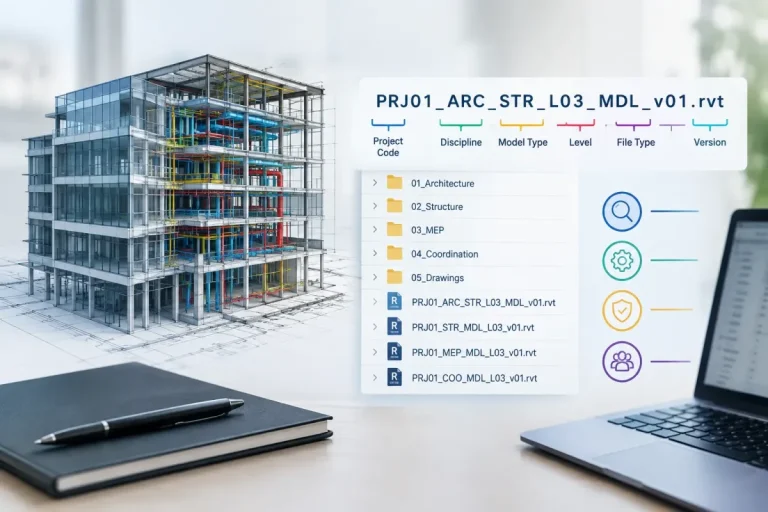

On a large project I managed, the programme was a masterpiece: four hundred lines in a scheduling tool, beautifully linked, colored by trade, signed off by everyone. It told us when the foundations would start, when the steel would arrive and when the roof would close. It said nothing about when the information would arrive. The structural engineer’s models, the MEP coordination, the fire strategy, the specialist facade drawings, the asset data: all of it was assumed to appear in time, as if information were a utility that simply flowed when you needed it.
Predictably, it did not. In week fourteen, the steel fabricator was ready to start detailing, and the structural model it needed was ten days late because the architect’s levels had changed and nobody had told the engineer. In week twenty-two, the facade contractor asked for the services penetrations, which depended on an MEP coordination that was waiting for a structural update. Each delay was small and reasonable. Together, they cost the project six weeks.
The cure was a document that, until then, I had treated as a formality: a Master Information Delivery Plan, the MIDP. When we finally built one, it was not exciting. It was a table. But it listed every deliverable, who would produce it, when it was due, what it depended on and who would receive it. Overnight, the information became as visible as the concrete. This guide explains what an MIDP is, how it relates to the TIDPs and the rest of the ISO 19650 documents, what it contains, how to build and maintain one and how to avoid the problems that turn it into shelfware.
The Short Answer
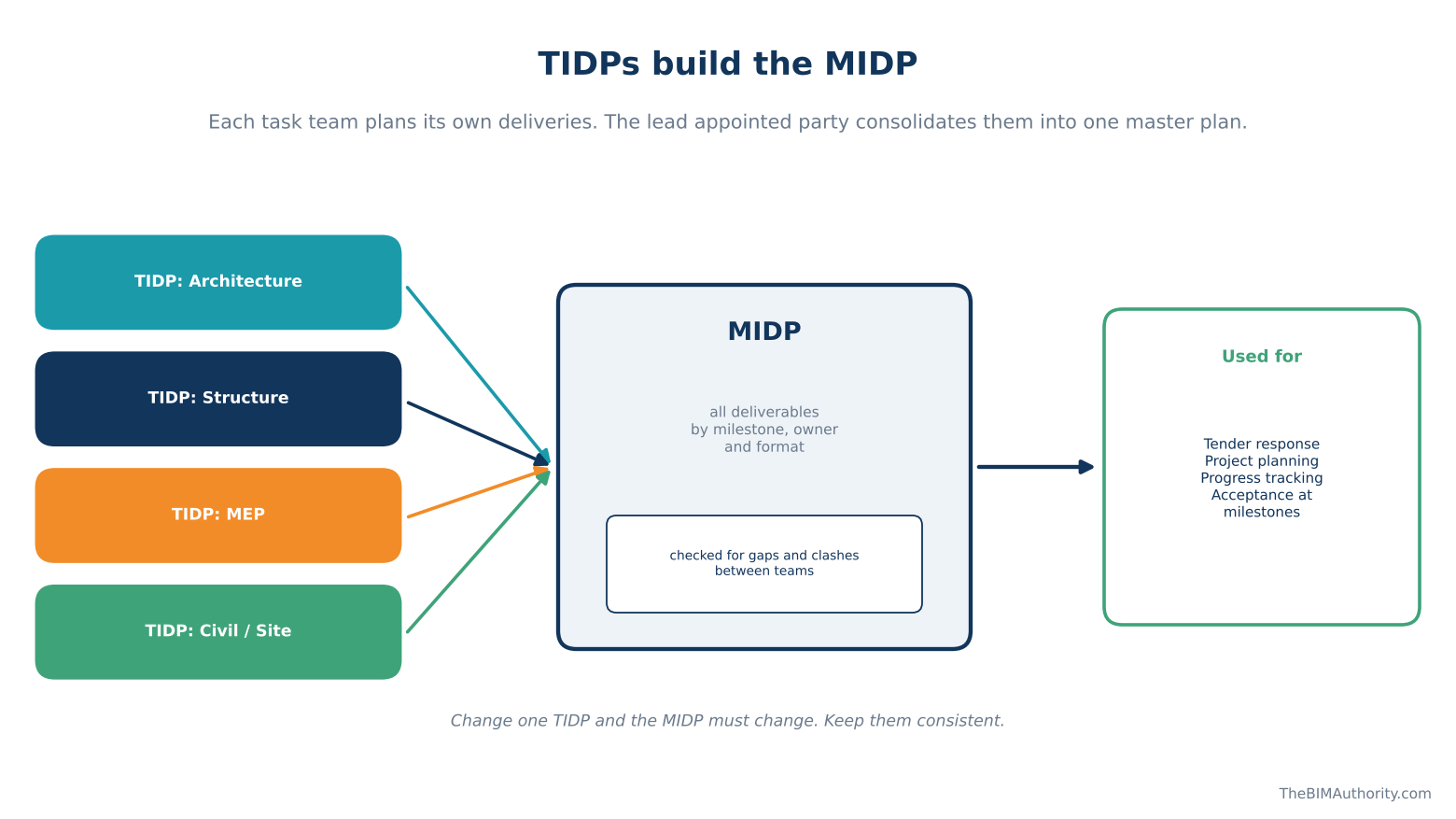
The Master Information Delivery Plan (MIDP) is the plan of all information to be delivered by the delivery team, consolidated from the Task Information Delivery Plans (TIDPs) of the task teams. It states what information containers will be produced, by whom, in what form and by when, aligned with the project’s information delivery milestones and the requirements of the EIR.
In ISO 19650-2:
- Each task team prepares its own TIDP.
- The lead appointed party consolidates them into the MIDP for the delivery team.
- A draft MIDP is part of the tender response, and the MIDP is completed at appointment.
- The MIDP is maintained during the project and used to track delivery against the plan.
In one sentence:
The MIDP is the programme of the information: a single, consistent schedule of what will be delivered, by whom, when and to what standard.
Why an MIDP Matters
| Without an MIDP | With an MIDP |
|---|---|
| Information delivery is assumed, not planned | Every deliverable has an owner and a date |
| Dependencies between teams are discovered late | Dependencies are visible and managed |
| Milestone deliveries are rushed and incomplete | Work is paced toward milestones |
| The client cannot tell whether the team will meet the EIR | The MIDP shows how each requirement will be satisfied |
| Gaps and duplications go unnoticed | Consolidation reveals both |
| Progress cannot be measured | Delivery can be tracked against planned dates |
| Tender responses cannot be compared | Bidders show comparable, concrete plans |
The MIDP is also an accountability tool. It makes it hard to say “I did not know that was due”.
MIDP vs. TIDP vs. BEP vs. Programme
These documents are often mixed up. Here is how they differ.
| Document | Scope | Author | What it says |
|---|---|---|---|
| TIDP | One task team | Task team (with its lead) | What this team will deliver, when and in what form. See Task Information Delivery Plan (TIDP): Complete Guide |
| MIDP | The whole delivery team | Lead appointed party | The consolidation of all TIDPs: the master schedule of information |
| BEP | The delivery team’s approach | Lead appointed party | How information will be managed: roles, standards, processes. See BIM Execution Plan (BEP): How to Create and Implement One |
| Project programme | The works | Project manager or contractor | When physical work and design stages happen |
| Responsibility matrix | Who does what | Delivery team | Who is responsible for each type of information. See How to Create a BIM Responsibility Matrix |
| EIR | The client’s requirements | Appointing party | What must be delivered. See Exchange Information Requirements (EIR): Complete Guide |
A helpful way to remember it: the EIR says what, the BEP says how, the MIDP says when and who, and the responsibility matrix says who is responsible for each type.
What the MIDP Contains
A good MIDP is a structured schedule, usually a table or database, accompanied by a short explanatory note. These are its typical contents.
For Each Information Container (or Group)
| Field | Purpose | Example |
|---|---|---|
| Container ID or group | Identification following the naming convention. See BIM File Naming Conventions and ISO 19650 | HOSP1-ABC-XX-L02-M3-A-0001, or a group “Architectural models, all levels” |
| Title / description | What it is | Architectural model, level 2 |
| Type | Model, drawing, schedule, report, specification and so on | Model |
| Originator / task team | Who produces it | Architect task team |
| Responsible person | A named individual or role | Architectural BIM coordinator |
| Format | File format, schema version and model view where relevant | Native plus IFC4 Reference View |
| Level of information need | Reference to the EIR or LOIN table | Per matrix, milestone 3 |
| Milestone | The information delivery milestone it supports | Milestone 3: design approval |
| Planned delivery date | When it will be shared or delivered | 14 March |
| Status on delivery | The suitability status it will have | S2 (suitable for information), or published at milestone |
| Dependencies | What it needs from others, and who needs it | Needs structural grid update; needed by MEP coordination |
| Acceptance / checks | How it will be checked and by whom | IDS check; coordinator review |
| Federation / volume reference | Where it fits in the federation and volume strategy | Building A, level 2 |
| Actual dates and status | For tracking | Delivered 15 March; accepted 18 March |
Overall Information
- Information delivery milestones with dates and what each requires.
- A summary of the federation strategy and volume strategy, showing how models are divided and combined. See BIM Models vs. Federated Models: What Is the Difference?.
- Assumptions and dependencies on external parties, including client-provided reference information.
- Review and update procedure and version history.
- Risks to information delivery, linked to the risk register.
How the MIDP Is Built: A Step-by-Step Method
Step 1: Start From the EIR and the Milestones
List the information delivery milestones and the requirements attached to each. The MIDP must show how every EIR requirement will be met, so start there.
Step 2: Define the Federation and Volume Strategy
Decide how the project’s information is divided into models and containers (by discipline, building, zone and level) and how it will be combined. This determines how many containers there will be and how they are named. See BIM Execution Plan (BEP): How to Create and Implement One.
Step 3: Agree the Task Teams and Responsibilities
List the task teams and their scopes. Use the responsibility matrix to confirm who produces which type of information.
Step 4: Ask Each Task Team to Draft a TIDP
Provide a template with the columns above. Each team lists its deliverables, dates and dependencies. Run a short briefing so teams know what level of detail is expected.
Step 5: Consolidate
The lead appointed party (or the information manager) combines the TIDPs into one table. Use consistent names, milestones and formats.
Step 6: Check for Gaps, Duplications and Clashes of Dependencies
Review the consolidated schedule systematically.
| Check | Question |
|---|---|
| Coverage | Does every EIR requirement have at least one deliverable? |
| Duplication | Are two teams producing the same information? |
| Dependencies | Is every deliverable scheduled after the information it depends on? |
| Capacity | Do dates overload any team in a given week? |
| Milestones | Is each milestone’s information complete and consistent? |
| Review time | Is there time for checking and approval between production and delivery? |
| Programme alignment | Do dates support the project programme and decisions? |
Step 7: Align With the Project Programme
Compare the MIDP with the design and construction programme. Information must arrive before it is needed for decisions and work. Resolve conflicts, and record assumptions.
Step 8: Review With the Team and the Client
Walk through the MIDP with task team leads and the appointing party’s information manager. Confirm that it is realistic, and that the client can review at the planned times.
Step 9: Issue and Baseline
Issue the MIDP through the CDE with a version, and treat it as a controlled document. Keep the baseline to measure variances.
Step 10: Maintain and Track
Update it as the project evolves. Record actual dates and status, review progress and slippage in each cycle and use the results in coordination meetings and reporting.
A Worked Example (Extract)
Here is an extract of an MIDP for a fictional building project, showing how a few deliverables line up around a milestone. It is a teaching example.
| ID / group | Description | Task team | Milestone | Planned date | Dependencies | Format | Check |
|---|---|---|---|---|---|---|---|
| ARCH models, all levels | Architectural models | Architecture | M3 Design approval | 14 Mar | Structural grid and core confirmed by 28 Feb; site survey (client-provided) | Native + IFC4 Reference View | IDS check; coordinator review |
| STR models, all levels | Structural frame models | Structure | M3 | 14 Mar | Architectural levels frozen 28 Feb | Native + IFC4 RV | IDS check; clash with ARCH |
| MEP models, plant and distribution | Mechanical and electrical models | MEP | M3 | 14 Mar | ARCH and STR M3 drafts by 7 Mar | Native + IFC4 RV | Clash with ARCH, STR; clearances |
| Area schedule | Area schedule against brief | Architecture | M3 | 14 Mar | ARCH model | Spreadsheet export from model | Reconciled with brief by client |
| Fire strategy report | Fire strategy | Fire engineer | M3 | 7 Mar | ARCH layout | Document | Review by authority liaison |
| Cost plan | Cost plan by element | Cost consultant | M3 | 18 Mar | ARCH, STR, MEP quantities | Spreadsheet | Reconciled against budget |
| Asset data, draft | Draft asset register: critical plant | MEP | M3 | 14 Mar | MEP model | Register template | Completeness check vs AIR |
Notice the dependencies column: it is what turns a list into a plan. The cost plan waits for quantities, which wait for models, which wait for frozen levels.
Format and Tools
An MIDP does not need special software.
| Option | Strengths | Limits |
|---|---|---|
| Spreadsheet | Flexible, familiar, easy to share and filter | Version control and tracking need discipline |
| Project programming tool | Dependencies and timelines visible | Heavier; may not carry all container-level fields |
| CDE reporting features | Direct link between plan and actual deliveries | Depends on the platform’s capabilities |
| Database or specialized tool | Scales for large projects; links to tracking | Setup and training effort |
A common, effective combination: a spreadsheet MIDP for the plan, plus CDE reports to track what was actually delivered, reconciled each cycle. Whatever the tool, the MIDP must be versioned, owned and accessible to all task teams.
Tracking and Using the MIDP in Delivery
The MIDP is valuable only if it is used.
- Weekly or fortnightly review in coordination meetings: what was due, what was delivered, what is slipping. See BIM Coordination Meetings: Planning, Reporting, and Best Practices.
- Use CDE data to see which containers have reached which status.
- Track metrics such as the share of deliverables delivered on time, average lateness and the number of rejections at gates.
- Escalate slippage early to the lead appointed party and the appointing party, linking it to risk management.
- Re-plan when scope or programme changes, and issue a new version.
- Use it for acceptance: at each milestone, compare what was delivered with the MIDP and the EIR.
| Metric | What it shows |
|---|---|
| On-time delivery rate | Reliability of the information supply |
| Average delay | Severity of slippage |
| Share of deliverables rejected at first submission | Quality of production and clarity of requirements |
| Number of dependencies missed | Coordination between teams |
| Percentage of EIR requirements covered by the plan | Completeness of the plan |
MIDP in the Tender and Appointment
The MIDP appears at two moments in the ISO 19650-2 process.
In the Tender Response
Bidders submit a proposed MIDP (a draft, with the TIDPs as far as they are known), alongside the pre-appointment BEP, capability and capacity evidence, mobilization plan and risk register. For the client, it is a powerful evaluation tool: a bidder who cannot produce a credible MIDP probably cannot deliver the information. See How to Respond to BIM Requirements in Tenders and BIM Procurement and Appointments Under ISO 19650.
At Appointment
The MIDP is completed and confirmed with the post-appointment BEP and the detailed responsibility matrix, and the lead appointed party writes EIR for its own appointed parties, with their TIDPs fitting into the MIDP.
Scaling the MIDP
| Project size | Approach |
|---|---|
| Small project | A one- or two-page table: the main deliverables, dates and owners, with milestones |
| Medium project | A spreadsheet with container groups, dependencies and a review routine |
| Large project | Container-level schedule, linked TIDPs, CDE tracking, dashboards and formal change control |
The principle: never skip it; size it to the project.
Common Problems and Remedies
| Problem | Cause | Remedy |
|---|---|---|
| MIDP is a list of dates with no dependencies | Teams plan in isolation | Require a dependencies column; run a consolidation workshop |
| Dates are unrealistic | No review time, no capacity check | Add review and approval time; check team capacity |
| MIDP does not match the programme | Prepared separately | Align with the project programme and decision dates |
| TIDPs inconsistent | No template or naming rules | Provide a template and common terms |
| Plan never updated | No owner, no process | Assign an owner; review each cycle |
| EIR requirements not covered | No traceability | Map each EIR requirement to deliverables |
| Client cannot review on time | Client capacity ignored | Include client review slots in the plan |
| Teams ignore it | Not used in meetings | Make it the agenda backbone |
| Too detailed to maintain | Container-level for small projects | Use groups; scale to the project |
Common Mistakes
- Treating the MIDP as a tender formality.
- Building it without the task teams.
- No dependencies.
- No link to the EIR and the programme.
- No review and approval time in the schedule.
- Not baselining and tracking.
- No change control.
- Ignoring client reviews and reference information.
- Making it too detailed or too coarse.
- Never using it in meetings.
See also Common BIM Mistakes Beginners Should Avoid.
A Short Checklist
- Does every EIR requirement map to deliverables in the MIDP?
- Are milestones defined and tied to decisions?
- Does each deliverable have an owner, date, format and check?
- Are dependencies shown, and dates consistent with them?
- Does it fit the project programme?
- Is there time for checks and approvals?
- Is the federation and volume strategy summarized?
- Is it versioned and baselined in the CDE?
- Is progress tracked and reviewed regularly?
- Is there a change process?
Frequently Asked Questions
What is an MIDP in BIM?
The Master Information Delivery Plan: the consolidated plan of all information the delivery team will produce, by whom, when and in what form, built from the task teams’ TIDPs.
Who prepares the MIDP?
The lead appointed party, consolidating the TIDPs prepared by the task teams.
What is the difference between MIDP and TIDP?
A TIDP covers one task team. The MIDP consolidates all TIDPs for the whole delivery team.
Is the MIDP the same as the BIM Execution Plan?
No. The BEP explains how information will be managed. The MIDP schedules what will be delivered, by whom and when.
When is the MIDP produced?
A draft is part of the tender response, and the MIDP is completed at appointment, then maintained throughout the project.
What format should an MIDP take?
A spreadsheet or database table is typical, with a short explanatory note. Use a format that can be versioned and tracked.
How detailed should it be?
Detailed enough to schedule and track every important deliverable, grouped sensibly. Do not list every file unless the project needs it.
Does the MIDP include documents as well as models?
Yes. It covers all information containers: models, drawings, schedules, specifications, reports and data.
How does the MIDP help the client?
It shows whether the delivery team can meet the EIR, helps compare bidders, supports planning of client reviews and provides a basis for acceptance.
Final Thoughts
After that project, I made it a rule: no project starts production without a one-page picture of when the information will arrive. Not because information is more important than concrete, but because it is invisible until it is late. The MIDP makes the invisible visible. It puts the delivery of models and data on the same footing as the delivery of steel and glass, and it gives everyone, client, designers and builders alike, a shared way of saying “I am waiting for that”.
Build yours with the people who will deliver it, include the dependencies, leave time for checking and use it in every coordination meeting. It will never be the most glamorous document on the project. It will often be the one that quietly saves the most weeks.
Where to go next: to see the building blocks, read Task Information Delivery Plan (TIDP): Complete Guide. For the plan around it, continue with BIM Execution Plan (BEP): How to Create and Implement One and How to Create a BIM Responsibility Matrix, and for the requirements it must satisfy, Exchange Information Requirements (EIR): Complete Guide.