


If ISO 19650-1 is the dictionary, Part 2 is the recipe book. It is the part that tells you what to do, step by step, from the moment a client realizes that a project needs information management to the day the project closes and the lessons are recorded. It is also the part that most teams actually work with, tender after tender, and the one that is most often misunderstood.
I have lived on both sides of the table. As a consultant, I have helped clients write the documents that start the process: the information requirements, the tender instructions, the appointment conditions. As a CAD and BIM manager inside delivery teams, I have written the pre-appointment BEPs that go into tenders and the post-appointment plans that follow. I know what a good Part 2 process feels like, calm and traceable, and I know what a bad one feels like: a pile of well-formatted documents that nobody reads, and a project where the real work follows other rules.
This guide explains the eight activities of the ISO 19650-2 information management process in practical terms. For each activity, you will see who does what, which documents appear and what typically goes wrong. If you are new to the vocabulary, read ISO 19650-1: Information Management Concepts and Principles first.
The Short Answer
ISO 19650-2 specifies the information management process for the delivery phase of an asset: the phase in which the asset is designed and constructed. It is organized in eight activities performed by the appointing party (the client) and the delivery team (the lead appointed party and its appointed parties):
- Assessment and need
- Invitation to tender
- Tender response
- Appointment
- Mobilization
- Collaborative production of information
- Information model delivery
- Project close-out
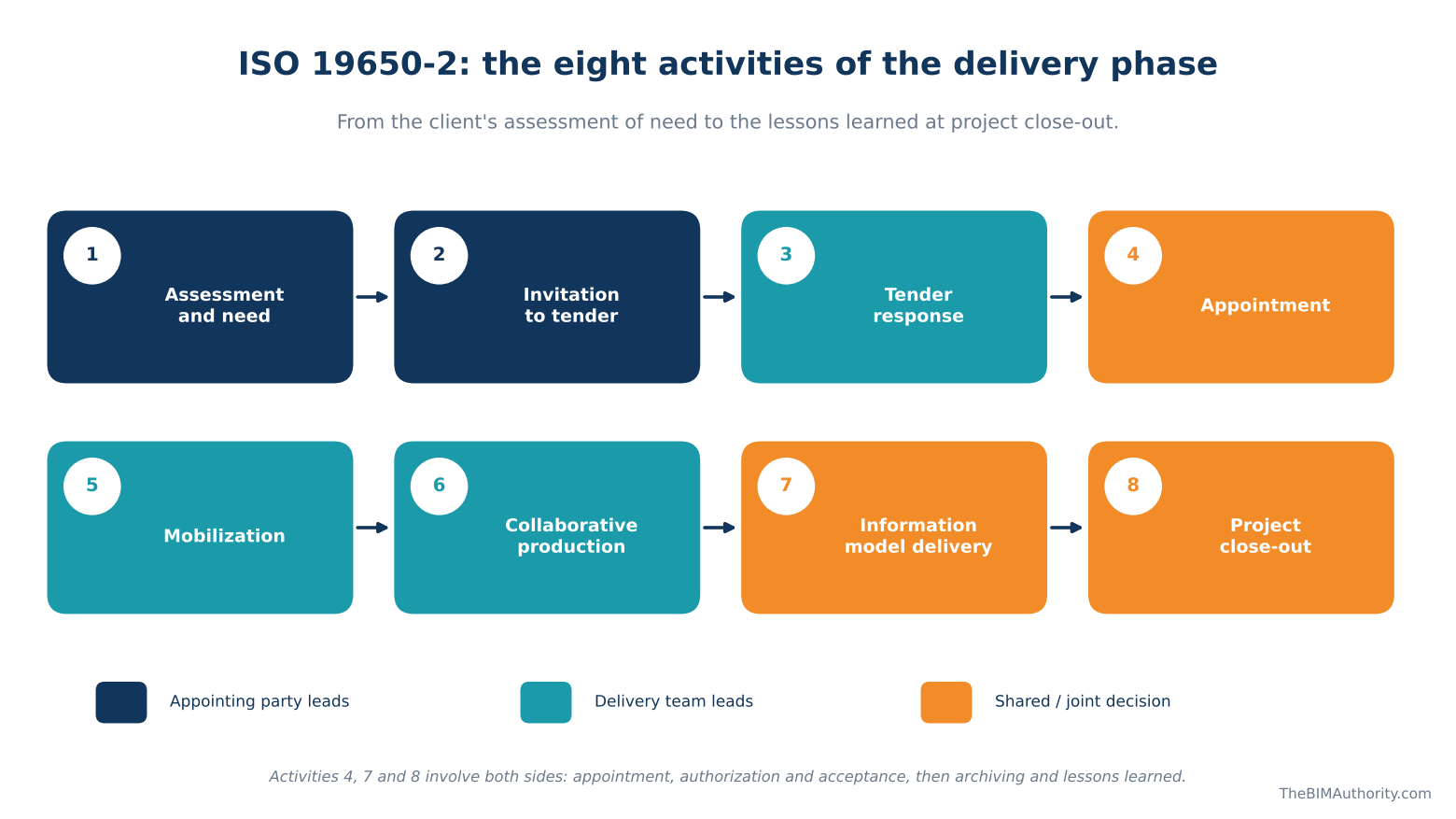
The first four are mostly about agreeing what will be done. The next three are about doing it. The last one is about learning from it.
The process is applied at every appointment level: the client appoints a lead appointed party, the lead appointed party may appoint other parties, and so on. Each appointment has its own cycle of activities.
Before You Start: The Cast of Characters
| Role | In this process |
|---|---|
| Appointing party | Defines requirements, runs the tender, appoints, accepts the information model |
| Lead appointed party | Coordinates the delivery team’s information, interfaces with the appointing party |
| Appointed party | Provides information, works, goods or services, through its task teams |
| Task team | Produces specific information (for example the structural model) |
| Information management function | Carries out the information management process, on both sides |
Also remember the main documents that will appear.
| Document | Purpose | Produced by |
|---|---|---|
| Exchange Information Requirements (EIR) | What must be delivered, when and how | Appointing party (and lead appointed party for its own appointments) |
| Pre-appointment BEP | The delivery team’s proposed approach, in the tender | Delivery team |
| Post-appointment BEP | The confirmed approach, after appointment | Lead appointed party, with the delivery team |
| MIDP / TIDP | Schedules of information delivery | Delivery team and task teams |
| Responsibility matrix | Who is responsible for which information | Delivery team |
| Capability and capacity assessment | Evidence that the team can deliver | Delivery team |
| Mobilization plan | How resources and technology will be set up | Delivery team |
| Risk register | Risks to information delivery | Delivery team |
| Project information protocol | Contractual terms on information use | Appointing party |
See Exchange Information Requirements (EIR): Complete Guide, BIM Execution Plan (BEP): How to Create and Implement One, Master Information Delivery Plan (MIDP): Complete Guide and Task Information Delivery Plan (TIDP): Complete Guide.
Activity 1: Assessment and Need
Led By
The appointing party.
What Happens
This is the preparation stage, and in my experience, the one that determines the quality of everything after it. The appointing party decides what information it needs and sets up the environment in which it will be produced. The sub-activities include:
- Appointing individuals to carry out the information management function on the client side.
- Establishing the project’s information requirements (PIR), informed by the organization’s and the asset’s requirements.
- Establishing information delivery milestones: when information must be delivered and reviewed.
- Establishing the project’s information standard: the conventions for information, such as naming, classification and formats.
- Establishing the project’s information production methods and procedures: how information will be generated, checked and exchanged.
- Establishing reference information and shared resources: surveys, existing models, libraries and templates made available to the delivery team.
- Establishing the project’s common data environment (CDE): the solution and workflow.
- Establishing the project’s information protocol: the contractual conditions regarding information.
Outputs
The appointing party ends up with the building blocks of the tender: PIR, milestones, standards, methods, reference information, the CDE and the protocol.
Typical Problems
- No one has asked what the owner needs to operate the asset. The AIR and OIR are missing, so the PIR and EIR are guesses.
- Milestones are linked to dates, not to decisions. Information is delivered, but nobody uses it for a decision.
- The CDE is chosen by habit rather than by requirements.
- Client resources are not planned. The appointing party needs capacity to review and accept information.
See ISO 19650 Information Requirements Explained: OIR, AIR, PIR, and EIR and Common Data Environment (CDE): The Complete Guide.
Activity 2: Invitation to Tender
Led By
The appointing party.
What Happens
The appointing party packages its requirements into the tender. The sub-activities include:
- Compiling the invitation to tender information: the EIR and the supporting information (milestones, standards, methods, protocol, reference information).
- Establishing the tender response requirements and evaluation criteria: what the bidders must provide and how responses will be judged.
- Compiling the reference information and shared resources to be given to bidders.
- Issuing the invitation to tender.
Outputs
An invitation to tender that includes the EIR, the response requirements and the evaluation criteria.
What Makes a Good Invitation
- EIR that are specific and verifiable. “Provide a high-quality model” is not an EIR.
- Clear evaluation criteria that include information management capability, not only price.
- Realistic effort expectations. Bidders will price the work: if the requirements are huge, the price will reflect it.
Typical Problems
- Copy-pasted EIR from another project, with requirements that do not fit.
- Contradictory documents: the EIR says one thing, the contract another.
- Unreasonable tender response requirements, such as demanding a complete BEP with every detail before appointment.
See How to Respond to BIM Requirements in Tenders and BIM Procurement and Appointments Under ISO 19650.
Activity 3: Tender Response
Led By
The prospective delivery team (the proposed lead appointed party, with its proposed appointed parties).
What Happens
The bidders show how they will meet the requirements. The sub-activities typically include:
- Nominating individuals for the information management function.
- Preparing the pre-appointment BEP: the approach, tools, roles and methods the team proposes.
- Assessing the capability and capacity of the lead appointed party and its task teams.
- Establishing the delivery team’s mobilization plan.
- Establishing the delivery team’s risk register for information delivery.
- Preparing the proposed master information delivery plan (MIDP).
- Compiling the tender response.
The Pre-Appointment BEP
This document is often misunderstood. It is not a marketing brochure. It is a commitment: the bidder says “this is how we will manage information for you”. It typically covers:
- Information management roles and the people proposed.
- The proposed federation strategy.
- Tools and technology, including the proposed CDE usage.
- A summary of how requirements will be met.
- The proposed MIDP and its milestones.
- Key risks and how they will be handled.
Capability and Capacity
The team has to show it can do what it promises. That means the skills and experience of the people, the resources and tools, and the time available. The assessment is made for the lead appointed party and for each task team, and an honest assessment of weaknesses is better than a polished fiction. See BIM Execution Plan (BEP): How to Create and Implement One.
Typical Problems
- Generic BEPs with no link to the requirements.
- Overpromising capabilities the team does not have.
- Task team assessments skipped, so the lead appointed party discovers gaps after appointment.
- Risk registers with nothing but boilerplate.
Activity 4: Appointment
Led By
Both parties. The appointing party selects, and the lead appointed party confirms its plan.
What Happens
The selected team confirms and details its approach, and the appointment is formalized. The sub-activities include:
- Confirming the delivery team’s BEP: the pre-appointment BEP is confirmed or updated into the post-appointment BEP.
- Establishing the delivery team’s detailed responsibility matrix: who is responsible for each information deliverable.
- Establishing the lead appointed party’s exchange information requirements for its own appointed parties.
- Completing the master information delivery plan (MIDP).
- Completing the appointment documents, including references to the information protocol and the relevant requirements.
Outputs
The post-appointment BEP, the detailed responsibility matrix, the MIDP, the EIR for lower tiers, and appointment documents.
Cascading Appointments
If the lead appointed party appoints others, the same logic repeats: it writes EIR for them, receives their tender responses, and appoints them. Requirements must flow down the supply chain without distortion. A broken chain here is a common source of problems later. See How to Create a BIM Responsibility Matrix.
Typical Problems
- The post-appointment BEP is a reformatted pre-appointment BEP, with no reflection of what was learned.
- Responsibilities are vague for shared elements (such as openings, penetrations, fire stopping).
- Requirements do not cascade: subcontractors receive general statements instead of specific EIR.
Activity 5: Mobilization
Led By
The delivery team.
What Happens
Before real production starts, the team prepares. The sub-activities include:
- Mobilizing resources: people, training, standards, templates.
- Mobilizing information technology: software, hardware, access to the CDE.
- Testing the project’s information production methods and procedures: a dry run with sample information.
Why Testing Matters
I have never regretted a mobilization test, and I have often regretted skipping one. A simple trial exchange, a few containers from each team passing through the CDE and into the federated model, reveals problems in naming, coordinates, permissions and formats when they are still cheap to fix.
What a Good Mobilization Test Includes
- Each task team uploads a sample container with the correct naming and metadata.
- The coordinator federates the samples and checks alignment (origin, units, levels).
- The team tests an IFC export and verifies what arrives. See How to Export and Import IFC Models Correctly.
- Permissions and status transitions in the CDE are verified.
- Training gaps are identified and addressed.
Typical Problems
- Mobilization compressed or skipped under schedule pressure.
- Templates not ready, so teams start with their own settings.
- Access problems discovered when the first deadline arrives.
Activity 6: Collaborative Production of Information
Led By
The delivery team. This is the longest activity, and it is where most of the real work happens.
What Happens
Each task team produces information, and the team as a whole manages its quality and sharing. The sub-activities for every information container include:
- Check the availability of reference information and shared resources.
- Generate the information according to the standards, methods and procedures.
- Undertake a quality assurance check of the information.
- Review the information and approve it for sharing.
- Perform an information model review after information has been shared, to ensure the combined information meets requirements.
How It Flows Through the CDE
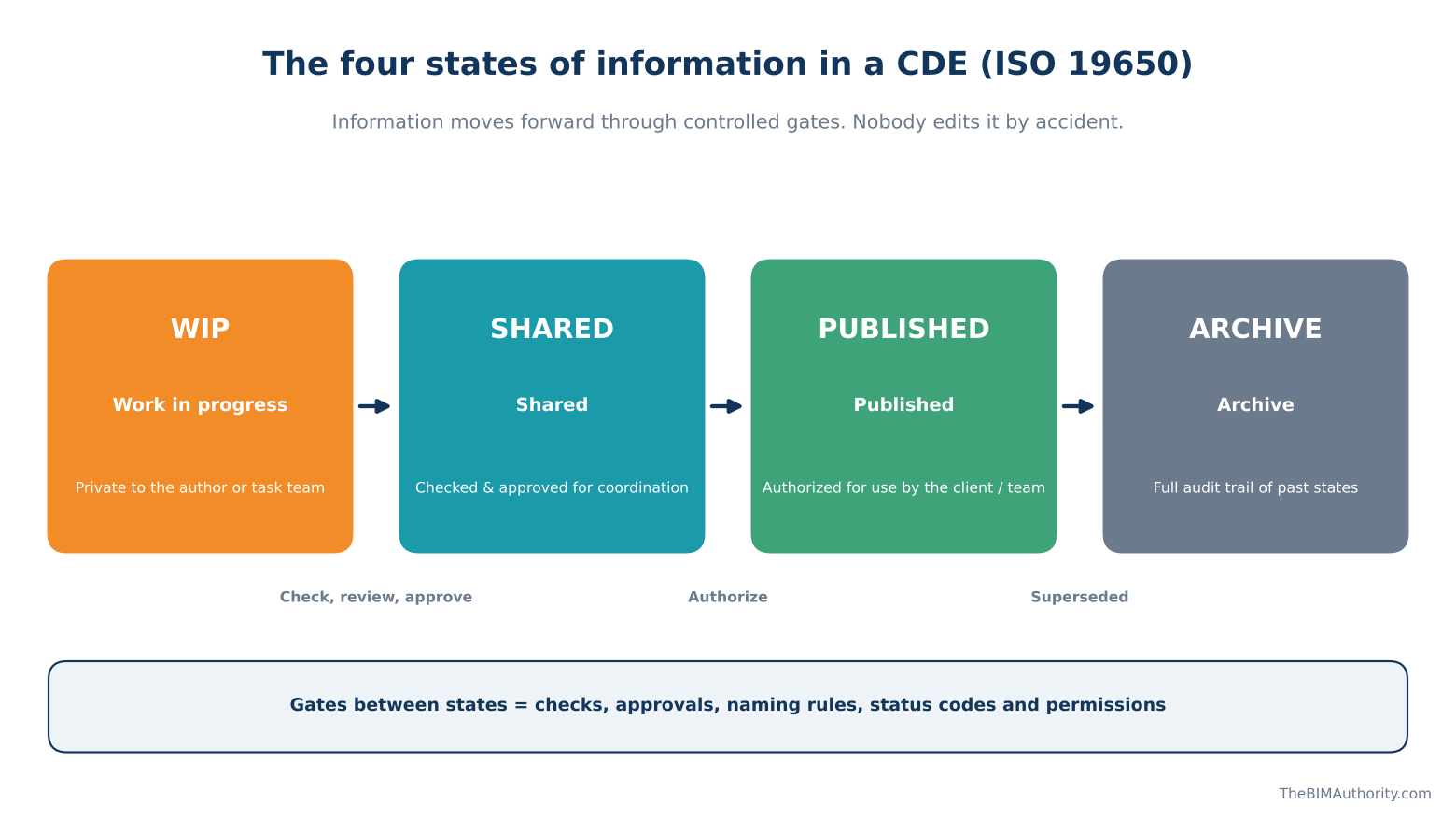
- Information is created in work in progress, private to the task team.
- After the quality check, review and approval, it moves to shared, where other teams can use it for coordination.
- At milestones, information is published after authorization.
- Superseded information goes to the archive.
The Quality Assurance Check
Before anything is shared, the author’s team checks that the container meets the project’s requirements: naming, metadata, coordinates, required properties, absence of obvious errors. This is not the same as the coordinator’s checks after federation. Think of it as inspecting your own work before handing it to a colleague. See BIM Quality Assurance vs. Quality Control: Processes and Checklists and BIM Model Checking: Geometric and Information Validation.
The Information Model Review
Once information from several task teams is combined, the combined result is reviewed: clash detection, completeness against requirements, consistency of data. Issues are recorded and assigned. This is the territory of coordination. See BIM Coordination: The Complete Guide, BIM Clash Detection: The Complete Guide and BIM Issue Tracking and Resolution Using BCF.
Typical Problems
- Information shared without checks, polluting the federation.
- Status codes ignored: work in progress used as if it were approved.
- Reference information outdated, so teams design on obsolete surveys.
- Coordination without decisions: issues recorded, nobody assigned.
- Late changes not communicated to affected teams.
Activity 7: Information Model Delivery
Led By
Both parties. The delivery team submits, the lead appointed party authorizes and the appointing party accepts.
What Happens
At each information delivery milestone, the information model is formally delivered. The sub-activities include:
- Submitting the information model for lead appointed party authorization.
- Reviewing and authorizing the information model (the lead appointed party checks that it meets the requirements before passing it on).
- Submitting the information model to the appointing party for acceptance.
- Reviewing and accepting the information model (the appointing party decides whether it meets the EIR).
If information is rejected, the delivery team corrects and resubmits.
Why the Double Check Is Valuable
The lead appointed party is accountable for the team’s information, so it must verify before it passes information up. The appointing party is entitled to a deliverable that has already been checked, not a first draft.
Typical Problems
- Submissions without evidence of checking. Provide a short check report with each delivery.
- Acceptance criteria not defined in advance, leading to subjective disputes.
- Delivery at the last moment, leaving no time for review.
- Authorization treated as a formality.
See BIM Model Handover Checklist and Requirements for the end-of-project version of this activity.
Activity 8: Project Close-Out
Led By
Both parties.
What Happens
At the end of the project, two things happen.
- Archiving the project information model: the final PIM is archived with its history, and relevant information is transferred to the asset owner, usually to feed the Asset Information Model (AIM).
- Capturing lessons learned: what worked, what did not, what to change next time.
The Link With the Operational Phase
This is the point where Part 2 hands over to ISO 19650-3. The quality of handover depends on how well the AIR were defined at the start. See ISO 19650-3: Information Management During Asset Operations, Asset Information Models (AIM): Creation and Management and COBie Explained: The Complete Guide to BIM Asset Data Handover.
Typical Problems
- Archive is an unstructured dump of folders.
- Lessons learned never written down, or written and never read.
- Handover data does not match what the owner needs.
- Rights and ownership of information unclear.
The Process at a Glance
| # | Activity | Key outputs | Typical documents |
|---|---|---|---|
| 1 | Assessment and need | PIR, milestones, standards, methods, reference information, CDE, protocol | PIR, project information standard, protocol |
| 2 | Invitation to tender | Tender package, evaluation criteria | EIR, tender instructions |
| 3 | Tender response | Proposed approach and capability evidence | Pre-appointment BEP, capability and capacity assessment, mobilization plan, risk register, draft MIDP |
| 4 | Appointment | Confirmed plan and responsibilities | Post-appointment BEP, responsibility matrix, MIDP, EIR for lower tiers |
| 5 | Mobilization | Ready resources and tested procedures | Mobilization records, test results |
| 6 | Collaborative production | Checked and shared information | Information containers, check records, issue logs |
| 7 | Information model delivery | Authorized and accepted information model | Delivery submissions, acceptance records |
| 8 | Project close-out | Archived PIM, lessons learned | Archive, lessons learned report |
How to Scale the Process for Small Projects
The standard is written for projects of all sizes, and the application should be proportionate. For a small project, the eight activities still exist, but they can be light.
- Activity 1 and 2 may fit in a short EIR (a few pages) and an agreed CDE.
- Activity 3 may be a short BEP, a half-day capability statement and a simple schedule of deliverables.
- Activity 4 may be a confirmed BEP and a one-page responsibility matrix.
- Activity 5 may be a one-hour dry run.
- Activity 6 is as important as ever: naming, status, checks.
- Activity 7 may be a short checklist and an acceptance email recorded in the CDE.
- Activity 8 may be a one-page lessons learned note and an organized archive.
The rule I give clients: never skip an activity, but size its output to the project. The thinking is the same; the paperwork is smaller.
What Good Looks Like: A Short Checklist
For the appointing party:
- Do we know what we need to operate the asset (AIR and OIR)?
- Are our PIR and EIR specific and verifiable?
- Have we defined milestones linked to decisions?
- Do we have a CDE and a protocol ready?
- Have we planned our own capacity to review and accept?
For the delivery team:
- Does our BEP respond to the EIR point by point?
- Have we honestly assessed capability and capacity, including task teams?
- Is our responsibility matrix specific, including shared elements?
- Have we tested our procedures before production?
- Do we check information before sharing it?
- Do we submit with evidence of checks?
- Do requirements cascade to our own appointed parties?
- Do we capture lessons learned?
Common Mistakes with ISO 19650-2
- Treating it as a documentation exercise rather than a way of working.
- Copying a BEP or an EIR from another project without adapting it.
- Defining no acceptance criteria, so delivery turns into negotiation.
- Skipping mobilization, and discovering problems under deadline pressure.
- Letting requirements dissolve down the supply chain.
- Appointing an information manager without authority or time.
- Ignoring the client’s capacity to review.
- Forgetting that the process is about decisions, not about documents.
- Starting the CDE late.
- Not updating the BEP when the project changes.
See also Common BIM Mistakes Beginners Should Avoid and Why BIM Implementations Fail (and How to Avoid It).
Frequently Asked Questions
What is ISO 19650-2?
The part of the standard that specifies the information management process for the delivery phase of assets, in eight activities from assessment of need to project close-out.
How many activities does ISO 19650-2 have?
Eight: assessment and need, invitation to tender, tender response, appointment, mobilization, collaborative production of information, information model delivery and project close-out.
What is the difference between a pre-appointment and a post-appointment BEP?
The pre-appointment BEP is part of the tender response and states the proposed approach. The post-appointment BEP is the confirmed and detailed plan after appointment.
Who writes the EIR?
The appointing party writes the EIR for its appointment. The lead appointed party writes EIR for its own appointed parties.
What is the difference between the MIDP and the TIDP?
A TIDP is the delivery plan of one task team. The MIDP consolidates all TIDPs into a master plan.
Does ISO 19650-2 apply to small projects?
Yes, proportionately. The activities remain, but the documents and effort can be scaled.
What is the lead appointed party?
The appointed party that coordinates the delivery team’s information and interfaces with the appointing party.
Where does ISO 19650-2 end?
At project close-out, where the PIM is archived and relevant information passes to the asset information model. The operational phase is governed by Part 3.
Final Thoughts
When I think about the best ISO 19650-2 projects I have worked on, what they had in common was not sophistication. It was honesty and rhythm. The client wrote requirements it genuinely needed and was ready to review what it asked for. The delivery team promised what it could do, tested it before starting and shared information on a predictable cycle. Problems were recorded and solved, not hidden.
The eight activities are, in the end, a discipline for making these good habits explicit, repeatable and verifiable. If you apply them with the question “What problem does this step prevent?”, the process stops feeling like bureaucracy and starts feeling like insurance.
Where to go next: to see what happens after handover, read ISO 19650-3: Information Management During Asset Operations. For the practical documents of Part 2, continue with BIM Execution Plan (BEP): How to Create and Implement One, Master Information Delivery Plan (MIDP): Complete Guide and Exchange Information Requirements (EIR): Complete Guide.



