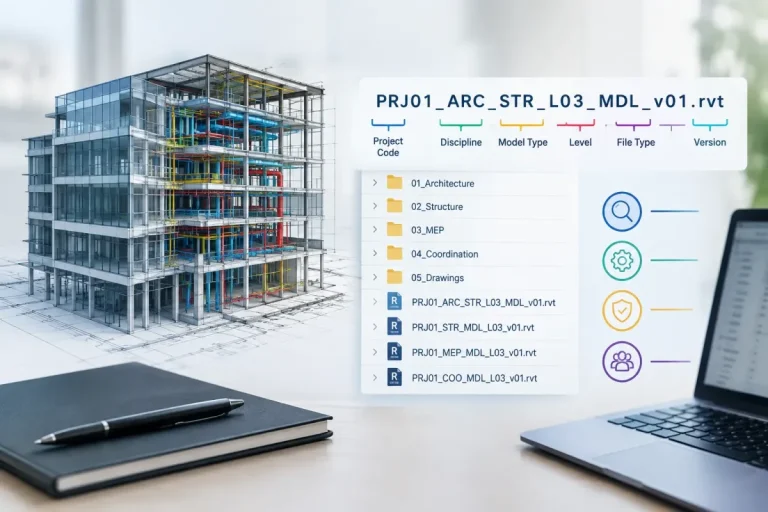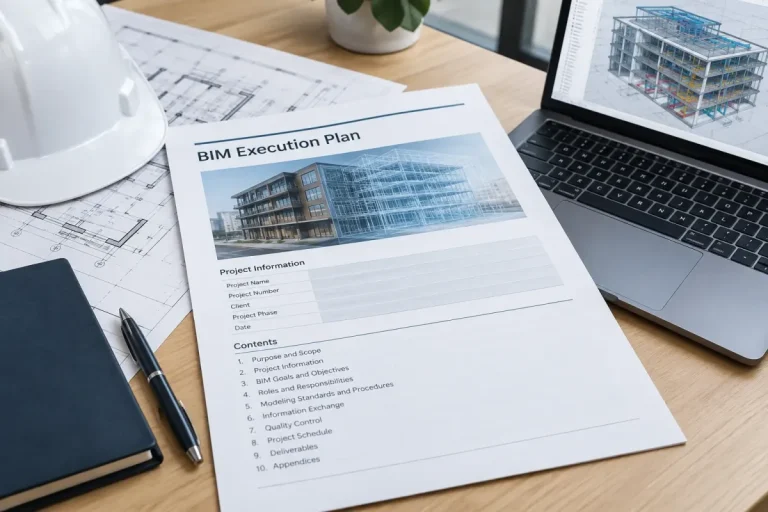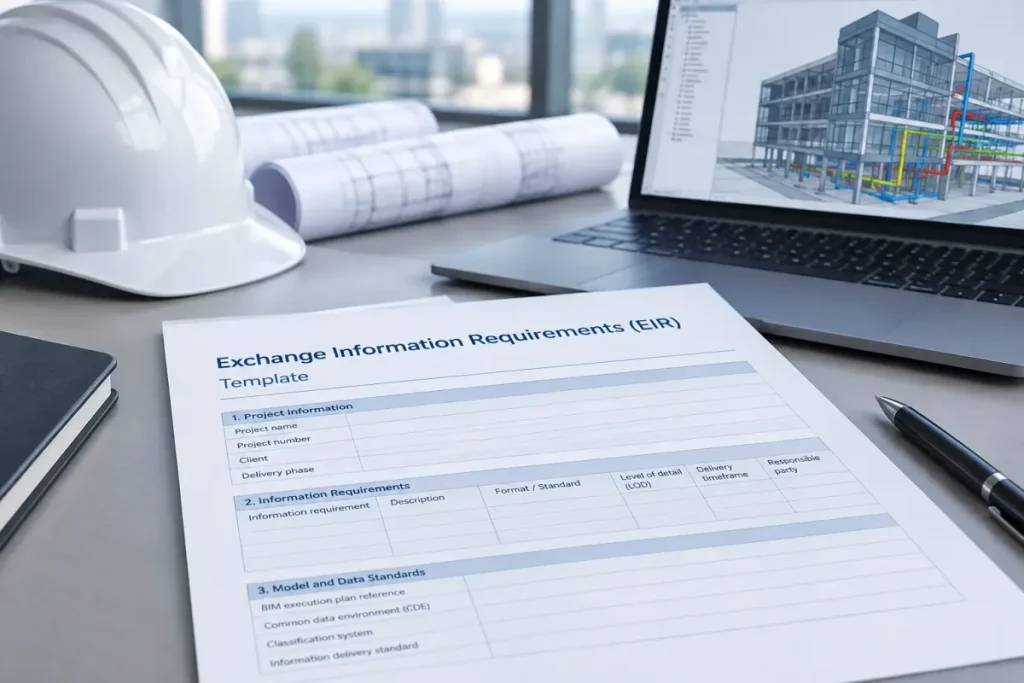

The most common weakness I find in a client’s information requirements is not that they ask for too little. It is that they ask for everything, in no particular form, at no particular time: “Provide a fully coordinated model at LOD 400,” “Deliver COBie,” “Comply with ISO 19650.” Each sentence sounds reasonable. None can be tested. When the project team receives them, it must guess what the client wants, and, being rational, it guesses cheaply. The client then discovers at handover that “COBie” meant something quite different from what the contractor delivered, and a dispute begins about whether the requirement was ever clear.
An exchange information requirements (EIR) document is the appointing party’s statement, in ISO 19650 terms, of what information it needs from each appointed party, when, in what form and to what standard. It is derived from the client’s wider information requirements: the organizational information requirements (OIR), the asset information requirements (AIR) and the project information requirements (PIR). It is issued as part of the tender documents and, together with the contract, tells bidders what to plan for; they respond with a pre-appointment BEP, which is confirmed after appointment. A good EIR is specific, testable, proportionate and organized around decisions the client must make. A bad EIR is a wish list.
This guide provides a complete EIR template with guidance for each section, a worked example with testable requirement statements for the invented Harbor View Clinic, a method for turning vague requests into testable ones, advice on how an EIR relates to the BEP, the tender evaluation, IDS and the handover, how to keep an EIR proportionate for small projects, a review checklist and the mistakes to avoid. It works with Exchange Information Requirements (EIR): Complete Guide (the explanation of the concept), Asset Information Requirements (AIR): Complete Guide and BIM Execution Plan (BEP) Template: Complete Guide and Example. An EIR is a project document that supports the contract; its contractual force depends on how it is referenced in the appointments. Seek legal advice for contractual terms.
Free Download
Download: EIR template (ZIP with Word file)
The download is a ZIP archive containing a Word document with the ten EIR sections, a vague-to-testable guide, an appendix list and a review checklist. It is free to use and adapt for your own projects. Adapt it to your contract, client requirements and standards; it supports professional judgment and is not legal advice.
The Short Answer
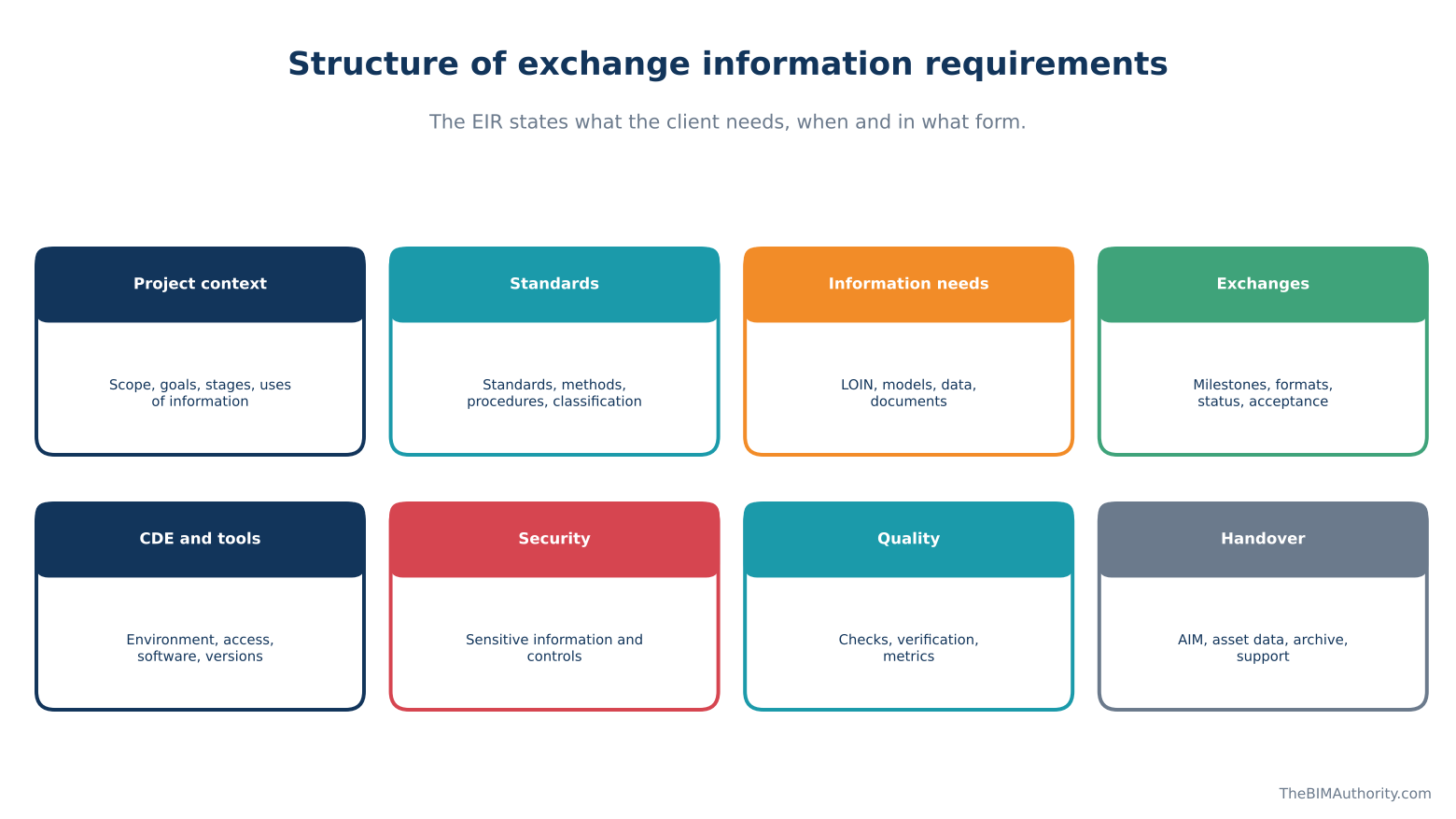
| Section | Purpose |
|---|---|
| Project context | Scope, goals, stages and uses of information |
| Standards | Standards, methods, procedures and classification |
| Information needs | Level of information need, models, data and documents |
| Exchanges | Milestones, formats, status and acceptance |
| CDE and tools | Environment, access, software and versions |
| Security | Sensitive information and controls |
| Quality | Checks, verification and metrics |
| Handover | AIM, asset data, archive and support |
In one sentence:
An EIR tells appointed parties what information the client needs, when, in what form and how it will be checked, in statements that can be tested.
How to Write an EIR
| Step | Action |
|---|---|
| 1. Start from decisions and uses | What decisions will the information support, at which stages, in operation? |
| 2. Review OIR, AIR and PIR | Derive the EIR from them. See Asset Information Requirements (AIR): Complete Guide |
| 3. Decide what you need, and what you do not | Tier by importance; avoid wish lists |
| 4. Write testable statements | Entity, property, value rule, stage, format |
| 5. Define exchanges | Milestones, content, formats, status |
| 6. Define the environment and security | CDE, access, standards, security level |
| 7. Define quality and acceptance | Checks, criteria, consequences |
| 8. Define handover | AIM requirements, verification and archive |
| 9. Check proportionality | Match demands to project size, risk and team capacity |
| 10. Review with advisers and, ideally, a sample of bidders | Find ambiguities before issue |
| 11. Issue with tender documents | Version it |
| 12. Maintain it | Update at appointment and stage gates |
From Vague to Testable
| Vague request | Testable requirement |
|---|---|
| “A coordinated model” | “Models shall be federated and tested against the agreed clash matrix before each stage gate; no unresolved hard clashes classed P1 or P2 shall remain at gate submission.” |
| “COBie data” | “Asset data shall be delivered as a structured workbook in the table structure defined in Appendix C, covering the asset types in Appendix B, with all fields marked required completed, in the draft states at the milestones in Section 4 and verified at completion.” |
| “Comply with ISO 19650” | “Information management shall follow ISO 19650-2 and the national annex edition stated in Section 2; information containers shall be named per Section 2.3 and moved through the states in Section 5.” |
| “High-quality models” | “Models shall pass the IDS file in Appendix D with zero failures for mandatory requirements before each exchange.” |
| “LOD 400” | “Element groups shall meet the level of information need in the table in Appendix A for each stage; geometric, alphanumeric and documentation requirements are stated per element group.” |
| “Use open formats” | “Models shall be exchanged as IFC 4 using the reference view named in Section 6, in addition to native files; IFC exports shall preserve stable element identifiers.” |
The Template
Fields in square brackets are for completion. Example text is from the fictional Harbor View Clinic (a three-storey health centre, 4,800 m²).
Document Control
| Field | Content |
|---|---|
| Project and client | [Harbor View Clinic; Harbor Health Trust] |
| Document | [Exchange Information Requirements] |
| Version, date, status | [v1.0; date; issued with tender] |
| Prepared by / approved by | [Names] |
| Related documents | [OIR v1.0; AIR v1.0; contract; BIM protocol; security requirements] |
Section 1: Project Context and Purpose
| Field | Guidance | Example |
|---|---|---|
| Asset and project description | Type, size, location, procurement, stages | Three-storey health centre; design and build; five stages |
| Client objectives for information | Three to five objectives | Reduce operational surprises; load asset data into the client’s CMMS on day one; coordinate services before construction; support energy and carbon reporting |
| Uses of information | By stage | Design coordination; quantities for cost checks; 4D sequencing; asset management |
| Roles | Appointing party, lead appointed party, information manager | Client’s information manager named; lead appointed party to nominate its information manager |
| Relationship to other documents | OIR, AIR, PIR, contract, protocol | See Document Control |
Section 2: Standards, Methods and Procedures
| Topic | Requirement (example) |
|---|---|
| Standards and versions | ISO 19650-1 and ISO 19650-2 with the national annex edition [state]; ISO 19650-5 for security; ISO 7817-1 for level of information need; IFC 4 for exchange |
| Information container naming | Seven-field convention per Appendix E; code lists maintained by the lead appointed party and approved by the client |
| Metadata | Status, revision, classification, author, date, description |
| Coordinate system | National coordinate reference system with project origin as defined in Appendix F; shared coordinate sheet issued by the client’s designer |
| Units and tolerances | Millimeters for lengths; square meters for areas |
| Classification | The client’s classification scheme, edition as stated, for elements and spaces |
| Spaces and areas | Measured per the agreed area standard |
| Property data | Required properties per Appendix B and the data dictionary in Appendix C |
Section 3: Information Needs
| Topic | Requirement (example) |
|---|---|
| Level of information need | Defined by element group and stage in Appendix A: geometric information, alphanumeric information and documentation |
| Models required | Architectural, structural, mechanical, electrical, public health and fire protection models; federated model by the lead appointed party |
| Data required | Spaces with number, name, use, area; asset types and components per Appendix B |
| Documents required | Specifications, calculations, test certificates, O&M manuals per the delivery schedule |
| Existing information | Survey data and existing records provided by the client; reliability noted |
| Health and safety information | Residual risks and safe maintenance information per ISO 19650-6 and applicable regulations |
| Carbon and environmental data | Material quantities and product declarations where required by the sustainability brief. See BIM for Carbon Footprint and Embodied Carbon Assessment |
Section 4: Information Exchanges and Milestones
| Milestone | Date | Required information | Format | Status at submission |
|---|---|---|---|---|
| [Concept] | [Date] | [Federated massing model; space schedule] | [Native and IFC] | [Shared, suitable for information] |
| [Developed design] | [Date] | [Coordinated models; room data; draft asset types] | [Shared, suitable for review] | |
| [Technical design] | [Date] | [Coordinated models; product data; draft asset data] | [Shared, suitable for stage approval] | |
| [Construction] | [Dates] | [Construction models; installation data] | ||
| [Completion and handover] | [Date] | [As-built models; verified asset data; documents] | [Published, authorized] |
The appointed parties’ information delivery plans (MIDP and TIDPs) shall conform to this table. See BIM Information Delivery Schedule Template.
Section 5: Common Data Environment
| Topic | Requirement (example) |
|---|---|
| Platform | The lead appointed party provides a CDE meeting the requirements below; the client has read access throughout |
| States and workflows | Work in progress, shared, published, archive; workflows for state transitions defined in the BEP |
| Access | Role-based; least privilege; the client reviews access lists quarterly |
| Metadata enforcement | Required metadata fields completed on upload |
| Data location and ownership | Data hosted in agreed regions; the client owns project information; export in open formats on request |
| Continuity | Backups; archive at project end |
Section 6: Tools and Exchange Formats
| Topic | Requirement (example) |
|---|---|
| Authoring software | Any, provided IFC 4 exchange meets the requirements; versions stated in the BEP |
| Coordination and checking | The lead appointed party defines tools; the client may run independent checks |
| Exchange formats | Native files for authoring; IFC 4 reference view for coordination; PDF for documents; structured workbook for asset data |
| IFC export | Agreed export settings, mapping tables, stable identifiers; validated before submission |
| Open standards | BCF for issues; IDS for information requirements |
Section 7: Security
| Topic | Requirement (example) |
|---|---|
| Security approach | Proportionate to the sensitivity of the asset, following ISO 19650-5 |
| Sensitive information | Security-related information (for example security systems) classified and handled under controlled access |
| Personnel and access | Named individuals; confidentiality obligations |
| Incident response | Notification within an agreed time |
| Third-party tools | Approval required before sending client information to external services, including AI services. See BIM Information Security, Access Control, and Data Governance |
Section 8: Quality and Verification
| Topic | Requirement (example) |
|---|---|
| Author checks | Checklists before each exchange. See BIM Quality Control Checklist for Architectural, Structural, and MEP Models |
| Automated checks | The IDS in Appendix D and agreed rulesets, with results submitted at each exchange |
| Coordination | Federated model tested against the agreed clash matrix; reports per cycle. See BIM Clash Detection Report Template and Instructions |
| Audits | Independent audits at stage gates; client right to audit. See BIM Model Audit Checklist: Complete Guide |
| Acceptance criteria | No mandatory IDS failures; no open P1 or P2 coordination issues at gates; naming and metadata compliance 100% |
| Non-conformance | Corrective action within [number] working days |
Section 9: Handover and Asset Information
| Topic | Requirement (example) |
|---|---|
| AIM requirements | Per the AIR; asset types and fields in Appendix B |
| Asset data format | Structured workbook per Appendix C |
| Verification | Sample verification on site; acceptance rule per BIM Model Handover Checklist and Requirements |
| Load test | Into the client’s CMMS before completion |
| Documents | Linked to assets or types |
| Archive | Project information model archived in open formats with metadata |
| Training and support | Sessions for operators; contact during the early operational period |
Section 10: Responsibilities, Capability and Tender Response
| Topic | Requirement (example) |
|---|---|
| Responsibilities | Responsibility matrix issued with the BEP. See BIM Responsibility Matrix Template: Roles and Deliverables |
| Capability and capacity | Tenderers to state their information management capability, capacity and supply chain arrangements |
| Pre-appointment BEP | Required with the tender, covering the topics in Sections 2 to 9 |
| Evaluation | Criteria and weighting stated in the tender instructions. See How to Respond to BIM Requirements in Tenders |
| Contract and protocol | See BIM Protocol and Contract Addendum Template |
Appendices (Typical)
| Appendix | Content |
|---|---|
| A | Level of information need by element group and stage |
| B | Asset types and required properties |
| C | Data dictionary and asset data structure |
| D | IDS files (machine-readable requirements) |
| E | Naming convention and code lists |
| F | Coordinate system and control points |
| G | Security requirements |
| H | Responsibility matrix (draft) |
| I | Information delivery milestones |
A Worked Requirement Statement (Fictional)
The EIR for the Harbor View Clinic includes the following requirement for doors. It is written to be testable by an IDS or rule set.
| Element | Content |
|---|---|
| Applicability | All door elements (IfcDoor) in architectural models |
| Requirement 1 | Each shall have a property set Pset_DoorCommon with the property FireRating, value selected from the approved list in Appendix C |
| Requirement 2 | Each shall have a classification reference from the client’s scheme |
| Requirement 3 | Each shall be assigned to a space (the room it opens into) |
| Stage | Mandatory from the developed design exchange onward |
| Consequence | Missing or invalid values are a mandatory failure at gate submission |
A requirement of this kind can be checked automatically on every exchange, producing a pass or fail result per element. See Information Delivery Specification (IDS): The Complete Guide and Automated BIM Model Checking and Data Validation.
A Proportionality Check (Fictional Arithmetic)
Suppose the draft EIR lists 60 requirement statements. A review classifies them: 22 are essential (decisions or contractual obligations depend on them), 28 are important (valuable but not critical), 8 are nice to have and 2 are redundant duplicates. Arithmetic: 22 + 28 + 8 + 2 = 60. Removing the 2 duplicates and moving the 8 nice-to-haves to guidance (not requirements) leaves 22 + 28 = 50 requirements, a reduction of 10 (about 17%, since 10 ÷ 60 ≈ 0.167). The client then tiers the 50: the 22 essential items become mandatory with acceptance criteria; the 28 important items become mandatory from the stage where they matter. The EIR becomes shorter and more enforceable. (Figures are invented for illustration.)
Linking the EIR to Other Documents
| Document | Link |
|---|---|
| OIR, AIR, PIR | The EIR is derived from them |
| BEP | The bidder’s and appointed party’s answer to the EIR. See BIM Execution Plan (BEP) Template: Complete Guide and Example |
| MIDP and TIDPs | Conform to Section 4 |
| Responsibility matrix | Assigns responsibility for each requirement |
| IDS and rulesets | Machine-readable expression of Section 3 and Appendix B |
| Contract and protocol | Give the requirements contractual weight |
| Handover checklist | Section 9 is operationalized there |
| Tender evaluation | Capability and BEP assessed against the EIR |
Keeping an EIR Proportionate
| Project | Approach |
|---|---|
| Small project | A three to five page EIR: goals, standards (naming, coordinates, formats), exchanges, handover data and checks |
| Medium project | Eight to fifteen pages with appendices for data and IDS |
| Large or complex | Full EIR with detailed appendices, client-run audits and security annexes |
| Frame agreements and portfolios | A standard EIR, tailored per project |
Ask: Will we use this information? Can the team afford to produce it? Can we check it? If the answer to any is no, remove or simplify the requirement.
Review Checklist
| Check | Yes / No |
|---|---|
| Is every requirement tied to a decision or use? | |
| Are requirements testable (entity, property, value, stage)? | |
| Are standards and versions stated? | |
| Is the level of information need defined by stage and element group? | |
| Are milestones, formats and status defined for each exchange? | |
| Are CDE, access and ownership requirements defined? | |
| Are security requirements proportionate and clear? | |
| Are quality checks and acceptance criteria stated? | |
| Is handover specified, with verification and load test? | |
| Are tender response requirements and evaluation criteria stated? | |
| Is the EIR proportionate to the project? | |
| Has it been reviewed by advisers and tested with bidders where possible? |
Common Mistakes
- Wish lists instead of requirements.
- Untestable statements.
- “LOD 400 everywhere.”
- “Deliver COBie” without a specification.
- No stage or timing.
- No standards versions.
- No acceptance criteria.
- Too long to read, too much to produce.
- Ignoring the supply chain’s capability.
- No link to the AIR and OIR.
- No handover verification.
- No update at appointment and stage gates.
See also Common BIM Mistakes Beginners Should Avoid.
A Short Checklist
- Did we derive the EIR from the OIR, AIR and PIR and from the decisions the information supports?
- Are all requirements testable, tiered and proportionate?
- Are standards, naming, coordinates, classification and level of information need specified?
- Are exchanges, formats and status defined by milestone?
- Are CDE, security, quality and handover requirements stated?
- Are appendices (LOIN, data, IDS, naming, coordinates) attached?
- Is the tender response defined and evaluated?
- Have we reviewed and tested the EIR before issue?
Frequently Asked Questions
What is an EIR?
The appointing party’s statement of the information it needs from appointed parties: what, when, in what form and to what standard.
How is an EIR different from an AIR and an OIR?
The OIR states the organization’s information needs; the AIR states what is needed about the asset in operation; the EIR states what the appointing party requires from appointed parties on a project, derived from them.
Who writes the EIR?
The appointing party, often with an information manager or consultant.
When is it issued?
With the tender documents, and updated or confirmed at appointment.
How long should an EIR be?
As short as the project allows while being specific and testable; from a few pages to several dozen with appendices.
How do I make requirements testable?
State the entity, property, value rule, stage and consequence; express data requirements in IDS where possible.
What is the relationship between the EIR and the BEP?
The BEP is the delivery team’s plan for meeting the EIR.
Is the EIR a contract document?
It is a project document referenced by the appointments; check the contract and protocol. See BIM Protocol and Contract Addendum Template.
Final Thoughts
I advise clients to apply a test to every sentence of their EIR, which I call the “audit question”: “How will we know, on the day, whether this was done?” If the answer is a rule that a machine or a person can apply (a property exists, a value is in a list, a test shows no open P1 issues, a sampled register has fewer than two percent errors), the sentence stays. If the answer is “we will form a view,” the sentence is rewritten or deleted. A client who did this to a thirty-page draft ended with a twelve-page EIR and four IDS files. Bidders told him afterward that it was the first time they had understood, before bidding, exactly what they were being asked to deliver.
That is the aim of an EIR: clarity that can be tested. Start from decisions, derive from the OIR and AIR, write statements a rule can check, state exchanges and acceptance, keep it proportionate, review it with the people who must answer it and maintain it as the project moves. The BEP, the delivery schedule, the checks and the handover then have a firm foundation.
Download the template: EIR template (ZIP with Word file).
Where to go next: for the concept, read Exchange Information Requirements (EIR): Complete Guide and Asset Information Requirements (AIR): Complete Guide. For the answer, continue with BIM Execution Plan (BEP) Template: Complete Guide and Example and BIM Information Delivery Schedule Template, and for the contract, BIM Protocol and Contract Addendum Template.