



Contracts and models have a difficult relationship. Contracts are written in words, in a tradition that treats the document as the authoritative record: a drawing is signed, a specification is issued, a certificate is dated. Models are digital, change continuously, belong to many authors and exist, in a meaningful sense, in no single place. When the two meet, questions appear that traditional contracts did not ask. Which prevails if the model and the drawing disagree? Who owns the information in a federated model? May the client reuse the model to extend the building? Who is responsible if the coordinator’s clash test missed a problem? Is the model a contract document at all?
Left unanswered, these questions generate disputes, and the disputes tend to arrive at the worst possible time. For this reason, standard-form contract publishers have developed BIM protocols and addenda: supplementary documents that are incorporated into the main contract (or appointment) and that address, in one place, the obligations, rights, liabilities and limits that apply to the use of building information models and digital information. The best-known examples include the CIC BIM Protocol in the United Kingdom (first commissioned in 2013; the second edition published in April 2018, closely aligned with PAS 1192-2 and therefore applying to information, not just models), the AIA digital practice documents in the United States (E203–2013 Building Information Modeling and Digital Data Exhibit, with G201–2013 and G202–2013 protocol forms, updated in a 2017 release) and the ConsensusDocs 301 BIM Addendum. Sources note that the CIC protocol states that its wording should not be amended and that it takes precedence over existing agreements; in 2021, the UK BIM Framework published an information protocol intended to support ISO 19650 contexts and replace the CIC protocol, so check the current document for your jurisdiction.
This guide is a practical template and checklist for the content of a BIM protocol or contract addendum: what topics to cover, the decisions each requires, options, illustrative plain-language clause drafts to show the type of language involved, schedules to attach, how the protocol relates to the EIR, BEP and appointments, how to use it in practice and the mistakes to avoid. This is not legal advice and the illustrative clauses are not suitable for use as drafted. Contract terms, liability, insurance, intellectual property and dispute resolution depend on jurisdiction and circumstances. Have a qualified lawyer prepare or review any protocol or addendum, and prefer established standard forms.
Free Download
Download: BIM protocol topic and decision checklist (ZIP with Word file)
The download is a ZIP archive containing a Word checklist of the ten protocol topics with a column to record each decision, the schedules to attach and a review checklist; it is a preparation tool for your lawyer, not a contract. It is free to use and adapt for your own projects. Adapt it to your contract, client requirements and standards; it supports professional judgment and is not legal advice.
The Short Answer
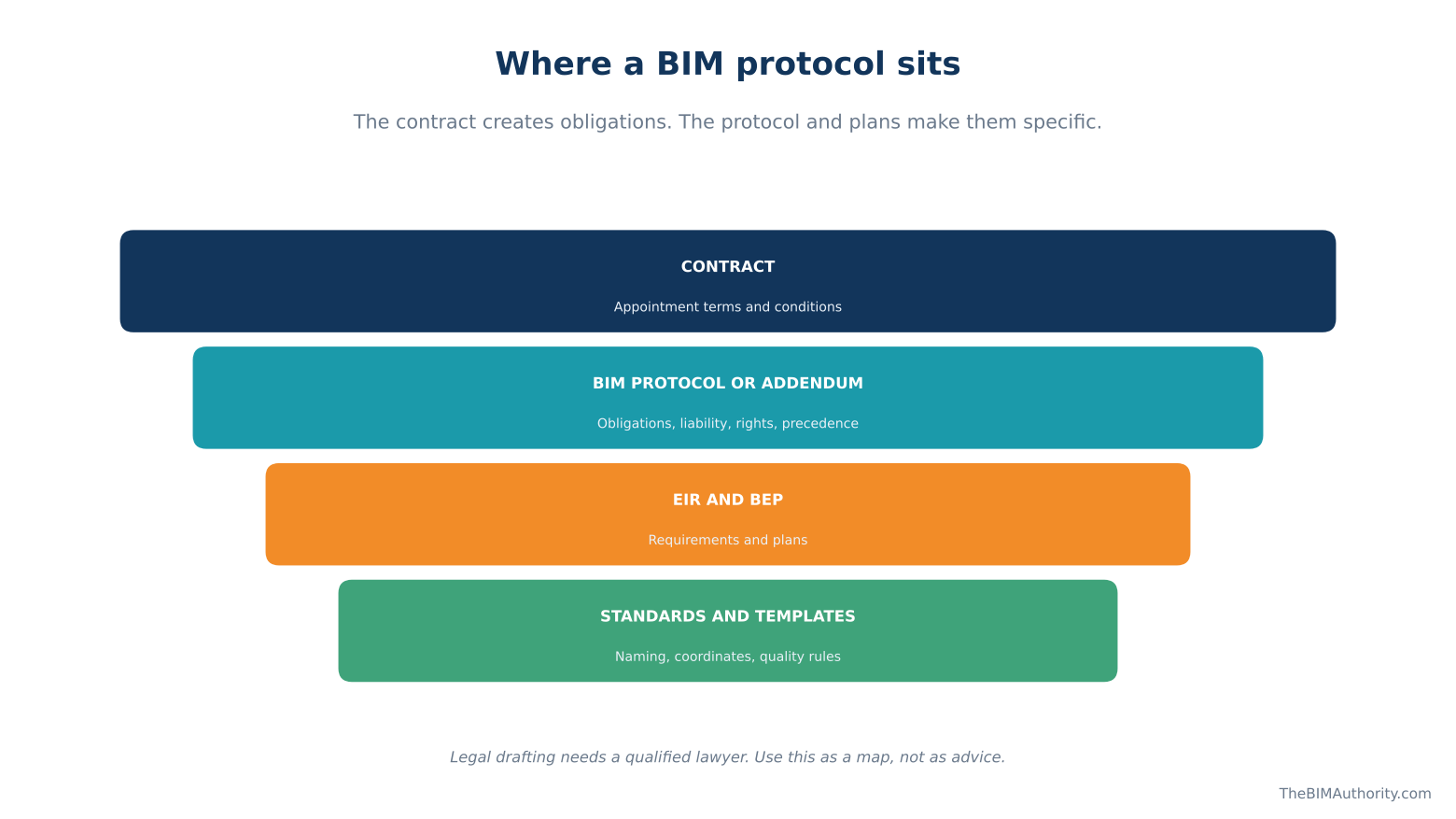
| Layer | Role |
|---|---|
| Contract or appointment | Creates the main obligations and rights |
| BIM protocol or addendum | Sets specific obligations, liability, rights and precedence for information and models |
| EIR and BEP | State requirements and plans for information delivery |
| Standards and templates | Naming, coordinates, quality rules and tools |
In one sentence:
A BIM protocol or addendum, drawn up with legal advice, states in the contract how models and information are to be produced, used, owned and relied on, and which document prevails if they conflict.
What a Protocol Does
| Function | Explanation |
|---|---|
| Incorporates information management obligations | Requires compliance with the EIR, BEP and standards |
| Allocates responsibilities | Information manager, model authors, coordination |
| Defines status and reliance | What may be relied upon, and for what purpose |
| Sets order of precedence | Which prevails among contract, protocol, drawings, models and the BEP |
| Addresses intellectual property | Ownership and licences for models and data |
| Limits and allocates liability | Clarifies that modeling does not alter design responsibility or add unintended duties |
| Covers security and data | Confidentiality, access, data protection |
| Provides schedules | Model production and delivery table, level of information need, software, responsibilities |
| Manages change | How the protocol and plans are updated |
| Addresses end of the relationship | Return, retention and archive of information |
When to Use One
| Situation | Practice |
|---|---|
| Projects with BIM requirements in the EIR | Incorporate a protocol into every appointment, so obligations are consistent |
| Multi-party projects | A common protocol across the supply chain |
| Public-sector and standard-form contexts | Use the recommended protocol |
| Small projects | A short addendum may suffice, but cover the core topics |
| International projects | Adapt to local law; use legal advice in each jurisdiction |
| Operational-phase appointments | A protocol for information in operation, aligned with the asset information model. See ISO 19650-3: Information Management During Asset Operations |
The Template: Topics, Decisions and Options
For each topic, record the decision the parties must make, the options and who decides. Illustrative wording follows in the next section.
1. Definitions and Interpretation
| Decision | Options and notes |
|---|---|
| Defined terms | Information, model, information container, federated model, common data environment, EIR, BEP, MIDP, TIDP, appointing party, lead appointed party, information manager, level of information need, status codes |
| Alignment with standards | State the standards and editions that terms follow (for example ISO 19650) |
| Digital terms | Define “model” and “digital data” broadly enough to cover future formats |
2. Order of Precedence
| Decision | Options and notes |
|---|---|
| Between the protocol and the main contract | The protocol usually prevails on BIM matters; state this explicitly |
| Between models and other documents | Decide which document type prevails: for example, signed drawings and specifications prevail over models, or a specified model prevails for stated purposes |
| Between the EIR, BEP and standards | State the hierarchy |
| Conflicts within the model | Process for resolving discrepancies |
Ambiguity here is the single most common source of BIM disputes. State it clearly.
3. Information Management Obligations
| Decision | Options and notes |
|---|---|
| Duty to comply with the EIR, BEP and standards | Make compliance an obligation |
| Information manager | Who holds the function; whether it is a contractual role; limits of authority |
| Information delivery plans | MIDP and TIDPs binding or indicative |
| Standards for naming, coordinates, formats | Reference the BEP or attach as schedule |
| Cooperation and coordination | Duty to cooperate with other parties and with the information manager; what this does not include |
4. Model Production and Delivery
| Decision | Options and notes |
|---|---|
| Model production and delivery table | List the models each party must produce, the stages, level of information need and format (a key schedule in the CIC protocol) |
| Level of information need | By element group and stage; reference the standard |
| Exchange formats | Native, IFC version and view; other formats |
| Delivery times and status | Reference the delivery schedule |
| Acceptance | How information is accepted or rejected |
5. Status, Reliance and Use of Models
| Decision | Options and notes |
|---|---|
| Purpose of each status | State what each status means and for what it may be relied on |
| Reliance | Whether and how third parties may rely on models; typical positions limit reliance to the stated purpose and status |
| No unintended warranty | State that sharing a model does not warrant its fitness for other purposes |
| Responsibility for checking | Who must check information received before use |
6. Roles, Responsibilities and Liability
| Decision | Options and notes |
|---|---|
| Design responsibility | State that the protocol does not change design responsibility under the appointment |
| Model authorship and accuracy | Each party is responsible for its own information |
| Integration and coordination responsibility | Who is responsible for coordinating, and what is not included |
| Information manager liability | Scope and limits |
| Errors and notification | Duty to notify errors discovered, and to correct |
| Limits on liability | If any, per the main contract |
| Insurance | Whether the protocol affects insurance; consult insurers and brokers |
7. Intellectual Property and Licences
| Decision | Options and notes |
|---|---|
| Ownership | Each party retains ownership of its models and information; the client’s rights as agreed |
| Licence to use | Scope: use for the project, and for operation, maintenance, alteration, extension, repair and sale; whether for future projects |
| Licence to third parties | Whether the client may share models with others (for example subsequent designers, contractors, facility managers) |
| Third-party content | Manufacturers’ objects and licensed content; who is responsible for licences |
| Moral rights and attribution | As law and contract allow |
| Survival | Licences continue after termination, subject to conditions |
8. Common Data Environment, Security and Data Protection
| Decision | Options and notes |
|---|---|
| CDE provision and rules | Who provides it; access; states and workflows; ownership of data in the CDE |
| Security obligations | Confidentiality; access control; incident reporting; alignment with ISO 19650-5 |
| Data protection | Compliance with privacy law for personal data in models or CDE |
| Use of external tools, including AI services | Whether sending project information to external or cloud services requires approval; confidentiality and licensing implications. See BIM Information Security, Access Control, and Data Governance |
| Cross-border data transfer | If relevant |
| Retention and archive | How long information is kept and in what formats |
9. Software, Technology and Interoperability
| Decision | Options and notes |
|---|---|
| Software and versions | Listed in a schedule; change procedure |
| Interoperability obligations | Exchange via open formats; export settings |
| Costs of software and training | Who bears them |
| Obsolescence and long-term access | Archive formats for long-term readability |
10. Changes, Disputes and Termination
| Decision | Options and notes |
|---|---|
| Change to the protocol or plans | Procedure; notice; effect on price and program |
| Disputes about information | How disputes about models or information are raised and resolved, consistent with the main contract’s dispute process |
| Termination | Return and transfer of information; continuing licences; archive |
| Assignment and novation | Effect on protocol obligations |
Schedules to Attach
| Schedule | Content |
|---|---|
| A | Model production and delivery table |
| B | Level of information need tables |
| C | EIR (or reference) |
| D | BEP (or reference) |
| E | Responsibility matrix. See BIM Responsibility Matrix Template: Roles and Deliverables |
| F | Software and versions |
| G | Security requirements |
| H | Information delivery plans. See BIM Information Delivery Schedule Template |
Illustrative Clause Language (Not Legal Advice)
The following examples show the kind of plain language that protocols use. They are not drafted for use and omit definitions, qualifications and jurisdiction-specific terms. Do not copy them into a contract. A lawyer should draft or adapt the clauses.
| Topic | Illustrative idea |
|---|---|
| Precedence | “If there is a conflict between this Protocol and the Appointment on matters concerning information and models, this Protocol shall prevail.” |
| Information management | “The Consultant shall produce, exchange and manage information in accordance with the EIR, the BEP and the standards stated in Schedule D.” |
| Status and reliance | “Information shared in a state other than published may be relied upon only for the purpose stated by its status code.” |
| Design responsibility | “Nothing in this Protocol changes the Consultant’s responsibility for design under the Appointment.” |
| Coordination | “Each party is responsible for the content of its own information. The Information Manager’s role in coordination does not relieve any party of responsibility for its own information.” |
| Errors | “A party that becomes aware of an error in information it has produced or received shall notify the Information Manager promptly and correct the error in the next exchange.” |
| Licence | “Each party grants the Employer a non-exclusive licence to use the information it produces for the purposes of the Project and its subsequent operation, maintenance, alteration, extension and repair.” |
| Security | “Parties shall handle information in accordance with the security requirements in Schedule G and shall notify the Information Manager of any security incident without delay.” |
| External tools | “A party shall not upload Project information to an external service without the prior approval of the Employer, where that service may store or use the information outside the Project environment.” |
| Archive | “At completion, the project information model shall be archived in the formats stated in Schedule A and retained for the period stated.” |
How the Protocol Relates to Other Documents
| Document | Relationship |
|---|---|
| EIR | Sets requirements; the protocol makes them obligations. See Exchange Information Requirements (EIR) Template and Example |
| BEP | The plan for meeting the EIR; the protocol makes compliance with it an obligation. See BIM Execution Plan (BEP) Template: Complete Guide and Example |
| Appointments and scopes of services | The protocol must be consistent with them, particularly on responsibilities |
| Responsibility matrix | A working document; align it with the protocol and scopes |
| Delivery schedule | Referenced by the protocol |
| Standards and templates | Referenced; stated with versions |
| Insurance and professional indemnity | Check coverage for BIM-related responsibilities |
| Dispute resolution | Follow the main contract’s process |
See BIM Contracts and Legal Considerations for the broader legal context.
Using the Protocol in Practice
| Practice | Why |
|---|---|
| Include it in every appointment on the project | Consistent obligations |
| Brief the team at the kickoff | Contracts that are not understood are not followed. See BIM Project Kickoff Checklist: Complete Guide |
| Keep it short and aligned with the BEP | Avoid contradictions |
| Do not duplicate technical detail | Reference the BEP and schedules |
| Ensure schedules are completed | An empty model production table protects nobody |
| Keep versions and dates under control | The version in force must be clear |
| Review at stage gates | Responsibilities and tools change |
| Use the order of precedence in disputes | That is its purpose |
| Seek legal advice on changes | Do not edit informally |
| Learn from disputes | Update standard forms |
Common Mistakes
- No protocol or addendum on a BIM project.
- Copying a protocol without adapting it, or amending standard wording carelessly.
- No order of precedence.
- Contradictions between the protocol, BEP and appointments.
- Empty or missing schedules.
- Silence on reliance and status.
- Silence on intellectual property and licences.
- Assuming the information manager takes on design liability.
- Ignoring security and the use of external tools.
- No archive or termination provisions.
- Not briefing the team.
- Treating a template as legal advice.
See also Common BIM Mistakes Beginners Should Avoid.
A Short Checklist
- Have we involved a qualified lawyer and considered an established standard form?
- Does the protocol include definitions, order of precedence, information management obligations, model production and delivery, status and reliance, roles and liability, intellectual property, CDE, security and data protection, technology, changes and termination?
- Are schedules completed (model production table, level of information need, EIR and BEP references, responsibilities, software, security)?
- Is the protocol consistent with appointments, scopes, insurance and the main contract?
- Is the hierarchy among models and other documents stated?
- Is it incorporated into every appointment?
- Has the team been briefed?
- Is there a review and change procedure?
Frequently Asked Questions
What is a BIM protocol?
A supplementary contract document that sets out obligations, liabilities, rights and limits relating to the use of models and information on a project.
What is the CIC BIM Protocol?
A UK protocol first commissioned in 2013, with a second edition published in April 2018 aligned with PAS 1192-2, intended to be incorporated into appointments; a successor information protocol was published by the UK BIM Framework in 2021 for ISO 19650 contexts. Check the current document.
What are the US equivalents?
The AIA digital practice documents (such as E203, G201 and G202) and the ConsensusDocs 301 BIM Addendum, among others.
Is the BIM model a contract document?
It depends on how the contract and protocol define it. Many protocols state which documents prevail and for what purposes. Decide this explicitly.
Does the protocol change design liability?
Usually protocols state that design responsibility is not changed by the protocol; check the actual wording with a lawyer.
Who owns the models?
Typically each author retains ownership and grants licences for stated purposes; the details are for the contract. Decide explicitly.
Can I write my own protocol?
You can, but prefer established forms and legal advice; informal drafting risks conflicts and gaps.
How is the protocol related to the BEP?
The protocol makes obligations contractual; the BEP details how information will be managed. They must be consistent.
Final Thoughts
A construction lawyer who has spent her career on BIM disputes told me what she sees in nearly every one. “They are never about technology,” she said. “They are about assumptions: one party assumed the model prevailed, another assumed the drawing did; one assumed the information manager checked everything, another assumed nobody did; one assumed the client could reuse the model, another that it could not. A protocol’s job is to turn assumptions into sentences.” She reads the first draft of any protocol with a pencil and writes in the margin, over and over, the same question: “Who decides?”
Use the template as a checklist of the questions a protocol should answer, record the decisions, adopt or adapt an established standard form with a lawyer’s help, attach the schedules, brief the team and keep the protocol consistent with the EIR, BEP and appointments. The protocol will then do what contracts exist to do: let people work together on shared information with their rights and limits agreed in advance.
Download the template: BIM protocol topic and decision checklist (ZIP with Word file).
Where to go next: for the legal context, read BIM Contracts and Legal Considerations. For the documents the protocol incorporates, continue with Exchange Information Requirements (EIR) Template and Example, BIM Execution Plan (BEP) Template: Complete Guide and Example and BIM Responsibility Matrix Template: Roles and Deliverables, and for security, BIM Information Security, Access Control, and Data Governance.



