



If you want to understand what an information manager does, think about a library. Not a library of books, but a library of everything a construction project knows: every model, drawing, specification, report, issue, approval and record, produced by dozens of organizations over years. In such a library, a person would be needed to decide how things are named, where they are kept, who may see them, when a thing is ready to be used and how to find out whether what is on the shelf is the latest, the approved or the superseded. That person would be neither an author nor a reader. They would be the librarian of the project’s information, and the project would fall apart without them.
That is the role that ISO 19650 formalized as information management. The standard describes an information management function: a set of activities carried out by the project team to establish and run the processes by which information is requested, produced, checked, shared, approved and delivered. In practice, the function is carried out by a person or team, often called the information manager, who may be a dedicated role, part of a BIM manager‘s job or shared among several people. The role has grown in importance as projects have become more digital, as owners have started to demand structured information and as the common data environment has become the project’s spine.
This guide explains the information manager’s role and career. It covers what information management is, the responsibilities, how the role differs from BIM manager and coordinator, where information managers work, the skills and qualifications, the tools, the processes they run, how to enter and progress in the role, the market and credentials, challenges and the mistakes to avoid. It supports ISO 19650 Explained: A Complete Guide for BIM Professionals, Common Data Environment (CDE): The Complete Guide and BIM Specialist vs. BIM Coordinator vs. BIM Manager. Role definitions vary by country, contract and organization; the standard describes functions rather than job titles. Check the contract and the BEP for the actual allocation of responsibilities.
The Short Answer
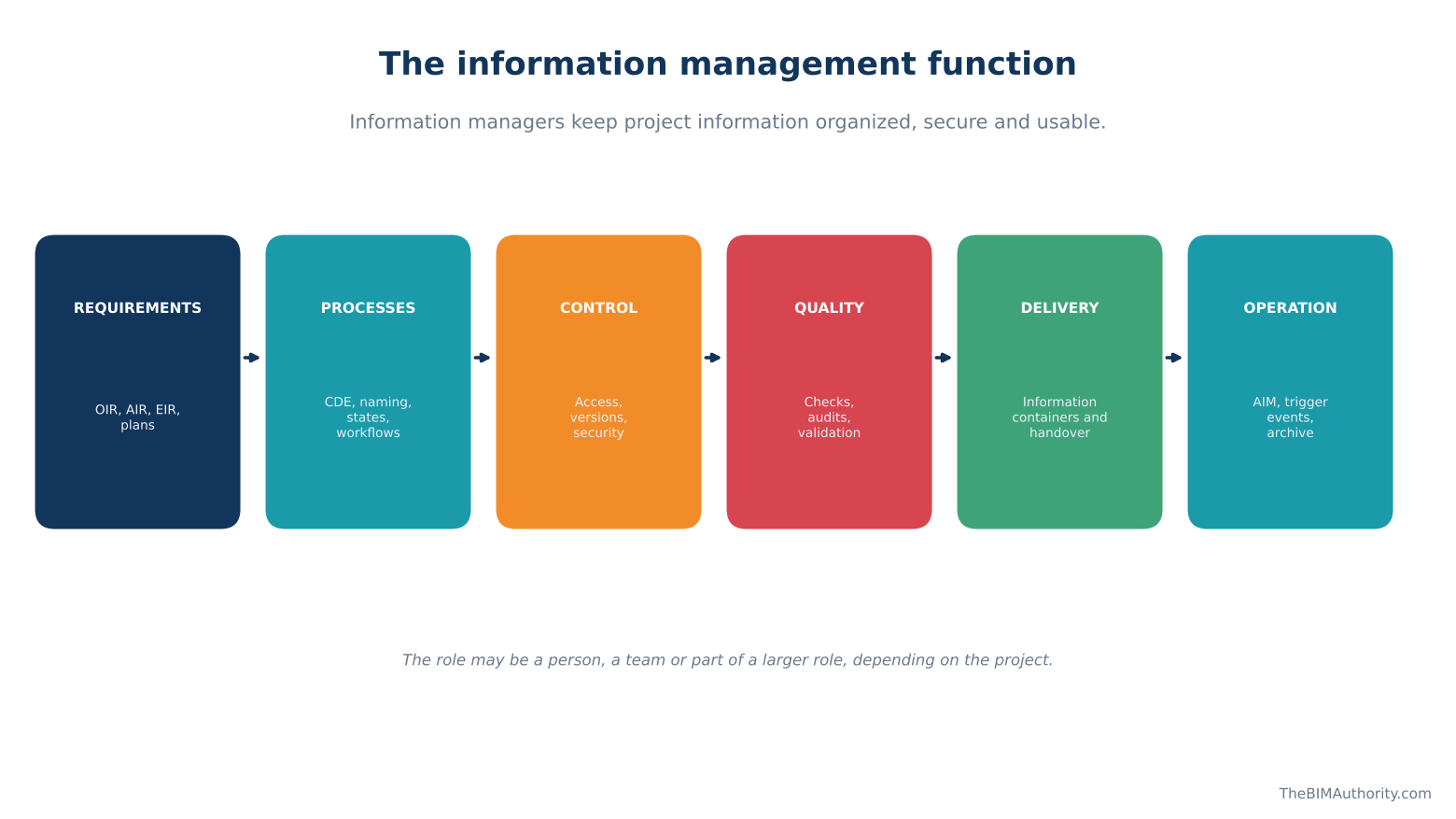
| Area | What happens |
|---|---|
| Requirements | OIR, AIR, EIR and plans define what information is needed |
| Processes | CDE, naming, states and workflows are set up |
| Control | Access, versions and security are managed |
| Quality | Checks, audits and validation run |
| Delivery | Information containers and handover are delivered |
| Operation | The AIM is maintained through trigger events; archives kept |
In one sentence:
An information manager establishes and runs the processes that keep project information organized, secure, checked and usable from requirements to handover and operation.
What Information Management Is
ISO 19650 sets out a framework for information management over the life cycle of built assets. In its description, an information management function is responsible for activities such as:
| Activity | Examples |
|---|---|
| Establishing the information requirements and standards | Supporting the appointing party in defining OIR, AIR, PIR and EIR; agreeing standards, methods and procedures |
| Planning | Contributing to the pre-appointment and post-appointment BEP; defining the master information delivery plan and task information delivery plans |
| Setting up the CDE and workflows | Containers, naming, metadata, states, roles, permissions. See Common Data Environment (CDE): The Complete Guide |
| Managing information production | Monitoring that information is produced in the right form, at the right time |
| Quality assurance | Checking that information meets requirements before it moves to shared or published |
| Controlling access and security | Roles, permissions, sensitive information. See BIM Information Security, Access Control, and Data Governance |
| Delivering information | Managing the transfer of information at milestones and handover |
| Maintaining records | Archive, versions, audit |
| Supporting operation | Asset information model and trigger events. See Asset Information Models (AIM): Creation and Management and ISO 19650-3: Information Management During Asset Operations |
The standard describes functions and responsibilities and allows different parties to hold them. Contracts and BEPs allocate who does what.
Responsibilities in Practice
Before and At the Start
| Responsibility | Details |
|---|---|
| Support requirements | Help the client or owner shape OIR, AIR and EIR. See Exchange Information Requirements (EIR): Complete Guide and Asset Information Requirements (AIR): Complete Guide |
| Evaluate and appoint | Support tender evaluation of BIM capability. See BIM Procurement and Appointments Under ISO 19650 |
| Plan | BEP, information delivery plans, responsibility matrices. See BIM Execution Plan (BEP): How to Create and Implement One and How to Create a BIM Responsibility Matrix |
| Set up the CDE | Structure, naming, metadata, workflows, permissions |
| Define standards | Naming, classification, coordinates, exchange formats. See BIM File Naming Conventions and ISO 19650 |
During Delivery
| Responsibility | Details |
|---|---|
| Operate the CDE | Onboard users; manage states; monitor activity |
| Control quality | Run or oversee checks; manage rulesets and IDS. See Automated BIM Model Checking and Data Validation and Information Delivery Specification (IDS): The Complete Guide |
| Manage exchanges | Coordinate cycles; track deliveries against plans |
| Manage security | Access reviews; incident handling |
| Support teams | Training, helpdesk, problem solving |
| Report | Status, risks, metrics to the project team and client. See BIM Data Analytics: Dashboards, KPIs, and Automated Reporting |
At Handover and in Operation
| Responsibility | Details |
|---|---|
| Validate handover information | Check against EIR and AIR; verify against the asset. See BIM Model Handover Checklist and Requirements |
| Create the AIM | Select, transform and load into the owner’s systems. See Project Information Models (PIM) vs. Asset Information Models (AIM) |
| Archive | Project information model archived with metadata |
| Maintain the AIM | Processes for trigger events; custodianship |
| Support systems integration | Link to CMMS and digital twin platforms. See BIM and Computerized Maintenance Management Systems (CMMS) |
How It Differs From Other Roles
| Role | Center of gravity | Relationship to information management |
|---|---|---|
| BIM modeler | Builds models and documents | Produces information containers to the standards |
| BIM coordinator | Brings models together; tests; reports; facilitates | Often works closely with, or partly performs, information management on a project |
| BIM manager | Standards, strategy, people and delivery across projects | May hold information management responsibility, especially in smaller organizations |
| Information manager | Processes that govern information: requirements, CDE, quality, security, delivery, handover | The focus of the role |
| Document controller | Controls documents and transmittals | A related function; information managers cover models and data as well |
| Data or analytics specialist | Analyzes data | Works with information managers on data quality |
See BIM Specialist vs. BIM Coordinator vs. BIM Manager. In many organizations, one person holds several of these roles; in large projects, they are distinct.
Where Information Managers Work
| Setting | Typical emphasis |
|---|---|
| Owner or client organization | Requirements, AIM, handover, information governance across a portfolio |
| Lead appointed party (main contractor or lead consultant) | Project information delivery, CDE, supply chain information |
| Independent consultancy | Acting as the project’s information manager for the client |
| Design practice | Project information management and standards |
| Infrastructure organizations | Large datasets, GIS integration, long-lived assets. See Infrastructure BIM: The Complete Guide |
| Software and platform vendors | Implementation and customer support |
| Public authorities and agencies | Requirements and policy |
| Facility management providers | Operational information |
Skills and Competencies
Knowledge
| Area | Notes |
|---|---|
| ISO 19650 and national guidance | The framework and its terms: requirements, containers, states, plans, delivery |
| CDE concepts and platforms | Setup, workflows, metadata, access |
| Information requirements and standards | OIR, AIR, EIR, classification, naming |
| IFC, COBie, IDS, bSDD and BCF | Open standards for data and issues. See buildingSMART Data Dictionary (bSDD) Explained and COBie Explained: The Complete Guide to BIM Asset Data Handover |
| Contracts and procurement | How information obligations appear in appointments |
| Information security and data protection | Controls and regulations |
| BIM across disciplines | Enough to understand what each team produces |
| Asset management concepts | AIM and operational use |
Skills
| Skill | Why |
|---|---|
| Process design | Create workflows that people can follow |
| Systems configuration | CDE and tools |
| Data and quality checking | Rulesets, IDS, scripts |
| Documentation | Plans, procedures, guides |
| Communication and training | Explain processes to many audiences |
| Stakeholder management | Clients, designers, contractors |
| Problem solving and attention to detail | Information problems are often small and numerous |
| Automation and data skills | Scripts and reports. See BIM Automation: The Complete Guide |
| Risk and security awareness | Protect information |
Personal Qualities
Information managers need patience, precision and diplomacy: they enforce rules that people find inconvenient and must explain why the rules help.
Tools of the Trade
| Tool | Use |
|---|---|
| Common data environment and document management | The information backbone |
| Model checkers and IDS validators | Quality assurance. See Solibri: BIM Model Checking and Validation Guide |
| Issue trackers and BCF tools | Issues. See BIMcollab: BCF-Based Coordination and Issue Tracking |
| Registers and plans | MIDP, TIDPs, model registers, responsibility matrices |
| Scripting and automation | Checks, reports and integrations |
| Dashboards and analytics | Metrics |
| Asset and facility systems | For AIM |
| Security tools | Access control, audit logs |
Qualifications and Credentials
| Route | Notes |
|---|---|
| Education | Degrees or diplomas in architecture, engineering, construction, information management or related fields |
| ISO 19650 training and credentials | Several training bodies offer ISO 19650 programs; for example BRE Academy’s program is described as staged from essentials toward delivering information management and practitioner level in some references |
| openBIM certification | The buildingSMART professional certification program offers levels such as Foundation, Practitioner and Management, with approved training providers; check current availability in your country. See BIM Certifications: The Complete Guide to Professional Credentials |
| Vendor and platform training | For CDE and tools |
| Experience | Typically years across BIM delivery, coordination and standards |
Credentials help, but evidence of running information processes on real projects matters most.
Entering and Progressing
| Stage | Typical activities |
|---|---|
| Entry | BIM modeler or coordinator who takes on CDE administration, naming checks, delivery tracking |
| Developing | Project information manager on small and medium projects; writes BEP sections; configures CDE; runs checks |
| Experienced | Information manager on large or complex projects; defines standards; trains teams; interacts with clients |
| Senior | Head of information management; portfolio standards; owner-side AIM strategy; consultancy leadership |
| Beyond | Digital director; owner-side digital asset roles; digital twin strategy. See Digital Twins in Construction: The Complete Guide |
How to Build the Profile
| Step | Practice |
|---|---|
| Learn ISO 19650 | Read and apply; take training |
| Volunteer for information tasks | Naming, registers, CDE setup, checks |
| Run a small project’s information process end to end | Evidence |
| Build data skills | IFC, IDS, scripts |
| Learn the owner’s perspective | AIR, AIM and operations |
| Write and share | Procedures, guides, case studies |
| Seek mentors | Experienced information managers |
| Document results | Metrics, lessons. See How to Build a Professional BIM Portfolio |
Market and Pay
Demand for information management skills is shaped by client requirements, public sector policy, adoption of ISO 19650, owners’ asset information needs and digital twin ambitions. In some markets, information management is a distinct and well-paid role; in others it is folded into BIM manager or coordinator roles. See BIM Salaries Around the World for how to read published salary figures; role definitions differ, so compare responsibilities rather than titles.
Challenges
| Challenge | Approach |
|---|---|
| Responsibility without enforcement power | Embed obligations in contracts and BEPs; escalate through the project structure |
| Over-engineered processes | Keep workflows simple and proportionate |
| Resistance from busy teams | Reduce friction; automate; explain benefits |
| Unclear role allocation | Agree in the BEP and responsibility matrix |
| Tool limits in CDEs | Configure within limits; choose platforms carefully |
| Security and privacy | Policies, training and audits |
| Quality at scale | Automated checks and clear fix guidance |
| Client requirements that are vague | Help sharpen them into testable requirements |
| Handover failures | Plan early; test with samples |
| Keeping up with standards and tools | Continuous learning |
Common Mistakes
- Treating information management as clerical work.
- Building workflows nobody can follow.
- No link between requirements and checks.
- Weak contract position for information obligations.
- Ignoring security and access reviews.
- No handover testing.
- Over-reliance on one platform’s features.
- Not training users.
- Not measuring quality or delivery.
- Isolation from design and construction teams.
- Ignoring the owner’s operational needs.
- Not learning the data standards.
See also Common BIM Mistakes Beginners Should Avoid.
A Short Checklist
- Do I understand ISO 19650 concepts and responsibilities?
- Can I set up and run a CDE with naming, metadata, states and permissions?
- Can I translate requirements into plans and checks?
- Do I understand IFC, IDS, BCF, COBie and bSDD?
- Can I run quality assurance and report results?
- Can I manage security and access?
- Can I plan and test handover and the AIM?
- Can I communicate and train?
- Do I have evidence from real projects?
- Do I know my next step: owner side, consultancy, digital leadership?
Frequently Asked Questions
What does a BIM information manager do?
Establishes and runs the processes by which project information is requested, produced, checked, shared, delivered and archived, including the CDE, standards, quality and handover.
Is information manager a job title or a function?
ISO 19650 describes an information management function; the job title varies. Responsibility is allocated in contracts and BEPs.
How is an information manager different from a BIM manager?
A BIM manager covers standards, strategy and delivery across projects; an information manager focuses on information processes on projects or portfolios. In smaller organizations one person may do both.
What qualifications do I need?
Experience, knowledge of ISO 19650 and openBIM standards, and, often, relevant training or credentials; requirements vary.
Which tools should I know?
CDE platforms, model checkers, IDS and BCF tools, registers and basic scripting.
Is it a good career?
Demand is growing with digital requirements and owner information needs, with pathways to digital leadership and owner-side roles; markets vary.
Do I need to be a modeler first?
Not necessarily, but understanding what modelers and coordinators produce is essential.
How do I start?
Take on CDE, naming and delivery tracking in your current role, learn ISO 19650 and build evidence.
Final Thoughts
The best information manager I know carries a mental test that she applies to every process she designs: “Could a tired person on a Friday afternoon do this correctly?” If the answer is no, she redesigns it: fewer steps, clearer names, automatic checks, a message that says exactly what to fix. Her CDE is not elaborate. Her naming convention fits on one page. Her checks run overnight and email authors a short list. People on her projects follow the process, not out of obedience, but because the easy path and the correct path are the same path.
That is the craft of information management: make the right thing the easy thing, protect what must be protected, verify what must be true and keep the information alive after the project ends. It is a quiet, essential role, and a growing one. For those who like systems, standards and enabling others, it is an excellent place to build a career.
Where to go next: for the standards, read ISO 19650 Explained: A Complete Guide for BIM Professionals and Common Data Environment (CDE): The Complete Guide. For roles and growth, continue with BIM Specialist vs. BIM Coordinator vs. BIM Manager and BIM Certifications: The Complete Guide to Professional Credentials, and for operation, Asset Information Models (AIM): Creation and Management.



