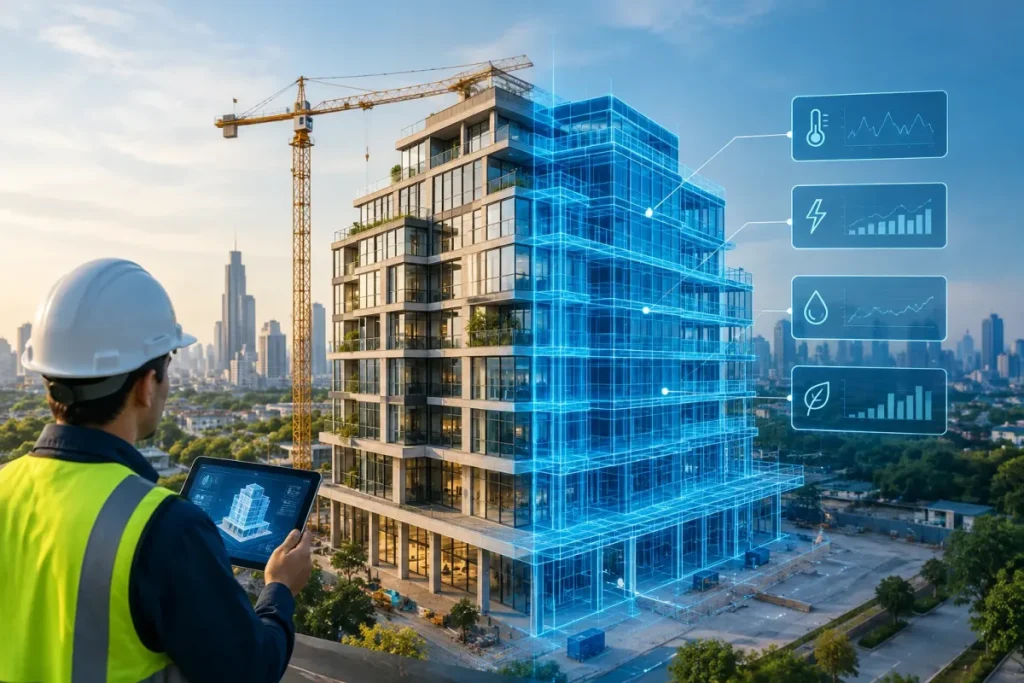

The term “digital twin” has had one of the fastest journeys from technical niche to industry buzzword in the history of construction. In ten years, it has gone from a concept used by engineers in aerospace and manufacturing to a phrase in marketing brochures for everything from dashboards to scanners to animated models of buildings. The result is a familiar kind of confusion. When two people say “digital twin,” they may mean a lightweight website that shows a building model with a temperature reading on it, or an elaborate system that simulates an entire city’s traffic and energy flows and adjusts them automatically. Both are called twins. They have little in common except the name.
I find it helpful, when someone proposes a digital twin, to ask three plain questions. What decision will it improve? Whose decision is it? What information would they need, and how often? Most of the time, the answers reveal that the proposal is really one of three things: a good building information model that has not yet been connected to operations; a monitoring dashboard that needs a model for context; or an analytic capability that needs live data, a model and a purpose. All three are valuable. None is magic. And the difference between a digital twin that earns its keep and one that becomes an expensive demonstration is almost always purpose, data and governance, not technology.
This guide explains digital twins in construction clearly and practically. It covers what a digital twin is (with reference to international terminology), how it differs from a model and from a “digital shadow”, the components of a twin, how BIM and the asset information model fit, applications across the construction lifecycle, maturity levels, a way to approach implementation, data and architecture, standards, challenges including security and privacy, how to evaluate value and the mistakes to avoid. It is the hub for the digital twin guides in this section, alongside BIM vs. Digital Twins: Differences, Connections, and Applications and Connecting BIM Models to IoT Sensors and Building Management Systems. Digital twins combine data, systems and decisions. Responsibility for safety, security and compliance remains with the owners, operators and competent professionals.
The Short Answer
A digital twin is a digital representation of a real asset or system, connected to it by data, that is used to understand, predict or improve its behavior for a defined purpose.
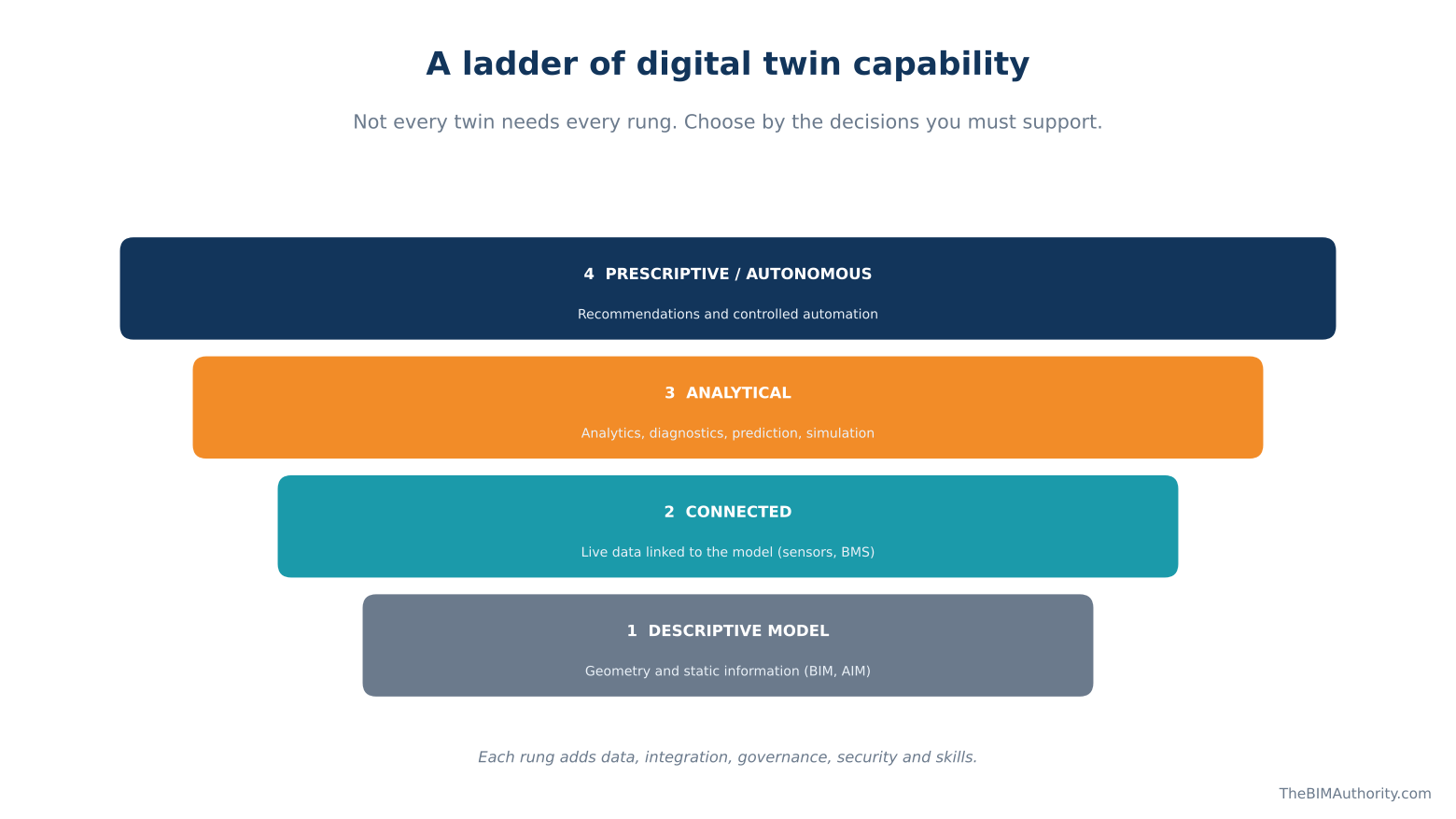
| Rung | Capability | Typical example |
|---|---|---|
| 1. Descriptive model | Geometry and static information | A building information model or asset information model |
| 2. Connected | Live or periodic data linked to the model | A dashboard with sensor readings mapped to spaces and equipment |
| 3. Analytical | Analytics, diagnostics, prediction, simulation | Fault detection, energy forecasts, scenario testing |
| 4. Prescriptive or autonomous | Recommendations or automated action | Optimized control strategies with oversight |
In one sentence:
A digital twin is a model that stays connected to the real thing and is used to make better decisions: the value is in the decisions, not in the twin.
What Is a Digital Twin?
International terminology work has helped. The standard ISO/IEC 30173:2023, Digital twin: Concepts and terminology, published in November 2023, establishes terminology and describes concepts for digital twins, including their system context, life cycle processes, types of digital twin, a functional view and stakeholders. Among the types it describes are component, asset, system and process digital twins. The standard applies to all types of organizations and is intended to support communication among diverse parties.
In the built environment, a widely cited early framing came from the UK, where an industry-led initiative published principles for national digital twins (the “Gemini Principles”), emphasizing that twins should have a clear purpose, be trustworthy and function effectively. I mention this framing from general knowledge; the underlying idea is useful: purpose, trust and function are what matter.
Model, Shadow and Twin
A common way to distinguish levels of connection:
| Term | Data flow | Description |
|---|---|---|
| Digital model | None automated | A representation of the asset with manual updates (for example a BIM model) |
| Digital shadow | Physical to digital | Data flows automatically from the physical asset into the digital representation, which reflects the asset’s state, but does not act back |
| Digital twin | Both directions (or closed loop with decisions) | The digital representation is synchronized with the asset and used to decide actions that affect the asset, whether by people or by control systems |
Not everyone uses these terms the same way, and many practical “twins” in buildings are, strictly, digital shadows with analytics. What matters is that you state what yours does.
The Components of a Twin
| Component | Role |
|---|---|
| The physical asset or system | A building, infrastructure asset, system or process |
| Data acquisition | Sensors, meters, controllers, building systems, surveys, drones, manual inputs, enterprise systems |
| Connectivity | Networks, gateways, protocols |
| Data platform | Ingest, store, validate, harmonize and serve data; manage time series and events |
| The model | Geometry, spaces, assets, systems, relationships, semantics: BIM, AIM, GIS |
| Analytics and simulation | Rules, statistics, machine learning, physics-based simulation |
| Applications and interfaces | Dashboards, alerts, reports, work order triggers, control interfaces |
| People and processes | Who uses the twin, for what decisions, with what authority |
| Governance | Ownership, quality, security, privacy, lifecycle, standards |
A twin is a system, not a model. Most failures come from missing components: no clear users, no data governance, no process that acts on the insight.
BIM, the AIM and the Twin
| Layer | Contribution |
|---|---|
| BIM (project information model) | Design and construction information; geometry; coordination; seeds the AIM. See Project Information Models (PIM) vs. Asset Information Models (AIM) |
| Asset information model | Structured information about assets, spaces and systems for operation; the static backbone of the twin. See Asset Information Models (AIM): Creation and Management |
| GIS | Location, context, networks, terrain. See BIM and GIS Integration: The Complete Guide |
| Sensor and operational data | The dynamic layer. See Connecting BIM Models to IoT Sensors and Building Management Systems |
| Enterprise data | Work orders, costs, occupancy, finance |
| Analytics | Insight from combining the above |
A well-structured AIM with persistent identifiers, a clear asset and spatial hierarchy and classification is the best preparation for a twin. Without it, twins become bespoke integration projects. See BIM vs. Digital Twins: Differences, Connections, and Applications.
Applications Across the Lifecycle
Design
| Use | Description |
|---|---|
| Design in context | Models placed in real geography and environmental conditions |
| Performance-informed design | Simulation with data from comparable operating assets, for example measured occupancy and energy patterns |
| Stakeholder engagement | Interactive visualization |
| Feedback from operation | Lessons from twins of existing assets inform briefs and designs |
Construction
| Use | Description |
|---|---|
| Progress monitoring | Reality capture and field data compared with planned status. See BIM for Construction Progress Monitoring and Reporting |
| Logistics and site monitoring | Site models with live information on deliveries, equipment and conditions |
| Quality and safety monitoring | Sensor and inspection data linked to elements and zones; always within safety management processes |
| Prefabrication tracking | Units tracked from factory to site |
| Environmental monitoring | Noise, dust, vibration, weather linked to zones |
| As-built capture | Verified records. See BIM for As-Built Documentation and Project Handover |
Operation
| Use | Description |
|---|---|
| Energy and comfort optimization | Live data compared with intent and benchmarks. See BIM for Building Performance Monitoring and Energy Optimization |
| Fault detection and diagnostics | Analytics identify equipment problems |
| Condition-based and predictive maintenance | Maintenance triggered or predicted from data. See BIM for Asset Tracking and Preventive Maintenance |
| Space utilization | Occupancy data informs space decisions |
| Emergency and security support | Situational awareness |
| Tenant and occupant services | Information and feedback |
| Scenario testing | What happens if layouts, schedules or systems change? |
Infrastructure and Cities
| Use | Description |
|---|---|
| Network operation | Traffic, rail, utilities with live data |
| Structural health monitoring | Bridges, tunnels, dams. See BIM for Bridges: Structural Modeling and Asset Data and BIM for Tunnels and Underground Infrastructure |
| Resilience and flood analysis | Scenario modeling |
| Urban planning and energy | City-scale models linked to data. See BIM and GIS Integration: The Complete Guide |
Maturity: How Far Do You Need to Go?
| Rung | What you need | What it costs |
|---|---|---|
| 1. Descriptive | A good BIM or AIM, structured data | Information management |
| 2. Connected | Plus sensor data, point mapping, a data platform, dashboards | Integration, data quality, security |
| 3. Analytical | Plus analytics, simulation, skilled people, validated models | Skills, tools, validation |
| 4. Prescriptive or autonomous | Plus closed-loop control, assurance, oversight | Safety assurance, governance, accountability |
Climb only as far as the decisions justify. Many owners gain most of the value at rungs 1 and 2: knowing what they have and seeing what it is doing. Rungs 3 and 4 pay when the scale, cost of failure or optimization potential justify the investment, and when the organization can act on the results.
A Practical Approach to Implementation
| Step | Practice |
|---|---|
| 1. Define the purpose | Which decisions? Whose? What improvement is expected (cost, risk, performance, experience)? |
| 2. Define the minimum viable twin | The smallest scope (asset, data, analysis) that tests the value |
| 3. Assess data and model readiness | Do we have a reliable AIM, identifiers, sensors, data quality? |
| 4. Define the information requirements | OIR, AIR, EIR for twin-relevant information. See Asset Information Requirements (AIR): Complete Guide |
| 5. Design the architecture | Data sources, platform, integration, security, user interfaces; prefer open standards and interfaces |
| 6. Build the data foundation | Asset register, spatial structure, point mapping, data pipelines, validation |
| 7. Pilot | One building or system; real users; real decisions |
| 8. Measure value | Baseline and results |
| 9. Scale or stop | Based on evidence |
| 10. Govern and sustain | Owners, budgets, maintenance of models and data, security, skills |
A digital twin is an operating capability, not a project deliverable. Plan its running costs and ownership from the start.
Data and Architecture
Data Foundations
| Foundation | Practice |
|---|---|
| Identifiers | Persistent identifiers for assets, spaces, points and documents across systems |
| Semantic structure | Consistent descriptions of equipment, points and relationships; use open models and tagging approaches where possible. See BIM Metadata, Attributes, and Property Sets Explained |
| Spatial and asset hierarchy | From the AIM and GIS |
| Time series management | Platforms suited to high-volume time data |
| Data quality | Calibration, validation, gap handling, unit consistency |
| Metadata | Source, accuracy, time stamps, lineage |
| Master data ownership | Which system owns which data |
Architecture Principles
| Principle | Reason |
|---|---|
| Open interfaces and formats | Avoid lock-in; enable integration |
| Modular components | Replace parts as technologies change |
| Separation of concerns | Data platform, model repository, analytics and applications |
| Security by design | Protect operational technology and data |
| Scalability | From a pilot to a portfolio |
| Interoperability with BIM, GIS and enterprise systems | Reuse existing information |
| Auditability | Trace decisions and data |
Standards and Frameworks
| Area | Examples |
|---|---|
| Digital twin terminology | ISO/IEC 30173 |
| Information management | ISO 19650 series. See ISO 19650 Explained: A Complete Guide for BIM Professionals |
| Building and infrastructure data | IFC (including IFC 4.3 for infrastructure), COBie, bSDD. See IFC 4.3 for Infrastructure: Concepts, Capabilities, and Applications |
| Geospatial data | Open Geospatial Consortium standards and coordinate reference systems |
| Building data semantics | Open and community schemas for equipment and points (for example Brick and Project Haystack) |
| Communication protocols | Building automation and IoT protocols (for example BACnet, Modbus, MQTT, OPC UA) |
| Asset management | ISO 55000 family |
| Energy management | ISO 50001 |
These are examples from general knowledge; check which apply to your sector and country.
Challenges
| Challenge | Explanation | Approach |
|---|---|---|
| Hype and unclear purpose | Twins pursued as technology showcases | Start with decisions; define value |
| Poor foundational data | No reliable asset register, inconsistent identifiers | Invest in the AIM first |
| Integration complexity | Many systems and vendors | Open interfaces; staged integration; clear ownership |
| Data quality | Sensor drift, gaps, mislabeled points | Calibration, validation, commissioning |
| Cybersecurity | Connected systems expand attack surfaces | Security specialists; segmentation; access control; updates |
| Privacy and ethics | Occupancy and behavior data relate to people | Privacy law; minimization; transparency; purpose limits |
| Skills and change management | New roles and processes | Training; operating model |
| Cost and sustainability of operation | Platforms, licenses, data, people | Business case including running costs; phased scaling |
| Lock-in | Proprietary platforms | Open formats; exit plans |
| Trust and accountability | Who is responsible for automated decisions? | Governance; human oversight; assurance |
| Environmental impact of data and compute | Energy use of data systems | Proportionate design; efficiency |
Evaluating Value
| Question | Evidence |
|---|---|
| What decisions improved? | Examples of decisions informed by the twin |
| What outcomes changed? | Energy, cost, downtime, response time, safety indicators |
| What did it cost? | Build and run costs |
| Who uses it? | Active users; frequency |
| How reliable are the data and results? | Quality metrics; validation |
| What risks does it create? | Security, privacy, dependency |
| What would happen without it? | Counterfactual or baseline |
| Can it scale? | Technical and organizational |
Beware vanity metrics such as the number of sensors, models or dashboards. Measure outcomes. See How to Measure BIM Performance, ROI, and Project Success.
Roles
| Role | Responsibility |
|---|---|
| Owner / operator | Purpose, funding, decisions, accountability |
| Twin product owner | Priorities, requirements, value tracking |
| Information manager | AIM, identifiers, data governance |
| Data engineers | Pipelines, platforms |
| Domain experts | Facilities, energy, structures, operations; interpret analytics |
| Data scientists and analysts | Analytics and simulations |
| Controls and OT engineers | Building systems integration; safety |
| IT and security specialists | Infrastructure; cybersecurity |
| BIM and GIS specialists | Models and spatial data |
| Users | Decisions and feedback |
Common Mistakes
- Starting with technology instead of decisions.
- Calling a model a twin without data or purpose.
- No reliable asset register or identifiers.
- Ignoring data quality.
- No owner or operating budget.
- Proprietary lock-in.
- Ignoring cybersecurity and privacy.
- Overbuilding before piloting.
- Measuring sensors, not outcomes.
- No process to act on insight.
- Neglecting model and data maintenance.
- Promising autonomy before assurance.
See also Common BIM Mistakes Beginners Should Avoid.
A Short Checklist
- Have we defined purpose, decisions, users and expected value?
- Have we defined the minimum viable twin and the maturity level needed?
- Do we have a reliable AIM with persistent identifiers and spatial and asset hierarchies?
- Are sensors, point mapping and data quality planned?
- Is the architecture open and modular, with security by design?
- Are standards and terminology agreed (for example ISO/IEC 30173)?
- Are governance, ownership, privacy and cybersecurity addressed?
- Have we piloted with real users and decisions?
- Do we measure outcomes, not just activity?
- Is operation funded and owned, with a plan to scale or stop?
Frequently Asked Questions
What is a digital twin in construction?
A digital representation of a built asset or system, connected to it by data and used to understand, predict or improve its behavior for a defined purpose.
How is a digital twin different from a BIM model?
A BIM model is a structured model, mostly static; a digital twin adds live data connection, analytics and use in decisions. A BIM or asset information model is the foundation of a twin.
What standards define digital twins?
ISO/IEC 30173:2023 establishes concepts and terminology for digital twins; other standards cover information management, building data and communications.
Do I need a digital twin?
Only if there are decisions that live data, models and analytics will improve. Many owners gain most of the value from a good asset information model and a connected dashboard.
What data does a digital twin need?
A reliable asset and spatial model, sensor and operational data with point mapping, enterprise data (work orders, costs) and quality, governance and security.
What are the risks?
Unclear purpose, poor data, cost, vendor lock-in, cybersecurity and privacy issues, and unclear accountability.
Where should I start?
With the decisions you want to improve, a pilot on a small scope, and a solid asset information model.
Can a digital twin control a building automatically?
Some do, with closed-loop control under human oversight and safety assurance. Most practical twins support human decisions.
Final Thoughts
An owner I respect was asked by his board, in a meeting full of enthusiasm, whether the organization should invest in a digital twin. He asked for a week. At the end of it, he returned with one page: the three operational decisions that cost the organization most money or disruption each year, the information needed to improve each, what the organization already had, what it lacked and a six-month pilot plan on a single building. The board approved the pilot. It was not called a digital twin in the paperwork. It was called “the asset visibility project.” Eighteen months later, when someone asked whether it counted as a twin, he shrugged. “It helps us make three decisions better,” he said. “What we call it is a matter for the marketing department.”
That is the right spirit. Purpose first. Foundation second. Technology third. Build the asset information model, connect the data that matter, use analytics where they pay, govern what you build and measure the results. A digital twin is not a thing you buy. It is a capability you grow, one decision at a time.
Where to go next: for the comparison, read BIM vs. Digital Twins: Differences, Connections, and Applications. For the live data side, continue with Connecting BIM Models to IoT Sensors and Building Management Systems, and for the information backbone, Asset Information Models (AIM): Creation and Management.