


If the ISO 19650 series were a building, Part 1 would be the foundations: invisible once the structure is finished, but responsible for whether everything above it stands up. Most people skip it. They jump to Part 2 because that is where the “real” process is, with its activities, deliverables and checklists. I did the same on my first reading, and I paid for it. A few months later, in a heated meeting about who was responsible for an information requirement, I realized that I could not answer a simple question because I had never properly understood the concepts that Part 1 defines.
After many years working as a CAD manager, BIM manager and trainer, I now start every ISO 19650 course with Part 1, and I tell people the same thing: if you understand Part 1, Parts 2 to 6 feel like consequences; if you skip it, they feel like arbitrary rules.
In this guide, I will walk you through the concepts and principles of ISO 19650-1, in plain language, with practical interpretations from real projects. This is the guide to read before the others in the series.
The Short Answer
ISO 19650-1 (“Concepts and principles”) is the part of the series that defines the vocabulary, the concepts and the high-level principles of information management using BIM across the life cycle of a built asset. It applies to both the delivery phase (design and construction) and the operational phase, and it describes:
- The parties and their roles (appointing party, appointed party, lead appointed party, task team).
- The information requirements (OIR, AIR, PIR, EIR).
- The information models (PIM and AIM) and information containers.
- The common data environment (CDE) and its states.
- The information delivery cycle, from requirements to delivery and operation.
- The principles of information delivery planning and level of information need.
- The idea of collaborative working and the information management function.
It does not specify detailed activities: those are in Part 2 (delivery) and Part 3 (operation). It also does not specify exchange or security procedures, which are in Parts 4 and 5. Part 1 is the conceptual framework on which they all rely.
See the overview of the series in ISO 19650 Explained: A Complete Guide for BIM Professionals.
Scope: What Part 1 Applies To
The standard applies to the whole life cycle of any built asset: buildings, but also roads, railways, bridges, tunnels, utilities and other civil engineering works. It is intended for use by all parties involved with an asset: owners, operators, designers, contractors, manufacturers, consultants and others.
Two points are worth underlining.
- It is scale-independent. The standard says the approach can be applied to assets and projects of all sizes and complexity. In practice, the application is proportionate: a small project needs a lighter set of documents than a hospital.
- It is process-oriented, not technology-oriented. It does not require specific software, formats or methods. It describes what must be managed and by whom.
Principle 1: Information Is Managed for a Purpose
The first principle, which underlies everything else, is that information should be produced and managed because someone needs it. This sounds obvious, but a great deal of BIM effort in the world is spent on information that nobody ever uses.
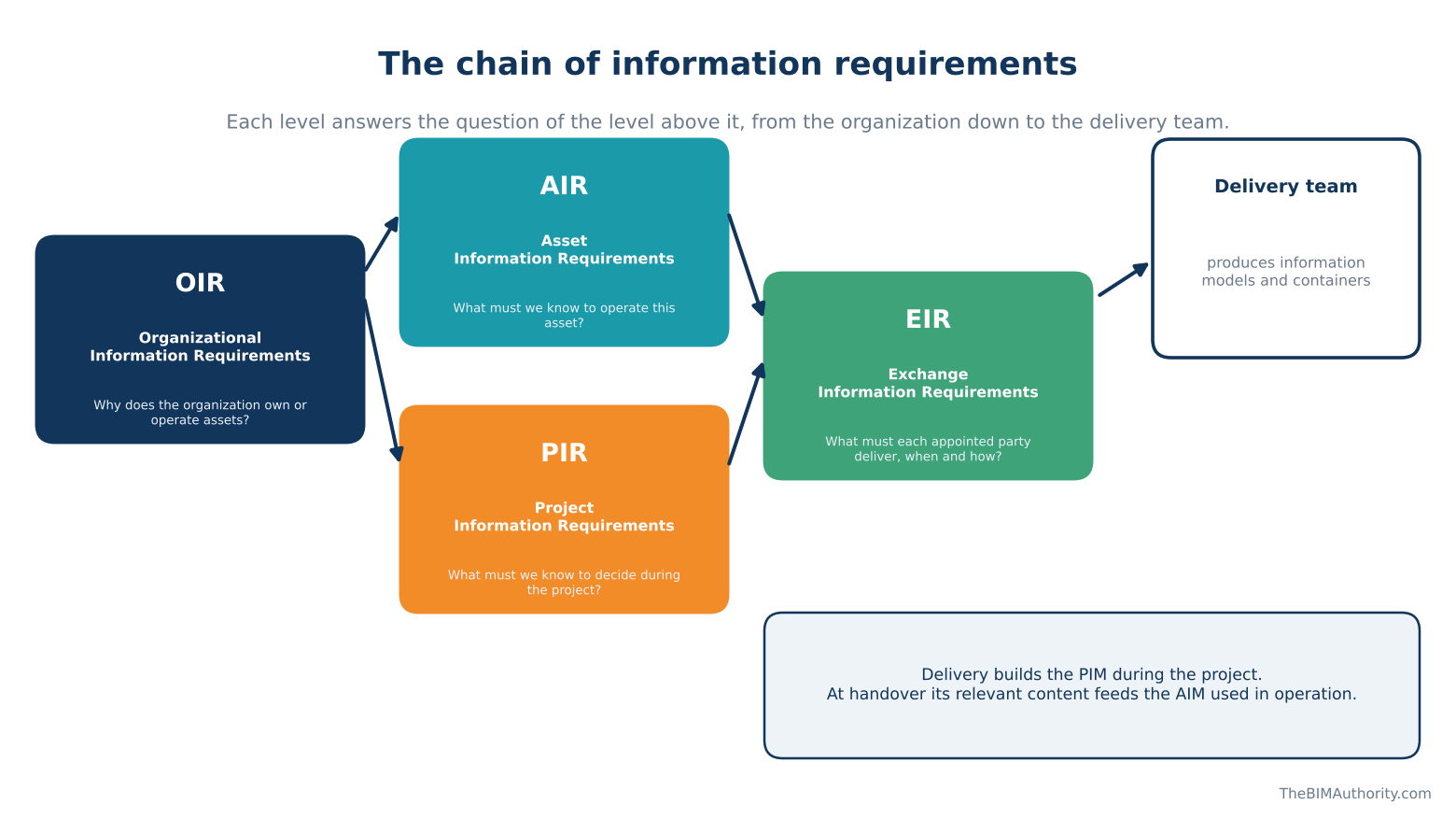
The standard builds a structure to prevent that: a chain of information requirements that connects the goals of the organization down to the specific deliverables of a project.
The Four Types of Information Requirement
| Requirement | Level | Question it answers | Typical author |
|---|---|---|---|
| OIR | Organization | What does the organization need to know about its assets to meet its business objectives? | Asset owner or operator |
| AIR | Asset | What do we need to know to operate and maintain this asset? | Asset owner or operator |
| PIR | Project | What do we need to know at project level to make decisions? | Appointing party |
| EIR | Appointment | What must each appointed party deliver, when, how and to what standard? | Appointing party (and lead appointed parties for their own appointments) |
How to Read This in Practice
- OIR are strategic and organization-wide. A hospital trust may need to know, across all its sites, the condition and age of its critical plant.
- AIR are asset-specific. For one hospital, they may list the equipment data needed for maintenance.
- PIR relate to project decisions: the information the owner needs to approve a design stage, for example.
- EIR are the contractual-level specifications of what will actually be delivered: the content, format, timing, and level of information need.
Each level informs the next. A weakness at the top (nobody has thought about OIR) tends to flow all the way down, in the form of vague EIR and disappointing deliverables. See ISO 19650 Information Requirements Explained: OIR, AIR, PIR, and EIR, Organizational Information Requirements (OIR): Complete Guide, Asset Information Requirements (AIR): Complete Guide, Project Information Requirements (PIR): Complete Guide and Exchange Information Requirements (EIR): Complete Guide.
Principle 2: Information Lives in Models, Documents and Data
ISO 19650 defines an information model as a set of structured and unstructured information containers. That wording is deliberate. A BIM model is only one kind of container. The standard recognizes three broad types of information content.
- Geometrical information: shapes, dimensions, positions.
- Alphanumerical information: properties, identification, classifications.
- Documentation: drawings, specifications, certificates, reports, manuals.
This matters because many teams think of “the BIM model” as the whole story. In reality, an asset owner needs models, data and documents, linked and consistent.
Project Information Model and Asset Information Model
- The Project Information Model (PIM) is the information model developed during the delivery phase of an asset.
- The Asset Information Model (AIM) is the information model that supports asset management during operation.
The relationship between them is a handover: the relevant content of the PIM feeds the AIM at the end of a project, and the AIM later informs the requirements of the next project. See Project Information Models (PIM) vs. Asset Information Models (AIM) and Asset Information Models (AIM): Creation and Management.
Principle 3: Information Is Held in Identifiable Containers
An information container is a named, persistent set of information retrievable from a file, system or application storage. A model file, a PDF drawing, a schedule, a point cloud: each is a container. They can also be sub-divided (for example, a layer or a chapter of a document) depending on how the project chooses to manage them.
What Every Container Needs
To be manageable, each container must carry metadata:
- A unique identifier following the project’s naming convention.
- A status that says what the information may be used for.
- A revision that identifies its version.
- A classification, where relevant.
The standard leaves the exact conventions to the project, the appointing party or a national annex. What it insists on is the principle: anyone should be able to tell what a container is, who produced it and what it may be used for. See BIM File Naming Conventions and ISO 19650 and BIM Metadata, Attributes, and Property Sets Explained.
Why This Is More Important Than It Sounds
On a hospital project, I once found four files with almost identical names in four different folders, each marked “final”. None of them had a status or a revision. Two had been issued to different subcontractors. That is a direct consequence of not treating information as identifiable containers with metadata. The cost of the confusion was measured in weeks.
Principle 4: A Common Data Environment Controls the Flow
ISO 19650-1 defines the common data environment (CDE) as the agreed source of information for a given project or asset, used to collect, manage and disseminate each information container through a managed process.
Solution and Workflow
The standard separates two aspects.
- The CDE solution: the technology (a platform, a system, a set of tools) that supports the process.
- The CDE workflow: the rules and the process that move information through its states, with approvals and checks.
You can have an excellent CDE solution and a terrible workflow, or the reverse. A good implementation needs both. In my experience, the most common failure is buying a platform and assuming the workflow will arrive by itself.
The Four States
Information in the CDE moves through defined states.
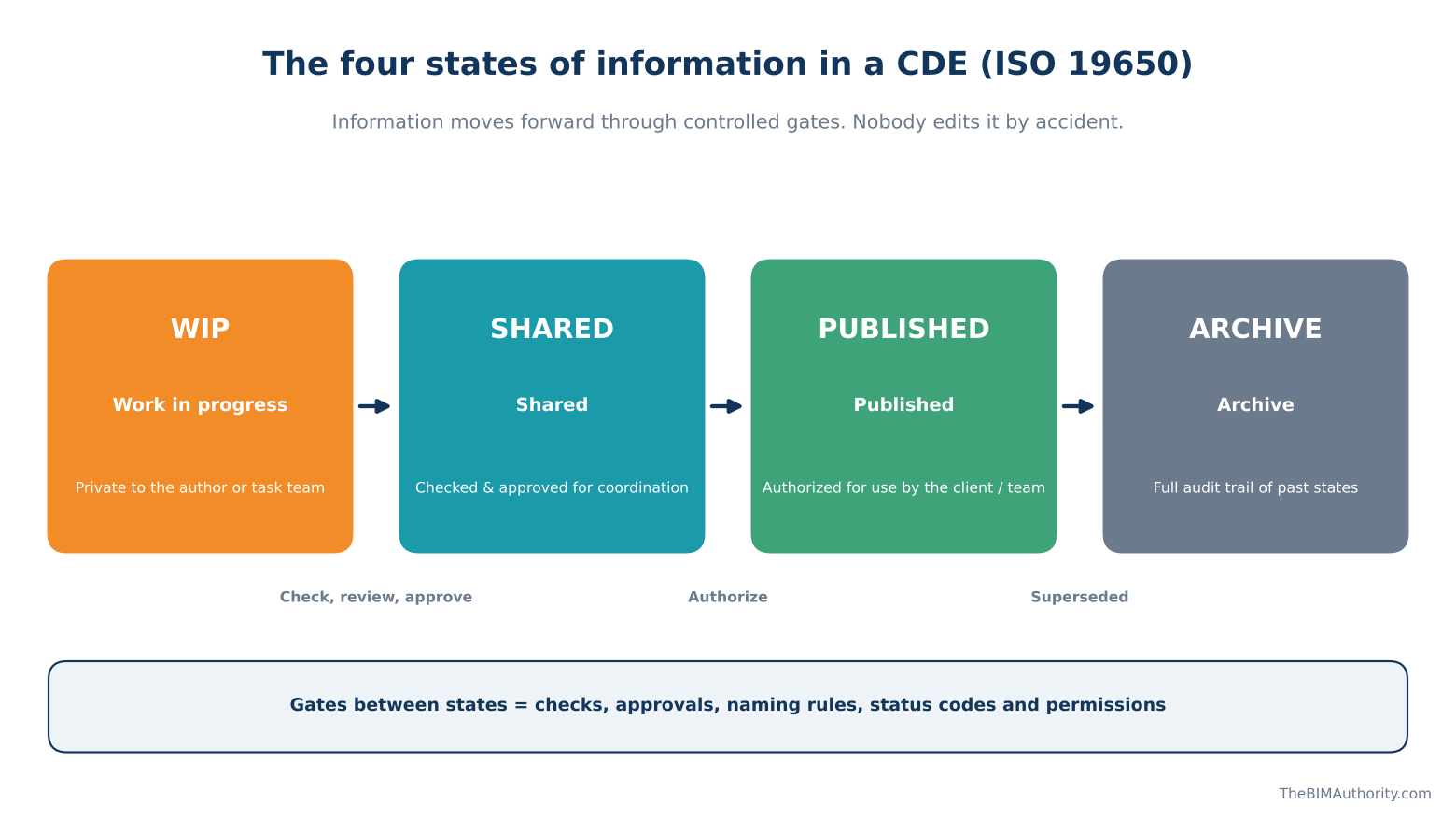
| State | Meaning | Who can see it |
|---|---|---|
| Work in progress | Being developed by its author or task team | The task team that produces it |
| Shared | Checked and available for coordination and use by others | The project team, as permitted |
| Published | Authorized for use as agreed, for example for construction or by the appointing party | Those who need it, as permitted |
| Archive | Record of what was shared and published, for traceability | Controlled access |
Transitions between states are gateways: checks, reviews and approvals. This prevents unreviewed work from leaking into coordination and ensures that published information has been authorized. See Common Data Environment (CDE): The Complete Guide and How to Set Up a Common Data Environment for BIM Projects.
Principle 5: Roles Are Defined by the Appointment
ISO 19650-1 defines the parties in terms of who appoints whom.
| Term | Definition in practice |
|---|---|
| Appointing party | Receives information from the lead appointed party and defines requirements. Usually the client. |
| Lead appointed party | Coordinates the delivery team’s information and interfaces with the appointing party. |
| Appointed party | Provides information, works, goods or services under an appointment. |
| Delivery team | The lead appointed party and the appointed parties. |
| Task team | A group assigned a specific scope of work within the delivery team. |
Two clarifications I give in every course.
- Roles are relative to an appointment. A main contractor is an appointed party relative to the client, and an appointing party relative to its subcontractors.
- The standard describes functions, not job titles. Someone must carry out the information management function, but the title, the person and whether it is full-time depend on the project.
See BIM Roles and Responsibilities: Manager, Coordinator, Modeler, and Information Manager.
Principle 6: Information Delivery Is a Cycle, Not a Line
Many people imagine information as flowing from designers to builders to operators in a straight line. ISO 19650-1 describes it differently: as an information delivery cycle that repeats over the life of the asset.
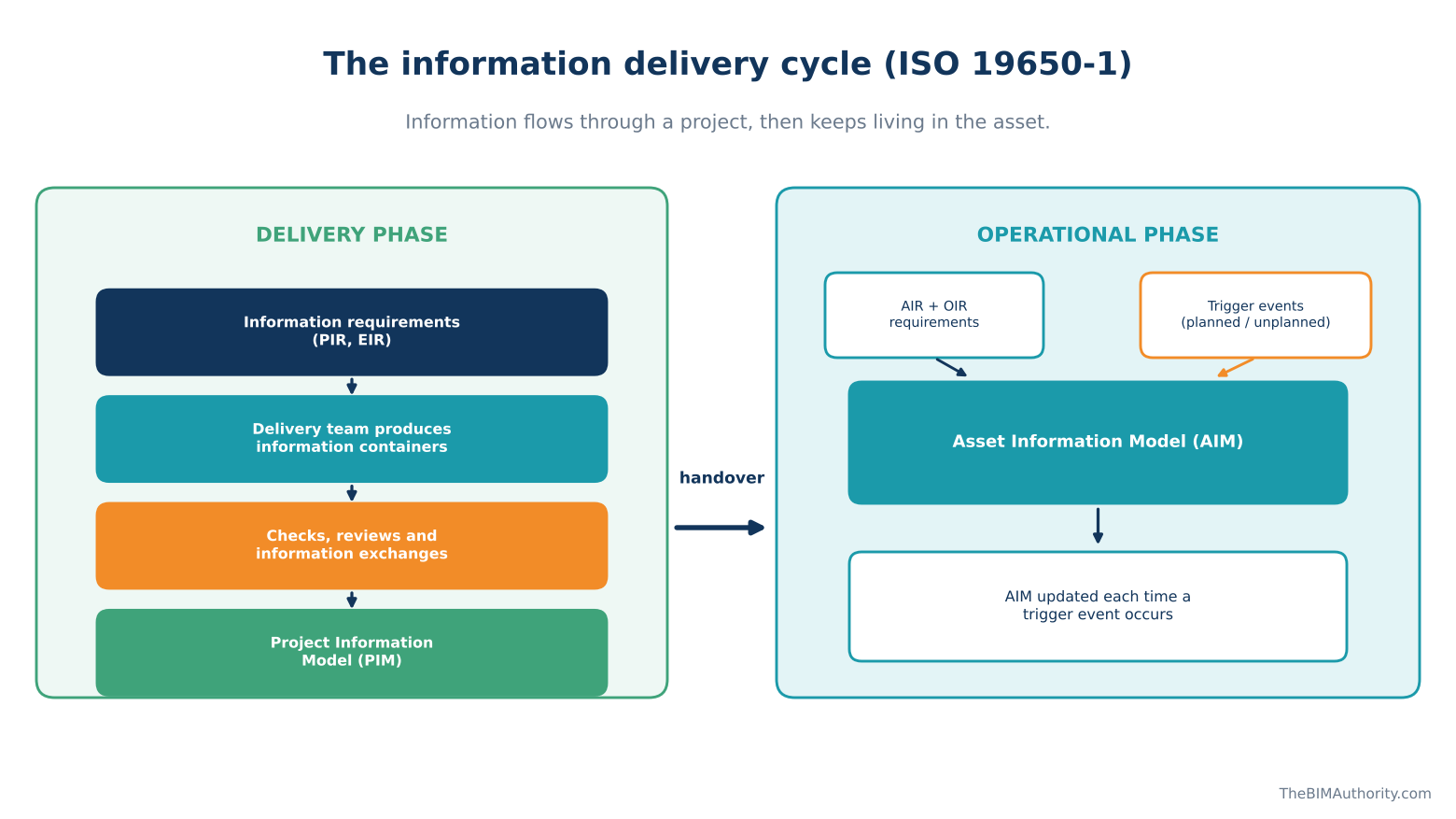
- Requirements (OIR, AIR, PIR, EIR) are defined by the appointing party.
- During the delivery phase, the delivery team produces information containers, checks them, exchanges them and builds the PIM.
- At handover, relevant information moves to the AIM.
- During the operational phase, trigger events cause the AIM to be updated.
- When a new project affects the asset, the AIM becomes an input to that project’s requirements.
Why the Cycle Matters
This model breaks the idea that information management ends at practical completion. It insists that the same information keeps being used, corrected and extended, and that every project inherits what the asset already knows. See ISO 19650-3: Information Management During Asset Operations.
The Link With Asset Management
ISO 19650-1 explicitly connects information management with asset management, referencing the ISO 55000 series. The idea is that information about assets should support the organization’s asset management objectives, which is why the OIR and AIR matter so much.
Principle 7: Information Delivery Is Planned
The standard describes how the delivery team plans the production and delivery of information. Key elements:
- Information delivery milestones: points in time when information is formally delivered and reviewed.
- Task information delivery plans (TIDP): each task team’s plan of what it will deliver and when.
- Master information delivery plan (MIDP): the consolidation of all TIDPs, showing the whole picture.
- Federation strategy: how information is divided into separately authored models and combined for coordination.
- Volume strategy: how the project’s information is spatially divided so that teams can work in parallel.
- Responsibility matrix: who is responsible for each piece of information.
These are explained in the later parts and in the dedicated guides. See Master Information Delivery Plan (MIDP): Complete Guide, Task Information Delivery Plan (TIDP): Complete Guide, How to Create a BIM Responsibility Matrix and BIM Models vs. Federated Models: What Is the Difference?.
Principle 8: Information Need Is Limited to What Is Necessary
One of the most valuable concepts of ISO 19650-1 is the level of information need: a framework that defines the extent and granularity of information required for each purpose.
The principle behind it can be summarized in six words: provide what is needed, no more. Excess information has real costs: heavier models, more time to produce and check, more risk of errors and confusion.
The detailed method for specifying it is in ISO 7817-1 (EN ISO 7817-1 in Europe). See ISO 7817-1: Level of Information Need Explained and Level of Information Need vs. LOD vs. LOI: Key Differences.
Principle 9: Collaboration Is Structured
The standard promotes collaborative working, but it does not mean “everybody talks to everybody”. It means collaboration within defined processes:
- Information is shared through the CDE, not by private channels.
- Each party takes responsibility for its own information.
- Information is checked before sharing.
- Reference information and shared resources (such as survey data, standard libraries and templates) are made available to the delivery team.
- A project information protocol (a contractual document) records the obligations and rights relating to information use.
The idea is that collaboration is easier and safer when the rules are clear. See BIM Contracts and Legal Considerations and BIM Protocol and Contract Addendum Template.
Principle 10: Capability and Capacity Are Assessed
Before appointing a delivery team, the appointing party should assess whether it has the capability (skills, tools, experience) and the capacity (resources, time) to manage information as required. This appears in the tender and appointment processes of Part 2.
It is a sensible requirement. I have seen many projects fail because a supplier promised a process they could not deliver, and the client had never asked for evidence. See BIM Procurement and Appointments Under ISO 19650.
Principle 11: Security and Safety Matter
Although Part 1 does not specify detailed procedures, it recognizes that information can be sensitive and that its management must consider security. The detailed approach is in Part 5. Similarly, Part 6 addresses information that supports health and safety. See ISO 19650-5: Security-Minded BIM Information Management and ISO 19650-6: Health and Safety Information Management.
Part 1 Vocabulary: A Quick Reference
| Term | Short explanation |
|---|---|
| Asset | Item, thing or entity that has potential or actual value to an organization |
| Appointing party | The client, or the party acting for the client |
| Appointed party | A supplier of information, works, goods or services |
| Lead appointed party | Appointed party that coordinates the delivery team’s information |
| Delivery team | The lead appointed party and its appointed parties |
| Task team | A group assigned a specific task |
| OIR / AIR / PIR / EIR | Information requirements at organization, asset, project and exchange level |
| Information model | Set of structured and unstructured information containers |
| PIM / AIM | Project and asset information models |
| Information container | Named, persistent set of information |
| CDE | Agreed source of information, with solution and workflow |
| Trigger event | Event that changes asset information needs during operation |
| Level of information need | Framework defining the extent and granularity of information |
| Information management function | The function that carries out the information management process |
| Reference information / shared resources | Information and resources provided to the delivery team |
For a broader list, see BIM Terminology: The Essential Glossary for Beginners.
How to Apply Part 1 in a Real Office
The concepts of Part 1 can be applied even before you use the full process of Part 2. Here is a practical sequence I use with offices that are starting.
- Agree on the vocabulary. Run a one-hour session to define the roles, containers and states in your own terms.
- Inventory your information. What kinds of containers do you produce? Models, drawings, schedules, reports?
- Define identification and status. Create a naming convention and a small set of status codes.
- Set up the states. Even with a simple folder structure, create areas for work in progress, shared, published and archive, with permissions.
- Define the gateways. Who checks and approves information before it moves to shared or published?
- Start asking for requirements. For each project, write down what information the client needs and why.
- Identify the information management function. Who is responsible for running the process?
- Review after each project. What did we produce that nobody used? What did we lack?
See How to Implement BIM in Your Company: A Step-by-Step Roadmap.
Common Misunderstandings About Part 1
- “Part 1 is only theory.” It contains the definitions that every other part relies on. Misreading it produces misreadings elsewhere.
- “A CDE is a shared folder.” It is a solution and a workflow, with states and gateways.
- “The information model is the 3D model.” It includes models, data and documents.
- “The lead appointed party is the same as the main contractor.” It depends on the appointment structure. It may be a lead designer, a main contractor or another party.
- “EIR means Employer’s Information Requirements.” That was the older UK term. In ISO 19650 it means Exchange Information Requirements.
- “The standard specifies LOD.” It uses the level of information need concept instead.
- “Part 1 applies only to new buildings.” It applies to the whole life cycle of any built asset.
Frequently Asked Questions
What does ISO 19650-1 cover?
Concepts and principles for information management using BIM across the life cycle of built assets: vocabulary, information requirements, information models, containers, the CDE, the delivery cycle, planning and collaboration.
What is the difference between ISO 19650-1 and ISO 19650-2?
Part 1 explains the concepts and principles. Part 2 specifies the process for the delivery phase of an asset, activity by activity.
What is an information container?
A named, persistent set of information retrievable from a file, system or application storage, such as a model, a drawing, a document or a schedule.
What are the four states of the CDE?
Work in progress, shared, published and archive.
What is the difference between PIM and AIM?
The PIM is the information model developed during design and construction. The AIM supports operation and maintenance. Relevant PIM content feeds the AIM at handover.
What is the difference between OIR, AIR, PIR and EIR?
They are information requirements at four levels: organization, asset, project and exchange (appointment). Each informs the next.
Is ISO 19650-1 mandatory?
Only when a law, client or contract requires it. Many public and private clients now do.
Do I need to read the standard itself?
Summaries and guides help, but if you commit to the standard in a tender or contract, you should read the relevant clauses of the official text, which you can obtain from your national standards body.
Final Thoughts
Part 1 of ISO 19650 is the least glamorous part of the series, and it is the one that has changed the way I think about projects. Before, I thought of BIM as a modeling activity with some coordination around it. After reading Part 1 properly, I understood that BIM is an information supply chain, with customers, suppliers, requirements, quality checks and a life cycle that outlasts every individual project.
If you absorb this view, you will read every other part with ease, and you will notice, in your own organization, where the supply chain has gaps: missing requirements, unclear responsibilities, information without identity. That awareness is the first step toward fixing them.
Where to go next: continue with ISO 19650-2: BIM Information Management During Project Delivery to see how these concepts become a process. For the requirements side, read ISO 19650 Information Requirements Explained: OIR, AIR, PIR, and EIR, and for the operational side, ISO 19650-3: Information Management During Asset Operations.



