



The first EIR I ever wrote ran to ninety-four pages. I was proud of it. It covered everything: modeling standards, software versions, file formats, drawing conventions, meeting schedules, even the font to be used on title blocks. I sent it to the bidders with a sense of satisfaction. Three weeks later, the tender responses arrived, and I learned how it had been received. Two bidders had simply copied my headings into their BEP and written “will comply” under each. One had not read it, as far as I could tell. And the best bidder, the one I most wanted to work with, rang me to say politely: “We think we understand about a third of what you want, but we cannot tell which third is important.”
He was right. My EIR had no hierarchy of purpose. It told bidders how to do everything and never said why or what mattered most. When I rewrote it, the new version was twelve pages. It began with a table of the decisions the information would support, then listed the deliverables for each milestone, then described the standards in a short annex. It was shorter, clearer and, most importantly, checkable. The project that followed was one of the calmest I have ever worked on.
This guide is what I wish I had read before writing that first EIR. It explains what an EIR is in ISO 19650, what it must and should contain, how to structure it, how to write requirements that can be verified, how to cascade it down the supply chain, how it relates to the BEP, MIDP and acceptance and where EIRs typically go wrong. It includes a skeleton and a worked example. A ready-to-adapt document is covered separately in Exchange Information Requirements (EIR) Template and Example.
The Short Answer
Exchange Information Requirements (EIR) specify what information an appointed party must deliver, when, in what form and to what standard, under a given appointment. They are written by the appointing party for each appointment it makes (and by lead appointed parties for the appointments they make in turn), and they are issued as part of the invitation to tender.
A terminology note: in ISO 19650, EIR means Exchange Information Requirements. In older UK documentation, it meant Employer’s Information Requirements. They serve similar purposes, but the ISO term is more precise, because the EIR concern exchanges of information under appointments, not the employer in general.
In one sentence:
The EIR are the contract between the people who need information and the people who produce it, written precisely enough that both sides can tell whether it has been delivered.
Where the EIR Sit in the Chain
| Level | Document | Role |
|---|---|---|
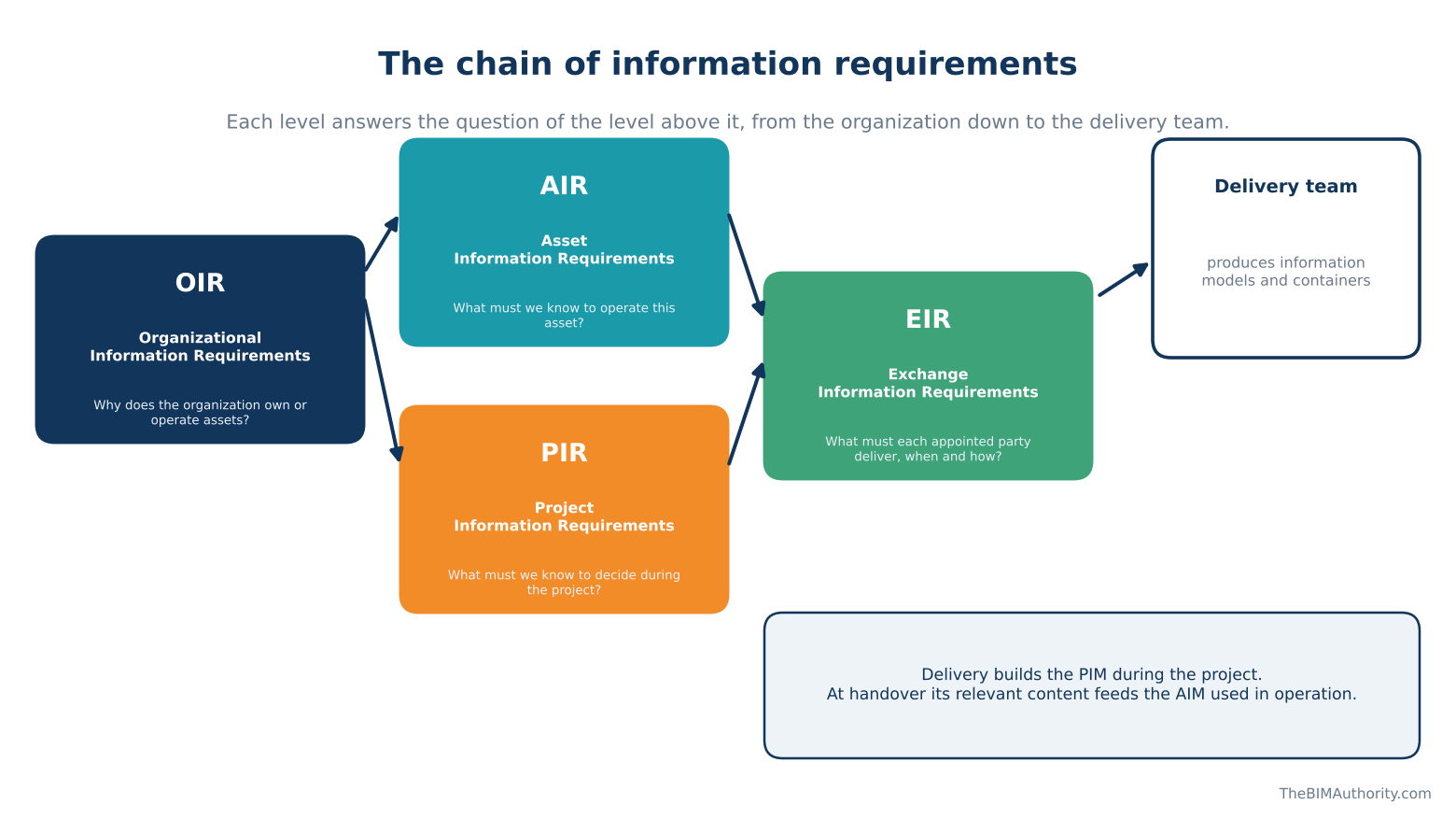
| Organization | OIR | What the organization needs to know about its assets |
| Asset | AIR | What is needed to operate and maintain the asset |
| Project | PIR | What is needed to make project decisions |
| Appointment | EIR | What each supplier must deliver |
The EIR are the end of the chain in the sense that they are the operational requirements that suppliers can be held to. They should therefore trace back to the PIR, AIR and OIR. See ISO 19650 Information Requirements Explained: OIR, AIR, PIR, and EIR, Project Information Requirements (PIR): Complete Guide and Asset Information Requirements (AIR): Complete Guide.
When and by Whom EIR Are Written
In the Delivery Process (ISO 19650-2)
- Assessment and need: the appointing party establishes the PIR, milestones, standards, production methods, reference information, CDE and information protocol.
- Invitation to tender: the appointing party compiles the EIR and the supporting information into the tender package, with tender response requirements and evaluation criteria.
- Tender response: bidders respond with a pre-appointment BEP, capability and capacity evidence, a draft MIDP and a risk register, showing how they will meet the EIR.
- Appointment: the BEP is confirmed, and the lead appointed party writes EIR for its own appointed parties.
See ISO 19650-2: BIM Information Management During Project Delivery and BIM Procurement and Appointments Under ISO 19650.
Two Directions of EIR
| Direction | Writer | Recipient | Example |
|---|---|---|---|
| Downward from the client | Appointing party | Lead appointed party | The client’s EIR to the lead designer or main contractor |
| Downward in the supply chain | Lead appointed party | Appointed parties and subcontractors | The main contractor’s EIR to the MEP subcontractor |
The second direction is where requirements most often get lost. A client’s carefully written EIR means little if the subcontractor receives only “follow the BIM requirements”.
What an EIR Contains
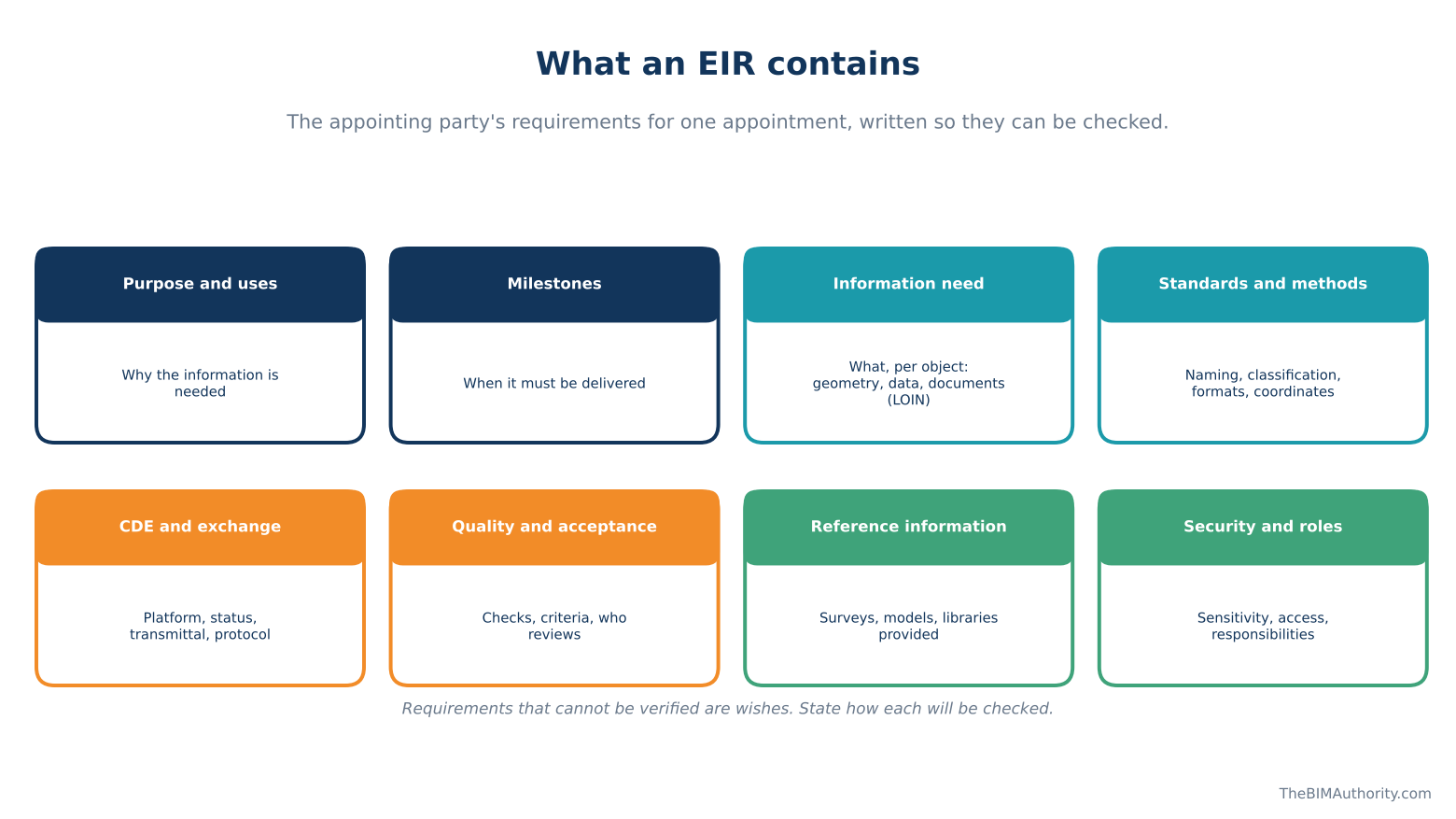
ISO 19650-2 lists what the appointing party establishes before the tender, and the EIR draw these together for the appointment. In practice, a good EIR covers eight areas.
1. Purpose, Context and Uses
Why the information is needed: the BIM uses and the decisions it supports, with a link to the PIR and AIR. This is where the “why” lives. See BIM Uses Explained: What Is BIM Actually Used For?.
2. Information Delivery Milestones
The points at which information is formally delivered and reviewed, linked to project stages and decisions. These milestones structure the MIDP and the acceptance process. See Master Information Delivery Plan (MIDP): Complete Guide.
3. Level of Information Need
The core: what information is needed, per object group, purpose and milestone, covering geometrical information, alphanumerical information and documentation. This is where the LOIN method applies. See ISO 7817-1: Level of Information Need Explained.
4. Information Standards and Production Methods
- Naming and identification of containers, and status and revision conventions. See BIM File Naming Conventions and ISO 19650.
- Classification system and edition.
- File formats and schema versions, including IFC version and model view. See Model View Definitions (MVD): Understanding IFC Exchange Requirements.
- Coordinates, units and levels. See BIM Georeferencing: Coordinate Systems and Model Positioning.
- Property definitions and property sets. See BIM Metadata, Attributes, and Property Sets Explained.
- Modeling methods where they affect the deliverable.
- Software and versions, if constrained.
5. CDE, Exchange and Protocol
The platform and workflow, status codes, transmittal procedures and the information protocol (the contractual document describing obligations and rights in relation to information). See Common Data Environment (CDE): The Complete Guide and BIM Contracts and Legal Considerations.
6. Quality, Checking and Acceptance
How information will be checked and accepted: checks the supplier must perform before sharing, checks the client or lead will perform, acceptance criteria, response times and what happens to rejected information. See ISO 19650-4: Information Exchange Requirements Explained and BIM Quality Assurance vs. Quality Control: Processes and Checklists.
7. Reference Information and Shared Resources
What the client provides to the delivery team: surveys, existing models, asset information, libraries, templates, standards. State its status and reliability, and who is responsible for it.
8. Security, Roles and Responsibilities
The outcome of the security triage and the measures that follow, the information management roles on both sides and any named responsibilities. See ISO 19650-5: Security-Minded BIM Information Management and BIM Information Security, Access Control, and Data Governance.
How to Write Requirements That Can Be Checked
The difference between a useful EIR and a decorative one is verifiability. Here are the principles I apply to every sentence.
1. One Requirement, One Statement
Do not bundle. “Provide coordinated, classified, fully parametric models” hides three requirements, and a fourth (“coordinated” according to whom?).
2. Name the Object, the Information and the Moment
A good pattern: For [objects], provide [information], at [milestone], [in this form].
| Weak | Strong |
|---|---|
| “Models shall be of high quality.” | “At the design approval milestone, every external door shall carry a unique identifier, a classification code in the agreed system and a fire rating from the agreed list, as properties in the IFC model.” |
| “Provide as-built information.” | “At practical completion, provide for every item in the asset register: manufacturer, model, serial number and installation date, as structured data using the agreed template, linked to documents by asset ID.” |
| “Models shall be coordinated.” | “Before each milestone, run clash detection between structure and services using the agreed matrix. Hard clashes above the agreed tolerance shall be resolved or recorded with an owner and a date.” |
| “Use open formats.” | “Exchange models as IFC4 in the Reference View, validated before sharing, with the property sets and classification specified in the attached IDS.” |
3. Say How It Will Be Checked
For every requirement, ask: who will check it, how and what counts as a pass? If you cannot answer, rewrite or remove it. Where possible, express alphanumerical requirements as IDS specifications. See Information Delivery Specification (IDS): The Complete Guide.
4. Use Defined Terms
Write a short glossary of terms used (milestone names, status codes, asset tiers). Use each term consistently. See BIM Terminology: The Essential Glossary for Beginners.
5. Be Proportionate
Ask for what the purposes need. Over-specification increases supplier cost, reduces focus and makes compliance impossible to verify.
6. Separate Requirements From Guidance
Mark clearly what is mandatory and what is advice or an example. Mixed documents cause arguments.
7. Reference, Do Not Repeat
Where a standard, an annex or another document already defines something, refer to it with its edition, rather than restating it with slight differences.
A Skeleton for an EIR
Here is a structure I use. It can be a short document, or a main document with annexes.
- Introduction: project, appointment, purpose of the EIR, relationship to PIR and AIR.
- Definitions and references: terms, standards and editions.
- Information uses and decisions: the BIM uses and the decisions supported.
- Information delivery milestones: a table of milestones, dates or stages and what each requires.
- Information requirements by milestone: the LOIN content (geometry, data, documents) per object group and purpose. Often an annex, as a matrix.
- Information standards and methods: naming, classification, formats, versions, coordinates, properties.
- CDE, exchange and protocol: platform, workflow, statuses, transmittals, contractual protocol.
- Quality, checking and acceptance: supplier checks, client checks, criteria, response times, handling of rejection.
- Reference information and shared resources: what is provided, status and responsibility.
- Security: triage result and measures.
- Roles and responsibilities: information management functions and contacts.
- Tender response requirements and evaluation criteria: what bidders must submit and how it will be judged.
- Annexes: matrices, code lists, IDS files, templates.
A Worked Example: One Section of an EIR
Here is a condensed example of an EIR section, to show how the principles look in practice. It is a teaching example.
Section 5.3: External doors and windows (envelope openings)
| Item | Requirement |
|---|---|
| Purpose | Fire safety review at design approval; thermal and acoustic assessment; asset register population at handover |
| Milestones | Design approval (milestone 3); practical completion (milestone 5) |
| Provider / user | Provided by the architect (milestone 3) and the contractor (milestone 5). Used by the fire engineer, the cost consultant, the energy assessor and the facility manager |
| Objects | All external doors and windows |
| Geometrical information | M3: accurate dimensions and position in the host wall; M5: as installed, verified |
| Alphanumerical information, M3 | Unique identifier; classification code; type reference; fire rating; thermal transmittance value; acoustic rating |
| Alphanumerical information, M5 | All M3 information plus manufacturer, product reference, serial number, installation date, warranty end date |
| Documentation, M5 | Test certificates and manufacturer maintenance instructions, linked by identifier |
| Format | IFC4 Reference View, with property sets as defined in the attached property catalogue and IDS (file DOORS-WINDOWS-v1.2); asset register in the agreed template |
| Verification | Supplier runs the IDS and a geometry and coordinate check before sharing. Client runs the IDS at acceptance. Pass criterion: 100% of required properties present and valid; 100% of identifiers unique |
| Rejection | Information failing the criteria is returned with a list of failures within five working days; the supplier corrects and resubmits |
Look at what each line does. A bidder can price it. A modeler can produce it. A checker can test it. A dispute about whether it was delivered can be settled by running the IDS.
EIR for Different Appointments
The structure holds, but the emphasis differs by who is appointed.
| Appointment | Typical emphasis in the EIR |
|---|---|
| Lead designer / design team | Design information per milestone, coordination, model quality, properties for cost, performance and compliance, early asset data structure |
| Main contractor | Construction information, 4D and logistics information, fabrication and installation data, as-built and asset data against the AIR, health and safety information |
| Specialist subcontractors and fabricators | Fabrication models, product data, test certificates, installation records; the contractor’s requirements cascaded |
| Surveyors and scanning providers | Accuracy, formats, coordinates, deliverable structure. See Scan-to-BIM: Converting Point Clouds into Intelligent Models |
| Facility management providers | Operational information, updates to the AIM after trigger events, response times. See ISO 19650-3: Information Management During Asset Operations |
| Consultants (cost, fire, energy, sustainability) | Information they must receive and provide at each milestone, and formats |
Cascading the EIR Down the Supply Chain
Requirements must flow downward without distortion. Here is how.
- The lead appointed party reads the client’s EIR and identifies which requirements apply to each appointed party.
- For each appointment, it writes a tailored EIR, using the same terms, milestones and standards, adding detail specific to the scope.
- It assesses capability and capacity of each appointed party, and provides templates and training where needed.
- It checks what appointed parties deliver, before passing information up.
- It records exceptions and agreements.
A common failure: the main contractor passes the client’s EIR to subcontractors as a PDF, with “comply with Annex C”. Nobody reads Annex C, and the information arrives, if at all, in a form nobody expected.
EIR, BEP, MIDP and Acceptance: How They Fit
| Document | Question | Relationship to the EIR |
|---|---|---|
| EIR | What must be delivered? | The requirement |
| Pre-appointment BEP | How will you meet it? | The supplier’s proposal in response. See BIM Execution Plan (BEP): How to Create and Implement One |
| Post-appointment BEP | How will we meet it together? | The confirmed plan after appointment |
| MIDP / TIDP | When will each deliverable arrive? | The schedule of deliveries that satisfy the EIR. See Master Information Delivery Plan (MIDP): Complete Guide and Task Information Delivery Plan (TIDP): Complete Guide |
| Responsibility matrix | Who is responsible for what? | Assigns each EIR requirement to a party. See How to Create a BIM Responsibility Matrix |
| Acceptance | Has it been delivered? | Checks against the EIR criteria |
A useful consistency check: pick five EIR requirements and trace each into the BEP, the MIDP, the responsibility matrix and the acceptance checklist. If any link is missing, the EIR will not be delivered reliably.
Common Problems in EIR
| Problem | Cause | Remedy |
|---|---|---|
| Ninety pages nobody reads | Everything included, nothing prioritized | Start from decisions and milestones; move detail to annexes |
| “Will comply” tender responses | No required evidence of capability | Ask for specific evidence: a pre-appointment BEP, sample deliverables, named people |
| Requirements that cannot be checked | Prose | Rewrite as verifiable statements; add IDS |
| Copy-paste from another project | Convenience | Adapt objects, milestones and purposes |
| Contradictions with contract and BEP | Different authors | Cross-check before issue |
| Requirements lost down the chain | No cascade | Lead appointed party writes tailored EIR |
| “IFC” with no version or view | Vagueness | State schema and view |
| Impossible demands | No capability assessment | Test with a pilot or sample deliverable |
| No acceptance criteria | Oversight | Write criteria and response times |
| No change control | Informal updates | Version and approve changes |
How to Test an EIR Before Issue
- Read it as a bidder. Can you price it? Can you tell what matters most?
- Trace five requirements into deliverables, checks and responsibilities.
- Run a pilot: ask a team to produce a small sample against the EIR and see what is unclear.
- Ask an operator to review the asset-related parts. Would the data answer their questions?
- Have a lawyer check contractual language, including the information protocol (this guide is not legal advice).
- Check consistency with the contract, BEP template and standards.
Common Mistakes
- Writing the EIR after the tender, so it cannot influence the bids.
- Starting from standards instead of purposes.
- Over-specifying geometry and under-specifying data and documents.
- No milestones or milestones disconnected from decisions.
- No verification method.
- Ignoring reference information, so suppliers design on unreliable surveys.
- Not cascading to subcontractors.
- No capacity of the client to review what it asks for.
- Mixing mandatory requirements and advice.
- No change control.
- Leaving security out.
- Forgetting handover and the AIM.
See also Common BIM Mistakes Beginners Should Avoid.
A Short Checklist
- Does the EIR trace to PIR, AIR and OIR?
- Are uses, decisions and milestones stated?
- Is the level of information need specified per object, purpose and milestone?
- Are standards, formats, versions and coordinates precise?
- Are CDE, protocol and exchange procedures defined?
- Are checks and acceptance criteria written, with response times?
- Is reference information provided and described?
- Are security and roles addressed?
- Can each requirement be checked by someone, and how?
- Is the cascade to lower tiers planned?
- Has it been tested by reading it as a bidder and with a pilot?
Frequently Asked Questions
What are EIR in ISO 19650?
Exchange Information Requirements: the requirements for information to be delivered under an appointment, specifying what, when, in what form and to what standard.
Who writes the EIR?
The appointing party for its appointments, and lead appointed parties for the appointments they make.
What is the difference between EIR and BEP?
The EIR state what must be delivered. The BEP explains how the delivery team will deliver it.
What is the difference between EIR and PIR?
PIR state what the client needs to know to decide. EIR state what each supplier must deliver to provide that.
When is the EIR issued?
With the invitation to tender, so bidders can respond with a pre-appointment BEP and capability evidence.
How long should an EIR be?
As short as it can be while remaining precise. Many good EIRs are 10 to 25 pages with annexes. Length is not quality.
Does the EIR include LOD?
It should specify the level of information need: geometry, data and documentation per object, purpose and milestone. LOD may be used as shorthand for geometry, with a stated reference.
Can EIR be machine-readable?
Alphanumerical requirements for IFC models can be expressed as IDS, which software can check automatically.
Is EIR the same as Employer’s Information Requirements?
In older UK documents, yes. In ISO 19650, it is Exchange Information Requirements.
What happens if a supplier cannot meet the EIR?
Assess capability and capacity at tender, agree a realistic subset or support, record exceptions and manage risk through the BEP and risk register.
Final Thoughts
I kept my ninety-four-page EIR for a long time, in a drawer, as a reminder. It is a perfect specimen of the instinct that ruins requirements: the belief that more words mean more control. In reality, more words mean more ambiguity, more contradiction and less attention to what matters. The twelve-page version worked because every line answered a question that somebody would actually ask: what do you need, when, in what form, and how will we know you have it?
Write your EIR as if you were the person who has to deliver it, with a deadline and a budget. Make every requirement something you could check on a Friday afternoon with a cup of coffee. When you do, the document stops being paperwork and becomes what it was always meant to be: the shortest route from what you need to what you get.
Where to go next: for a ready-to-adapt document, read Exchange Information Requirements (EIR) Template and Example. To see the supplier’s response, continue with BIM Execution Plan (BEP): How to Create and Implement One, and for the scheduling side, Master Information Delivery Plan (MIDP): Complete Guide.



