



There is a moment in every project that I have come to dread and to love in equal measure: the exchange. It is the moment when one team says “here is our model” and another says “thank you, we will check it”. On paper, nothing could be simpler. In reality, I have watched exchanges go wrong in every conceivable way. The wrong version sent to the right person. The right version sent to the wrong format. A beautiful model that arrived on time but contained none of the properties the receiver needed. A rejection email that said only “this is not what we asked for”, with no explanation of what had been asked.
For many years, we handled exchanges the way offices handled everything before standards existed: through habit, goodwill and one very patient person who knew where everything was. ISO 19650-4 is the part of the series that brings discipline to this critical moment. It deals with the information exchange process and with the requirements that govern it, and it is one of the least known and most practical parts of the whole series.
In this guide, I will explain what Part 4 covers, how information exchange works in a well-managed project, how to write eir/” data-khs-tag=”207″>exchange information requirements (EIR) that can actually be checked, and how to avoid the failures I have just described. I come at this as a former CAD manager and software trainer who has had to receive, check and sometimes reject thousands of files, and who has also had to deliver them.
The Short Answer
ISO 19650-4 specifies requirements for information exchange during the delivery and operational phases of assets, as part of the information management process. It concentrates on how information is prepared, checked, transmitted, received and accepted or rejected, in relation to the exchange information requirements.
Put simply:
Parts 2 and 3 say what information is needed and who is responsible. Part 4 makes sure that each handover of information between two parties is controlled, checked and recorded.
It was published in 2022, which makes it the newest of the core process parts. Implementation practices, tools and templates are still maturing, and I would encourage you to read the clauses of the standard itself before committing to it in a contract.
Why Information Exchange Deserves Its Own Part
Every BIM project is, at heart, a series of exchanges. Designers send information to coordinators, coordinators to the client, the client to contractors, contractors to fabricators, and finally everything flows to the owner. If each exchange loses a little information, adds a little confusion or relies on informal agreements, the cumulative effect over a project is enormous.
Exchanges are risky for four reasons.
- The sender and the receiver often have different expectations, because requirements were never expressed precisely.
- Technology adds friction. Export settings, file formats, naming and coordinates can all damage information in transit.
- Checking is often informal. “It looks fine” is not a check.
- Decisions are not recorded. When an exchange is accepted or rejected, the reasons vanish.
Part 4 addresses all four by asking for a structured exchange process with clear requirements, defined roles and traceable outcomes.
Where Part 4 Fits in the Series
| Part | Relationship to information exchange |
|---|---|
| ISO 19650-1 | Defines the concepts: information containers, information requirements, CDE, milestones |
| ISO 19650-2 | Describes when exchanges happen in the delivery phase (for example, information model delivery) |
| ISO 19650-3 | Describes exchanges during operation, linked to trigger events |
| ISO 19650-4 | Specifies how an exchange is managed, from requirements to acceptance |
| ISO 19650-5 | Adds security considerations for sensitive information |
Think of Part 4 as a module that plugs into the other parts. Whenever Part 2 or Part 3 says “information is exchanged”, Part 4 explains how to do it properly. See ISO 19650 Explained: A Complete Guide for BIM Professionals.
Key Ideas of Information Exchange
Sender and Receiver
Every exchange has two parties: the one who provides information (the sender) and the one who receives it (the receiver). Roles are relative to each exchange. A designer is the sender when delivering a model to the coordinator, and the receiver when getting survey data from the client.
Being explicit about this has a practical benefit: each party knows its obligations. The sender must produce and check against the requirements. The receiver must review within an agreed time and give a clear decision.
Information Containers in Transit
What is exchanged are information containers: models, documents, drawings, data sets, each with identification, status and revision. An exchange should be identifiable: what was sent, by whom, when, in which state and for which purpose.
Requirements Before Delivery
The central rule: no exchange without agreed requirements. The receiver defines what it needs, and the sender knows what to deliver before producing it. This is where the Exchange Information Requirements (EIR) come in.
The Exchange Information Requirements (EIR) in Detail
Terminology first, because it causes confusion. In ISO 19650, EIR means Exchange Information Requirements. In older UK documentation, the same abbreviation meant Employer’s Information Requirements. They serve a similar purpose, but the ISO term is precise: the EIR specify what information must be exchanged, in each appointment.
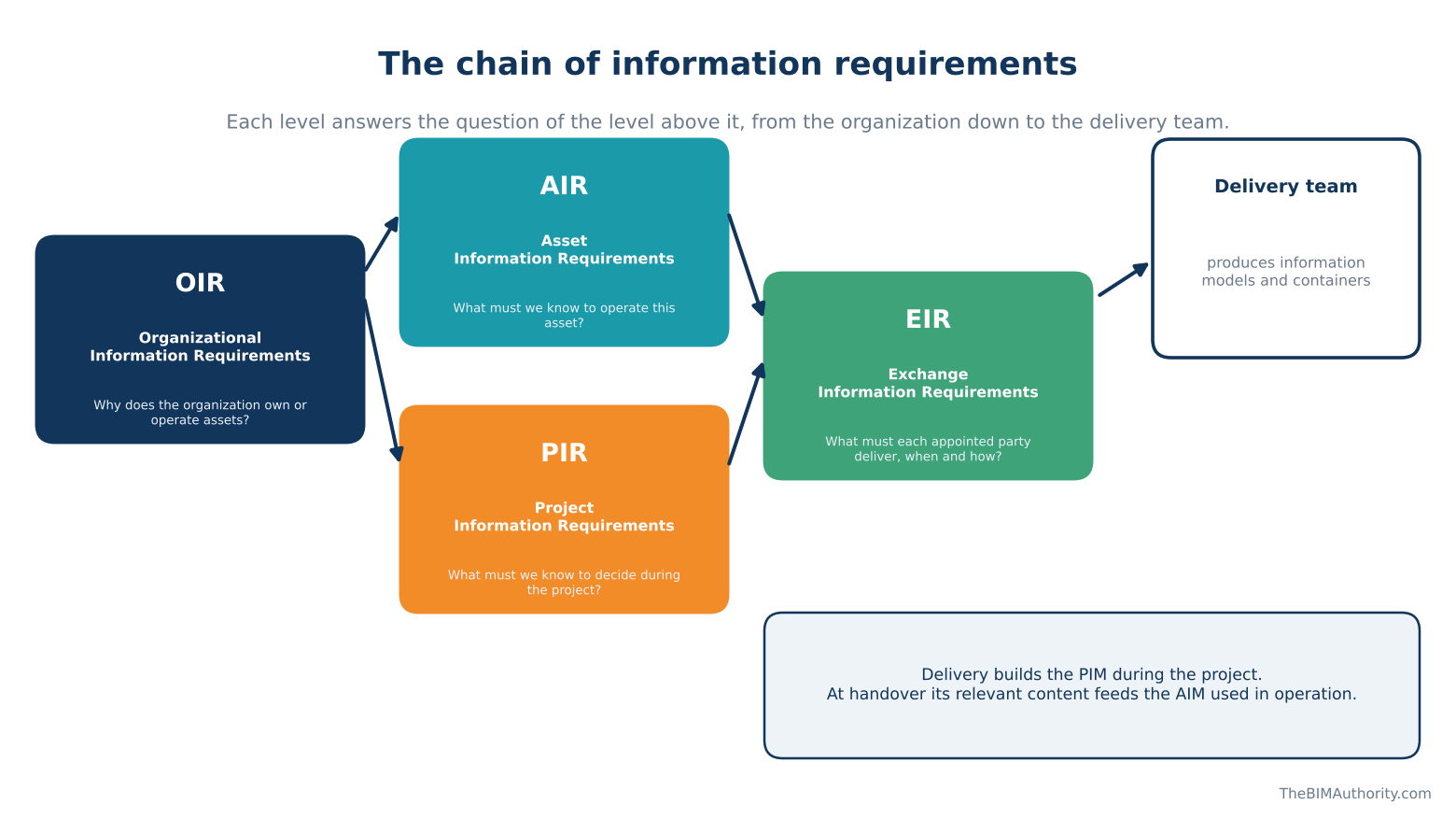
The EIR sit at the bottom of the chain: the OIR, AIR and PIR express needs at higher levels, and the EIR translate them into specific, deliverable requirements for an appointment.
What a Good EIR Contains
| Section | Content | Example |
|---|---|---|
| Purpose and uses | Why the information is needed | Coordination, quantity takeoff, fire safety review |
| Milestones and timing | When exchanges occur | End of concept, end of design development, handover |
| Information content | What must be delivered: geometry, data and documents, per purpose and milestone | Level of information need per element group |
| Formats and software | In which form | Native files plus IFC, specified schema version and view |
| Structure and naming | Container identification, classification, status codes | Naming convention and classification system |
| Coordinates and units | Common basis | Project origin, survey point, units |
| Quality criteria | What “acceptable” means | Required properties present, no duplicate elements, clash tolerance |
| Verification method | How the receiver will check | Rule-based checking, IDS, visual review |
| Delivery method | How and where information is delivered | Upload to the CDE with required metadata |
| Review and acceptance | Response times and process | Decision within an agreed number of working days |
| Security and access | Handling of sensitive information | Access restrictions, see Part 5 |
| Standards and references | Documents the sender must follow | ISO 19650, project information standard |
The Level of Information Need Inside the EIR
The heart of the EIR is the specification of information content. A modern approach uses the Level of Information Need: for each purpose and milestone, state the geometrical information, alphanumerical information and documentation required. See Level of Information Need vs. LOD vs. LOI: Key Differences and ISO 7817-1: Level of Information Need Explained.
Writing Requirements That Can Be Checked
A requirement is only useful if someone can verify it. Compare these two statements.
| Vague | Verifiable |
|---|---|
| “Models shall be of high quality.” | “Every door shall carry a fire rating, a unique identifier and a classification code at the design development milestone.” |
| “Provide as-built information.” | “Provide equipment records for all items in the asset register, with manufacturer, model, serial number and installation date, delivered as structured data linked to room locations.” |
| “Models shall be coordinated.” | “Clash detection shall be run between structure and MEP using the agreed matrix, with hard clashes above the agreed tolerance resolved or recorded before milestone submission.” |
A good test I teach: “Could a person I have never met check this requirement without asking me a question?” If not, rewrite it.
See Exchange Information Requirements (EIR): Complete Guide and Exchange Information Requirements (EIR) Template and Example.
The Exchange Process, Step by Step
Part 4 treats an exchange as a managed sequence. The precise terminology and clauses are in the standard, but the practical logic can be described in six steps.
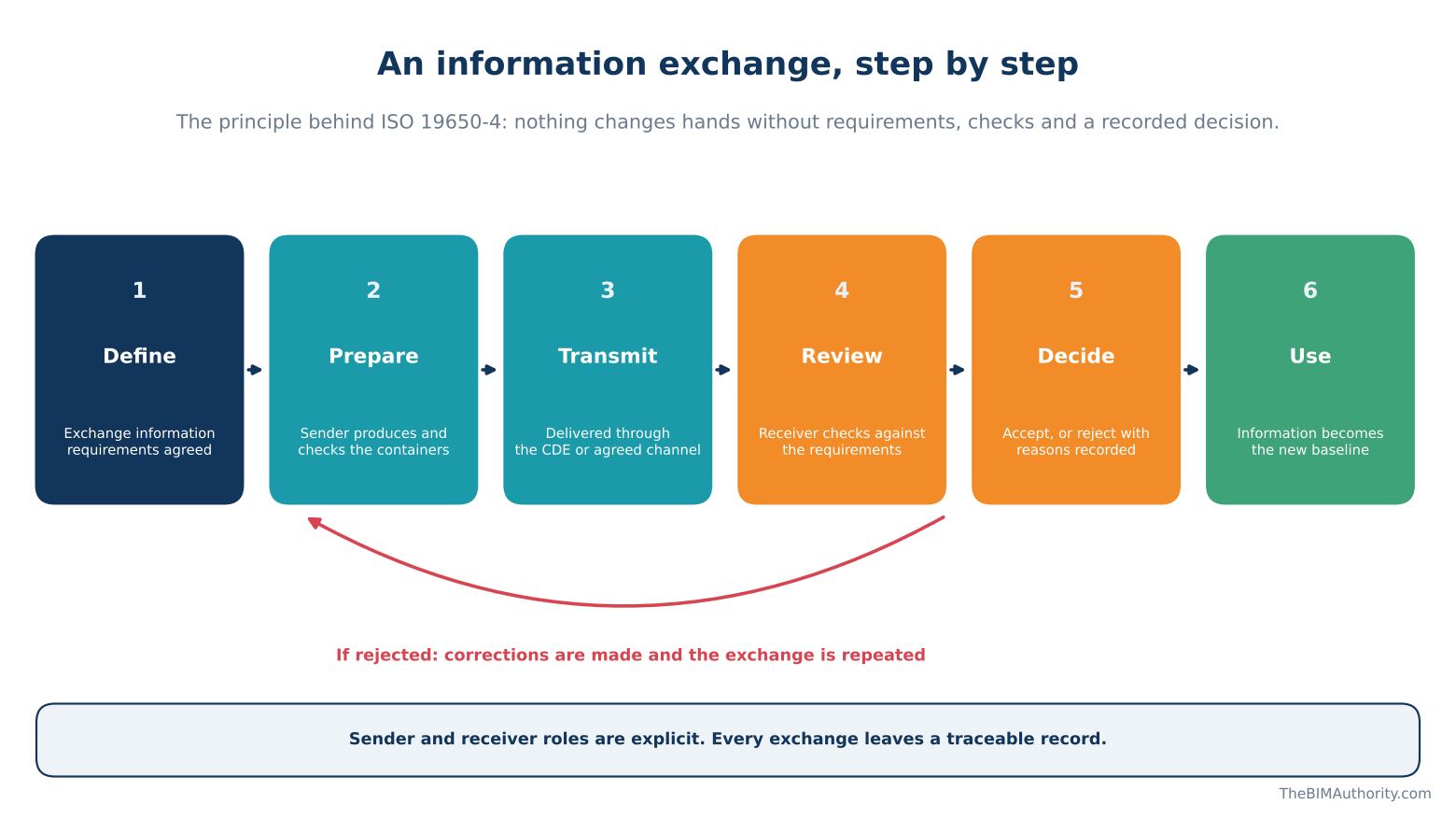
Step 1: Define
The exchange information requirements for this exchange are known and agreed: content, format, timing, quality criteria and verification method.
Step 2: Prepare
The sender produces the information containers and applies its own quality assurance: checks against requirements, naming, metadata, coordinates, completeness. This is the sender’s responsibility, and it is where most exchange failures should be caught.
Step 3: Transmit
The information is delivered through the agreed channel, normally the CDE, with the required identification, status and revision. A transmittal record shows what was sent, when and by whom.
Step 4: Review
The receiver checks the information against the requirements: automated rule-based checks where available, plus human review for what cannot be automated.
Step 5: Decide
The receiver accepts the information or rejects it, giving reasons that refer to the requirements. The decision is recorded.
Step 6: Use
Accepted information becomes the agreed baseline for the next steps and may move to a new state in the CDE (for example, from shared to published).
If the Exchange Is Rejected
The sender corrects and resubmits, and the cycle repeats. A well-run project treats rejection as a normal part of the process, not as a conflict. The key is that the reasons are specific and traceable to a requirement.
Exchange Types in a Real Project
Not every exchange is a formal milestone delivery. In practice, projects have several layers.
| Type of exchange | Typical frequency | Example |
|---|---|---|
| Internal exchange | Continuous | Within a task team, in work in progress |
| Coordination exchange | Weekly or fortnightly | Task teams sharing models for federation and clash detection |
| Milestone exchange | At agreed milestones | Delivery of the information model to the client |
| Handover exchange | At completion | Transfer of the PIM to the AIM |
| Operational exchange | At trigger events | Updating the AIM after a maintenance intervention |
It is useful to apply different levels of formality to each. Weekly coordination exchanges need a light, fast process. Milestone and handover exchanges need the full process, with documented acceptance criteria. See BIM Coordination: The Complete Guide and BIM Model Handover Checklist and Requirements.
How Information Exchange Relates to Other Documents
| Document | Relationship to exchange |
|---|---|
| EIR | Defines the requirements each exchange must meet |
| BEP | Explains how the delivery team will meet them, including exchange procedures |
| MIDP / TIDP | Schedule when exchanges happen and who delivers what |
| Responsibility matrix | Shows who is responsible for each information deliverable |
| Project information standard | Defines naming, classification and format conventions |
| Information protocol | Contractual terms for the use of exchanged information |
See BIM Execution Plan (BEP): How to Create and Implement One, Master Information Delivery Plan (MIDP): Complete Guide, Task Information Delivery Plan (TIDP): Complete Guide and How to Create a BIM Responsibility Matrix.
Technology That Supports Exchange
Standards do not exchange information; tools do. Several technologies work with the exchange process.
The CDE
The Common Data Environment is the natural channel: it holds the containers, applies the states and records who did what. See Common Data Environment (CDE): The Complete Guide.
Open Formats
IFC allows models to be exchanged between different software, and BCF carries issues and review comments. See How to Export and Import IFC Models Correctly and BIM Collaboration Format (BCF): The Complete Guide.
Machine-Readable Requirements: IDS
The Information Delivery Specification (IDS) allows the receiver to express requirements in a form that software can check automatically against an IFC model. This is a natural companion to Part 4, because it turns many requirements into automated acceptance tests. See Information Delivery Specification (IDS): The Complete Guide.
Delivery Manuals and Model Views
Standards such as the Information Delivery Manual (IDM) and Model View Definitions (MVD) describe exchanges and the subsets of IFC used for them. See Model View Definitions (MVD): Understanding IFC Exchange Requirements.
Checking and Validation Tools
Rule-based checkers, IFC validators and clash detection tools help the receiver (and the sender) verify content. See Solibri: BIM Model Checking and Validation Guide, How to Validate IFC Models for Data Quality and Compliance and BIM Model Checking: Geometric and Information Validation.
Open APIs
Open APIs for collaboration platforms allow exchanges and issue tracking to work across different systems. This reduces dependence on one vendor.
Practical Acceptance Criteria: A Checklist You Can Adapt
Here are criteria I have used, grouped by what they verify. Adapt them to each project.
Identification and structure
- Every container follows the naming convention.
- Status and revision are present and correct.
- Classification codes are present for the required elements.
Geometry and coordinates
- The model uses the agreed origin, units and levels.
- Models align with reference models.
- No duplicate or overlapping elements beyond tolerance.
Information content
- Required properties are present for each element group.
- Property values follow the agreed formats and lists.
- Required documents are linked and accessible.
Technical quality
- The file opens and can be processed by the receiver’s tools.
- IFC export meets the agreed schema version and model view.
- File size is within agreed limits.
Coordination
- Clash detection has been run per the agreed matrix.
- Remaining clashes are recorded with owners and dates.
Process
- The exchange was made through the agreed channel.
- A transmittal record exists.
- A short check report accompanies the exchange.
Common Problems in Information Exchange
| Problem | Typical cause | Remedy |
|---|---|---|
| “This is not what we asked for” | Vague or contradictory requirements | Write verifiable requirements; confirm in kickoff |
| Models do not align | Coordinates and units not agreed or tested | Test alignment in mobilization |
| Properties missing in IFC | Export mapping not configured | Test the export and check results early |
| Information arrives late | Review time not planned | Plan sender and receiver timelines in the MIDP |
| Version confusion | Informal channels, no status | Use the CDE and metadata |
| Endless back-and-forth | Rejections without reasons | Require decisions that cite requirements |
| Heavy files | No limits on detail or size | Specify size and detail in the EIR |
| Sensitive data shared widely | No security triage | Apply Part 5 |
| Requirements lost down the supply chain | EIR not cascaded | Cascade EIR with every appointment |
How to Introduce Structured Exchange in Your Office
You can adopt the logic of Part 4 gradually.
- Define your standard exchanges. List the types of exchange you handle: coordination, milestone, handover.
- Write a standard EIR section for the ones you receive and a standard response for the ones you send.
- Create a check list for each exchange type, as above.
- Make senders responsible for self-checking before delivery, with a short report.
- Define receiver turnaround times. An exchange that waits two weeks for review is a delay in disguise.
- Record every decision in the CDE.
- Automate what you can, starting with naming, required properties and coordinates.
- Review failures. Each rejected exchange teaches you something about your requirements.
See How to Implement BIM in Your Company: A Step-by-Step Roadmap and BIM Quality Assurance vs. Quality Control: Processes and Checklists.
Common Mistakes with Part 4 and Exchange Requirements
- Writing the EIR after the project starts. Requirements must come first.
- Copy-pasting an EIR that does not match the project’s purposes.
- Demanding maximum information “just in case”. This inflates cost and risk. See Level of Information Need vs. LOD vs. LOI: Key Differences.
- No verification plan. If no one will check a requirement, do not write it.
- Treating IFC as a guarantee. A valid IFC file can still be missing the required information.
- Skipping the sender’s self-check. The receiver is not a quality department.
- No time for review in the schedule.
- Inconsistent vocabulary between the EIR, the BEP and the naming convention.
- Rejecting without reasons.
- Ignoring security for sensitive exchanges.
See also Common BIM Mistakes Beginners Should Avoid.
Frequently Asked Questions
What is ISO 19650-4?
The part of the series on information exchange: how information is prepared, checked, transmitted, received and accepted or rejected, in relation to the exchange information requirements.
What does EIR stand for in ISO 19650?
Exchange Information Requirements. In older UK documents, EIR meant Employer’s Information Requirements.
What is the difference between the EIR and the BEP?
The EIR states what must be delivered. The BEP explains how the delivery team will deliver it.
Who writes the EIR?
The appointing party for its appointment, and the lead appointed party for the appointments it makes to its own appointed parties.
How do I check that an exchange meets the EIR?
By combining rule-based model checking, IFC validation, IDS checks where available, and human review of what cannot be automated, all against pre-defined acceptance criteria.
Is Part 4 mandatory?
Only if a contract, client or law requires it. Because it is relatively new, many projects apply its principles without formal reference to it.
Does Part 4 replace Part 2?
No. Part 4 works together with Parts 2 and 3: they define the process and responsibilities, while Part 4 defines how exchanges within that process are managed.
What is the role of IDS in exchange?
IDS lets you express requirements in a machine-readable form so software can check automatically whether a model contains the required information.
What should a small project do?
Apply the principles proportionately: a short EIR, a simple check list, delivery through the CDE and recorded decisions.
Final Thoughts
Looking back on my years of receiving and sending files, I realize that the biggest improvement in my own practice did not come from better software. It came from a habit: before every exchange, I wrote down what the receiver needed, and after every exchange, I wrote down what had been decided. Two short notes, a few minutes of work, and the number of misunderstandings fell dramatically.
ISO 19650-4 turns that habit into a framework that an entire project can share. It will not make exchanges effortless. It will make them predictable, which is better. And predictable exchanges are the quiet foundation of every calm, on-time, on-budget BIM project I have ever seen.
Where to go next: to write the requirements themselves, read Exchange Information Requirements (EIR): Complete Guide. To automate checks, continue with Information Delivery Specification (IDS): The Complete Guide and BIM Model Checking: Geometric and Information Validation. For the surrounding process, return to ISO 19650-2: BIM Information Management During Project Delivery.



