


I have read well over a hundred BIM Execution Plans, and I have written close to fifty. If I am honest, the pattern is depressing. The great majority fall into one of two categories. The first is the encyclopedia: sixty pages that describe every conceivable standard, borrowed from the last three projects, and that nobody on the team has read beyond the cover. The second is the placeholder: four pages of headings and promises, written to satisfy a tender requirement and then filed away. Both share the same fate. They are never opened again after the kickoff meeting.
The BEP I am proudest of was neither. It was fourteen pages, written in plain language by the people who would use it, and it lived on the wall of the coordination room as a one-page summary. Its test was simple: any team member could answer, in under a minute, the questions that a BEP exists to answer. What are we trying to achieve with BIM on this project? Who is responsible for what? When is information due? How do we name, check and share it? What do we do when something goes wrong?
That is the right way to think about a BEP. It is not a compliance document. It is the shared agreement on how the delivery team will manage information, and its value lies in being used. This guide explains what a BEP is in the ISO 19650 process, the difference between the pre-appointment and the post-appointment versions, what each contains, how to write one step by step, how to implement and maintain it and how to avoid the traps. For the related documents, see Master Information Delivery Plan (MIDP): Complete Guide, How to Create a BIM Responsibility Matrix and Exchange Information Requirements (EIR): Complete Guide.
The Short Answer
A BIM Execution Plan (BEP) is the document that explains how the information management aspects of a project will be carried out by the delivery team. It answers the EIR: where the EIR say what must be delivered, the BEP says how the team will deliver it.
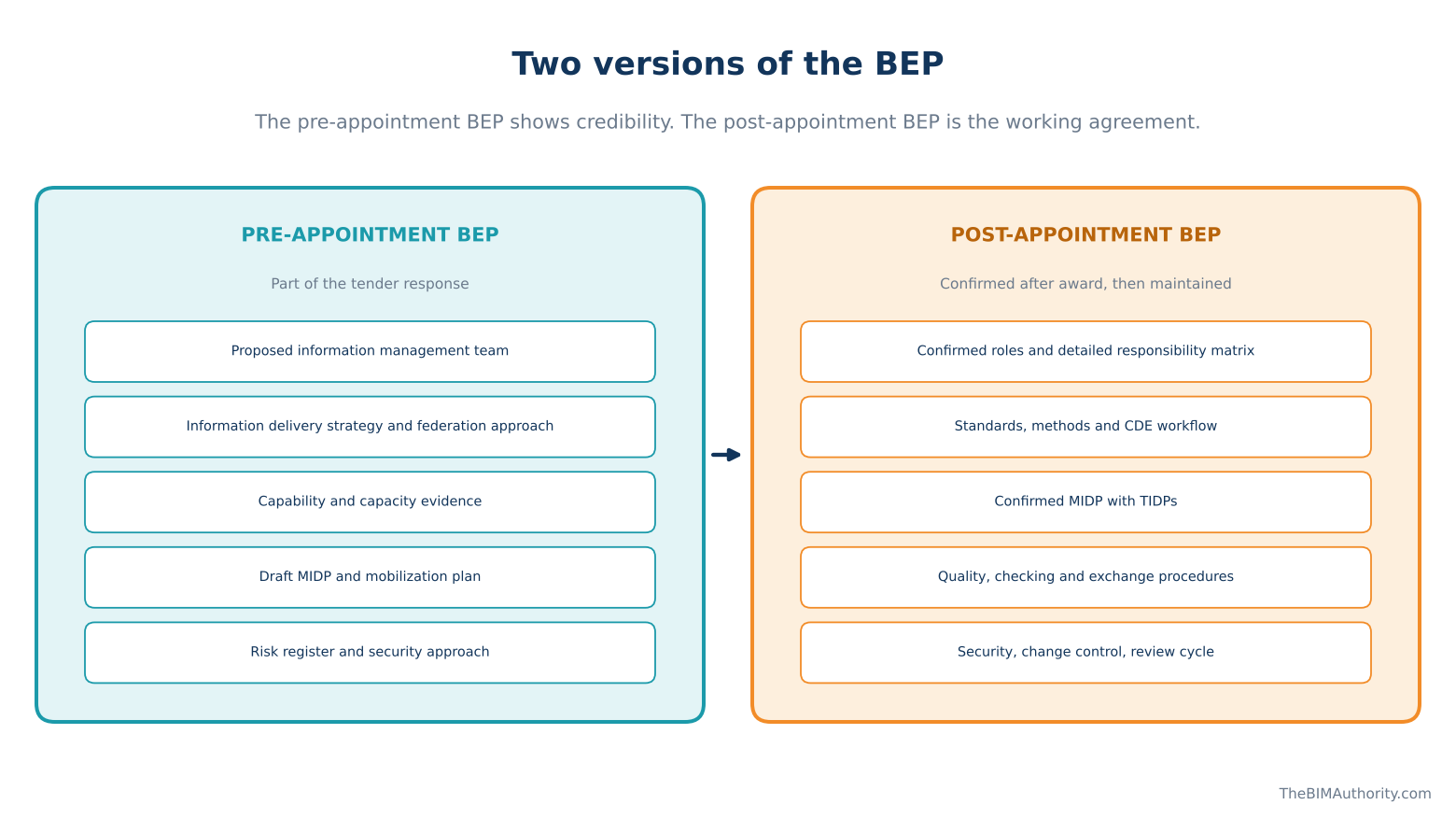
In ISO 19650-2, there are two versions:
| Version | When | Purpose | Judged mainly on |
|---|---|---|---|
| Pre-appointment BEP | Submitted with the tender response | Shows the appointing party that the prospective lead appointed party understands the requirements and can meet them | Credibility: capability, approach, people, risks |
| Post-appointment BEP | Confirmed after appointment, then maintained | The working agreement of the delivery team: confirmed roles, responsibilities, standards, plans and procedures | Completeness and usability |
The delivery team’s BEP is prepared by the lead appointed party, with the contributions of appointed parties and task teams. In earlier UK practice, these were called the pre-contract and post-contract BEP, and the concept was already present in PAS 1192-2. The ISO terminology is “pre-appointment” and “post-appointment”.
In one sentence:
The BEP is the delivery team’s written promise of how it will manage information, and the reference the team returns to when it is unsure what to do.
BEP, EIR, MIDP and the Rest: How They Fit
| Document | Role | Author |
|---|---|---|
| EIR | What the appointing party requires | Appointing party. See Exchange Information Requirements (EIR): Complete Guide |
| Pre-appointment BEP | How a bidder proposes to meet the EIR | Prospective lead appointed party |
| Post-appointment BEP | How the delivery team will meet the EIR | Lead appointed party with the delivery team |
| Responsibility matrix | Who is responsible for which information and tasks | Delivery team. See How to Create a BIM Responsibility Matrix |
| MIDP and TIDPs | When and by whom information is delivered | Lead appointed party and task teams. See Master Information Delivery Plan (MIDP): Complete Guide and Task Information Delivery Plan (TIDP): Complete Guide |
| Mobilization plan | How the team will be ready to produce information | Delivery team |
| Risk register | Risks to information delivery | Delivery team. See BIM Project Risk Management: Common Risks and Mitigation Strategies |
Treat the BEP as the spine of the set: it refers to the others, and they refer to it.
What Goes Into a BEP
Guidance published for the UK BIM Framework gives a useful picture of the typical content, and similar structures appear in other countries’ templates. The sections below follow that logic, in plain language.
1. Project Information and Purpose
Project name and description, parties, the relationship to the EIR and PIR, versions and the document’s owner. Keep it to a page.
2. Goals and BIM Uses
Why the team uses BIM on this project and for what: the goals (for example reduce clashes, control cost, support operation) and the BIM uses selected to meet them (coordination, quantity takeoff, 4D, asset data and so on). This is where many BEPs are weak, because they skip straight to standards. See How to Define BIM Goals, Uses, and Project Deliverables and BIM Uses Explained: What Is BIM Actually Used For?.
3. Management: Roles, Responsibilities and the Information Management Function
- The information management function: who carries each activity on the delivery side, with names, organizations and contact details. In the pre-appointment BEP, this can be limited to the key individuals; the post-appointment version contains the detailed responsibility matrix.
- Roles and authority: who decides what, and how disagreements are escalated.
- Competence: evidence of the skills of the people nominated.
See BIM Roles and Responsibilities: Manager, Coordinator, Modeler, and Information Manager and How to Create a BIM Responsibility Matrix.
4. Information Delivery Strategy
- Milestones and deliverables: how the team will meet the EIR’s milestones, linked to the MIDP.
- Federation and volume strategy: how the project is divided into models and containers and how they are combined; the purposes each federated model serves (coordination, review, quantities, and so on). See BIM Models vs. Federated Models: What Is the Difference?.
- Information requirements per milestone: how the level of information need will be met. See ISO 7817-1: Level of Information Need Explained.
5. Standards, Methods and Procedures
- Naming, identification, status and revision. See BIM File Naming Conventions and ISO 19650.
- Classification, file formats, schema versions and views. See IFC 2×3 vs. IFC4 vs. IFC4.3: Key Differences.
- Coordinates, units and levels.
- Modeling and drawing standards where they matter for exchange; reference to templates. See How to Build a BIM Project Template.
- Software and versions, and how updates are managed.
- Collaboration procedures: coordination meetings, clash detection, issue management. See BIM Coordination: The Complete Guide.
6. The CDE and Exchange
The CDE solution and workflow: platform, areas, states, gates, permissions, status codes and transmittals. See Common Data Environment (CDE): The Complete Guide.
7. Quality
How the team will ensure and check information model quality: self-checks, reviews, validation, acceptance, handling of non-conformities. See BIM Quality Management: Processes, Metrics, and Best Practices.
8. Security
The result of the sensitivity triage and the controls the team will apply. See BIM Information Security, Access Control, and Data Governance.
9. Mobilization
How the team will get ready: the mobilization plan, resources, IT infrastructure, tests and training. UK guidance updated in 2022 added a dedicated mobilization section, which reflects how often projects stumble here. See How to Set Up a Successful BIM Project from Day One.
10. Risks and Assumptions
A risk register for information delivery and the assumptions the plan depends on.
11. Appendices
The responsibility matrix, the MIDP and TIDPs, a mobilization checklist, code lists, IDS files and templates.
Pre-Appointment BEP: Writing for Credibility
The pre-appointment BEP is a sales document with a duty of honesty. Its reader is an evaluator comparing several bidders, often under time pressure.
What Evaluators Look For
- Understanding of the EIR and the project.
- A credible approach with specifics, not generic text.
- Named people with relevant experience.
- Capability and capacity evidence: similar projects, tools, training, supply chain.
- A realistic draft MIDP and mobilization plan.
- Honest risks with mitigation.
How to Write It
- Answer the EIR directly. Quote or reference each requirement and say how you will meet it. Do not paste your standard BEP.
- Be specific about this project: its milestones, its disciplines, its risks.
- Show, do not claim. A sample responsibility matrix, a draft MIDP extract and a diagram of the federation strategy persuade more than paragraphs of assurances.
- Show your supply chain approach: how you will cascade requirements and check capability.
- Keep it short. Many clients set page limits. Respect them.
- Be honest about gaps. A risk you have named and planned for is a strength; a gap discovered later is a liability.
See How to Respond to BIM Requirements in Tenders.
Post-Appointment BEP: Writing for Use
After award, the BEP’s audience changes. It is read by modelers, coordinators and task team leads who need to know what to do on Monday morning.
How to Write It
- Start from the pre-appointment BEP, updating it to reflect the confirmed appointments, the final team and any agreed changes.
- Complete the detailed responsibility matrix and the MIDP, with task teams’ TIDPs.
- Write procedures people can follow: short, numbered steps, with examples.
- Use tables and diagrams instead of long prose.
- Put detail in appendices so the main document stays readable.
- Create a one-page summary for the wall and the onboarding pack.
- Review it with the people who will use it, especially task team leads and the coordinator.
- Get it confirmed through the agreed route with the appointing party.
A Skeleton You Can Adapt
- Introduction: project, parties, purpose, document control.
- Goals and BIM uses.
- Roles and responsibilities: information management function; summary matrix; escalation.
- Information delivery strategy: milestones; federation and volume strategy; level of information need approach.
- Standards and methods: naming; classification; formats and versions; coordinates; modeling rules; software.
- Collaboration and coordination: meetings; clash process; issue management; reporting.
- CDE and exchange: workflow; states; permissions; transmittals.
- Quality: checks; acceptance; non-conformities.
- Security.
- Mobilization and training.
- Risks, assumptions and change control.
- Appendices: detailed responsibility matrix; MIDP and TIDPs; code lists; templates; checklists.
A ready-made structure with example text is covered in BIM Execution Plan (BEP) Template: Complete Guide and Example.
An Example Extract
Here is a short, illustrative extract from a post-appointment BEP, to show the style. It is fictional.
Section 5.2: Coordinates and levels
| Item | Agreement |
|---|---|
| Coordinate system | Project base point at grid intersection A/1, shared coordinates set by the architect and issued by the information manager as a reference model on week 1 |
| Levels | Level names and elevations as defined in the architectural reference model, version R03. No discipline may change them. Changes go through change control |
| Units | Millimeters for length; square meters for area |
| Verification | Each discipline checks alignment against the reference model before every share. The coordinator verifies on receipt |
| Responsible | Architect (definition); each task team (compliance); coordinator (verification) |
| Reference documents | EIR section 6.2; Coordinate Setup Guide v1.1 |
Notice what it does: what, who, how it is checked, where to look next. That pattern repeats through a good BEP.
Implementing the BEP: Making It Live
A BEP that is written well and never implemented is a waste. These practices make it real.
1. Launch It
Hold a kickoff session with all task teams. Walk through the one-page summary, the responsibility matrix and the first milestones. Make time for questions, and record the answers in the BEP.
2. Train
Give role-specific briefings: modelers on naming, templates and checks; coordinators on the issue process; task team leads on TIDPs and sharing gates; reviewers on acceptance. Keep sessions short and practical.
3. Mobilize and Test
Run the mobilization test: sample exports, CDE gates, a trial federation and an issue round trip. Fix what fails before production. See How to Set Up a Common Data Environment for BIM Projects.
4. Use It in Meetings
Make the BEP and MIDP the backbone of coordination meetings. If a procedure is not working, discuss the BEP, not just the problem.
5. Check Compliance
Audit a sample of containers against the BEP’s rules at each milestone. Report the results plainly and help teams improve. See BIM Quality Management: Processes, Metrics, and Best Practices.
6. Maintain It
A BEP is a living document. Update it when:
- the team or appointments change;
- requirements or milestones change;
- tools or versions change;
- a review or audit shows that a procedure does not work;
- lessons learned justify a change.
Version each update, record what changed and why, and tell everyone. Changes should pass through the information manager and, where needed, be agreed with the appointing party.
7. Close It
At close-out, review the BEP against reality: what worked, what did not. Feed the lessons into your office standards and templates.
Common Problems and Remedies
| Problem | Cause | Remedy |
|---|---|---|
| Nobody reads it | Too long; written for compliance | Cut it; one-page summary; plain language; examples |
| Teams ignore it | No launch, no checks | Kickoff, training, audits, feedback |
| It contradicts the EIR or contract | Written separately | Cross-check before issue; trace key requirements |
| It describes tools nobody uses | Copied from another project | Rewrite for this team and these tools |
| Responsibilities unclear | Matrix missing or vague | Complete a detailed matrix; one accountable party per row |
| Standards conflict between companies | No single agreed standard | Agree one project standard; test it in mobilization |
| Out of date | No change process | Version control; triggers for update; named owner |
| Pre-appointment BEP is generic | Time pressure | Answer the EIR directly; include project-specific evidence |
| No link to the programme | MIDP missing or separate | Align the MIDP with the project programme |
| Security omitted | Seen as IT | Include the triage result and controls |
Common Mistakes
- Writing the BEP after production has started.
- Copying a template without adapting it.
- No goals or uses, so standards float free of purpose.
- No named people.
- Standards without examples.
- Making it too long.
- No launch, training or mobilization test.
- Never updating it.
- No quality or acceptance procedure.
- Ignoring subcontractors in the plan.
- No link to the MIDP, responsibility matrix and risk register.
- Treating the pre-appointment BEP as a formality.
See also Common BIM Mistakes Beginners Should Avoid.
A Short Checklist
- Does the BEP respond directly to the EIR and PIR?
- Are goals and BIM uses stated?
- Are roles, authority and the information management function named?
- Is there a detailed responsibility matrix and a MIDP with TIDPs?
- Are federation strategy, standards and methods defined, with examples?
- Is the CDE workflow described?
- Are quality, acceptance and security covered?
- Is there a mobilization plan and a risk register?
- Is there a one-page summary and a launch plan?
- Is there version control and a change process?
- Has it been reviewed by the people who will use it?
Frequently Asked Questions
What is a BIM Execution Plan?
A document explaining how the delivery team will manage information on a project, in response to the client’s requirements, covering roles, goals, delivery, standards, procedures, quality and security.
What is the difference between a pre-appointment BEP and a post-appointment BEP?
The pre-appointment BEP is part of the tender response and shows capability and approach. The post-appointment BEP is the confirmed working plan after appointment.
Who writes the BEP?
The lead appointed party, with contributions from appointed parties and task teams.
How long should a BEP be?
As short as it can be while remaining useful. Many good post-appointment BEPs are 15 to 30 pages with appendices, with a one-page summary.
What is the difference between BEP and EIR?
The EIR state what the client requires. The BEP states how the delivery team will meet it.
Does the BEP include the MIDP?
The MIDP is normally an appendix or a closely linked document. See Master Information Delivery Plan (MIDP): Complete Guide.
How often should the BEP be updated?
Whenever the team, requirements, milestones or tools change, and after reviews. Version it each time.
Is a BEP required on every project?
ISO 19650 expects one in the delivery process. Small projects can use a short one. The thinking applies at any scale.
What is the Penn State BIM Project Execution Planning Guide?
An openly available guide from Penn State University’s research group, describing a procedure to develop a BEP (in version 3.0, five steps: goals, uses, process, information exchanges and infrastructure). It is a useful method alongside ISO 19650 terminology.
Final Thoughts
The fourteen-page BEP on the coordination room wall worked because it was owned. The team leads had helped write it, so they knew why each rule existed. When a modeler asked “what do I do about this?”, someone usually answered “it is in the BEP, section 6”. And when it turned out that a rule did not work, they changed it, with a version number, and told everyone.
That is the model. Write your BEP with the people who will use it. Make it answer the client’s requirements directly. Keep the main document short and the examples concrete. Launch it, test it, check against it and keep it alive. A BEP that is used is a management tool. A BEP that is filed is a risk with a cover page.
Where to go next: to write the schedule that supports it, read Master Information Delivery Plan (MIDP): Complete Guide. For the people side, continue with How to Create a BIM Responsibility Matrix, and for the starting point of the BEP’s content, How to Define BIM Goals, Uses, and Project Deliverables.



