



There is an exercise I run at the start of every BIM project, and it always makes people slightly uncomfortable. I call it the pre-mortem. I ask the team to imagine it is eighteen months in the future and that the project’s information management has failed badly. Then I ask them to write down, on sticky notes, why. Within ten minutes, the wall is covered. “The client changed the brief three times and we kept modeling the old one.” “The mechanical subcontractor turned out not to be able to produce IFC.” “We lost the structural modeler in month four and nobody else knew the setup.” “The platform went down the week before the milestone.” “The model got so heavy that nobody could open it.”
What strikes me every time is that nobody has trouble listing the risks. They know them. They have lived through them. The failure is that, in most projects, those risks stay in people’s heads, unrecorded, unowned and unmanaged until one of them happens. A risk that is written down, assessed and given an owner is a manageable item. A risk that is only a feeling in someone’s stomach becomes a crisis.
BIM project risk management is the discipline of moving risks from stomachs to registers. It is not complicated, and it needs no special software. This guide explains how to do it: what a risk is in an information management context, how ISO 19650 expects risk to be handled, which risks recur most often, how to assess and treat them, how to build a useful risk register and how to keep it alive. It includes a worked register with a dozen typical risks and mitigations. For the planning context, see BIM Project Planning: Milestones, Deliverables, and Coordination.
The Short Answer
A risk is the effect of uncertainty on objectives: something that might happen and, if it did, would affect what you are trying to achieve. BIM project risk management identifies, assesses, treats, monitors and communicates the risks to the delivery of information and to the benefits expected from BIM.
The general process follows the widely used structure of risk management standards such as ISO 31000, which describes a cycle of establishing scope, context and criteria; assessing risk (identification, analysis, evaluation); treating risk; monitoring and review; communication and consultation; and recording and reporting.
In one sentence:
Write down what could go wrong, decide how much it matters, assign someone to deal with it and keep looking.
How ISO 19650 Treats Risk
ISO 19650-2 makes risk part of the delivery process.
- During the tender response, the prospective lead appointed party prepares a risk register for the delivery team, alongside the pre-appointment BEP, the draft MIDP and the mobilization plan. The register captures the risks to information management that the team has identified.
- After appointment, the register is maintained as the project proceeds, and the lead appointed party’s information management function reports on it.
- The appointing party also considers risks in its assessment and need activity, including the security triage and risks relating to information. See ISO 19650-5: Security-Minded BIM Information Management.
The standard does not prescribe a method. It expects the parties to apply a recognized approach proportionate to the project. See ISO 19650-2: BIM Information Management During Project Delivery.
What Kinds of Risk Does a BIM Project Face?
I group them into eight families. Use them as a prompt list in workshops.
| Family | Examples |
|---|---|
| 1. Requirements and scope | Unclear or changing EIR; requirements that cannot be verified; scope creep; mismatch between brief, PIR and EIR |
| 2. People and capability | Supplier cannot deliver what is required; skills shortage; key person leaves; resistance to new methods; insufficient client review capacity |
| 3. Process and planning | Unrealistic MIDP; missed dependencies; late reference information or client decisions; no freeze dates; coordination breakdown |
| 4. Technology and infrastructure | Software version mismatches; poor interoperability; model size and performance; CDE outage; hardware limits |
| 5. Information and data quality | Missing or wrong properties; poor classification; unstable identifiers; unreliable survey data; handover data incomplete |
| 6. Commercial and contractual | BIM obligations unclear in contracts; liability for models and data unclear; intellectual property; fee does not match scope |
| 7. Security and governance | Unauthorized access; leaks of sensitive information; non-compliant data handling; leaver access not removed. See BIM Information Security, Access Control, and Data Governance |
| 8. External and organizational | Regulatory change; client reorganization; supply chain disruption; changes in standards or mandates |
A single event can touch several families. A late client decision (family 3) may create scope changes (1) and cost disputes (6).
Step 1: Establish Scope, Context and Criteria
Before listing risks, agree the frame.
- Scope: which objectives are at risk? Typically the information deliverables, milestones, quality, cost and the benefits expected from BIM. See How to Define BIM Goals, Uses, and Project Deliverables.
- Context: the project’s size, complexity, parties, timeline, technology and client requirements.
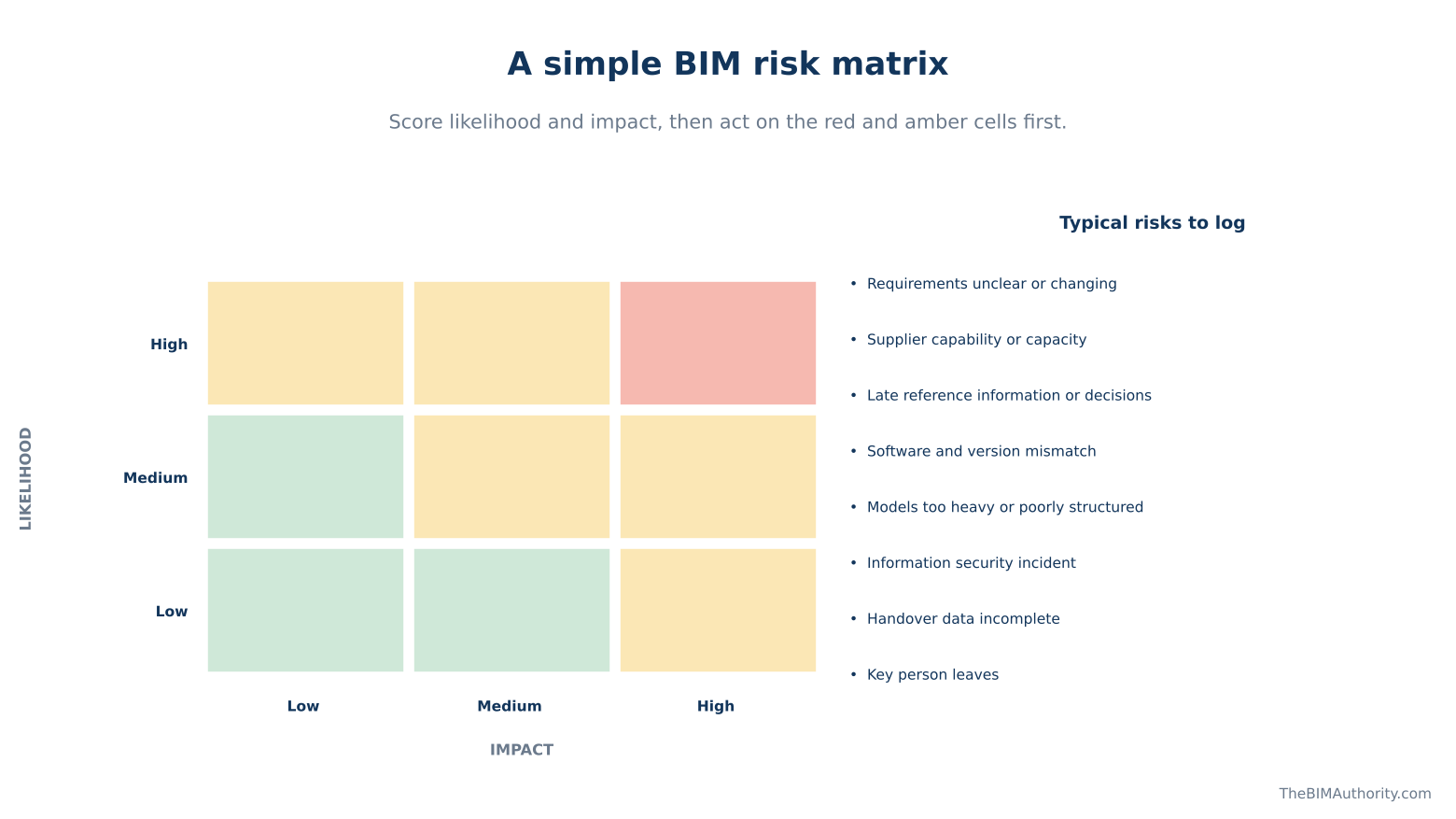
- Criteria: how will you rate likelihood and impact? Define scales that suit the project.
A Simple Scale
| Level | Likelihood (example) | Impact on information delivery (example) |
|---|---|---|
| Low | Unlikely during the project | Minor rework; no effect on milestones |
| Medium | Possible; has happened on similar projects | Noticeable rework; milestone at risk; some cost |
| High | Likely or already occurring | Milestone missed; significant cost; contractual consequences; safety or security impact |
Three levels are enough for most projects. Larger projects may use five levels with numeric scoring. Define the scales in the BEP so that everyone rates consistently.
Step 2: Identify Risks
Methods That Work
| Method | How |
|---|---|
| Pre-mortem workshop | Imagine failure and ask why; capture every cause on sticky notes |
| Prompt-list workshop | Walk the eight families above; ask “what could go wrong here?” |
| Lessons-learned review | Read lessons from previous projects |
| Document review | Read the EIR, contract, programme and BEP looking for gaps and conflicts |
| Interviews | Ask task team leads, the client, the facility manager |
| Process walk-through | Follow a deliverable from request to acceptance, noting weak points |
| Capability assessment | Review suppliers’ capability and capacity evidence |
Write Risks Well
A risk statement should say cause, event and consequence.
| Weak | Better |
|---|---|
| “Supplier problems.” | “Because the MEP subcontractor has no experience producing IFC with the required property sets, it may deliver incomplete data at the design milestone, causing rework and a late asset register.” |
| “Software.” | “Because disciplines use different versions of the coordination software, models may open incorrectly, causing misleading clash results.” |
| “Client.” | “Because the client has not fixed the room layouts, late changes may invalidate coordinated models, causing rework and missed milestones.” |
Step 3: Analyze and Evaluate
For each risk, estimate:
- Likelihood: how probable is it?
- Impact: how bad if it happens?
- Proximity: when might it occur?
- Controllability: how much can you influence it?
- Owner: who can best manage it?
Plot on the matrix and rank. Act first on high-likelihood, high-impact items, and consider proximity: a medium risk that could occur next week may need earlier action than a high risk six months away.
Be honest about uncertainty. Estimates are judgments. Their value lies in comparing risks and focusing effort, not in precision.
Step 4: Treat the Risks
For each prioritized risk, choose a response. Common options:
| Response | Meaning | Example |
|---|---|---|
| Avoid | Change the plan to remove the risk | Do not rely on a tool the supplier cannot support; choose another exchange format |
| Reduce likelihood | Make it less likely to happen | Pilot the exchange early; train; provide templates |
| Reduce impact | Make the consequence smaller | Keep backups; plan contingency time; use stage gates |
| Transfer or share | Move or share the risk with another party | Contractual allocation; insurance where appropriate; shared responsibility in the matrix |
| Accept | Decide to live with it, knowingly | Low-impact risks; document the decision |
| Exploit | Where a risk is an opportunity, increase its chance | Early engagement with a supplier who offers added capability |
For each response, define actions, owners, deadlines and cost. A mitigation with no owner is a wish.
Residual Risk
After treatment, some risk remains. Record the residual rating, and decide whether it is acceptable. If not, treat further or escalate.
Step 5: Build and Keep the Risk Register
The register is a simple table, but a living one.
| Field | Content |
|---|---|
| ID | Unique reference |
| Risk statement | Cause, event, consequence |
| Family / category | For grouping |
| Likelihood, impact, rating | Current assessment |
| Proximity | When it could occur |
| Owner | Person accountable for managing it |
| Response and actions | What will be done, by whom, by when |
| Residual rating | After actions |
| Status | Open, mitigated, closed, occurred |
| Early warning indicator | What would tell you it is materializing |
| Date and history | Dates of review and changes |
A Worked Example
Here is an extract from a fictional BIM risk register. The ratings are illustrative.
| # | Risk (cause, event, consequence) | Rating | Response | Owner | Early warning |
|---|---|---|---|---|---|
| 1 | Because EIR requirements are written in prose, the team may interpret them differently, causing disputes at acceptance | High | Translate key requirements into verifiable checks (IDS); review the EIR with the client in week 2 | BIM manager | Questions about requirements in meetings |
| 2 | Because the MEP subcontractor has limited IFC experience, asset data may be incomplete at the design milestone, causing rework | High | Capability assessment; provide property templates and a sample deliverable; trial export in week 3 | MEP task team lead; BIM coordinator | Failed trial export |
| 3 | Because client decisions on layouts are expected late, coordinated models may become obsolete, causing rework | High | Put decisions in the MIDP; set freeze dates; record impact of slippage | Project manager | Decision date slipping |
| 4 | Because disciplines use different software versions, models may open incorrectly, causing false clash results | Medium | Fix versions in the BEP; test in mobilization; control updates | BIM manager | Inconsistent results between users |
| 5 | Because models are large, performance may degrade, delaying coordination | Medium | Federation and volume strategy; modeling detail rules; hardware check | BIM coordinator | File open times increasing |
| 6 | Because the structural modeler is the only person who knows the setup, a departure may delay delivery | Medium | Document the setup; train a deputy; pair work | Structural task team lead | Key person leave notice |
| 7 | Because export settings are not controlled, identifiers may change, breaking issue links | Medium | Save and control export settings; test identifier stability | Information manager | Issues losing element links |
| 8 | Because there is no leaver procedure, former staff may retain access to sensitive information | High | Implement joiner, mover, leaver procedure; quarterly access reviews | Information manager | Stale accounts in CDE |
| 9 | Because the survey is incomplete, models may be based on unreliable reference information | Medium | Request a verified survey; label reference information with reliability; plan verification | Project manager | Discrepancies on site |
| 10 | Because the CDE may be unavailable, delivery on a milestone date could be missed | Low | Check service levels; backup access route; avoid last-day uploads | Information manager | Outages or slow performance |
| 11 | Because BIM liability is unclear in appointments, disputes may arise over model errors | Medium | Align BEP and appointments; obtain legal advice; clarify the role of the models | Project manager; legal adviser | Disagreement over responsibilities |
| 12 | Because handover data is planned late, the asset register may not be ready at completion | High | Plan asset data milestones from design; draft checks at technical design | MEP lead; contractor; client’s FM | Asset data not in plan |
This is a typical twelve-line register for a medium project. A register of twelve well-managed risks beats one of ninety forgotten ones.
Step 6: Monitor, Review and Communicate
Review Rhythm
- Weekly or fortnightly in coordination or project meetings: top risks, new risks, changes.
- At each milestone: full review; close mitigated risks; add new ones.
- After events: when a risk occurs or a change happens.
Early Warning Indicators
For each important risk, define an indicator that tells you early. Examples:
| Risk | Indicator |
|---|---|
| Supplier capability | Failed trial exports; late TIDP |
| Late decisions | Decision log slipping; unresolved questions |
| Quality | Falling first-time pass rate |
| Security | Stale accounts; unusual downloads |
| Performance | Increasing model open time |
Communication
Report to the project manager and client in plain language: top five risks, what changed, what help is needed. Escalate risks that exceed the team’s authority.
Record Lessons
When a risk occurs, record what happened and what worked, and add it to the organization’s lessons. See How to Measure BIM Performance, ROI, and Project Success.
Risk in the Tender and Appointment
| Moment | Risk activity |
|---|---|
| Assessment and need (client) | Identify risks in requirements, the supply chain market and security; set evaluation criteria for risk management |
| Tender response (bidder) | Prepare the delivery team’s risk register with the pre-appointment BEP; show how risks will be managed. See How to Respond to BIM Requirements in Tenders |
| Appointment | Confirm the register; align contractual allocation of responsibility with legal advice. See BIM Contracts and Legal Considerations |
| Mobilization | Test the highest risks (exports, CDE, capability) before production |
| Production and delivery | Monitor and review regularly |
| Close-out | Capture lessons |
From the client’s side, ask bidders for their risk registers and judge quality of thinking, not the length of the list.
Treating Typical Risks: Practical Measures
A short catalog of measures that work across many risks.
| Measure | Risks it addresses |
|---|---|
| Pilot exchange in mobilization | Interoperability, supplier capability, software mismatch, export problems |
| Capability assessment and support | Supplier capability, skills gaps |
| Verifiable requirements (IDS and checks) | Disputes, acceptance problems, data quality |
| MIDP with dependencies and freezes | Late information, rework, coordination failures |
| Templates and controlled content | Quality, inconsistency, training load |
| Deputies and documentation | Key person dependency |
| Federation and volume strategy | Model size, performance |
| Joiner, mover, leaver and access reviews | Security, leaks |
| Early asset data planning | Handover failures |
| Change control | Scope creep, rework |
| Contractual clarity with legal advice | Liability and responsibility disputes |
Common Mistakes
- No risk register.
- A register written at tender and never updated.
- Risks too vague to act on.
- No owners.
- Mitigations without actions or deadlines.
- Too many risks, so nothing is managed.
- Ignoring low-probability, high-impact risks such as security incidents.
- No early warning indicators.
- Treating risk as negative only, missing opportunities.
- Not testing high risks in mobilization.
- Not communicating to the client and project manager.
- Not capturing lessons.
See also Common BIM Mistakes Beginners Should Avoid.
A Short Checklist
- Have we agreed scales and criteria for rating risk?
- Have we run a pre-mortem or similar workshop with the team?
- Are risks written as cause, event, consequence?
- Is there a register with owners, responses, residual ratings and indicators?
- Are the top risks actively managed, with actions and dates?
- Are high risks tested in mobilization?
- Is the register reviewed at a defined rhythm?
- Is it communicated to the project manager and client?
- Are contract and legal risks reviewed with legal advice?
- Are lessons captured at close-out?
Frequently Asked Questions
What is risk management in BIM?
Identifying, assessing, treating and monitoring the risks to information delivery and to the benefits expected from BIM, using a register and a regular review.
What are the most common BIM project risks?
Unclear or changing requirements, supplier capability gaps, late decisions and reference information, software and interoperability problems, poor data quality, model size, unclear contract responsibility, security failures and late handover planning.
Does ISO 19650 require a risk register?
ISO 19650-2 includes a risk register for the delivery team in the tender response and expects it to be maintained as the project proceeds.
How many risks should a register have?
Enough to cover the important ones, usually ten to thirty. A short, active register is better than a long, ignored one.
Who owns BIM risks?
Each risk has a named owner who can act on it. The BIM manager or information management function maintains the register.
How do I assess BIM risks?
Rate likelihood and impact on a simple scale, consider proximity, rank them and act first on the highest.
What is a pre-mortem?
A workshop exercise in which the team imagines that the project has failed and lists the reasons, to surface risks early.
How do contracts affect BIM risk?
They allocate responsibilities and liabilities. Align the BEP and appointments, and take legal advice on contractual terms.
How do I manage supplier capability risk?
Assess capability at tender, provide templates and training, test a sample exchange early and monitor deliveries.
Final Thoughts
When I run the pre-mortem now, the wall of sticky notes still fills up in ten minutes. But something has changed in how teams respond. They no longer see the exercise as pessimism. They see it as relief. A designer once told me: “I have been worrying about three of these for months and nobody ever asked.” Writing the risks down turned private anxieties into shared problems with owners, and a shared problem is half-solved.
That is what good risk management feels like. It is not a spreadsheet, though a spreadsheet helps. It is a habit of saying out loud what might go wrong, deciding what to do and checking back. Start with a pre-mortem and a twelve-line register. Review it every week. The risks will not disappear, but they will stop being surprises.
Where to go next: to plan around the risks, read BIM Project Planning: Milestones, Deliverables, and Coordination. For controls that reduce them, continue with BIM Quality Management: Processes, Metrics, and Best Practices, and for the measure of results, How to Measure BIM Performance, ROI, and Project Success.



