
Every project has a programme. It shows the design stages, the tender, the construction start, the completion date. Very few projects have a programme for the information. That absence explains an astonishing proportion of the delays I have investigated. The works programme assumes that the structural model will exist when the steel detailers need it, that the services coordination will be complete when the ceilings are fixed and that the asset data will be ready at handover. Nobody has planned when those things will actually be produced, by whom and in what order. Information is treated like air: assumed to be there.
I learned to plan information the hard way, on a project where a six-week coordination period was scheduled before a fabrication release. The coordination started on time. But two disciplines were waiting for a design decision from the client that arrived in week four, a third was waiting for an architectural update that depended on that decision and the structural model that everyone needed was frozen on a version that predated the decision. We spent weeks coordinating models that were about to be obsolete.
BIM project planning solves this by putting information on the programme: what is delivered, when, in what order, with what dependencies and with what time for checking and coordination. This guide explains how to plan a BIM project around milestones, deliverables and coordination cycles. It covers how to define information milestones, build the delivery plan, design the coordination rhythm, manage freeze dates and change, plan resources and track progress. For the consolidated plan, see Master Information Delivery Plan (MIDP): Complete Guide.
The Short Answer
BIM project planning organizes the work of producing information in time.
| Element | Question | Documents |
|---|---|---|
| Milestones | When is information formally delivered, reviewed and accepted? | EIR, MIDP |
| Deliverables | What exactly is delivered at each milestone, by whom, in what form? | MIDP, TIDPs |
| Dependencies | What must happen before each deliverable can be completed? | TIDPs, MIDP |
| Coordination cycles | How and when are the pieces integrated and checked? | BEP, coordination procedure |
| Resources | Who has the time and skill to do it? | TIDPs, resource plans |
| Control | How do we track progress and manage change? | Reports, change control |
In one sentence:
BIM planning is the programme of the information: milestones that matter, deliverables that serve them, dependencies made visible and a coordination rhythm the team can sustain.
Step 1: Start From the Decisions and Milestones
Information is produced to support decisions and work. Start from those.
Information Delivery Milestones
ISO 19650 uses information delivery milestones: points in the project at which information is formally delivered, checked and accepted. They are normally set by the appointing party in the EIR, linked to project stages and the PIR decision points. See Project Information Requirements (PIR): Complete Guide.
Stage frameworks differ between countries and procurement routes, so use the stages of your project, not a universal list. A typical set of milestones might include:
| Milestone (illustrative) | Typical purpose |
|---|---|
| Concept approved | Confirm the chosen option and brief |
| Developed design | Coordinated disciplines; early quantities and performance |
| Technical design complete | Information ready for tender and permits |
| Tender / award | Comparable bids; contractor appointment |
| Fabrication release | Information ready for manufacture |
| Practical completion | As-built information; commissioning data |
| Handover | Asset information model and documents delivered |
Questions to Ask About Each Milestone
- What decision or work depends on the information?
- Who is the recipient and what do they need to see?
- What level of information need applies? See ISO 7817-1: Level of Information Need Explained.
- How long does the recipient need to review?
- What happens if the information is late or rejected?
Step 2: Plan the Deliverables
Build From the Bottom: TIDPs
Ask each task team to plan its own deliverables in a TIDP: containers, dates, dependencies, checks. Consolidate them into the MIDP. See Task Information Delivery Plan (TIDP): Complete Guide and Master Information Delivery Plan (MIDP): Complete Guide.
Include Everything
Plan models, documents and data: drawings, schedules, specifications, calculations, reports, asset registers, certificates. Many plans list only models and then discover, a week before the milestone, that fifteen documents are missing.
Group Sensibly
Plan by container groups (for example “structural models by level”) rather than every file, unless the project needs more detail. Align groups with the federation and volume strategy. See BIM Models vs. Federated Models: What Is the Difference?.
Step 3: Map the Dependencies: The Critical Path of Information
Dependencies decide whether a plan works. In BIM projects, information flows in predictable sequences.
A Typical Sequence on a Building Project
- Survey and reference information: site, existing conditions, coordinates, levels.
- Brief and design decisions: client approvals, key parameters.
- Architectural layout and levels: the reference that everyone else uses.
- Structural concept and primary frame, informed by the layout.
- Services strategy and plant spaces, informed by layout and structure.
- Detailed coordination: distribution, ceilings, openings, supports.
- Specialist and fabrication information.
- Quantities, cost and analysis, which depend on the models.
- Asset data, which depends on selected equipment.
Make the Dependencies Explicit
For every deliverable, record inputs (what you need, from whom, by when) and outputs (who needs this, for what). Check that every output has a matching input in another team’s plan, with compatible dates. This is what a consolidated MIDP review is for.
Identify the Early Reference Information
A few deliverables unlock most others: levels and grids, coordinates, room data and layouts, client decisions, survey data. Plan them first and freeze them. Delays here cascade through everything.
Step 4: Design the Coordination Cycle
Coordination is a rhythm, not an event. A good cycle is regular, predictable and short enough to keep problems small.
The Anatomy of a Cycle
| Step | What happens | Typical owner |
|---|---|---|
| 1. Freeze and share | Each team shares its checked models by the cut-off date | Task teams |
| 2. Federate | The coordinator combines models and verifies alignment | Coordinator |
| 3. Check | Clash detection, rule-based and information checks run | Coordinator |
| 4. Report | Issues are grouped, assigned and sent (typically as BCF topics) | Coordinator |
| 5. Meet | Short coordination meeting to resolve and decide | Coordinator, task team leads |
| 6. Resolve | Teams fix their source models | Task teams |
| 7. Verify | Coordinator checks fixes in the next cycle | Coordinator |
See BIM Coordination: The Complete Guide, BIM Clash Detection: The Complete Guide and BIM Collaboration Format (BCF): The Complete Guide.
Choosing the Frequency
| Project phase | Typical rhythm | Reason |
|---|---|---|
| Early design | Every two to four weeks | Models change quickly; fewer detailed clashes |
| Developed and technical design | Weekly or fortnightly | Intensive coordination; many interfaces |
| Pre-construction and construction | Weekly, sometimes more often for critical areas | Short windows; fabrication dependencies |
| Handover | At defined checkpoints | Data verification |
The right frequency balances problem size and team workload. Too rare, and issues pile up. Too frequent, and teams spend all their time coordinating.
Plan the Meetings
- Set a fixed day and time and publish the calendar for the whole project.
- Keep an agenda based on the MIDP and the issue list.
- Send the issue report in advance.
- Record decisions and actions with owners and dates.
- See BIM Coordination Meetings: Planning, Reporting, and Best Practices.
Plan Zones and Priorities
On large projects, divide coordination by zone, level or system, and prioritize areas with the tightest constraints (plant rooms, risers, ceiling voids, congested corridors). Do not try to coordinate everything at once.
Step 5: Manage Freeze Dates and Change
Freeze Dates
A freeze is a date after which a defined set of information may not change without formal approval. Freezes protect downstream work.
| Freeze (examples) | Protects |
|---|---|
| Levels, grids and coordinates | All models |
| Architectural layout | Structural and services design |
| Structural frame | Services coordination, openings |
| Plant and riser locations | Distribution design |
| Design freeze before fabrication | Fabrication models |
Publish freezes in the MIDP and the coordination calendar.
Change Control
Changes will happen. Control them:
- Raise a change request stating what, why and impact.
- Assess impact on other disciplines, deliverables and dates.
- Approve or reject through the agreed authority.
- Communicate to all affected parties.
- Update the models, the MIDP and the BEP as needed.
- Record the change.
A late client decision is the most common cause of replanning. Record the decision date, the affected deliverables and any consequences, so the project can see what the delay cost.
Step 6: Plan Resources and Capacity
A plan that ignores capacity is fiction.
| Check | Question |
|---|---|
| Team size and skills | Can the team produce the planned volume with the right skills? |
| Peaks | Where do milestones, holidays or other projects overload people? |
| Review time | Does the plan allow for checking and approval? |
| Client capacity | Can the client review and decide in the planned time? |
| Supply chain | Are specialists and subcontractors engaged in time? |
| Tools and infrastructure | Is the CDE, hardware and software ready and licensed? |
Ask each task team to state its capacity assumptions in its TIDP, and review them when consolidating. Add contingency where risk is high. See BIM Project Risk Management: Common Risks and Mitigation Strategies.
Step 7: Align With the Project Programme
The information plan must fit the works and design programme.
- Information must be ready before it is needed: tender documents before tender, fabrication information before orders, asset data before handover.
- Review and approval time must be in the programme, not squeezed after.
- Coordination periods must precede decisions and releases, with margin.
- Dependencies on external parties (authorities, clients, utilities) must be visible.
Hold a joint session between the project manager and the BIM manager to reconcile the two. Many projects have two plans that quietly disagree.
Step 8: Track Progress and Report
What to Track
| Item | Indicator |
|---|---|
| Deliverables | Planned versus actual dates; status in the CDE |
| Quality | First-time pass rate; open non-conformities |
| Coordination | Issues raised, closed and overdue; age of open issues |
| Dependencies | Inputs received late and consequences |
| Resources | Utilization and capacity warnings |
| Risks | Status of the risk register |
How to Report
- A one-page dashboard for the project manager and client: milestone status, traffic lights, top risks.
- A detailed view for the coordination meeting.
- Trends, not only snapshots: is the open issue count falling?
Act on What You See
Reports are only useful if they trigger decisions. When a deliverable is at risk, escalate early, replan if necessary and tell the people who depend on it. See How to Measure BIM Performance, ROI, and Project Success.
Planning for Handover From the Start
Handover is not the last milestone. It is a thread that runs through the project.
- Include asset data milestones in the plan from early design, with draft deliveries at technical design and verified delivery at completion. See Asset Information Requirements (AIR): Complete Guide.
- Plan commissioning and testing data collection during construction.
- Plan verification of asset data on site.
- Plan the transfer to the asset information model and the owner’s systems.
- Plan training for the operators.
See BIM Model Handover Checklist and Requirements.
Scaling the Plan
| Project size | Approach |
|---|---|
| Small | A one-page timeline: milestones, main deliverables, three freeze dates and a coordination calendar |
| Medium | MIDP in a spreadsheet; coordination every one to two weeks; dashboard each cycle |
| Large | Detailed MIDP linked to the master programme; zoned coordination; dedicated planner; automated reporting from the CDE |
Never skip planning. Size it to the project.
Common Problems and Remedies
| Problem | Cause | Remedy |
|---|---|---|
| Coordination on obsolete models | No freeze dates | Define freezes; align coordination with decisions |
| Milestones missed repeatedly | Plans ignore dependencies and review time | Rebuild the MIDP with dependencies and review slots |
| Meetings full of the same issues | No owners or deadlines | Assign owners and dates; track closure |
| Late client decisions | Decisions not planned | Put client decisions in the plan; flag early; record impact |
| Team overload at milestones | Peaks not planned | Smooth workload; add resources; shift internal deadlines |
| Two conflicting programmes | Works and information plans separate | Reconcile with the project manager |
| Documents forgotten | Plan lists only models | Add documents and data to deliverable lists |
| Handover rushed | Not planned | Plan asset data from early design |
Common Mistakes
- No information plan, only a works programme.
- Milestones disconnected from decisions.
- No dependencies in the plan.
- No review and approval time.
- Coordination without freezes.
- Too few or too many coordination cycles.
- Ignoring the client’s capacity to review.
- Planning models only.
- Leaving handover to the end.
- Not tracking actual progress.
- Not replanning when change occurs.
- Not connecting the plan to the responsibility matrix and BEP.
See also Common BIM Mistakes Beginners Should Avoid.
A Short Checklist
- Are information milestones defined and tied to decisions?
- Is there a deliverables plan (MIDP and TIDPs) covering models, documents and data?
- Are dependencies and the early reference information identified?
- Is the coordination cycle designed, with calendar and agenda?
- Are freeze dates and change control defined?
- Have we planned resources, capacity and review time?
- Is the plan aligned with the project programme?
- Are progress, quality and risks tracked and reported?
- Is handover planned from early design?
- Is the plan reviewed and updated regularly?
Frequently Asked Questions
What is BIM project planning?
Planning the production of information over time: milestones, deliverables, dependencies, coordination cycles, resources and control.
What are information delivery milestones?
Points in the project when information is formally delivered, checked and accepted, linked to decisions and stages, usually set in the EIR.
How often should BIM coordination meetings happen?
Typically every one to two weeks during intensive design and pre-construction, less often early in design. Choose the rhythm that keeps issues small without overloading the team.
What is a design freeze?
A date after which defined information may not change without formal approval, protecting downstream work.
How does BIM planning relate to the MIDP?
The MIDP is the main planning document for information deliverables. BIM planning also includes coordination cycles, freezes, resources and tracking.
Who is responsible for BIM planning?
The lead appointed party’s BIM manager or information management function, with task teams and the project manager.
How do I plan for late decisions?
Put client decisions in the plan with dates, flag risks early, record impact when they slip and use freezes to protect downstream work.
Should handover be in the plan from the beginning?
Yes. Asset data needs milestones from early design.
Final Thoughts
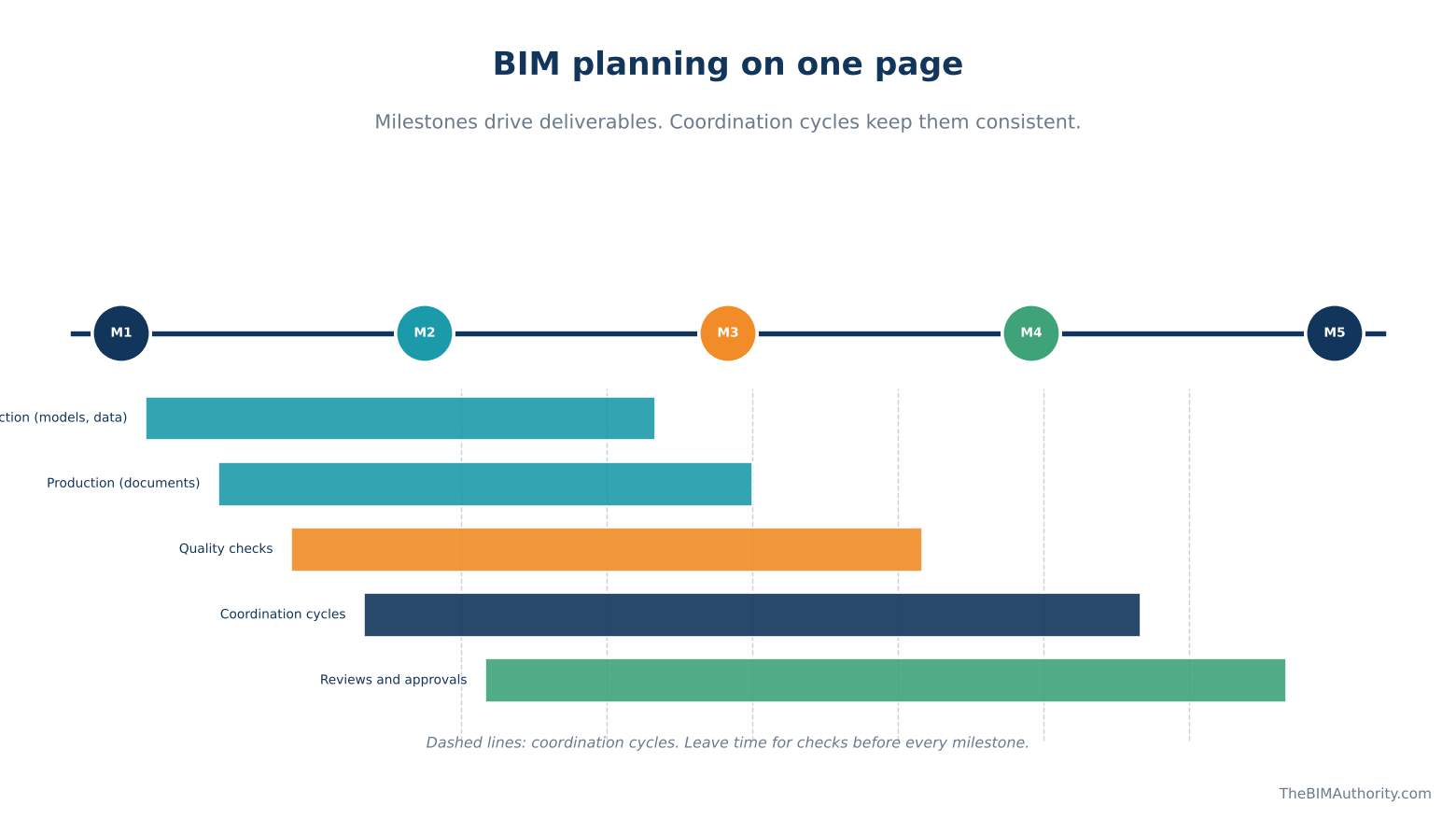
After the six-week coordination fiasco, I adopted a habit that I still follow. Before any project begins production, I draw one picture: milestones across the top, deliverables as bars, dependencies as arrows, coordination cycles as dashed lines and the client’s decisions as diamonds. It takes an hour. I put it on the wall. And in nearly every project, someone points at an arrow and says: “this will not work”, and they are usually right.
That is the purpose of planning information: to find the problems on paper, while they are cheap. Put the information on the programme, make dependencies visible, protect the work with freezes and keep a steady coordination rhythm. The project will not become perfect, but it will become predictable, and that is what everyone is really asking for.
Where to go next: to see the consolidated plan, read Master Information Delivery Plan (MIDP): Complete Guide. For the coordination side, continue with BIM Coordination: The Complete Guide and BIM Coordination Meetings: Planning, Reporting, and Best Practices, and for the controls around it, BIM Quality Management: Processes, Metrics, and Best Practices.