



Ask a project team a simple question: “When will the structural model for level 3 be ready for coordination?” On a project without an information delivery schedule, the answers will be a polite chorus of “soon,” “next week, probably,” “depends on the architect” and, from the one person who has actually looked at their own workload, “Thursday, if nobody changes anything.” On a project with a schedule, the answer is a date, a name and a status, visible to everyone, tied to a milestone and checked against the dependencies that feed it. The difference is not optimism. It is planning made visible.
ISO 19650-2 calls the planning documents for information delivery the master information delivery plan (MIDP) and the task information delivery plans (TIDPs). Each task team prepares a TIDP listing the information containers it will deliver, when, in what form and who is responsible. The lead appointed party consolidates them into the MIDP, which shows the whole project’s information deliverables, their dates and their dependencies, aligned with the project’s stages and the appointing party’s information exchanges. In practice, the MIDP and TIDPs are usually spreadsheets or CDE-linked registers, and what makes them valuable is not their format but that they are specific, owned, dated and kept up to date.
This guide provides a practical information delivery schedule template: field definitions, the MIDP and TIDP layouts, a worked fictional example for the invented Harbor View Clinic with arithmetic, guidance on setting dates and dependencies, how to track and report progress, how to link the schedule to the BEP, the CDE and checks, and the mistakes to avoid. It supports BIM Execution Plan (BEP) Template: Complete Guide and Example and Exchange Information Requirements (EIR) Template and Example. Adapt the template to your appointment, your EIR and your standard. It is a planning tool, not a contractual instrument unless your documents make it one.
Free Download
Download: BIM information delivery schedule template (ZIP with Excel file)
The download is a ZIP archive containing an Excel workbook with MIDP and TIDP registers, status drop-downs, days-late formulas and a milestone summary with on-time and acceptance rates. It is free to use and adapt for your own projects. Adapt it to your contract, client requirements and standards; it supports professional judgment and is not legal advice.
The Short Answer
| Element | Purpose |
|---|---|
| MIDP | The consolidated list of all information deliverables, with dates and owners |
| TIDP | Each task team’s list of its own deliverables and dates |
| Milestones | Stage gates and information exchanges that drive the dates |
| Dependencies | Which deliverables need which others first |
| Tracking | Status and progress against dates |
In one sentence:
An information delivery schedule lists every information container the project will produce, with owner, date, form and dependencies, so that delivery can be planned, tracked and checked.
How to Build the Schedule
| Step | Action |
|---|---|
| 1. Start from the EIR and BEP | Required deliverables, exchange points, formats and levels of information need |
| 2. Fix the milestones | Stage gates, client exchanges, approvals, tender and construction dates |
| 3. Ask each task team to draft its TIDP | Containers, forms, dates, dependencies, checks |
| 4. Consolidate into the MIDP | One register; remove duplicates; align dates |
| 5. Map dependencies | Who needs what, and when; find critical paths |
| 6. Set exchange cycles and cut-offs | Rhythm of model sharing and coordination |
| 7. Assign owners and reviewers | Responsible for production and for checks |
| 8. Add acceptance criteria | What “ready” means for each deliverable |
| 9. Issue, baseline and track | Version the schedule; monitor status |
| 10. Update at stage gates and when scope changes | Keep it current |
Field Definitions
| Field | Meaning | Example |
|---|---|---|
| ID | Unique schedule line ID | D-014 |
| Container ID | Name per the convention. See BIM Model Naming Convention Template and Guidelines | HVC-STR-V1-ZZ-M3-S-0001 |
| Title | Description | Structural model, main building |
| Type | Model, drawing, schedule, report, specification, asset data | Model |
| Originator and responsible person | Organization and named author or lead | STR; [name] |
| Task team | The team whose TIDP includes it | Structure |
| Stage | Project stage | Developed design |
| Milestone or exchange | The exchange or gate it supports | Developed design coordination exchange |
| Planned date | The date by which it must be in the CDE in the target state | [Date] |
| Target state and suitability | State and status code | Shared, suitable for coordination |
| Format | Native, IFC version, PDF, other | Native model and IFC 4 |
| Level of information need | Reference to the LOIN table | LOIN-DD-STR |
| Dependencies | Containers or decisions needed first | D-003 shared levels and grids; D-009 architectural model |
| Checks and acceptance | Quality checks required before issue | Author checklist; automated rule checks |
| Reviewer or approver | Who accepts it | Lead designer |
| Status | Not started, in progress, delivered, accepted, late | In progress |
| Actual date | When delivered | |
| Notes | Risks, comments |
Template A: MIDP Layout
| ID | Container ID | Title | Type | Originator | Stage | Planned date | Target state | Format | LOIN ref | Depends on | Reviewer | Status |
|---|---|---|---|---|---|---|---|---|---|---|---|---|
| [D-001] | [HVC-ARC-V1-ZZ-M3-A-0001] | [Architectural model, main building] | [Model] | [ARC] | [Developed design] | [Date] | [Shared, S1] | [Native, IFC 4] | [LOIN-DD-ARC] | [D-000 levels and grids] | [Lead designer] | [In progress] |
| [D-002] | [HVC-STR-V1-ZZ-M3-S-0001] | [Structural model] | [Model] | [STR] | [D-001] | |||||||
| [D-003] | [HVC-MEP-V1-ZZ-M3-M-0001] | [Mechanical model] | [Model] | [MEP] | [D-001; D-002] | |||||||
| [D-004] | [HVC-IMG-ZZ-ZZ-RP-Z-0001] | [Clash report] | [Report] | [IMG] | [D-001 to D-003] |
Milestone Summary Block
| Milestone | Date | Deliverables due | Gate decision by |
|---|---|---|---|
| [Concept exchange] | [Date] | [List or count] | [Client] |
| [Developed design exchange] | [Date] | ||
| [Technical design exchange] | [Date] | ||
| [Construction stage exchange] | [Date] | ||
| [Handover] | [Date] |
Template B: TIDP Layout (Per Task Team)
| ID | Container ID | Title | Type | Planned date | Format | Responsible | Checks before issue | Depends on | Status |
|---|---|---|---|---|---|---|---|---|---|
| [S-001] | [HVC-STR-V1-ZZ-M3-S-0001] | [Structural model] | [Model] | [Date] | [Native, IFC] | [Name] | [Author checklist; rule checks] | [D-001] | [In progress] |
| [S-002] | [HVC-STR-V1-ZZ-DR-S-0101] | [Foundation plan] | [Drawing] | [Date] | [PDF, DWG] | ||||
| [S-003] | [HVC-STR-XX-XX-CA-S-0001] | [Structural calculations] | [Calculation] | [Date] | [PDF] |
Each TIDP also records team resources (names, availability), assumptions and risks.
Setting Dates Sensibly
| Rule | Practice |
|---|---|
| Work backwards from milestones | Fix the gate date, then allow time for checks, review and approval |
| Allow for checks and correction | A deliverable “due” at the gate cannot be checked after it |
| Respect dependencies | Structure after architecture’s shared levels and grids; MEP after structure’s main frame |
| Use a regular exchange rhythm | Weekly or fortnightly cycles with a fixed cut-off day |
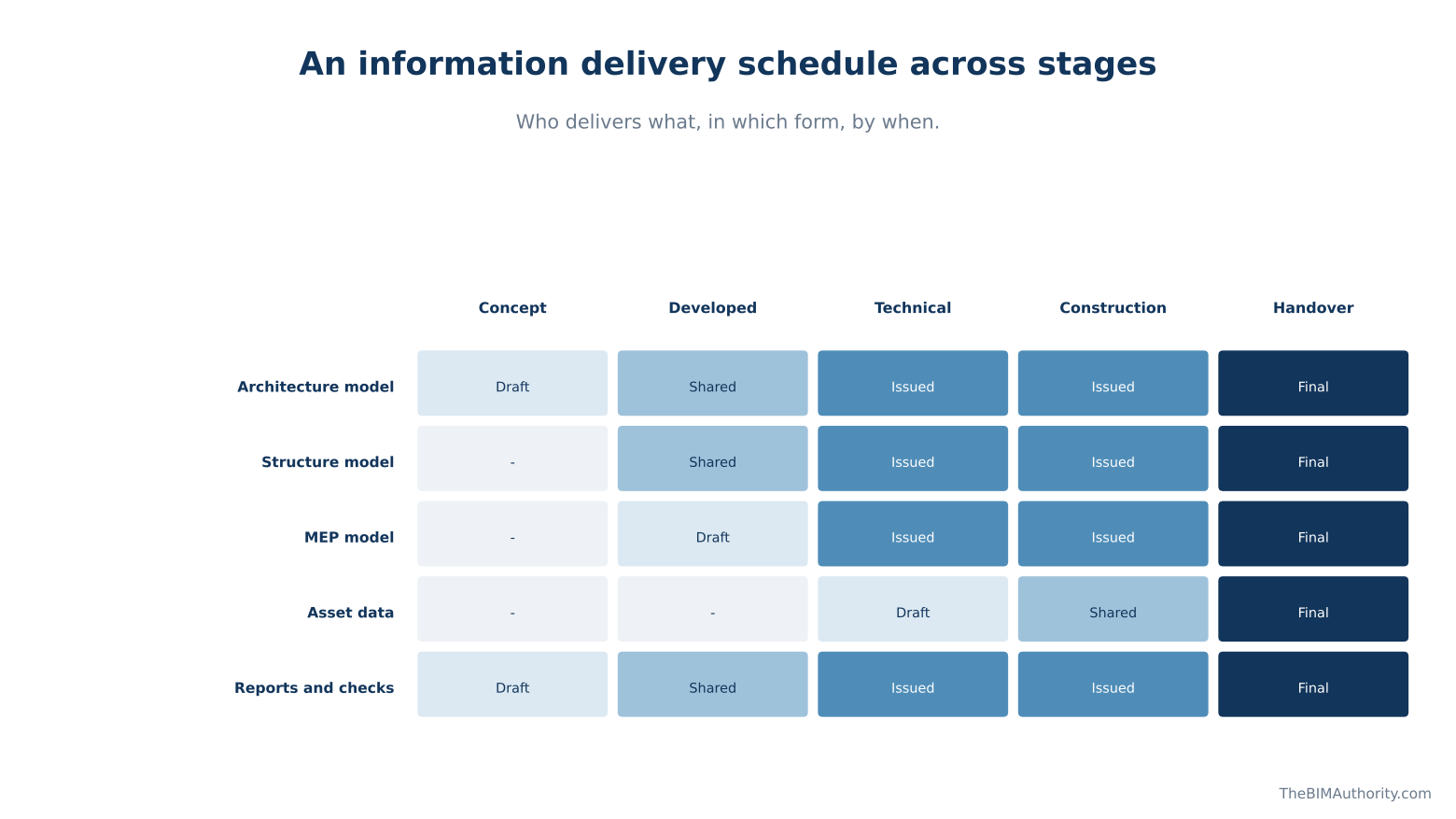
| Phase the work | Draft, shared and issued states at defined points |
| Build in float | Buffers for late changes |
| Use relative dates | “Gate minus 10 working days” helps when gates move |
| Check capacity | Do not schedule more than teams can deliver |
| Align with the client’s decision times | Approvals take time |
A Worked Illustration (Fictional)
For the Harbor View Clinic, the developed design gate is the reference. The team plans: shared levels and grids (T minus 30 working days), architectural model shared for coordination (T minus 20), structural model shared (T minus 15), MEP model shared (T minus 12), clash report issued (T minus 8), corrections republished (T minus 4), final checks and issue (T minus 2). The sequence respects dependencies: each model is shared after the one it depends on, with at least three working days between. Counting the planned deliverables for the gate:
| Team | Deliverables for the developed design gate |
|---|---|
| Architecture | 8 |
| Structure | 6 |
| MEP | 7 |
| Information management | 3 |
| Total | 24 |
Arithmetic check: 8 + 6 + 7 + 3 = 24. The MIDP shows 24 lines for that gate; if the consolidated register shows 22 or 26, something has been dropped or duplicated. (Figures are invented for illustration.)
Dependencies and the Critical Path
| Dependency type | Example | Action |
|---|---|---|
| Reference information | Shared levels, grids, coordinates | Issue first; lock after agreement |
| Model dependencies | Structure needs architecture; MEP needs structure | Order exchanges accordingly |
| Decision dependencies | Equipment selection before plant room layout | Add decision milestones to the schedule |
| Information dependencies | Product data needed for asset information | Link to procurement dates |
| Approval dependencies | Client approval needed before the next stage | Include approval time |
| External dependencies | Survey, ground information | Track as risks |
Mark the critical path: the chain of deliverables whose delay delays the gate. Review it weekly.
Tracking and Reporting
| Practice | Why |
|---|---|
| Update status weekly | The schedule is a living document |
| Use a simple status code | Not started; in progress; delivered; accepted; late; at risk |
| Compare planned and actual dates | Slippage trends |
| Report percentage delivered per milestone | Executive view |
| Flag at-risk items early | Intervene |
| Link to the CDE | Delivered containers visible in the right state |
| Link to checks | Delivered items include check results |
| Escalate persistent lateness | Through the project structure |
Metrics
| Metric | Definition |
|---|---|
| On-time delivery rate | Deliverables delivered by planned date ÷ deliverables due |
| First-time acceptance rate | Deliverables accepted without rework ÷ deliverables delivered |
| Average delay (days) | For late items |
| Scope change rate | Lines added or removed since baseline |
| Milestone readiness | Share of gate deliverables accepted by gate minus a buffer |
A fictional illustration: if 20 of 24 deliverables due this month were delivered by their planned dates, the on-time delivery rate is 20 ÷ 24 = 0.833, or about 83%; if 17 of the 20 delivered were accepted without rework, the first-time acceptance rate is 17 ÷ 20 = 85%. (Figures are invented for illustration.) See BIM Data Analytics: Dashboards, KPIs, and Automated Reporting.
Linking to Other Documents
| Document | Link |
|---|---|
| EIR | Every required exchange and deliverable appears in the schedule. See Exchange Information Requirements (EIR) Template and Example |
| BEP | The schedule is Section 4 and an appendix. See BIM Execution Plan (BEP) Template: Complete Guide and Example |
| Responsibility matrix | Owners match accountable and responsible parties. See BIM Responsibility Matrix Template: Roles and Deliverables |
| Naming convention | Container IDs follow the standard |
| CDE | States and workflows align with target states |
| Coordination cycle | Cut-offs align with meetings. See BIM Coordination Meeting Checklist and Report Template |
| Handover | Asset data deliverables included. See BIM Model Handover Checklist and Requirements |
Common Mistakes
- No schedule, or a schedule that is a list of dates without containers.
- Dates set at the gate itself with no time for checks.
- Ignoring dependencies.
- No owners.
- Teams not involved in drafting their TIDPs.
- Never updated.
- Too detailed to maintain, or too vague to use.
- No link to naming, states or checks.
- Missing asset information deliverables.
- No tracking or reporting.
- No process for scope changes.
- Treating the schedule as a contract instrument when it is not one.
See also Common BIM Mistakes Beginners Should Avoid.
A Short Checklist
- Does the schedule cover every deliverable required by the EIR and BEP?
- Do milestones and exchanges drive the dates?
- Does each line have container ID, type, owner, date, format, target state, LOIN and dependencies?
- Did each task team draft its TIDP, and is the MIDP consolidated?
- Are checks, review and approval time built in?
- Is the critical path identified and reviewed?
- Is status updated weekly and reported?
- Are changes controlled and the schedule versioned?
- Is it linked to the CDE, naming convention and coordination cycle?
Frequently Asked Questions
What is a MIDP?
The master information delivery plan: the consolidated plan of all information containers the project will deliver, with dates and responsibilities.
What is a TIDP?
A task information delivery plan: a task team’s list of its own deliverables, dates and responsibilities.
Who prepares them?
Each task team prepares its TIDP; the lead appointed party consolidates the MIDP.
What format should it take?
Any clear register: a spreadsheet, a database or a CDE-integrated list. Consistency matters more than tool.
How detailed should it be?
Detailed enough to track each container to a milestone; avoid excessive granularity.
How often should it be updated?
Weekly for status; formally at stage gates and when scope changes.
Is the delivery schedule a contract document?
Not by itself; its status depends on the appointment and protocol. See BIM Protocol and Contract Addendum Template.
How does it relate to the program?
It aligns with the project programme and shows information deliverables in detail; it should not conflict with it.
Final Thoughts
I once inherited a project where the only information schedule was a single line on the programme: “BIM models issued: end of stage.” The team was surprised, at the end of the stage, to discover that “end of stage” meant five different things to five different people. We replaced the line with a register of thirty-one containers, each with a date, an owner and a dependency. It took two days to write. In the first week of using it, three problems appeared that had previously stayed hidden: the structural model could not start because the architect’s shared grids were not yet issued; the MEP team had planned its delivery for a day before it would receive the structure; and nobody had assigned the asset data deliverable. All three were fixed before they became delays.
That is the value of an information delivery schedule: it makes the plan visible while there is still time to change it. Build it from the EIR and BEP, let each team draft its own part, respect dependencies, allow time for checks and track it weekly. Then “when will it be ready?” has an answer, and the answer has a name beside it.
Download the template: BIM information delivery schedule template (ZIP with Excel file).
Where to go next: for the plan it belongs to, read BIM Execution Plan (BEP) Template: Complete Guide and Example. For requirements and responsibilities, continue with Exchange Information Requirements (EIR) Template and Example and BIM Responsibility Matrix Template: Roles and Deliverables, and for names, BIM Model Naming Convention Template and Guidelines.



