
On one project I advised, the sponsor’s representative sat through the design review meeting looking increasingly uncomfortable. The architects presented a lovely scheme. The cost consultant presented a number. The engineer presented a structural concept. At the end, the sponsor said: “I am sorry, but I cannot approve this. I do not know whether it fits the brief.” Everyone in the room was surprised. The brief had been issued months earlier, and the scheme looked consistent with it. But the sponsor, who was not a designer, had no information in a form that let her check that. There was no area schedule against the brief. There was no cost plan tied to the budget lines she knew. There was no summary of the performance targets and how the design met them. She had a drawing set and a feeling.
That experience is, for me, the clearest illustration of what Project Information Requirements (PIR) are for. They are not about modeling. They are about decisions. Every project is a sequence of decisions: approve the brief, choose the concept, approve the design, award the contract, accept the building. At each point, someone with authority needs specific information in a form they can act on. If nobody has said in advance what that information is, the project produces plenty of material and very little decision-ready evidence.
This guide explains what the PIR are, how ISO 19650 positions them, how they differ from the brief and from the EIR, how to write them around decision points, what to include and how they flow into tenders and appointments. It also gives you a template and a worked example. For the full chain, see ISO 19650 Information Requirements Explained: OIR, AIR, PIR, and EIR.
The Short Answer
Project Information Requirements (PIR) are the information requirements in relation to a particular project: what the appointing party needs to know, at each stage of the project, to make decisions and to support the organization’s objectives.
In ISO 19650, the PIR:
- are established by the appointing party during the assessment and need activity of the delivery process;
- are tied to the project’s information delivery milestones;
- draw on the OIR and the AIR, which tell the project what the organization needs overall and what asset information the project must deliver for operation;
- are the basis from which the EIR are written for each appointment.
In one sentence:
PIR answer: “What must we know, at each decision point of this project, so that we can decide well and so that the organization gets what it needs?”
PIR, the Brief and the EIR: Three Different Things
These three documents are confused constantly. Here is how I separate them.
| Document | What it says | Question | Example |
|---|---|---|---|
| Brief (or project requirements) | What the project must achieve: purpose, scope, quality, budget, programme | What are we building and why? | “A 400-bed ward block meeting these clinical, budget and sustainability targets” |
| PIR | What the client must know to manage and approve the project | What do we need to know, and when, to decide? | “At design approval: cost plan against budget by element, area schedule against brief, energy and carbon estimates against targets, safety and compliance status” |
| EIR | What a supplier must deliver, in what form, under an appointment | What exactly must you give us, in which format and by when? | “At design approval: a federated IFC model with these properties, an area schedule export, an energy model, a compliance report” |
The brief drives design. The PIR drive governance and decision-making. The EIR drive supplier deliverables. A project can have a good brief and no PIR, and then discover, at the first approval gate, that it cannot tell whether the brief is being met.
Why PIR Matter
| Without PIR | With PIR |
|---|---|
| Approval meetings rely on opinions and drawings | Decisions rest on agreed, comparable evidence |
| Suppliers guess what the client wants to see | Suppliers know what evidence to produce at each stage |
| Information requests surface late, as change requests | Needs are known and priced from the start |
| Cost and area reporting differ between teams | One agreed structure for reporting |
| Regulators and funders ask for data in a rush | Their needs are built into the plan |
| Handover requirements appear at the end | The AIR content is planned in from the start |
| Disputes about “what we asked for” | A written record of what was required |
PIR also help the client resist the temptation to ask for everything. By tying information to decisions, they make it easy to ask: “Which decision does this support?”
What PIR Typically Contain
1. Project Context and Link to Higher-Level Requirements
A short statement of the project’s purpose, the organizational and asset needs it must serve (referring to the OIR and AIR), and any external requirements: funders, regulators, planning authorities.
2. Decision Points and Milestones
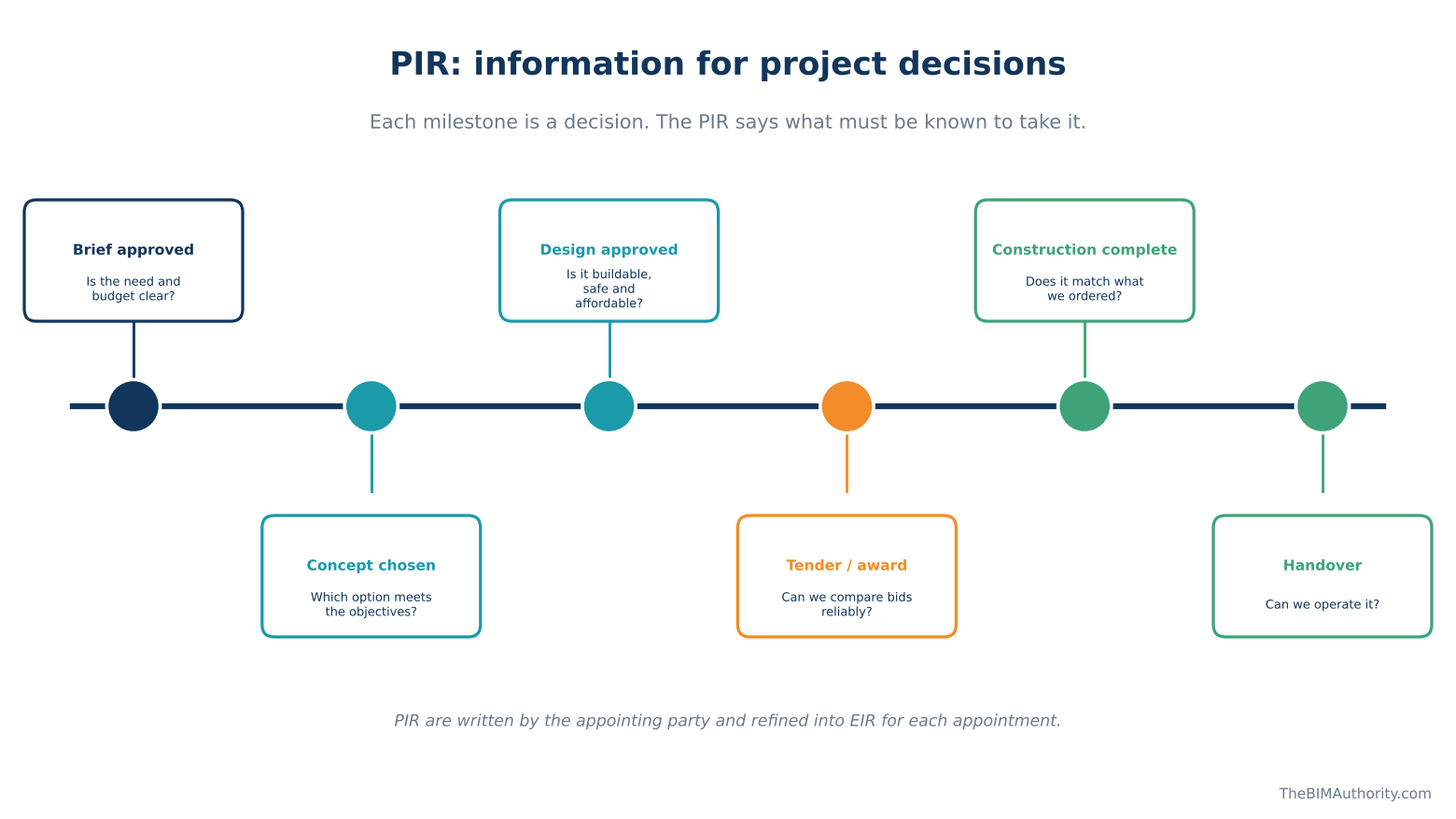
The heart of the PIR. List the key decisions and the milestones at which they are made. A typical building project might include:
| Decision point (illustrative) | Typical question |
|---|---|
| Strategic brief approval | Is the need clear, justified and affordable? |
| Concept selection | Which option best meets the objectives? |
| Design approval (before tender) | Is the design buildable, safe, compliant and within budget? |
| Tender evaluation and award | Can we compare bids reliably, and is the chosen bid acceptable? |
| Construction stage reviews | Is the work progressing as planned and as designed? |
| Practical completion | Does what was built match what was ordered? |
| Handover | Can we operate it? Is the asset information complete? |
| Post-occupancy review | Does it perform as intended? What do we learn? |
The names and number of decision points depend on your procurement route and stage framework. What matters is that each real decision is listed.
3. Information Needed for Each Decision
For each decision point, specify the information needed to take it. Express it by topic, not by file type.
| Topic | Examples of information needed |
|---|---|
| Scope and quality | Area schedule against brief, accommodation schedule, key quality indicators |
| Cost | Cost plan by element, risk allowance, variation to budget |
| Programme | Key dates, critical path, dependencies |
| Performance | Energy, carbon, daylight, acoustic, accessibility targets and predicted performance |
| Compliance and safety | Regulatory status, fire strategy, health and safety risk register. See ISO 19650-6: Health and Safety Information Management |
| Risk | Top risks, mitigation, open issues |
| Procurement | Packages, bidders’ capability, tender comparison |
| Asset data readiness | Status of the asset information to be delivered against the AIR |
| Stakeholder needs | User group sign-offs, planning conditions |
4. Format, Granularity and Frequency
State how the information should be presented for decision-makers: dashboards, summary reports, specific schedules, model-based reviews. State how detailed it needs to be at each stage, and how often progress information is required.
5. Quality and Verification
How will the client know the information is reliable? Who checks it, using which method? What are the acceptance criteria?
6. Roles and Responsibilities
Who provides, who reviews, who decides. Link to the responsibility matrix. See How to Create a BIM Responsibility Matrix.
7. Constraints and Standards
Reference the information standard (naming, classification, formats), the CDE arrangements and any security constraints. See Common Data Environment (CDE): The Complete Guide and BIM Information Security, Access Control, and Data Governance.
How to Write PIR: A Step-by-Step Method
Step 1: Gather the Inputs
Collect the OIR, AIR, brief, budget, programme, procurement strategy, regulatory and funding conditions and any lessons learned from previous projects.
Step 2: List the Decisions
Map the project’s decision points and milestones. Include formal approvals (board, funder, planning) and internal ones (value engineering, scope control). For each, identify who decides.
Step 3: Ask the Decision-Makers
For each decision, ask the people who will make it: What do you need to see to feel confident? What went wrong last time? This is the most valuable step. Decision-makers know what they need once they imagine being in the room.
Step 4: Define the Information Needed
For each decision, list the information topics and the level of detail required at that stage. Apply proportionality: only what the decision needs.
Step 5: Connect to the AIR and OIR
Identify which asset data will be needed for operation and when it should start being collected. Reference the AIR rather than duplicating them. Check that organization-wide reporting needs from the OIR are covered.
Step 6: Define Format and Verification
Decide how information will be presented and who checks it. Where information comes from models, plan model-based checks. See BIM Model Checking: Geometric and Information Validation.
Step 7: Align With the Delivery Process
Link PIR to the information delivery milestones that appear in the tender, the BEP and the MIDP. See Master Information Delivery Plan (MIDP): Complete Guide.
Step 8: Write It Briefly
A good PIR is a few pages: a table of decision points, the information needed at each and the format. Use plain language.
Step 9: Review With Stakeholders
Walk through it with sponsor, project manager, cost and programme advisers and operations. Ask: If we had exactly this information at each gate, could we decide?
Step 10: Maintain It
PIR change as the project changes. Version them, manage changes and keep the EIR consistent with them.
A Worked Example: PIR for a School Extension
Here is a condensed PIR for a fictional school extension. It is a teaching example.
| Decision point | Decision-maker | Information needed | Format | Verification |
|---|---|---|---|---|
| Concept selection | Project board | Options with areas against brief, outline cost range, high-level energy and carbon indication, planning risk summary | Options report and one-page comparison | Cost adviser review; planning consultant review |
| Design approval | Project board and governors | Cost plan by element against budget; area schedule against brief; energy and carbon prediction against targets; fire strategy status; health and safety risk register; programme | Design report; model-based area and quantity extracts | Cost reconciliation; model check of areas; compliance review |
| Tender award | Procurement panel | Priced tenders in comparable structure; capability and capacity assessments; BEP and MIDP submitted by bidders | Tender comparison; evaluation report | Evaluation against criteria, including information management |
| Construction mid-point review | Project manager | Progress against programme; cost to complete; open coordination issues; status of asset data against AIR | Dashboards and progress report | Site verification; issue log from BCF; asset data completeness check |
| Practical completion | Client | Evidence that completed building matches orders; as-built information; test and commissioning results; asset data against AIR | Completion report; asset register; verified model | Sample verification on site; data checks |
| Handover | Facility manager | Operation and maintenance information in the AIM; asset register loaded; training records | Structured data and documents in the asset system | Load test; completeness check |
Notice how the PIR give each stage a short list of evidence, and how asset data readiness appears long before handover.
PIR for Different Kinds of Projects
The structure holds, but the decisions and evidence vary.
| Project type | Typical emphasis in the PIR |
|---|---|
| New building | Brief compliance, cost, programme, performance, procurement, asset data readiness |
| Refurbishment or extension | Existing conditions information, hazards, phasing and occupant impact, asset information updates |
| Infrastructure | Alignment and geospatial data, utilities and constraints, environmental and consent conditions, asset condition data for operators |
| Fit-out and tenant works | Lease and landlord approvals, base-build information, handback conditions |
| Maintenance and renewal programs | Condition data, prioritization, cost by asset class, access and safety information |
| Framework or multi-project programs | Consistency across projects, comparable reporting, shared standards |
A Template for a PIR Document
- Purpose and scope: the project, the document’s role, links to OIR, AIR and the brief.
- Decision points and milestones: a table with decision, decision-maker and date or stage.
- Information needed per decision: topics, detail, format.
- Quality, verification and acceptance: who checks, how.
- Responsibilities: providers, reviewers, decision-makers.
- Information standards and CDE: references to the information standard, naming, classification, platform.
- Security and constraints: sensitivity triage outcome, consequences.
- Relationship to the EIR and BEP: how PIR flow into appointment documents.
- Change control: version, owner, process.
How PIR Flow Into the Tender and Appointments
The PIR are not delivered to suppliers as such. They are translated into the documents suppliers use.
| Document | How the PIR feed it |
|---|---|
| Invitation to tender | The PIR shape the milestones, standards, methods and evaluation criteria. See ISO 19650-2: BIM Information Management During Project Delivery |
| EIR | Each appointment’s EIR specify the deliverables that supply the PIR evidence. See Exchange Information Requirements (EIR): Complete Guide |
| Pre-appointment and post-appointment BEP | The delivery team shows how it will provide the information at each decision point |
| MIDP and TIDPs | Deliverables are scheduled to meet the PIR milestones. See Master Information Delivery Plan (MIDP): Complete Guide and Task Information Delivery Plan (TIDP): Complete Guide |
| Acceptance criteria | The appointing party checks deliverables against the PIR-derived EIR |
| Reporting arrangements | Progress reporting reflects PIR topics |
A good test: for each deliverable in the MIDP, ask which PIR decision it supports. A deliverable without an answer may be unnecessary, and a PIR decision without a deliverable is a gap.
Common Mistakes
- Confusing PIR with the brief.
- Writing PIR as a list of files instead of decision-supporting information.
- Not asking the decision-makers.
- Listing decisions but not the information they need.
- Asking for everything at every stage.
- Ignoring asset data readiness until handover.
- No verification method.
- Not linking PIR to milestones in the MIDP.
- Writing PIR once and never updating them.
- Copying another project’s PIR without adjusting decisions and evidence.
- Forgetting external stakeholders: regulators, funders and planning authorities.
- No owner for the PIR.
See also Common BIM Mistakes Beginners Should Avoid.
A Short Checklist
- Have we listed all key decisions and who takes them?
- For each, do we know the information needed, its detail and its format?
- Do the PIR reflect the OIR and AIR?
- Is asset data readiness tracked from early stages?
- Are verification and acceptance defined?
- Are PIR tied to information delivery milestones?
- Do EIR, BEP and MIDP trace back to PIR?
- Have decision-makers reviewed the PIR?
- Is there an owner and change control?
- Is the document short and plain?
Frequently Asked Questions
What are PIR in ISO 19650?
Project Information Requirements: the information the appointing party needs, at project level, to make decisions and to support the organization’s objectives.
Who writes the PIR?
The appointing party, with its project team, drawing on the OIR and AIR.
What is the difference between PIR and EIR?
PIR state what the client must know to decide. EIR state what each supplier must deliver. The EIR are derived from the PIR.
What is the difference between PIR and the project brief?
The brief says what the project must achieve. The PIR say what information is needed to manage and approve it.
Are PIR linked to project stages?
Yes. They are organized around decision points and information delivery milestones.
How long should PIR be?
A few pages for most projects: a decision table and a short explanation.
Do PIR include asset data?
They should reference the AIR and include milestones for asset data readiness, so handover data is not left to the end.
Do small projects need PIR?
The thinking applies. A small project can have a one-page table of decisions and the evidence needed.
How do PIR relate to the MIDP?
The MIDP schedules the deliverables, and each should support a PIR decision.
Final Thoughts
I later learned that the sponsor from the design review had done something clever. Before the next review, she asked the team for one page: five numbers and three sentences per decision. The area schedule against brief. The cost against budget. The energy target against the prediction. Three open risks. One page. The team, a little surprised, produced it, and the approval took twenty minutes.
That page was, in everything but name, a PIR. It did not require a model, a platform or a standard. It required someone to say, in advance, what she needed to know in order to decide. That is all a PIR is. Write yours around the decisions your project will face, ask the people who will take them what they need to see and make sure every deliverable has a reason. The decisions will get better, and so will the information.
Where to go next: to see how PIR become supplier deliverables, read Exchange Information Requirements (EIR): Complete Guide. For the scheduling side, continue with Master Information Delivery Plan (MIDP): Complete Guide, and for the asset side, Asset Information Requirements (AIR): Complete Guide.