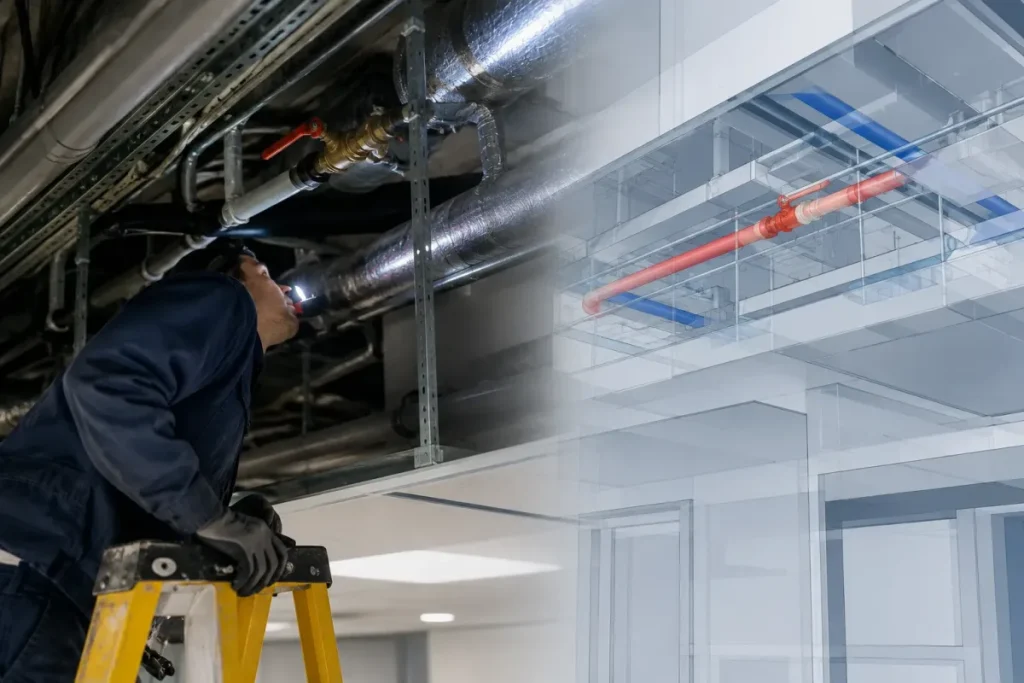

On a refurbishment project many years ago, I watched a maintenance technician stand on a stepladder in a ceiling void, holding a torch in his teeth, trying to find the isolation valve for a heating loop. The building had been handed over two years earlier with a very complete BIM model. The valve was in the model. Its position was accurate to the centimeter. Nobody had told the technician, and nobody had told the designers that the valve sat above a fixed ceiling with no access hatch, a fact that a designer had noticed during coordination, mentioned in a meeting and then forgotten. The information existed. It simply never traveled to the person who needed it, in a form he could use, at the moment it mattered.
That small, slightly comic scene contains the whole reason for health and safety information in BIM. Hazards are discovered in design, in procurement, on site and in operation. Each stage learns something that the next stage badly needs. And in most projects, that knowledge evaporates between stages, because nobody was responsible for carrying it.
ISO 19650-6 is the part of the series that addresses exactly this. It is the newest part of the series, published in January 2025, and the one for which the least practical guidance exists so far. I have spent my career in CAD and BIM management, not as a safety professional, so I will be careful to stay in my lane: this guide explains what the standard is for, how it fits into the information management process you already know and how a BIM team can apply it sensibly. For safety law and risk assessment methods, you need specialist advice, and I will say so where it matters.
The Short Answer
ISO 19650-6 deals with health and safety information across the life cycle of built assets. The official title of the standard is Part 6: Health and safety information. According to its published scope, it:
- specifies requirements for the collaborative sharing of structured health and safety information throughout project and asset life cycles;
- supports the digitization of structured health and safety information progressively, from the outset;
- specifies how health and safety information is shared for use throughout the life cycle;
- sets out a health and safety information cycle framework for the identification, use, sharing and generalization of health and safety information, through information management processes.
It applies to individuals and organizations that contribute to and influence the procurement, design, construction, use (including maintenance) and end of life of building and infrastructure assets. And an important point for beginners: the standard states that its principles and requirements can also be applied to projects that do not use BIM.
In one sentence:
ISO 19650-6 asks that what we learn about hazards and risks is treated as managed information, delivered to the right people at the right time, instead of as an afterthought or a folder of documents.
Where Part 6 Fits in the Series
| Part | Focus |
|---|---|
| ISO 19650-1 | Concepts and principles |
| ISO 19650-2 | Delivery phase process |
| ISO 19650-3 | Operational phase process |
| ISO 19650-4 | Information exchange |
| ISO 19650-5 | Security-minded approach |
| ISO 19650-6 | Health and safety information |
Like Parts 4 and 5, Part 6 is a topic module. It does not replace the process of Parts 2 and 3. It adds a specific kind of information, health and safety information, to that process, and explains how it should be identified, structured, shared and reused. If you are new to the series, read ISO 19650 Explained: A Complete Guide for BIM Professionals and ISO 19650-1: Information Management Concepts and Principles first.
The standard was developed by the same international committee as the rest of the series, and it has been adopted in Europe as an EN ISO standard, so it will appear in national standards catalogs with the usual national prefixes.
A Note on How Much I Can Tell You
ISO standards are copyrighted documents, and I will not reproduce them. What follows is based on the published scope and summary of ISO 19650-6, on the structure of the standard as publicly described, and on the draft stage text that circulated for public comment before publication. The final text may differ from the draft in details, so use this guide to understand the purpose and approach, and read the official standard before you write requirements or contract clauses that cite specific clauses. If you work in a regulated safety role, take professional advice on how the standard interacts with the safety legislation of your country.
Why Health and Safety Information Needs Its Own Part
The Problem: Safety Knowledge Is Created Everywhere and Lost Everywhere
Think about the life of a building, and about who learns what about hazards.
| Stage | Typical safety knowledge created |
|---|---|
| Design | Designers identify hazards in the design and decide how to eliminate or reduce them; some residual risks remain |
| Procurement | Bidders need to understand significant risks to price and plan safely |
| Construction | Contractors identify new hazards, plan temporary works, sequence work safely |
| Handover | The owner needs to know the risks that remain for operation and maintenance |
| Operation | Maintenance teams discover access problems, hazardous materials and incidents |
| End of life | Demolition teams need to know about hazardous materials, structural conditions and previous modifications |
At every transition, information is lost, diluted or buried. Designers write a long risk register that nobody reads. The contractor’s plan is created from scratch. The handover contains a generic safety file. The operator learns the hard way.
The Consequence
The consequence is not only paperwork inefficiency. It is people being exposed to risks that someone, somewhere earlier in the life cycle, already knew about. That is why the standard’s stated purpose is to provide clearer, more relevant health and safety information to the right people at the right time, in order to support a safer and healthier environment, reduce incidents and reduce costs over the whole life of the asset.
The Core Idea: The Health and Safety Information Cycle
The standard sets out a health and safety information cycle: a framework for how health and safety information is identified, used, shared and generalized.
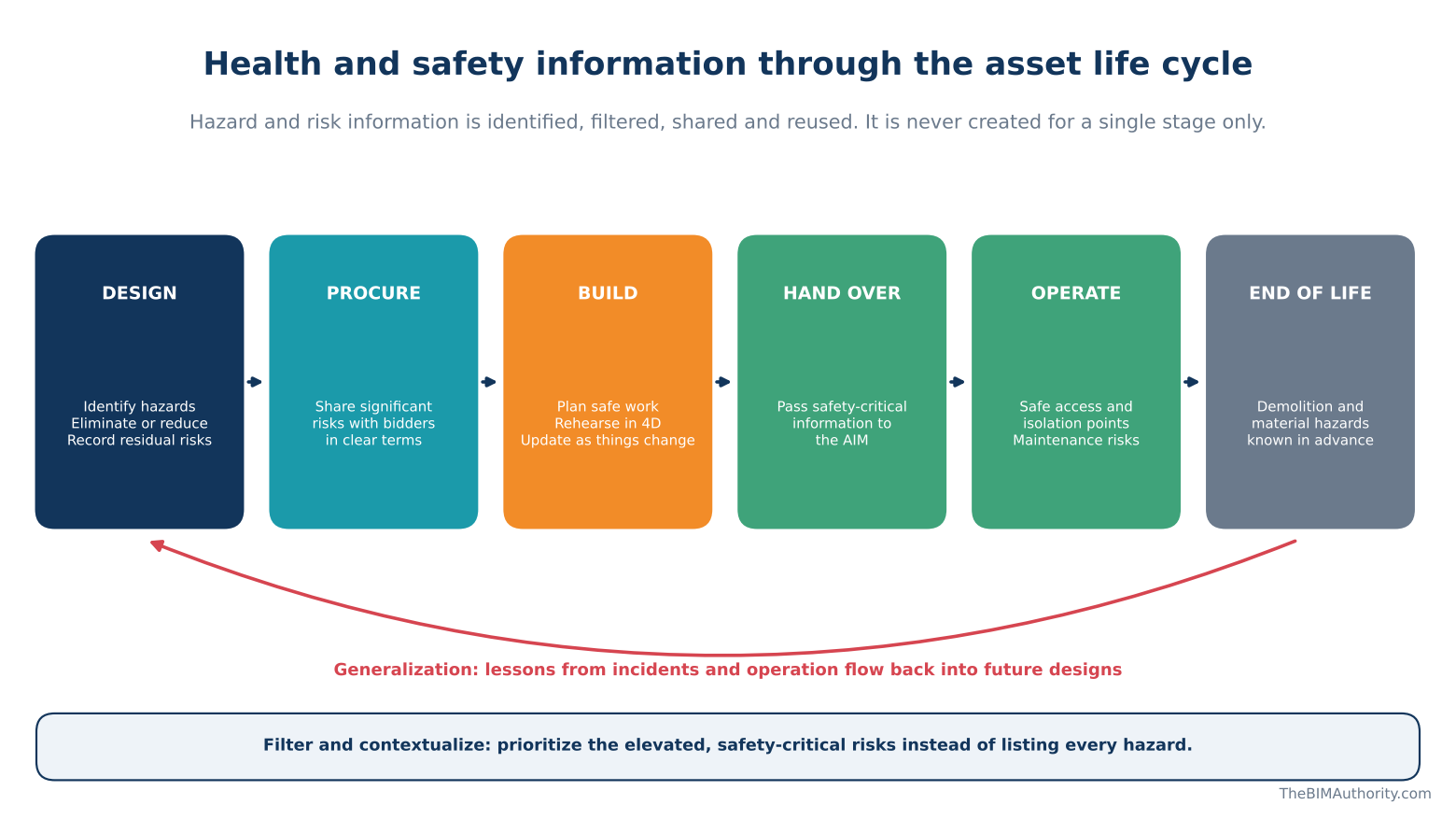
Let me translate each word of that cycle into practical terms.
Identification
Hazards and risks are identified as part of the work of each stage: in design reviews, in constructability workshops, in site planning, in maintenance inspections. In a BIM context, identification can use the model itself: spotting an access problem in a 3D view, a working-at-height situation in a 4D simulation, a clash between a maintenance route and a piece of equipment.
Use
Information is used in decisions: to change a design, to choose a construction method, to plan a maintenance routine. Information that is recorded but never used is a liability, not an asset.
Sharing
Information is shared between stages and parties, in a structured way. This is the heart of the standard: structured, collaborative sharing of health and safety information through the information management processes you already know: information requirements, delivery plans, the CDE and exchanges.
Generalization
Experience is generalized: lessons from one project, one incident or one asset become knowledge that informs future projects and assets. This is the long-term loop, the equivalent of the “lessons learned” step in Part 2, applied to safety.
The Principle of Filtering and Contextualizing Risk
One principle in the standard deserves special attention, because it addresses the opposite problem to “no information”: too much information.
The draft text states that while all health and safety risk information could be included in an information model, the standard requires the contextualization and filtering of hazards and risks, in order to prioritize the elevated risks and the safety-critical aspects.
Put simply: do not drown the people who need to act in thousands of low-level risks. Highlight the ones that matter.
Why This Is Wise
I have seen risk registers with four hundred lines, where the one hazard that could actually kill someone (for example, an unprotected edge at a roof access) was line 283. A person under time pressure will not find it. A good structured approach does the opposite: it surfaces the significant risks clearly, links them to the relevant part of the asset, and explains what should be done.
How BIM Can Help
BIM can link risk information to specific elements and locations: this roof edge, this plant room, this shaft. It can be filtered by stage, by trade or by risk level, and it can be presented visually. That is a genuine advantage over a PDF register, provided someone defines what must be recorded and how.
Types of Health and Safety Information
The standard is not a list of hazards. It is about how to manage information about them. But it helps to think in categories. These are the types of information that teams typically need to manage, drawn from common practice, not from the standard’s clause list.
| Category | Examples |
|---|---|
| Hazards and risks in design | Hazards identified, risk assessment outcomes, measures taken, residual risks |
| Site and context | Existing structures, utilities, contamination, adjacent occupiers, access constraints |
| Construction risks | Work at height, excavation, lifting, temporary works, hazardous operations |
| Construction planning | Sequences, exclusion zones, crane and plant positions, welfare and logistics |
| Materials and substances | Hazardous materials in the existing building or specified products |
| Operation and maintenance | Access for maintenance and cleaning, isolation points, confined spaces, safe working methods |
| Emergency information | Escape routes, fire safety strategy, shut-off locations, assembly points |
| Incident and learning information | Near misses, incidents, corrective actions, lessons learned |
| End-of-life information | Demolition and deconstruction risks, material recovery hazards |
Each category has an owner, a timing and a user. Defining those three things is the work of information management.
Connecting Part 6 to the Process You Already Know
Part 6 is not an extra process on the side. It plugs into the ISO 19650 process at every stage. Here is how I explain the integration to teams.
In the Information Requirements
The appointing party should state its health and safety information needs in the same chain of requirements as any other information.
| Requirement | Typical health and safety content |
|---|---|
| OIR | The organization’s overall safety objectives and requirements for asset information |
| AIR | Information needed to operate and maintain the asset safely: isolation points, access, hazardous areas |
| PIR | Information needed to make safe decisions during the project |
| EIR | Specific deliverables from each appointed party: risk information, residual risk registers, safe-access information, in a defined format |
See ISO 19650 Information Requirements Explained: OIR, AIR, PIR, and EIR.
In the Tender and Appointment
- The invitation to tender should include the health and safety information requirements and the relevant risk information already known.
- The tender response should show how the delivery team will manage health and safety information, including who is responsible.
- The BIM Execution Plan should describe how this information will be produced, structured, checked and shared. See BIM Execution Plan (BEP): How to Create and Implement One.
In Planning and Responsibilities
- The MIDP and TIDPs should include health and safety information deliverables with dates and owners.
- The responsibility matrix should say who identifies, who records and who verifies each category of information. See How to Create a BIM Responsibility Matrix.
In Production and Review
- Information is produced in work in progress and shared through the CDE with a status that makes clear what it can be used for.
- During the information model review, health and safety information should be reviewed together with the other information, not in a parallel universe. A model can pass its clash detection and still contain an unprotected hazard. See BIM Coordination: The Complete Guide.
At Handover and in Operation
- The relevant health and safety information passes to the asset information model, which means it must be structured in the way the AIR asked. See ISO 19650-3: Information Management During Asset Operations.
- Trigger events in operation (a failure, an incident, a refurbishment) generate new safety information and trigger updates.
In Lessons Learned
- At project close-out, safety lessons are captured and generalized, a natural link with the final activity of Part 2. See ISO 19650-2: BIM Information Management During Project Delivery.
How BIM Supports Safety in Practice
You do not need Part 6 to start using BIM for safety. Many teams already do some of the following. Part 6 gives a framework for doing them consistently and with proper information management.
Design for Safety and Constructability
- Reviewing the design in 3D to identify work-at-height, confined space and heavy lifting situations.
- Checking maintenance access and clearances around equipment, roof edges, plant rooms and fixed ladders. This is a classic soft clash topic. See Hard Clashes vs. Soft Clashes vs. Workflow Clashes.
- Comparing design options by their residual risk, not only by cost and appearance.
Construction Planning
- 4D simulation of the construction sequence to identify unsafe overlaps, exclusion zones and access routes. See 4D BIM Explained: Construction Scheduling and Simulation.
- Site logistics models showing cranes, hoists, storage, pedestrian routes and temporary works. See BIM for Construction Site Planning and Logistics.
- Rehearsal of high-risk operations in the model before they happen on site, for example work at height, which was an example used in public presentations about the draft standard.
Communication
- Visual communication of risks in toolbox talks and inductions, using views and animations that workers actually understand.
- Linking method statements and risk assessments to the relevant location in the model.
Operation and Maintenance
- Locating isolation points, safe access routes and hazardous areas quickly, for planned and emergency work. See BIM for Building Operations and Maintenance.
- Planning safe maintenance with the actual equipment layout and access constraints visible.
End of Life
- Recording hazardous materials and structural modifications so that those who deconstruct the asset decades later know what they will find. See Scan-to-BIM: Converting Point Clouds into Intelligent Models for existing assets.
The Legal Context: Part 6 Is Not the Law
This is important enough to repeat. ISO 19650-6 is a standard. It does not replace health and safety legislation, which varies by country and by project type. Many jurisdictions already have specific duties for managing design and construction safety information. Examples of the kind of frameworks you may meet:
- In the United Kingdom, construction health and safety regulation includes duties around pre-construction information, a construction phase plan and a health and safety file.
- In the European Union, a directive on temporary or mobile construction sites introduces coordinators, safety and health plans and a file with information for future work on the structure.
- In several countries, including Singapore, Australia and the United States, the idea of design for safety or prevention through design is established in guidance or regulation.
I mention these not to explain them (I am not qualified to) but to make a point: Part 6 is designed to work with these frameworks, not instead of them. A health and safety file, a risk register or a safe design report can be information containers managed through the CDE, structured so that they are easier to find, filter and reuse. Seek competent advice on legal duties for your project.
What a Health and Safety Information Requirement Might Look Like
To make the idea concrete, here is an illustrative example of how a client might write requirements, using the logic of the information requirements chain. It is a teaching example, not a text from the standard.
| Element | Content |
|---|---|
| Purpose | Enable safe maintenance of roof-mounted plant |
| Milestone | End of technical design, and again at handover |
| Who provides / who uses | Architect and MEP engineer provide; facility manager and maintenance contractor use |
| Object | Roof edges, roof access routes, roof-mounted plant, fixed access equipment |
| Information (alphanumerical) | Identifier, residual risk description, risk level, control measure (for example guardrail, fixed anchor), access method, inspection frequency |
| Information (geometrical) | Location and extent of the hazard zone and the access route, as simple 3D geometry or annotated model views |
| Documentation | Safe access method statement, equipment manuals for fixed anchors |
| Format and delivery | Properties in the model and exported to the asset register; documents linked in the CDE |
| Verification | Check that every roof-mounted plant item has an access route and a risk record |
Notice that it follows the same logic as any other information requirement: purpose, milestone, actors, object, content, format, verification. See Level of Information Need vs. LOD vs. LOI: Key Differences and Exchange Information Requirements (EIR): Complete Guide.
Roles and Responsibilities
Part 6 does not invent new job titles. It assigns the management of health and safety information within the existing roles of the ISO 19650 framework, working alongside the people who hold safety responsibilities under the law and the contract.
| Role | Typical contribution |
|---|---|
| Appointing party | States health and safety information requirements; provides known risk information; ensures the information is used after handover |
| Lead appointed party | Coordinates the delivery team’s health and safety information; ensures requirements cascade |
| Designers and task teams | Identify hazards and residual risks in their design; record them in the agreed structure |
| Contractors and specialists | Provide construction risk information; update information as work proceeds |
| Safety professionals (as appointed) | Advise on risk identification, filtering and prioritization; verify content |
| Information manager | Ensures the information is structured, identified, shared and archived correctly |
| Asset operator | Provides operational experience and incident information back to the AIM |
The key is clarity: if everybody is “responsible for safety information”, nobody checks that it is complete. See BIM Roles and Responsibilities: Manager, Coordinator, Modeler, and Information Manager.
Practical Steps to Start Applying Part 6
You do not need to wait for formal certification schemes. Here is a realistic starting path for a delivery team or an owner.
- Read the scope of the standard and agree with the client how it will be applied on your project.
- List the categories of health and safety information that matter for this asset (for example, access, isolation, hazardous materials, residual design risks).
- Decide the structure. What fields describe a hazard or risk record? Which classification will you use? How will it link to model elements or locations?
- Write the requirements in the EIR and BEP, with purpose, milestone, provider, user and format.
- Use the CDE to hold health and safety information as managed containers with status and revision.
- Filter and prioritize. Agree how significant risks are identified and highlighted.
- Review it with the rest of the information in model reviews and coordination.
- Hand over a structured set of safety-critical information to the AIM, aligned with the AIR.
- Capture lessons at close-out, and in operation through trigger events.
- Involve safety specialists from the start, not after the model is complete.
Common Mistakes
- Treating health and safety information as a separate paper exercise disconnected from the model and the CDE.
- Recording everything and highlighting nothing. Long registers hide the critical risks.
- Letting safety information stop at handover. The operator needs it most.
- Leaving it to modelers. The people who understand the risks are safety professionals, designers and builders. BIM people structure and carry the information; they do not invent it.
- Assuming the standard is a substitute for legal compliance.
- No ownership. Without a named owner for each category, information is never updated.
- Ignoring existing assets. Hazards in existing buildings (hazardous materials, structural conditions) are among the most important to capture.
- Treating the 3D model as proof of safety. A model can look perfect and still hide a dangerous situation.
- Never generalizing. Lessons stay in the heads of the people who experienced the incident.
See also Common BIM Mistakes Beginners Should Avoid.
A Short Checklist
For the appointing party:
- Have we stated our health and safety information needs for design, construction and operation?
- Have we provided the risk information we already hold about the site and existing assets?
- Is health and safety information part of our EIR and acceptance criteria?
- Have we planned how it will be used after handover?
For the delivery team:
- Does our BEP explain how health and safety information is produced, structured and shared?
- Are responsibilities clear for identifying, recording and verifying it?
- Do we filter and prioritize significant risks?
- Is the information linked to elements or locations where useful?
- Does it pass through the CDE with status and revision?
- Is it reviewed in coordination and information model reviews?
- Do we hand over safety-critical information in the structure the AIR asks for?
- Do we capture lessons at close-out?
Frequently Asked Questions
What is ISO 19650-6?
The part of the ISO 19650 series that covers health and safety information: how it is classified, shared and delivered collaboratively across the life cycle of built assets, using a health and safety information cycle.
When was ISO 19650-6 published?
In January 2025.
Does ISO 19650-6 apply only to BIM projects?
No. The standard states that its principles and requirements can be applied equally to delivery or in-use phases not using BIM.
Does ISO 19650-6 replace health and safety legislation?
No. It is a standard on information management. Legal duties come from legislation and contracts, which vary by country. Take professional advice.
What is the health and safety information cycle?
The framework in the standard for the identification, use, sharing and generalization of health and safety information through information management processes.
What does “filtering and contextualizing” mean?
It means prioritizing elevated and safety-critical risks instead of listing every hazard equally, so that the right people can act on the right information.
Who is responsible for health and safety information in a BIM project?
Responsibility follows the roles of the appointment, together with legal duties. Designers, contractors, safety professionals, the information manager and the asset operator all contribute. Define it in the BEP and responsibility matrix.
How does Part 6 relate to the asset information model?
Safety-critical information should pass from the PIM to the AIM in a structured form, so that operators have it for maintenance and incidents. See Asset Information Models (AIM): Creation and Management.
Where should I start?
With the scope of the standard, a conversation with your safety specialists and a small, practical set of requirements for one or two categories of information, such as roof access and isolation points.
Final Thoughts
When I think about the technician with the torch in his teeth, I do not think about a failure of technology. The model was excellent. I think about a failure of delivery: a piece of knowledge that existed at one stage, mattered at another and never made the journey in between.
ISO 19650-6 will not eliminate hazards. What it asks is more modest and more achievable: that we treat what we know about risk as information with an owner, a structure, a destination and a life after the project. If your team begins with one question on every project, “Who will need to know this later, and how will they find out?”, you will already be applying the spirit of this part.
Where to go next: to see how information requirements are written, read Exchange Information Requirements (EIR): Complete Guide. For the handover side, continue with ISO 19650-3: Information Management During Asset Operations, and for the wider framework, return to ISO 19650 Explained: A Complete Guide for BIM Professionals.