



The first time I was called a BIM manager, I did not feel like one. I had been a good modeler and then a decent coordinator, and I assumed that management was simply more of the same: bigger models, more meetings, a higher title. Within a month, I discovered that I had been wrong in a way that is almost universal. The job was not more BIM. It was a different job. I was no longer judged on the quality of my own models. I was judged on the quality of everyone’s: on whether new staff could become productive in weeks, whether the template stopped fighting people, whether a client’s information requirements were answered with confidence in a tender, whether a project’s standards matched the way the team actually worked and whether, at the end of the year, the company was better at BIM than at the beginning.
That shift, from doing excellent work to making an organization capable of excellent work, is the essence of BIM management. It is why some of the best modelers make mediocre managers and some quiet, systematic people thrive. It is also why the role is so varied: in a small practice, the BIM manager may be the only BIM specialist, writing standards in the morning and fixing a family in the afternoon; in a large contractor or consultancy, they may lead a team, own a technology roadmap and answer to a director. What unites them is responsibility for standards, processes, people, technology and results.
This guide is a career guide for people who want to become BIM managers, or who have just become one. It explains what the role involves, the variations by organization type, the competencies (technical, process, leadership and commercial), the routes into the role, how to build the evidence and experience, how to prepare for the transition, the first ninety days, challenges, certifications and training, progression beyond the role, and the mistakes to avoid. It is the senior companion of How to Become a BIM Modeler: Skills, Training, and Career Path and How to Become a BIM Coordinator: Responsibilities and Qualifications. Titles and responsibilities vary widely; use this as a map and adapt it to your organization and market.
The Short Answer
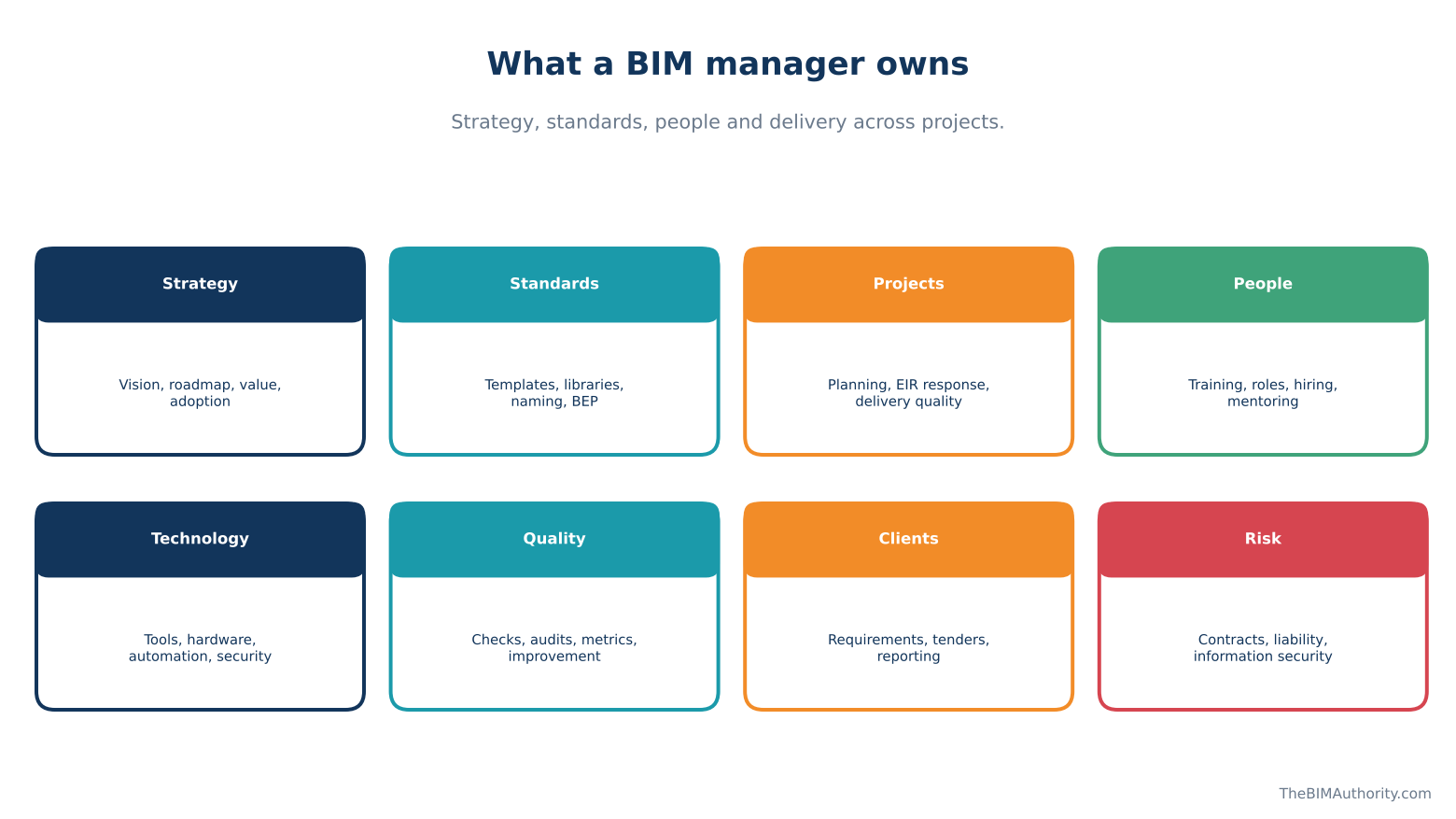
| Area | What the manager owns |
|---|---|
| Strategy | Vision, roadmap, value and adoption |
| Standards | Templates, libraries, naming and the BEP |
| Projects | Planning, EIR responses and delivery quality |
| People | Training, roles, hiring and mentoring |
| Technology | Tools, hardware, automation and security |
| Quality | Checks, audits, metrics and improvement |
| Clients | Requirements, tenders and reporting |
| Risk | Contracts, liability and information security |
In one sentence:
A BIM manager makes an organization good at BIM: standards, people, processes, technology and delivery, measured by the results of everyone’s work, not only their own.
What a BIM Manager Does
Core Responsibilities
| Responsibility | Examples |
|---|---|
| Define and maintain standards | Templates, libraries, modeling rules, naming, classification, exchange settings. See How to Build a BIM Project Template |
| Plan BIM on projects | Write and manage BIM execution plans; respond to EIRs; define roles. See BIM Execution Plan (BEP): How to Create and Implement One |
| Support tenders and clients | Interpret information requirements; present capability. See How to Respond to BIM Requirements in Tenders |
| Lead delivery quality | Quality management, audits, checks, metrics. See BIM Quality Management: Processes, Metrics, and Best Practices |
| Manage and develop people | Allocate resources, train, mentor, hire, define career paths. See BIM Skills Matrix: Competencies Required for Every Professional Level |
| Manage technology | Software choices, hardware, add-ins, automation, security. See Best BIM Software: A Complete Comparison Guide |
| Drive improvement | Lessons learned, new methods, innovation |
| Manage risk | Contracts, liability, information security, project risk. See BIM Contracts and Legal Considerations |
| Report and communicate | To directors, clients and teams |
| Represent the organization | Industry groups, standards bodies, client relationships |
Variations by Organization
| Organization | Typical emphasis |
|---|---|
| Architecture or engineering practice | Standards, templates, design coordination, training, client requirements |
| General contractor | Construction coordination, 4D and 5D, field technology, subcontractor requirements. See Construction BIM: The Complete Guide |
| Subcontractor or fabricator | Detailed modeling, fabrication data, coordination with the main contractor |
| Owner or developer | Requirements, information management, handover, asset information. See Asset Information Requirements (AIR): Complete Guide |
| Consultancy | Advising clients; project-level BIM management; independent checking |
| Infrastructure organization | Alignments, GIS, large datasets, owner requirements. See Infrastructure BIM: The Complete Guide |
| Software vendor or reseller | Implementation, training, support |
| Small firm | A hands-on generalist role: modeling, standards, IT and training in one |
Related Titles
| Title (varies) | Notes |
|---|---|
| BIM manager | Standards and delivery |
| Head of BIM or BIM director | Strategy, leadership and sometimes commercial responsibility |
| Digital delivery manager or head of digital construction | Broader technology and process scope |
| VDC manager | Virtual design and construction in contractors |
| Information manager | Information management processes. See BIM Information Manager: Roles, Skills, and Career Opportunities |
| BIM lead (project-level) | BIM management on a single project |
The Competencies
A useful way to think about a BIM manager’s profile is as four overlapping areas.
1. Technical Competence
| Competence | Why |
|---|---|
| Deep knowledge of at least one authoring tool, and good knowledge of others’ outputs | Credibility and judgment |
| Coordination and checking | Quality at project level |
| IFC, openBIM and exchange | Interoperability. See openBIM Explained: Principles, Standards, and Benefits |
| Data and information structure | Parameters, classification, property sets |
| Automation awareness | Spotting opportunities and risks. See BIM Automation: The Complete Guide |
| Technology infrastructure | Hardware, networks, cloud, security basics |
| Discipline knowledge | Understanding how designers and builders work |
2. Process and Standards Competence
| Competence | Why |
|---|---|
| ISO 19650 and information management | The common framework. See ISO 19650 Explained: A Complete Guide for BIM Professionals |
| BEP, EIR, OIR and AIR | Planning and requirements |
| CDE and workflows | Information control. See Common Data Environment (CDE): The Complete Guide |
| Quality management | Processes and measures |
| Template and library governance | Consistency at scale |
| Contracts and responsibilities | Where BIM meets law |
| Procurement and tendering | Responding to requirements |
3. Leadership and People Competence
| Competence | Why |
|---|---|
| Communication and influence | You lead through persuasion more than authority |
| Training and coaching | Raising the capability of others |
| Change management | Getting people to adopt new ways of working. See Building a BIM-Ready Team: Training and Change Management |
| Team management and recruitment | Building a team |
| Conflict resolution | Disputes about responsibility |
| Facilitation | Workshops and meetings |
| Mentoring | Developing talent |
4. Commercial and Strategic Competence
| Competence | Why |
|---|---|
| Business case and budgeting | Justify investment. See BIM Implementation Costs: Software, Training, and Hardware Budget |
| Value and ROI measurement | Show results. See How to Calculate ROI on BIM Implementation and How to Measure BIM Performance, ROI, and Project Success |
| Strategy and roadmapping | Where the organization is going. See How to Develop a BIM Implementation Strategy |
| Client and market understanding | Align capability with demand |
| Risk management | Commercial and information risk |
| Vendor and supplier management | Software and service relationships |
A manager does not need to be the best at everything. They need to know where they are strong, where they need support and how to build a team that covers the rest.
Routes Into the Role
| Route | Description |
|---|---|
| From coordination | The most common: coordinators who take on standards, planning and people responsibility |
| From modeling or specialist roles | Strong specialists who move into standards and team leadership |
| From design or engineering | Architects and engineers who become the office’s BIM lead |
| From construction or VDC roles | Site and planning professionals who lead digital delivery |
| From IT or technology roles | Technology professionals who learn the construction domain |
| Appointed as the “BIM person” | In small firms, someone who volunteers or is chosen, then grows into the role |
| Consultancy routes | Consultants who specialize in BIM management |
Typical experience: several years across modeling and coordination, with at least some project-level BIM management and exposure to standards and tendering. Many job advertisements ask for five years or more; requirements vary.
Building the Evidence
| Evidence | Examples |
|---|---|
| Standards you created or improved | A template, library, naming standard, BEP template |
| Projects you led BIM on | Scope, size, your role, outcomes |
| Tender and EIR responses | Contribution to winning work |
| Training you delivered | Programs, materials, results |
| Process improvements | Time saved, errors reduced, adoption achieved |
| Automation you built or championed | Tools and measured benefits |
| Quality metrics | Before and after |
| Client feedback | Testimonials with permission |
| Publications and talks | Articles, presentations, community work |
| Credentials | Relevant certifications and training. See BIM Certifications: The Complete Guide to Professional Credentials |
| A portfolio | See How to Build a Professional BIM Portfolio |
Preparing for the Transition
| Step | Practice |
|---|---|
| Volunteer for responsibility | Lead a template update, a training session, a BEP on a small project |
| Learn the business | Understand how your organization wins and delivers work; read contracts; join tender discussions |
| Learn the standards landscape | ISO 19650, national guidance, client requirements |
| Develop leadership skills | Mentor juniors; lead small teams; take management training |
| Find a mentor | An experienced BIM manager or director |
| Build relationships | With project managers, directors, IT, procurement |
| Learn to measure and communicate value | Metrics and short reports |
| Be visible | Share improvements and results |
| Ask for the role, with a plan | Present a one-page proposal of what you would do |
The First Ninety Days
| Period | Focus |
|---|---|
| Days 1 to 30: Listen and learn | Meet people; observe how projects run; review standards, templates and recent projects; identify pain points; learn client requirements and contracts |
| Days 31 to 60: Diagnose | Assess strengths and gaps; review quality, training and tools; collect data; identify quick wins; understand budget and decision-making |
| Days 61 to 90: Act | Deliver a few visible improvements; propose a roadmap; agree priorities and metrics with leadership; start communication routines |
Do not try to rewrite everything in the first month. Earn trust with a few useful, visible improvements, then propose structural change.
Challenges and How to Handle Them
| Challenge | Approach |
|---|---|
| Responsibility without authority | Build influence through service, evidence and relationships; agree roles in writing |
| Resistance to change | Involve people; start with pain points; show benefits; support learning |
| Competing priorities | Link BIM work to business objectives; prioritize |
| Limited budget | Build a business case; start small; measure results |
| Technical depth versus management time | Delegate; keep enough hands-on skill to stay credible |
| Standards ignored | Make standards easy to follow; automate checks; explain why |
| Skills shortage | Training plans; hiring; mentoring |
| Pressure from tenders and clients | Be honest about capability; propose realistic commitments |
| Technology overload | Choose tools by need; govern add-ins and automation |
| Isolation | Join communities; find peers |
| Burnout | Delegate and set boundaries |
Certifications, Training and Learning
| Area | Options |
|---|---|
| openBIM and standards | Tool-neutral credentials; ISO 19650 training. See BIM Certifications: The Complete Guide to Professional Credentials |
| Vendor programs | Software vendors offer manager-level programs; for example Graphisoft provides a BIM Manager Program; Autodesk lists a certification in BIM management for building design in some references |
| Management and leadership | General management training: people management, project management, negotiation |
| Technical depth | Automation, data analytics, information security. See BIM Automation: The Complete Guide |
| Industry events and communities | Conferences, user groups, standards bodies |
| Reading and self-study | Standards, guidance documents, case studies |
Choose by gaps in your profile and what your market recognizes. See Best BIM Courses and Training Programs.
Progression Beyond BIM Manager
| Direction | Description |
|---|---|
| Head of BIM, BIM director or digital director | Strategy and leadership across the organization |
| Information manager or head of information management | Specializing in information processes |
| Digital construction or VDC leadership | Broader digital delivery |
| Chief digital officer or innovation roles | Enterprise-level technology strategy |
| Consultant or advisor | Independent practice |
| Owner-side digital roles | Asset information and digital twin strategy. See Digital Twins in Construction: The Complete Guide |
| Software industry roles | Product, customer success, training |
| Academia and standards work | Teaching, research, committees |
Common Mistakes
- Thinking management is more modeling.
- Staying too hands-on to lead.
- Writing standards nobody can follow.
- Imposing change without involving people.
- Over-engineering processes.
- No metrics or evidence of value.
- Ignoring the business and commercial side.
- Neglecting training.
- Over-promising in tenders.
- Not delegating.
- Ignoring contracts and risk.
- Stopping learning.
See also Common BIM Mistakes Beginners Should Avoid.
A Short Checklist
- Can I show standards, templates or BEPs I created or improved?
- Have I led BIM on projects and can I describe outcomes?
- Do I understand ISO 19650, EIRs, BEPs, CDEs and contracts?
- Have I trained or mentored others?
- Can I measure and communicate value?
- Do I understand the business: tenders, costs, clients?
- Do I have leadership and change management skills and a mentor?
- Do I have a plan for the first ninety days?
- Have I considered relevant credentials for my market?
- Do I know where I want to go next?
Frequently Asked Questions
What does a BIM manager do?
Sets standards, plans and leads BIM delivery, manages people and technology, responds to client requirements, drives quality and improvement and manages risk.
What qualifications do I need to be a BIM manager?
Requirements vary. Employers typically look for several years of BIM experience, knowledge of standards and processes, leadership ability and relevant education; certifications help in some markets.
How long does it take to become a BIM manager?
Many people move into management after several years across modeling and coordination; timing depends on opportunities and demonstrated capability.
Do I need to be technical?
Yes: credibility requires technical understanding, but management success also depends on process, leadership and commercial skills.
What is the difference between a BIM manager and a BIM coordinator?
Coordinators run project-level coordination; managers set standards and strategy, lead people and own delivery quality across projects. See BIM Specialist vs. BIM Coordinator vs. BIM Manager.
Is BIM management a good career?
It offers influence, variety and progression into digital leadership, with pressure and responsibility. Demand depends on market and sector.
Can I become a BIM manager without a design degree?
In many markets yes, through experience, standards knowledge and leadership; discipline knowledge remains valuable.
How do I get promoted?
Take on responsibility, deliver visible improvements, measure results, build relationships with leadership and make a clear case.
Final Thoughts
The best piece of advice I received when I became a manager came from a director who had hired me. “Your first year,” he said, “your job is to make one person’s life measurably easier every month.” Not to transform the company. Not to publish a grand standard. One person, one pain point, one measurable improvement, each month. I thought it was modest. It turned out to be the strategy. By the end of the year, twelve people trusted me, and the improvements had compounded: the template was stable, the training was in place, the checks were running, and the director’s question about the value of BIM had an answer with numbers in it.
That is the path: know the technology, understand the business, lead people, build standards that help, measure what matters and keep making things better, one improvement at a time. The title is a milestone. The role is a way of working: you stop being the person who builds the best model and become the person who makes everybody’s models better.
Where to go next: for the roles around this one, read BIM Specialist vs. BIM Coordinator vs. BIM Manager and BIM Information Manager: Roles, Skills, and Career Opportunities. For evidence and learning, continue with BIM Skills Matrix: Competencies Required for Every Professional Level, BIM Certifications: The Complete Guide to Professional Credentials and How to Build a Professional BIM Portfolio.



