
Job titles in BIM are a minefield. I once reviewed three job advertisements posted in the same week, in the same city, by three similar companies. The first sought a “BIM Manager” who would model, produce drawings and manage a team of two. The second sought a “BIM Coordinator” who would write the company’s BIM standards and report to the board. The third sought a “BIM Specialist” whose duties were, in every respect I could discern, identical to those of a junior modeler. Each title had been chosen with care, and each was, in a quiet way, wrong by the standards of the other two.
This is not a scandal. It reflects the fact that BIM roles grew up inside organizations, before industry-wide definitions existed. A small practice needed someone to look after the software, and that person became “the BIM manager” regardless of what they managed. A contractor needed someone to run clash detection, and that person became “the BIM coordinator.” A design firm needed an expert in families, and that person became “the BIM specialist.” Over time, the labels spread, the responsibilities diverged, and today the same title can mean quite different jobs in different places.
Yet the underlying functions are real and distinct, and understanding them is essential for anyone choosing a career path, writing a job description, structuring a team or interpreting a job advertisement. This guide compares three commonly used titles: BIM specialist, BIM coordinator and BIM manager. It describes the center of gravity of each, the typical responsibilities, skills, tools and deliverables, how they overlap, how to read job advertisements, how teams are structured, how careers move among them, and the mistakes to avoid. It is the overview that ties together How to Become a BIM Modeler: Skills, Training, and Career Path, How to Become a BIM Coordinator: Responsibilities and Qualifications, How to Become a BIM Manager: The Complete Career Guide and BIM Information Manager: Roles, Skills, and Career Opportunities. These are patterns, not definitions. Always read the actual responsibilities of the role in front of you.
The Short Answer
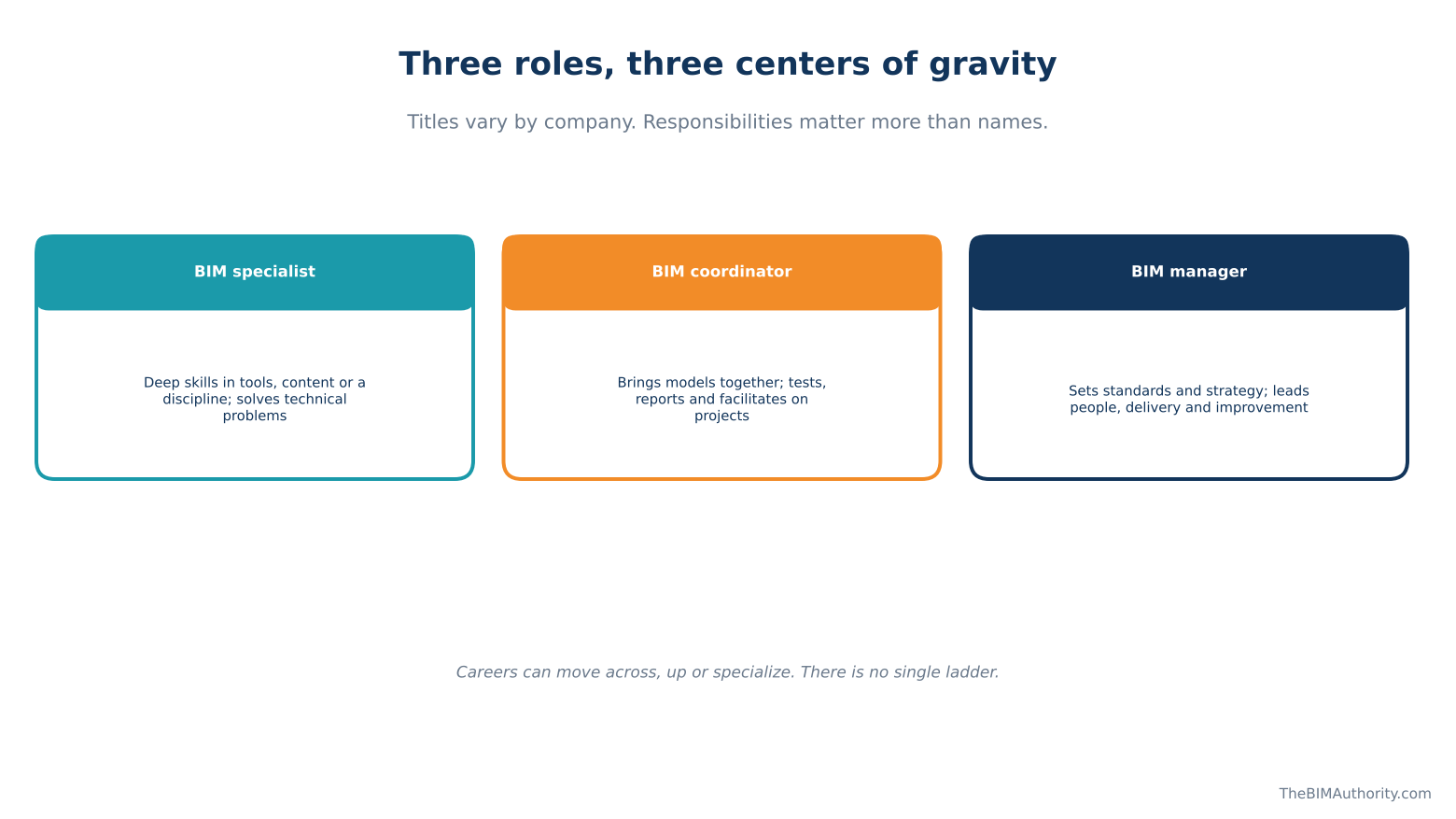
| Role | Center of gravity |
|---|---|
| BIM specialist | Deep skills in tools, content or a discipline; solves technical problems |
| BIM coordinator | Brings models together; tests, reports and facilitates on projects |
| BIM manager | Sets standards and strategy; leads people, delivery and improvement |
In one sentence:
Specialists go deep, coordinators go across, managers go wide: depth in a technical area, breadth across a project’s models, and breadth across an organization’s standards, people and results.
The Three Roles in Detail
BIM Specialist
| Aspect | Typical content |
|---|---|
| Purpose | Provide deep technical expertise that others rely on |
| Typical responsibilities | Advanced modeling in a discipline or tool; family and content creation; template development; troubleshooting complex modeling problems; technical support and training for colleagues; automation and scripts; research into new tools |
| Scope | Often a technical area (tools, content, a discipline, a workflow) rather than a whole project or organization |
| Skills | Expert-level tool knowledge; strong discipline knowledge; data and parameters; often scripting or computational skills |
| Tools | Authoring software; families; visual programming; scripting; checkers |
| Deliverables | Content libraries, templates, tools, solutions to hard problems, technical guidance |
| Works with | Modelers, coordinators, managers, vendors |
| Variations | Computational specialist, family specialist, structural or MEP BIM specialist, scan-to-BIM specialist, software specialist |
| Title confusion | Sometimes used for ordinary modeling roles |
BIM Coordinator
| Aspect | Typical content |
|---|---|
| Purpose | Make the models of a project work together |
| Typical responsibilities | Federate models; run clash and quality checks; group and report issues; run coordination meetings; apply project standards; keep registers and records; support authors. See BIM Coordination: The Complete Guide |
| Scope | A project or a part of a project |
| Skills | Coordination tools; IFC and exchange; coordinates; understanding of multiple disciplines; planning, communication, facilitation |
| Tools | Coordination and checking tools; issue trackers; CDE; dashboards |
| Deliverables | Federated model, clash reports, issue lists, minutes, model registers |
| Works with | Discipline teams, project managers, BIM manager, contractors, clients |
| Variations | Discipline coordinator (for example MEP coordinator), construction coordinator, design coordinator, VDC coordinator |
| Title confusion | In some firms the coordinator writes standards; in others “coordinator” means a senior modeler |
BIM Manager
| Aspect | Typical content |
|---|---|
| Purpose | Make the organization good at BIM |
| Typical responsibilities | Standards, templates and libraries; BEPs and EIR responses; quality management; training and people; technology and automation; client and tender support; risk; reporting; improvement. See BIM Quality Management: Processes, Metrics, and Best Practices |
| Scope | An organization, a department or a major project or program |
| Skills | Technical breadth; ISO 19650 and process; leadership and change; commercial and strategic thinking |
| Tools | Standards tooling; CDE; analytics; automation; project and resource management |
| Deliverables | Standards, plans, policies, training programs, strategy, reports, trained people |
| Works with | Directors, project managers, coordinators, specialists, clients, IT, vendors |
| Variations | Project BIM manager, head of BIM, BIM director, digital delivery manager, VDC manager |
| Title confusion | In small firms, a hands-on generalist; in large ones, a leadership role |
A Fourth Role: Information Manager
An information manager, in the sense of ISO 19650’s information management function, focuses on the processes that govern information: requirements, CDE, quality, security and delivery. It often overlaps with coordinator and manager roles. See BIM Information Manager: Roles, Skills, and Career Opportunities.
Side-by-Side Comparison
| Dimension | Specialist | Coordinator | Manager |
|---|---|---|---|
| Primary question | “How do I solve this technical problem?” | “Do these models work together, and what must be decided?” | “Is our organization or project set up to deliver BIM well?” |
| Time horizon | Task to project | Project cycle (weeks) | Project to organization to years |
| Focus | Depth | Integration | Direction |
| Output | Solutions, content, tools | Decisions and reports | Standards, people, strategy |
| Success measure | Technical quality; problems solved | Issues resolved; models aligned; cycles on time | Delivery quality; capability; adoption; value |
| Communication style | Technical explanation | Facilitation and negotiation | Leadership, influence, reporting |
| Typical background | Modeler with deep skill | Modeler or engineer with coordination experience | Coordinator, specialist or designer with leadership |
| People management | Rare (mentoring) | Rare (leads processes, not people) | Common |
| Contract and commercial exposure | Low | Medium | High |
| Technology breadth | Deep in a few tools | Broad across tools’ outputs | Broad and strategic |
Where They Overlap
| Overlap | Why |
|---|---|
| All need strong BIM fundamentals | Models, data, standards |
| Coordinator and manager | Both involve standards and process; in smaller firms one person does both |
| Specialist and manager | Specialists often become standards owners; managers keep technical skills |
| Specialist and coordinator | Both need technical depth; coordinators need breadth, specialists depth |
| All need communication | Different styles |
| Information management | Spread across the roles |
In small organizations, one person may be all three: modeling, coordinating projects and writing standards. In large organizations, roles separate and may have further layers.
Reading Job Advertisements
Titles mislead; responsibilities reveal.
| Clue in the advertisement | Likely meaning |
|---|---|
| “Model”, “produce drawings”, “Revit proficiency” | Modeling role, whatever the title |
| “Clash detection”, “coordination meetings”, “federated model” | Coordination role |
| “Standards”, “BEP“, “implementation”, “training”, “strategy”, “team management” | Management role |
| “Families”, “templates”, “automation”, “troubleshooting”, “R&D” | Specialist role |
| “CDE”, “ISO 19650”, “information requirements”, “delivery plans” | Information management role |
| “Reports to the director” | Leadership or strategic scope |
| “Reports to the project manager” | Project-level role |
| Years of experience and team size | Seniority and scope |
| Contract and tender duties | Commercial involvement |
Questions to Ask Before Accepting a Role
| Question | Why |
|---|---|
| What will I do in a typical week? | Reality behind the title |
| Who will I work with and report to? | Authority and support |
| What does success look like in the first year? | Expectations |
| What standards and tools exist? | Maturity |
| How many people will I manage or support? | Scope |
| What training and development is available? | Growth |
| How is BIM valued here? | Influence |
How Teams Are Structured
| Structure | Description |
|---|---|
| Small practice | One BIM lead (manager, coordinator, specialist in one), plus modelers |
| Mid-sized firm | A BIM manager; project coordinators or leads; one or two specialists; modelers |
| Large firm or contractor | A head of BIM or digital director; BIM managers by division; project BIM managers and coordinators; specialists (computational, content, reality capture); information managers; modelers |
| Owner organization | Information manager or head of information management; asset information specialists; links to FM and IT |
| Project team | A project BIM manager (or lead appointed party’s information manager), coordinators per discipline or zone, modelers per discipline |
Career Movement
Careers are not ladders; they are networks of possible moves.
| From | Possible moves |
|---|---|
| Modeler | Specialist, coordinator, discipline lead |
| Specialist | Senior specialist, computational lead, manager (if leadership interest), consultant |
| Coordinator | Senior coordinator, information manager, manager, VDC roles |
| Manager | Head of BIM or director, information management leadership, digital construction leadership, consultancy, owner-side roles |
| Information manager | Head of information management, owner-side digital asset roles, digital twin strategy |
Choosing a Direction
| If you enjoy… | Consider… |
|---|---|
| Solving hard technical problems and building tools | Specialist |
| Seeing the whole project, resolving conflicts, keeping a rhythm | Coordinator |
| Shaping how people work, leading and strategy | Manager |
| Systems, standards, governance and data | Information manager |
| Construction sequences and site realities | Construction BIM and VDC roles |
| Research and technology | Computational, reality capture or technology roles |
You can try each in small ways: lead a template update (manager), run coordination for a zone (coordinator), build a tool (specialist), set up a CDE (information manager).
Pay and Seniority
Pay patterns differ by market, employer and scope. In general, published figures show managers above coordinators and specialists in many markets, with significant variation and overlap. See BIM Salaries Around the World for sources and cautions. Compare responsibilities and scope, not titles.
For Employers: Defining Roles Well
| Practice | Why |
|---|---|
| Write responsibilities, not just titles | Clarity |
| Define scope and authority | Avoid “responsibility without authority” |
| Use a competency framework | Consistent expectations. See BIM Skills Matrix: Competencies Required for Every Professional Level |
| Create career paths | Retain people |
| Separate technical and managerial tracks | Specialists need paths that do not require managing people |
| Align with contracts and BEPs | Roles appear in project documents |
| Review periodically | Roles evolve |
Common Mistakes
- Choosing a title instead of a role.
- Assuming titles mean the same everywhere.
- Hiring a manager to do a specialist’s work, or vice versa.
- Expecting one person to be all three at scale.
- No technical career track.
- Responsibility without authority.
- Promoting the best modeler into management without support.
- Ignoring information management.
- No defined competencies.
- Misreading job advertisements.
- Not asking about the real week.
- Not reviewing roles as the organization changes.
See also Common BIM Mistakes Beginners Should Avoid.
A Short Checklist
- Do I know which center of gravity (depth, integration, direction) I enjoy?
- When reading a role, do I look at responsibilities and scope, not only the title?
- Do I know who I would report to and work with?
- Does the organization define competencies and career paths?
- For employers: have we written responsibilities, authority and success measures?
- Have we separated or clarified information management responsibilities?
- Are roles aligned with contracts and BEPs?
- Do we offer a technical track as well as a management track?
- Do we review roles regularly?
- Am I building evidence for the role I want next?
Frequently Asked Questions
What is the difference between a BIM coordinator and a BIM manager?
A coordinator makes the models of a project work together; a manager sets standards and strategy and leads people and delivery across projects or the organization.
What does a BIM specialist do?
Provides deep technical expertise: advanced modeling, content, templates, automation and support, depending on the organization.
Which role pays most?
Managers typically earn more than coordinators and specialists in many markets, but pay varies widely by country, employer and scope.
Which role should I choose?
The one that matches your strengths and interests: depth (specialist), integration (coordinator) or direction (manager).
Can one person do all three roles?
In small organizations, often yes; at scale, roles separate.
Is a BIM specialist junior or senior?
It varies; some organizations use the title for expert roles, others for junior ones. Read the responsibilities.
Where does the information manager fit?
Focused on information processes under ISO 19650; overlaps with coordinator and manager roles. See BIM Information Manager: Roles, Skills, and Career Opportunities.
How do I move from coordinator to manager?
Take on standards, planning, training and leadership tasks; build evidence; develop commercial awareness. See How to Become a BIM Manager: The Complete Career Guide.
Final Thoughts
When I interview people about their careers, I ask a question that has nothing to do with titles. “Describe a week in which you felt you did your best work.” The specialists describe a problem: a family that would not behave, a script that finally ran, a template that unblocked twenty people. The coordinators describe a room: a meeting where a conflict was resolved and a model stopped being a problem. The managers describe other people: someone they taught, a project that ran well because of a standard they wrote, a client who trusted them.
That answer tells me more than any title. Depth, integration or direction: each is a valid and valuable way to love this work. The industry needs all three, and needs people who understand how they fit together. Read responsibilities, ask about the real week, build evidence and move toward the center of gravity that makes you want to come back on Monday.
Where to go next: for each path, read How to Become a BIM Modeler: Skills, Training, and Career Path, How to Become a BIM Coordinator: Responsibilities and Qualifications and How to Become a BIM Manager: The Complete Career Guide. For competencies, continue with BIM Skills Matrix: Competencies Required for Every Professional Level, and for the information role, BIM Information Manager: Roles, Skills, and Career Opportunities.