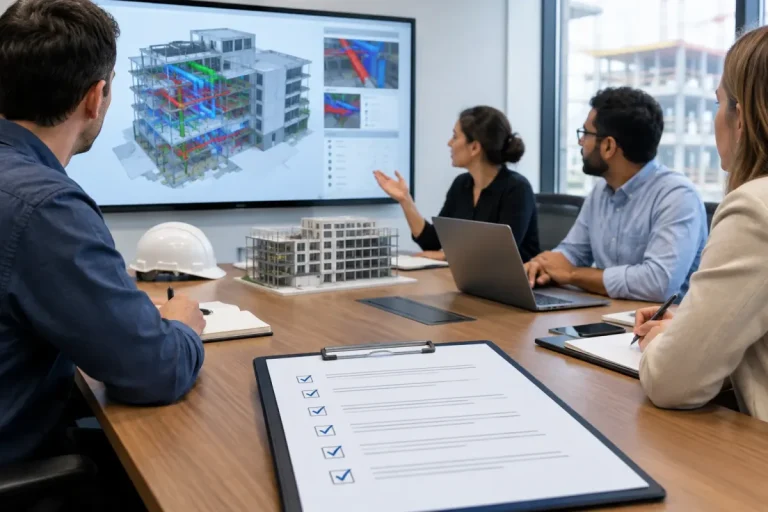

The best BIM team I ever worked with was not the most technically gifted. It was a group of eleven people in a mid-sized engineering office, with mixed skills and one famously grumpy senior engineer who had said, in the very first meeting, that BIM was “a way of making simple things expensive”. What made the team extraordinary was something that happened in month three. The grumpy engineer found a clash between his structure and a services riser that would have cost the project a week on site. He walked over to the coordinator’s desk, a little embarrassed, and said: “Fine. That one was worth it.” From that day, he became the team’s most demanding champion, because he understood what the work was for.
That small event contains most of what I know about building a team for BIM. Training matters, but it is the smaller part. What changes a team is a sequence of experiences: understanding why, seeing a benefit that is relevant to your own work, learning how, being able to do it on real work and finding that it sticks. Skip any of these and people comply without conviction or resist without saying so. Organizations that treat BIM as a training problem get certificates. Organizations that treat it as a change get capability.
This guide is about building that capability: how to think about the people side of BIM, a five-stage change journey, how to plan roles and skills, how to use champions and communities of practice, how to handle resistance with respect, how to recruit and develop talent and how to tell whether the team is truly ready. It pairs with BIM Training Plan for Your Team, which covers curriculum and scheduling in detail.
The Short Answer
A BIM-ready team has the right roles, the right skills and, above all, the right understanding and motivation, supported by leadership, processes and tools. Building one means managing two things at once: learning (skills and knowledge) and change (beliefs, habits and ways of working).
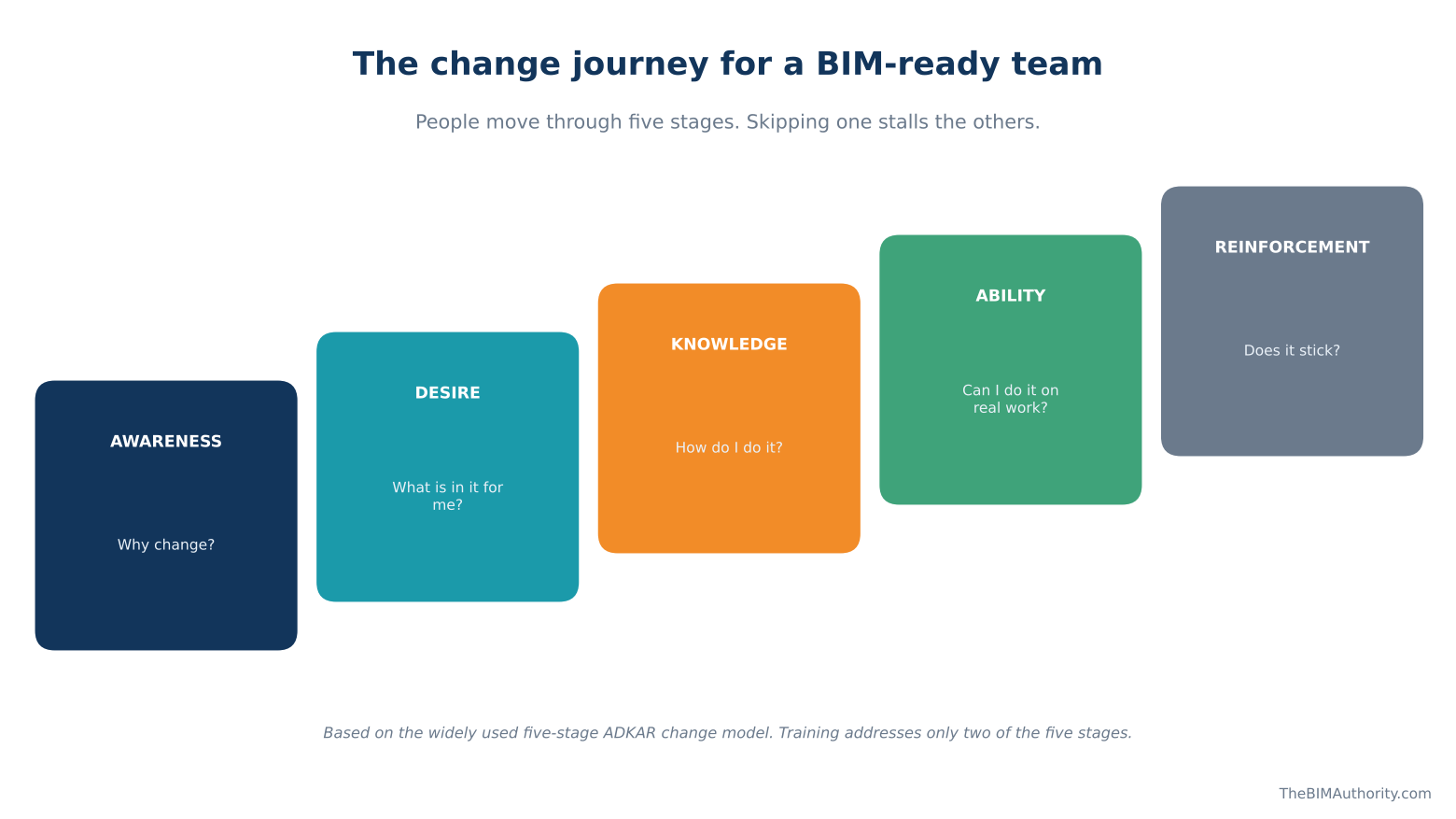
A widely used model of individual change, the five-stage ADKAR model associated with Prosci, describes the journey well:
| Stage | Question the person asks | What helps |
|---|---|---|
| Awareness | Why is this changing? | Clear explanation of the reasons, from leaders and clients |
| Desire | What is in it for me? Do I want to take part? | Relevant benefits, involvement, addressing concerns |
| Knowledge | How do I do it? | Training, guides, examples |
| Ability | Can I actually do it on real work? | Practice, coaching, time, tools |
| Reinforcement | Will it last? | Recognition, feedback, standards, leadership behavior |
Training addresses mainly knowledge and, with coaching, ability. The other three stages depend on leadership, communication and culture.
In one sentence:
People become BIM-ready when they understand why, want to, know how, can do it on real work and are supported to keep doing it.
What “BIM-Ready” Means
A team is BIM-ready when it can reliably do the following, to the standard the work requires:
| Capability | Evidence |
|---|---|
| Understand the purpose | Team members can explain why BIM is used on the project and what their information is for |
| Follow standards | Templates, naming, modeling and sharing rules are applied without constant reminders |
| Produce quality information | First-time pass rates at checks are acceptable and improving |
| Collaborate | Issues are raised, resolved and closed through the agreed process |
| Exchange information | Exports and imports work to the specification |
| Plan and deliver | Deliverables meet the TIDP and MIDP dates |
| Learn and improve | Problems lead to changes in standards and habits |
Readiness is a team property, not only a sum of individual skills.
Step 1: Understand Your Starting Point
Before planning training or communication, understand the team.
| Question | How to find out |
|---|---|
| What skills exist? | Skills inventory against a competence framework. See BIM Skills Matrix: Competencies Required for Every Professional Level |
| What attitudes exist? | Short interviews or anonymous survey: enthusiasm, doubts, fears |
| Who influences others? | Informal networks: who do people ask? |
| What is the workload? | Capacity for learning alongside projects |
| What has been tried before? | Past initiatives that succeeded or failed, and why |
| What do clients expect? | Requirements and upcoming tenders |
Map people into a simple stakeholder grid: strongly supportive, neutral, concerned, opposed, and high or low influence. It tells you where to invest conversation time.
Step 2: Design Roles and Structure
Decide how BIM roles will exist in the team. See BIM Roles and Responsibilities: Manager, Coordinator, Modeler, and Information Manager.
| Element | Consideration |
|---|---|
| BIM lead or manager | Sponsor-backed, with time and mandate |
| Coordinators | Experienced people who integrate models; some firms rotate this role to spread skills |
| Champions | One per team or discipline; respected, practical, willing; time allocated |
| Information management function | Named person for the CDE and standards |
| Mentors | Experienced staff paired with newer ones |
| Career paths | A visible route from modeler to coordinator to manager, so people see a future |
Make the Roles Real
Allocate time (for example a defined share of a champion’s week), include responsibilities in job descriptions and recognize the work in reviews. A role without time is a label.
Step 3: Communicate Why, Repeatedly
Awareness and desire are built by communication, not by training.
Principles
- Lead with why. Explain the business and client reasons, and what success will look like.
- Speak to the audience. Designers care about design quality and workload; project managers about risk and predictability; leaders about value and competitiveness.
- Be honest about the costs. Say that there will be a learning period and extra effort, and what support exists.
- Use examples. Concrete stories (like the riser clash) persuade more than slogans.
- Repeat. People need to hear things several times, from several people.
- Listen. Create channels for questions and concerns, and respond visibly.
- Show leadership behavior. Leaders who use the standards and ask for BIM information send the loudest signal.
A Simple Communication Plan
| Moment | Message | Channel |
|---|---|---|
| Start | Why, objectives, what will change, what support exists | All-hands meeting; one-page summary |
| Before each phase | What happens next, who is involved | Team meetings |
| During the pilot | Progress, early results, lessons | Short updates; showcase sessions |
| After milestones | Results, what we changed | Scorecard; lessons session |
| Continuously | Tips, wins, questions | Chat channel; monthly clinic |
Step 4: Plan Learning Properly
Training should be built around roles and moments, not around a catalog. The detailed method is in BIM Training Plan for Your Team. The essentials:
- Role-based pathways: leaders, project managers, coordinators, modelers and designers, support staff.
- Just-in-time timing: train when people will use the skills.
- Blended methods: short courses, workshops, e-learning, guides, coaching on real projects, peer learning.
- Practice on real work, with time allocated.
- Assessment: simple checks that people can do the tasks (for example producing a model to the template that passes checks).
- Certification where valuable: for example for roles that clients or tenders require. See BIM Certifications: The Complete Guide to Professional Credentials and Best BIM Courses and Training Programs.
Step 5: Support Ability: Coaching and Practice
The biggest gap I see between training and capability is ability: the moment when a person has to use a new skill on a real project, under pressure, with colleagues watching. This is where people either succeed or retreat to old habits.
What Helps
| Support | How it works |
|---|---|
| Embedded coaching | An experienced person works alongside the team on real tasks for a defined period |
| Buddy systems | Pair newer with experienced staff |
| Office hours / clinics | A regular slot where anyone can bring a problem |
| Quick guides and examples | One-page guides, sample files, short videos |
| Reviews with feedback | First-time models reviewed constructively |
| Protected time | A realistic allowance for slower work in early projects |
| Safe-to-fail pilots | Permission to make mistakes and report them |
Resist the temptation to demand immediate productivity. The dip is normal and brief if supported.
Step 6: Handle Resistance With Respect
Resistance is information. It usually has a reason.
| Reason | What people say | Response |
|---|---|---|
| Fear of incompetence | “I am too old to learn this.” | Provide safe practice, patient coaching, small first steps; recognize existing expertise |
| Loss of status or autonomy | “I do not need standards.” | Involve them in writing the standards; value their experience |
| Workload | “We have no time.” | Adjust workload; protect learning time; remove less valuable tasks |
| Doubt about value | “This will not help.” | Show relevant examples; run a pilot; share results honestly |
| Past bad experience | “We tried this before.” | Acknowledge it; explain what is different |
| Poor tools or process | “It is slower.” | Investigate; fix real problems quickly |
| Lack of trust in leadership | “They will drop it in a year.” | Show consistent commitment; protect resources |
Practical Moves
- Meet resistance with curiosity, not pressure.
- Convert skeptics into reviewers: their questions improve the standards.
- Fix real problems visibly: if a complaint is valid, change something and say so.
- Avoid public shaming, and avoid mandates without support.
- Recognize that some people will not adapt; plan roles accordingly, with respect.
Step 7: Champions and Communities of Practice
Champions
A champion is a respected team member who helps colleagues adopt the new way of working. Good champions:
- are practical, not just enthusiastic;
- have credibility with peers;
- have time allocated;
- are trained and briefed early;
- report problems upward and bring answers downward.
Meet them regularly as a group.
Communities of Practice
A community of practice is a group that meets regularly to share experience: lunchtime sessions, a chat channel, a monthly showcase. They spread knowledge, reduce dependence on a few experts and create belonging. Keep them informal, useful and short.
Knowledge Management
- Capture lessons at the end of each project.
- Maintain a knowledge base: how-to guides, templates, examples, FAQs.
- Make it searchable and keep it current.
- Reward contribution.
Step 8: Recruit and Develop Talent
Hiring
| Consideration | Guidance |
|---|---|
| Core roles | Define the competence profile for each role, from technical skills to communication and standards knowledge |
| Look beyond tool skills | Attitude, learning ability and collaboration often matter more than a specific tool |
| Hire for gaps | Coordination, information management and automation skills may be missing |
| Onboarding | A planned first month: standards, templates, CDE, shadowing |
| Use certification as a signal, not a guarantee | Combine with practical assessment |
Development
- Career paths from modeler to coordinator, information manager and BIM manager. See How to Become a BIM Coordinator: Responsibilities and Qualifications and How to Become a BIM Manager: The Complete Career Guide.
- Annual development plans linked to the competence framework.
- Rotations between projects and roles.
- External exposure: conferences, user groups, standards bodies.
- Mentoring from experienced practitioners.
Retention
BIM-skilled people are in demand. Retention depends on interesting work, learning, recognition and a visible future, not only on pay.
Step 9: Leadership Behavior
Leaders shape culture more than any training program.
| Behavior | Effect |
|---|---|
| Ask for information in the agreed form | Signals that standards matter |
| Use the CDE and dashboards | Shows it is the real system |
| Protect learning time | Shows commitment |
| Celebrate learning from mistakes | Encourages honesty |
| Make decisions that match the message | Builds trust |
| Resource the BIM lead | Shows seriousness |
| Do not bypass the process | Preserves credibility |
The fastest way to kill a BIM program is for a senior person to ask for a drawing by email, outside the process, “just this once”.
Measuring Team Readiness
Track a small set of indicators.
| Indicator | What it shows |
|---|---|
| Awareness and understanding | Survey: can people say why BIM is used and what is expected of them? |
| Training completion and application | Share trained; share applying the skills on projects |
| First-time pass rate at quality gates | Ability and quality |
| Standards compliance | Habit formation |
| Issue closure time | Collaboration |
| Questions and support requests | Pattern of needs; falling over time for basics |
| Champion activity | Engagement |
| Retention and satisfaction | Culture |
| Project outcomes | Value delivered |
Use a short pulse survey every quarter during the program: three or four questions on understanding, confidence, support and workload.
Common Mistakes
- Treating BIM as a training problem only.
- Training everyone at once, far from real use.
- Communicating once and assuming people understood.
- Ignoring workload and demanding immediate productivity.
- No coaching on real projects.
- Treating resistance as obstruction instead of information.
- No champions, or champions without time.
- Leaders who bypass the process.
- No career path for BIM roles.
- Hiring only for tool skills.
- No knowledge capture, so lessons are lost.
- No reinforcement: standards and recognition fade after the launch.
See also Why BIM Implementations Fail (and How to Avoid It) and Common BIM Mistakes Beginners Should Avoid.
A Short Checklist
- Do we understand the team’s skills, attitudes and influence networks?
- Are roles defined with time (BIM lead, coordinators, champions, information management)?
- Is there a communication plan that explains why, repeatedly?
- Is training role-based and just-in-time, with practice on real work?
- Is there coaching and support at the moment of need?
- Do we respond to resistance with curiosity and real fixes?
- Do we have communities of practice and knowledge capture?
- Are there career paths and development plans?
- Do leaders model the behavior?
- Do we measure readiness with a few indicators and a pulse survey?
Frequently Asked Questions
How do I build a BIM-ready team?
Understand the starting point, define roles with time, communicate why, provide role-based training, support people with coaching on real work, handle resistance respectfully, build champions and reinforce with leadership and measures.
What is change management in BIM?
Managing the people side of adoption: awareness, motivation, knowledge, ability and reinforcement, so new ways of working take hold.
How do I deal with staff who resist BIM?
Listen to their reasons, address real problems, involve them in standards, provide safe practice and protect time. Treat resistance as information.
What is a BIM champion?
A respected team member with allocated time who helps colleagues adopt standards, answers questions and brings feedback to the BIM lead.
Is training enough?
No. Training builds knowledge and, with coaching, ability. Awareness, desire and reinforcement depend on communication, leadership and culture.
How long does it take to build a BIM-ready team?
Typically months for a team and one to three years for a large organization, depending on starting point and project cycles.
Should I hire BIM specialists or train existing staff?
Usually both: train existing staff for continuity and culture, and hire for specific gaps such as coordination or information management.
How do I keep BIM skills in the team?
Provide interesting work, learning, recognition, career paths and a supportive culture.
How do I know the team is ready?
By evidence: understanding, first-time pass rates, standards compliance, issue closure, deliveries on time and reduced support needs.
Final Thoughts
The grumpy engineer stayed with that office for years, and he never stopped complaining about software. But he also became the person who taught new graduates how to read a clash report, with the patience of someone who had once been skeptical himself. When I asked him what had changed his mind, he said: “Nobody argued with me. Somebody showed me a problem I would have missed.”
That is the secret of a BIM-ready team. Not slogans, not mandates, not even great courses, but a sequence of respectful experiences that lead people to see the point, learn the skill, use it on real work and find that it helps. Plan that sequence deliberately. Give people reasons, skills, support and time. Everything else follows.
Where to go next: for the curriculum and schedule, read BIM Training Plan for Your Team. For the competence detail, continue with BIM Skills Matrix: Competencies Required for Every Professional Level, and for the roadmap the team supports, How to Implement BIM in Your Company: A Step-by-Step Roadmap.