


Of the four information requirements in ISO 19650, the OIR is the one that I see written least often, and the one whose absence causes the most expensive problems. This is a paradox, because OIR sounds like the most abstract document in the chain. It does not describe walls, doors or model detail. It describes something that executives rarely think about in terms of information: what the organization needs to know about its assets in order to do its job.
I remember sitting with the property director of a large public organization, asking a simple question: “What do you want to know about your buildings that you cannot easily find out today?” He looked at me for a while, then said: “Honestly, everything that matters. How old they are, what condition they are in, what it costs to run them, whether they are safe, and which ones I should sell.” After a pause, he added: “But nobody has ever asked me to write that down.” Within a morning, we had a one-page list of fourteen questions. That page became the foundation of the organization’s first OIR, and, over the following years, the reason its projects started delivering data that its asset managers could actually use.
This guide explains what an OIR is, how ISO 19650 defines it, what belongs in one, who should contribute, how to write one step by step, how to keep it alive and how it connects to the AIR, the PIR and the rest of the information management process. You will not need a large document. You will need a good conversation and the discipline to write down what it produces.
The Short Answer
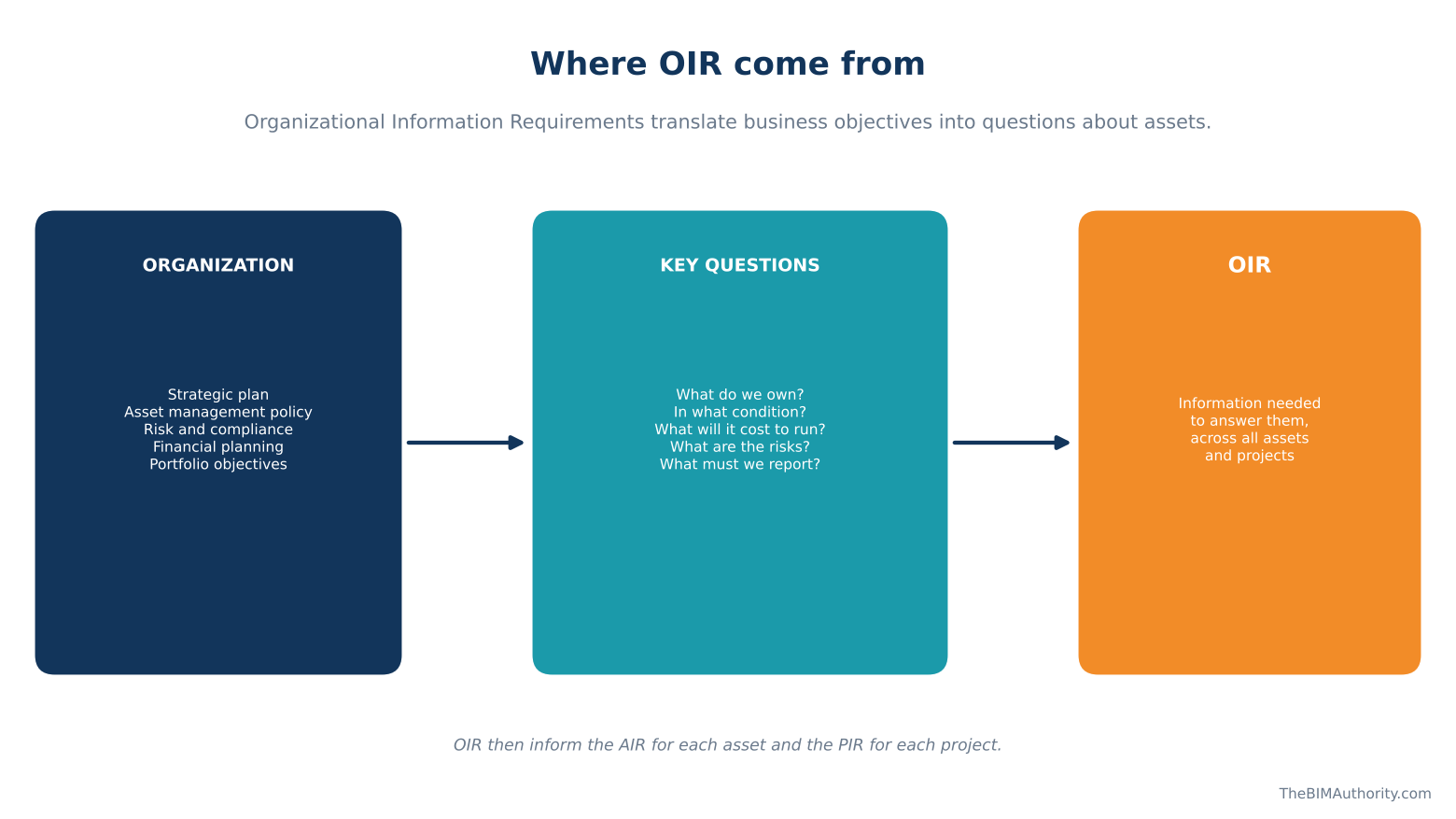
Organizational Information Requirements (OIR) are the information requirements of an organization in relation to its own objectives: what it needs to know about its assets, across its whole portfolio, to meet its strategic, operational, financial, regulatory and sustainability responsibilities.
In ISO 19650, the OIR:
- belong to the asset owner or operator (the organization that owns or manages the assets);
- apply to all assets and projects of the organization, not to a single one;
- are the top level of the chain, informing the AIR (asset level) and the PIR (project level);
- relate to the organization’s asset management, including its strategic planning, regulatory duties, policy making and portfolio management.
In one sentence:
The OIR answer the question: “Why does this organization need information about its assets, and what does it need to know?”
Why OIR Matter
Without OIR, the information chain starts in the middle. AIR and PIR are written without a clear reason, and EIR are written without any anchor. The consequences are predictable.
| Without OIR | With OIR |
|---|---|
| Each project invents its own information needs | Projects inherit consistent needs from the organization |
| Handover data does not match what asset managers need | Handover is designed backward from decisions |
| Information is requested “just in case” | Each requirement traces to a business purpose |
| Different departments ask for different data about the same asset | One agreed set of questions |
| Suppliers face different requirements on every contract | Stable requirements reduce supplier cost and confusion |
| Investment in BIM cannot be justified | Value is measured against stated business needs |
OIR are also where strategy meets data. A board that says “we want to reduce energy consumption by thirty percent” has just written an information requirement, whether it knows it or not: it needs reliable energy data by building.
What OIR Typically Contain
An OIR is not a list of technical fields. It is organized around business questions. Here are the typical categories, with the kind of questions they raise.
| Category | Example questions | Why the organization asks |
|---|---|---|
| Asset inventory | What assets do we own or operate? Where are they? Who owns them legally? | Basic accountability and planning |
| Condition and performance | In what condition is each asset? How is it performing against its purpose? | Maintenance and renewal planning |
| Cost | What does it cost to operate, maintain and renew each asset class? | Budgeting and value for money |
| Risk and safety | Which assets present safety or business-continuity risks? Are they compliant? | Duty of care and resilience |
| Compliance and reporting | What must we report, to whom and how often? | Regulatory and financial obligations |
| Utilization | How are spaces and assets used? | Efficiency and portfolio decisions |
| Sustainability | What are the energy use, carbon and resource impacts? | Environmental targets and disclosure |
| Life cycle and renewal | When will each asset reach end of life? What will it cost to replace? | Investment planning |
| Change and growth | Which assets are affected by planned projects? | Portfolio and project planning |
| Information governance | Who owns information, how is it protected, how long is it kept? | Security, privacy and retention |
You will notice that few of these are “BIM questions” at all. They are asset management questions. The OIR connect them to the information that BIM and other systems can supply. That is exactly the point.
The Link With Asset Management
ISO 19650 explicitly links information management with asset management, and refers to the ISO 55000 family of standards. The logic is that asset management decides what to do with assets, and information management ensures that decisions are made with reliable information. If your organization has an asset management policy, strategy or plan, it is the best raw material for an OIR. If it does not, writing an OIR will often reveal the gap.
Who Contributes to an OIR
The OIR belong to the organization, not to a BIM team. The best OIRs are written by cross-functional groups.
| Contributor | What they bring |
|---|---|
| Senior management | Strategic objectives and priorities |
| Asset and portfolio managers | Decisions about assets and the information they lack |
| Facility and operations managers | Day-to-day information needs |
| Finance | Cost, valuation and reporting requirements |
| Risk, safety and compliance | Regulatory and safety information |
| Sustainability and energy managers | Environmental reporting needs |
| IT and data teams | Existing systems, data standards and governance |
| Project and capital delivery teams | What they need from existing assets to plan projects |
| BIM or information managers | Translation into information requirements and standards |
The facilitator, often the information manager or an external adviser, turns discussion into structured text.
How to Write an OIR: A Step-by-Step Method
Here is the method I use. It fits in two or three workshops and produces a first version that is immediately useful.
Step 1: Gather the Strategic Context
Collect what already exists: corporate strategy, asset management policy, regulatory obligations, financial reporting requirements, sustainability targets, digital strategy, existing data standards and system landscape. Read them with one question: what information does this imply?
Step 2: Identify Stakeholders and Interview Them
Interview or run workshops with the contributors listed above. Ask open questions:
- What decisions do you make about assets?
- What information do you need for them?
- What information do you lack, or find hard to get?
- What do regulators and funders ask you for?
- What went wrong in the past because information was missing or wrong?
Step 3: Convert Needs into Questions
Turn each need into a clear business question. “We need asset data” is not a requirement. “Which critical plant items are beyond their expected service life, and what would replacement cost?” is.
Step 4: Group and Prioritize
Group the questions by category (as in the table above). Then prioritize: which questions are critical, which are important, which are nice to have? Resources are finite, and priorities guide what projects must deliver first.
Step 5: Derive the Information Needed
For each priority question, list the information needed to answer it, at a general level: asset identification, location, age, condition, cost, risk rating, compliance status. This is not yet the detailed AIR. It is the category of information the organization needs, across all its assets.
Step 6: Identify Sources and Owners
For each information need, note where it comes from today, who owns it and whether it exists at all. This reveals gaps and duplications.
Step 7: Define Principles and Constraints
Capture principles that apply to all information:
- Data standards the organization uses or wants to use (classification, identifiers, formats).
- Governance: ownership, security, privacy, retention. See BIM Information Security, Access Control, and Data Governance.
- Quality expectations: how complete, accurate and current information should be.
- Systems: which systems hold which information, and how project information will feed them.
Step 8: Write It Down, Briefly
Write the OIR in plain language, in a structured document. A good first OIR is often two to six pages. Use tables: question, why it matters, information needed, priority.
Step 9: Approve and Publish
Obtain approval from the appropriate level of management. Publish the OIR so that AIR writers, project teams and suppliers can use it.
Step 10: Plan Maintenance
Define the owner, the review cycle (at least annually) and the change process.
A Worked Example: A Municipal Property Owner
Here is a condensed illustration for a fictional municipality that owns schools, libraries, depots and offices. It is a teaching example, not a template to copy.
| # | Business question | Why it matters | Information needed (general) | Priority |
|---|---|---|---|---|
| 1 | Which buildings do we own, where are they and what are they used for? | Portfolio planning, insurance | Asset identification, location, use, ownership, area | Critical |
| 2 | In what condition is each building, and what maintenance backlog do we have? | Budgeting, safety | Condition rating, defects, remaining life of main systems, backlog cost | Critical |
| 3 | Do our buildings comply with fire and safety rules? | Duty of care, regulation | Fire safety systems, inspection dates, compliance status, certificates | Critical |
| 4 | How much energy and carbon does each building use? | Climate targets, disclosure | Energy consumption, floor area, systems, certificates | High |
| 5 | What does each building cost to run and maintain? | Value for money | Operating and maintenance costs by asset class | High |
| 6 | Which spaces are underused? | Efficiency, rationalization | Space areas, occupancy, usage patterns | Medium |
| 7 | Which assets will need replacing in the next ten years, and what will it cost? | Capital planning | Asset age, expected life, replacement cost estimates | High |
| 8 | When projects change a building, what must we know beforehand? | Project planning | Current asset information model, hazards, constraints | High |
| 9 | Who is responsible for each piece of information, and how long do we keep it? | Governance | Owners, retention periods, access rules | Medium |
From this table, the organization can derive its AIR for schools, depots and so on, and the PIR for each project.
OIR for Different Kinds of Organizations
The structure is the same, but the emphasis differs.
| Organization | Typical emphasis |
|---|---|
| Hospital trust or healthcare owner | Critical plant, infection control, compliance, continuity of service, space utilization |
| Local authority or public estate owner | Condition, backlog, safety, accessibility, energy, community use |
| Infrastructure operator (roads, rail, utilities) | Asset condition, inspection regimes, network performance, safety, resilience, geospatial position |
| Property investor or developer | Valuation, lease information, performance, sustainability ratings, exit and refurbishment planning |
| Industrial or corporate owner | Process-critical assets, production continuity, regulatory compliance, security |
| University or campus owner | Teaching space, research facilities, utilities, space allocation, energy |
For infrastructure, remember the link with geospatial information. See BIM and GIS Integration: The Complete Guide and Infrastructure BIM: The Complete Guide.
A Template for an OIR Document
A short, practical structure:
- Purpose and scope: what the OIR is for, which assets and organizational units it covers.
- Organizational context: the strategy, policies and obligations it supports.
- Roles and ownership: who owns the OIR, who is consulted.
- Business questions and information needs: the table, grouped and prioritized.
- Information principles: data standards, identifiers, classification, formats, quality expectations, governance and security.
- Systems and sources: where information is held and how projects feed it.
- Relationship to AIR, PIR and EIR: how the OIR will be used.
- Review and change control: cycle, owner, version history.
Keep it short. A document nobody reads has no value.
How OIR Flow Into the Rest of the Process
OIR are only useful if they are used.
| Next document | How the OIR feed it |
|---|---|
| AIR | For each asset type, the OIR priorities decide which asset information is needed and at what level. See Asset Information Requirements (AIR): Complete Guide |
| PIR | For each project, the OIR tell the project what organizational needs it must serve and what organizational data it must provide. See Project Information Requirements (PIR): Complete Guide |
| EIR | Indirectly, through AIR and PIR, shaping what suppliers must deliver. See Exchange Information Requirements (EIR): Complete Guide |
| Standards and information protocols | Identifier, classification and governance principles are reused across projects |
| Tender evaluation | Supplier capability to meet organization-wide information standards |
| Asset information model | Its structure reflects the organization’s questions. See ISO 19650-3: Information Management During Asset Operations |
A practical test: take one recent project and trace a deliverable back to the OIR. If you cannot, you either have a requirement without a purpose or an OIR with a gap.
Keeping OIR Alive
OIR are not a one-time exercise. Organizations change, regulations change and the questions evolve.
- Review annually, and after major strategic or regulatory changes.
- Collect feedback from projects: which information did they find unclear or missing?
- Track usage: which information is actually consumed, and which sits unused? Remove or simplify the latter.
- Version the document and keep a change log.
- Link it to governance: assign an owner at senior level, supported by the information manager.
- Align with other strategies: digital, asset management, sustainability.
Common Mistakes
- Not writing one at all, and starting the chain at the EIR.
- Writing it as a technical data list instead of business questions.
- Writing it in isolation, without the people who use the information.
- Making it too long, so it is never read.
- Making it too vague, such as “all information about all assets”.
- No prioritization, so everything is equally urgent.
- No link to asset management strategy.
- Confusing OIR with AIR, mixing organization-wide needs with asset-specific data fields.
- No owner and no review cycle.
- Never connecting it to projects, so the chain stops at the top.
See also Common BIM Mistakes Beginners Should Avoid.
A Short Checklist
- Have we identified the strategic and regulatory context?
- Have we consulted the people who use asset information?
- Are needs expressed as clear business questions?
- Are they grouped and prioritized?
- Have we listed the information needed and where it comes from?
- Have we defined information principles and governance?
- Is the document short, plain and approved?
- Do the AIR and PIR trace back to it?
- Is there an owner, review cycle and change control?
- Have we tested it by tracing a recent deliverable back to it?
Frequently Asked Questions
What are OIR in ISO 19650?
Organizational Information Requirements: the information an organization needs about its assets to meet its business objectives, covering all its assets and projects.
Who writes the OIR?
The asset owner or operator, usually through a cross-functional group, with support from the information manager.
What is the difference between OIR and AIR?
OIR are organization-wide and expressed as business questions. AIR are specific to an asset or asset type and expressed as the information needed to operate and maintain it.
How long should an OIR be?
As short as it can be while remaining useful. A first version can be a few pages.
Do small organizations need an OIR?
They need the thinking: a list of the questions they ask about their assets. It can be one page.
How do OIR relate to asset management?
They are the information side of the asset management objectives. Asset management defines what to do with assets; OIR define what must be known to do it.
How often should OIR be reviewed?
At least annually, and after significant changes in strategy, regulation or portfolio.
Do OIR have to be written before a project starts?
Ideally, yes, since they inform the AIR and PIR. If they do not exist, write a short first version at the start of the project, and refine it afterward.
Are OIR only for BIM?
No. They describe information needs regardless of the technology. BIM is one way of supplying some of the information.
Final Thoughts
The property director’s fourteen questions were not sophisticated. None required a technical vocabulary. But once written, they gave everyone downstream a reason: the asset managers knew what to ask for, the project teams knew what to deliver and the suppliers knew why. The conversation about data stopped being about formats and started being about decisions.
That is what an OIR does at its best: it ties information to purpose. If your organization has never written one, set aside two hours with three or four of the right people, bring a flip chart and ask the question: What do we wish we knew about our assets? The answers will be your OIR in embryo, and the beginning of an information chain that finally starts where it should.
Where to go next: to turn organizational questions into asset data, read Asset Information Requirements (AIR): Complete Guide. For the project level, continue with Project Information Requirements (PIR): Complete Guide, and for the overview of all four, ISO 19650 Information Requirements Explained: OIR, AIR, PIR, and EIR.



