



I have a theory about BIM procurement, built from watching hundreds of tenders: the quality of a project’s information is mostly decided before the first model is built, on the day the client issues its requirements. By the time a team is appointed, the shape of the information, what will be produced, to which standard, by whom and how it will be checked, has largely been fixed by the documents that went out with the invitation to tender. If those documents are vague, no amount of excellent modeling afterward will rescue the project. If they are specific, even an average team will produce useful information.
Yet most clients treat BIM procurement as an afterthought. A paragraph is added to the tender: “The successful bidder shall provide a BIM model in accordance with ISO 19650.” That sentence achieves very little. It does not say what to deliver, when, in what form or how it will be accepted. It does not ask bidders to show capability. And it does not carry down the supply chain, so the subcontractor who will produce half the data has never seen it.
ISO 19650-2 provides a better way. It treats procurement and appointment as part of the information management process: the client assesses its needs, issues information requirements, asks bidders to demonstrate capability and plan, appoints the lead party and expects that party to repeat the pattern for its own appointments. This guide explains that process from the client’s side: what to prepare, how to assess bidders, what to put in the appointment documents, how to handle different procurement routes and how to cascade requirements. It is the counterpart of How to Respond to BIM Requirements in Tenders, which describes the bidder’s side. It is not legal advice; see BIM Contracts and Legal Considerations.
The Short Answer
Under ISO 19650-2, procurement and appointment follow a pattern that repeats at every level of the supply chain.
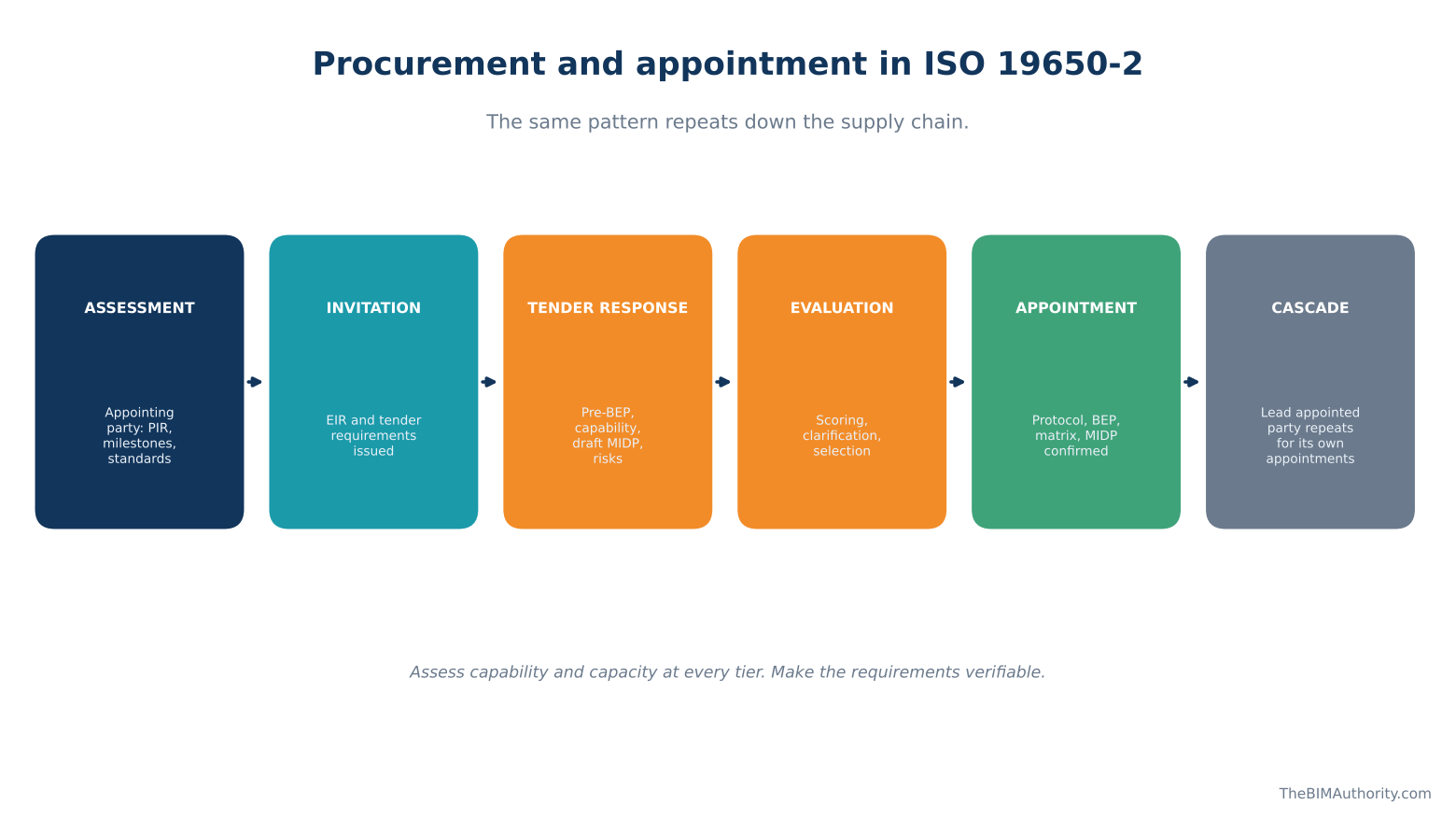
| Activity | Who | What happens |
|---|---|---|
| Assessment and need | Appointing party | Establish project information requirements, milestones, standards, methods, reference information, CDE and the information protocol |
| Invitation to tender | Appointing party | Issue the EIR, the information protocol and tender response requirements, with evaluation criteria |
| Tender response | Prospective lead appointed party | Submit a pre-appointment BEP, capability and capacity evidence, a draft MIDP, a mobilization plan and a risk register |
| Evaluation and selection | Appointing party | Assess against criteria; clarify; select |
| Appointment | Both | Confirm the BEP, responsibility matrix and MIDP; sign appointment documents including the information protocol |
| Cascade | Lead appointed party | Write EIR for its own appointed parties and repeat the pattern |
In one sentence:
Good BIM procurement asks for the right information, tests whether bidders can deliver it, and writes the answer into the appointment.
Terms in Brief
| Term | Meaning |
|---|---|
| Appointing party | The party that requires information from the party it appoints (the client, or a contractor appointing subcontractors) |
| Lead appointed party | The party that coordinates the information management of a delivery team |
| Appointed party | A party that provides information about works, goods or services |
| Task team | A group within a party assigned a specific task |
| Information protocol | The contractual document setting out obligations and rights relating to information |
| EIR | Exchange information requirements for an appointment |
| Pre-appointment BEP / post-appointment BEP | The delivery team’s proposed and confirmed plans |
See BIM Roles and Responsibilities: Manager, Coordinator, Modeler, and Information Manager and ISO 19650-2: BIM Information Management During Project Delivery.
Step 1: Assessment and Need (Before You Tender)
Before writing any tender document, the appointing party should establish what it needs. This is the stage where most of the value is created or lost.
What to Establish
| Item | Why |
|---|---|
| Project information requirements (PIR) | The information needed to make decisions. See Project Information Requirements (PIR): Complete Guide |
| Link to OIR and AIR | What the organization and operation need. See Organizational Information Requirements (OIR): Complete Guide and Asset Information Requirements (AIR): Complete Guide |
| Information delivery milestones | When information is delivered and accepted, linked to decisions |
| Information standard | Naming, classification, formats, coordinates. See BIM File Naming Conventions and ISO 19650 |
| Production methods and procedures | How information is produced and exchanged |
| Reference information and shared resources | Surveys, existing models, libraries: what the client provides, with its status and reliability |
| CDE solution and workflow | Who provides it, how it works. See Common Data Environment (CDE): The Complete Guide |
| Security approach | The outcome of the sensitivity triage. See ISO 19650-5: Security-Minded BIM Information Management |
| Information protocol | The contractual document on information rights and obligations |
| Internal capacity | Who on the client’s side will review and accept information, and when |
The Information Management Function
Assign the appointing party’s information management function. Someone must write the EIR, answer clarification questions, manage the CDE, review deliveries and accept information. If nobody does, the best tender documents will not survive the project.
Step 2: Invitation to Tender
What the Tender Package Should Contain
| Document | Notes |
|---|---|
| EIR | The specific information requirements for the appointment. See Exchange Information Requirements (EIR): Complete Guide |
| Information protocol and draft appointment terms | Contractual treatment of information. See BIM Contracts and Legal Considerations |
| Project information standard and methods | Naming, classification, formats, coordinates, CDE rules |
| Reference information | What is provided, in what form, with what reliability |
| Tender response requirements | What bidders must submit: pre-appointment BEP, capability and capacity evidence, draft MIDP, mobilization plan, risk register, high-level responsibility matrix |
| Evaluation criteria and weights | How responses will be scored |
| Programme and milestones | Information delivery milestones |
| Clarification procedure | How and when bidders may ask questions |
Principles for Good Tender Documents
- Be specific. Requirements that bidders cannot interpret consistently cannot be compared.
- Be proportionate. Ask for information that serves a purpose. Use the level of information need.
- Make requirements verifiable. State how each will be checked, and where possible express alphanumerical requirements as IDS. See Information Delivery Specification (IDS): The Complete Guide.
- Be consistent. Cross-check EIR, protocol, standards and programme for contradictions.
- Say what matters most. Prioritize. Everything cannot be equally important.
- Give bidders time to respond properly, and budget for the effort you ask for.
- Ask for evidence, not promises.
Step 3: Assess Capability and Capacity
ISO 19650-2 expects the appointing party to judge whether a prospective team can deliver the required information. Two ideas are involved.
| Idea | Question |
|---|---|
| Capability | Does the team have the skills, experience, tools and procedures to do it? |
| Capacity | Does it have enough people and time, at the right moments? |
Assessment Tools
Frameworks provide structured methods. The UK BIM Framework publishes a capability and capacity assessment template, in which a set of information management questions is designed for simple yes/no answers with evidence where required. Example questions concern the team’s ability to deliver information against an information standard and production methods consistent with ISO 19650-2, and to comply with a security management plan, with requests for evidence such as previous experience, resumes of proposed team members and the mobilization plan.
Guidance in the same framework also illustrates pre-qualification questionnaires and technical evaluation using both weighted scoring and pass/fail methods. Third-party certification schemes for ISO 19650-2 alignment also exist, which some clients accept as evidence; they can reduce the effort of assessing capability, but they do not replace project-specific evidence.
What Good Assessment Looks Like
| Practice | Why |
|---|---|
| Assess the whole delivery team, including main subcontractors | Capability gaps often sit down the chain |
| Ask for evidence | Claims without evidence are not information |
| Test with a sample | A small exercise or sample deliverable reveals real ability |
| Check references | Talk to previous clients |
| Look at named people | Capability lives in individuals |
| Assess capacity at the relevant time | Availability during the project, not in general |
| Treat honest gaps constructively | A bidder who names a gap and plans support is stronger than one who denies it |
Step 4: Evaluate and Select
Criteria and Weights
Set criteria that reflect what matters. Typical categories for the BIM element of a tender:
| Criterion | What is judged |
|---|---|
| Understanding of requirements | Responds specifically to the EIR and project |
| Information management team | Named people, competence, availability |
| Approach and plan | Pre-appointment BEP, federation strategy, draft MIDP, mobilization plan |
| Capability and capacity evidence | Experience, standards, tools, resources, supply chain |
| Quality and security approach | Checks, acceptance, security measures |
| Risk management | Quality of the risk register and responses |
| Handover approach | Asset data and the AIR |
| Price | Cost and clarity of the information management scope |
Publish the weights. Combine pass/fail minimums (for example evidence of ISO 19650-aligned practice, or acceptance of the information protocol) with weighted scoring for the rest.
Evaluation Practice
- Use a panel including someone who understands information management.
- Score individually, then moderate.
- Record reasons for scores.
- Clarify ambiguities with bidders, treating all fairly.
- Interview the proposed team where appropriate.
- Check consistency between plan and price.
Step 5: Appoint and Mobilize
Appointment Documents
On appointment, the documents typically include:
| Document | Notes |
|---|---|
| Appointment agreement and conditions | Scope, fees, risk |
| Information protocol | Information rights and obligations |
| EIR | As issued, with any agreed changes |
| Post-appointment BEP | Confirmed from the pre-appointment version. See BIM Execution Plan (BEP): How to Create and Implement One |
| Detailed responsibility matrix | See How to Create a BIM Responsibility Matrix |
| MIDP | Consolidated from TIDPs. See Master Information Delivery Plan (MIDP): Complete Guide |
| Mobilization plan | And outcome of mobilization tests |
Check that these documents agree with each other, and that the order of precedence is stated.
Mobilization
Insist that the delivery team mobilizes before production: resources, IT, standards and procedures established and tested. Review the results of the mobilization test. See How to Set Up a Successful BIM Project from Day One.
Client-Side Readiness
The client must be ready too: the CDE configured, reference information issued, reviewers and approvers named, response times agreed. Many delays originate on the client’s side.
Step 6: Cascade Down the Supply Chain
ISO 19650 is recursive. A lead appointed party is an appointing party in relation to its own appointed parties.
- The lead appointed party identifies the parts of the client’s EIR and protocol that apply to each appointment.
- It writes EIR for each appointed party, using the same terms, milestones and standards, with scope-specific detail.
- It assesses capability and capacity of each, using the same principles.
- It appoints them with an information protocol and the relevant extract of the BEP and responsibility matrix.
- Each appointed party prepares a TIDP that feeds the MIDP.
- The lead checks what appointed parties deliver before passing it up.
The client can help by requiring flow-down in the appointment, asking bidders to explain how they will cascade requirements and reviewing a sample appointment package.
Procurement Routes
The process adapts to different routes.
| Route | Considerations for BIM procurement |
|---|---|
| Traditional (design, then construction tender) | Design team information must serve the contractor; treatment of novation; clear reliance rules; contractor’s own EIR and BEP at construction stage |
| Design and build | Single lead; contractor writes EIR for designers and subcontractors; the client’s EIR must address handover to the asset information model |
| Two-stage and early contractor involvement | Early engagement helps constructability information; define information obligations for each stage |
| Construction management | Several lead appointed parties; coordination between packages needs a clear information management plan |
| Collaborative and alliance models | Shared incentives help; still require clear requirements and a common information standard |
| Frameworks and multiple projects | Standardize EIR templates, protocols and standards across projects for consistency |
Procurement for Existing Assets: ISO 19650-3
When appointing parties to operate or maintain an asset, ISO 19650-3 applies the same approach to the operational phase, with the AIR and trigger events at the center. The appointing party issues requirements, assesses capability and appoints, and an asset information model is maintained. See ISO 19650-3: Information Management During Asset Operations.
Common Problems and Remedies
| Problem | Cause | Remedy |
|---|---|---|
| Bids that cannot be compared | Requirements vague | Specific, verifiable EIR; standard response format |
| Bidders claim full compliance with no evidence | Evidence not requested | Ask for capability evidence, named people and samples |
| Wins by the cheapest, poorest team | Price outweighs capability | Weight capability; set pass/fail minimums; check consistency of plan and price |
| Requirements lost down the chain | No cascade | Require flow-down; review a sample appointment |
| Contradictory documents | Written by different people | Cross-check; state precedence; legal review |
| Late reference information | Client not ready | Prepare and issue early; state its status |
| Client cannot review deliverables | No client-side function | Assign the information management function; plan review time |
| BEP never updated | No governance | Include BEP maintenance and change control in the appointment |
| No capacity to assess bids | Evaluators lack knowledge | Include someone with information management expertise; use templates |
Common Mistakes
- A one-sentence BIM requirement in the tender.
- No EIR, or an EIR copied from another project.
- No capability assessment.
- Evaluating on price first and capability later.
- Asking for too much from bidders, or too little time.
- No information protocol in appointment documents.
- No flow-down to subcontractors.
- No client-side information management.
- Skipping mobilization.
- Not checking consistency across documents.
- No handover and AIM requirements.
- No acceptance criteria.
See also Common BIM Mistakes Beginners Should Avoid.
A Short Checklist for Appointing Parties
- Have we established PIR, milestones, standards, methods, reference information, CDE and security?
- Is our information management function assigned?
- Does the tender include EIR, protocol, standards and tender response requirements?
- Are requirements specific, proportionate and verifiable?
- Are evaluation criteria and weights published, with capability properly weighted?
- Do we assess capability and capacity with evidence, including the supply chain?
- Are appointment documents consistent, with an order of precedence?
- Is mobilization required and tested?
- Is flow-down required and checked?
- Are handover and acceptance defined?
Frequently Asked Questions
How does procurement work under ISO 19650?
The appointing party establishes requirements, issues the EIR and tender requirements, evaluates responses (including a pre-appointment BEP and capability evidence), appoints the lead party and expects it to repeat the process for its own appointments.
What should a BIM tender include?
The EIR, information protocol, information standard and methods, reference information, tender response requirements, evaluation criteria and programme.
How do I assess a bidder’s BIM capability?
With a structured capability and capacity assessment, evidence of relevant projects and named people, samples, references and, where relevant, third-party certification, all tied to the project’s requirements.
What is an information protocol?
The contractual document that sets out obligations and rights relating to information. ISO 19650-2 and -3 require the appointing party to produce one. See BIM Contracts and Legal Considerations.
What is mobilization?
The activity in which the delivery team establishes and tests resources, IT, standards and procedures before production.
How do requirements reach subcontractors?
The lead appointed party writes EIR for each of its appointments, assesses capability and includes the relevant protocol terms, repeating the process.
Do I need ISO 19650 certification from bidders?
You may ask for evidence of ISO 19650-aligned capability. Certification can be accepted as evidence, but should be complemented by project-specific information.
Who should evaluate BIM responses?
A panel that includes someone with information management expertise, using published criteria.
How does this apply to small projects?
Use the same pattern in a lighter form: a short EIR, a simple response requirement and a quick capability check.
Final Thoughts
The best BIM procurement I have seen was by a client with no particular technical sophistication. They did three things. They wrote a ten-page EIR that started with a table of the decisions they needed to make. They asked each bidder for a two-page plan for the first milestone and the names of the people who would deliver it. And they spent an afternoon interviewing the proposed information managers. They selected a team that was not the largest or the most famous, and the project ran quietly and on time.
That is the point of procurement under ISO 19650: it is a way of buying capability and clarity, not just models. Say what you need, ask for evidence, check the cascade and write the answer into the appointment. The rest of the project will be easier for everyone.
Where to go next: for the bidder’s side, read How to Respond to BIM Requirements in Tenders. For the contract language, continue with BIM Contracts and Legal Considerations, and for the requirements themselves, Exchange Information Requirements (EIR): Complete Guide.



