

Ask ten people in the industry what a BIM coordinator does and you will get twelve answers. In one office, the coordinator is a senior modeler who happens to run clash tests. In another, she is a project manager’s right hand who produces reports. In a third, “BIM coordinator” is the title given to anyone who knows how to open Navisworks. I once worked on a project where the client’s EIR required a “BIM manager”, the architect appointed a “BIM lead”, the contractor appointed a “digital construction manager” and the MEP engineer appointed nobody at all because “the modelers do it”. At the first coordination meeting, four people believed they were responsible for the federated model, and two others believed no one was.
The problem was not the titles. Titles in this industry are unreliable and always have been. The problem was that nobody had written down the functions: who sets the standards, who operates the CDE, who runs the checks, who produces the models, who accepts the deliverables. When functions are unassigned, they are either done twice or not at all.
This guide sorts it out. It explains how ISO 19650 describes roles at the appointment level, how the information management function works, and then describes the practical project roles: BIM manager, information manager, BIM coordinator, task team lead, modeler, checker and the client-side roles. It gives each role a card with purpose, responsibilities, skills and interfaces, shows how to combine roles on small projects and explains how to write them into the BEP and the responsibility matrix. For the matrix itself, see How to Create a BIM Responsibility Matrix.
The Short Answer
BIM roles exist on two layers.
| Layer | Question | Examples |
|---|---|---|
| Appointment roles (ISO 19650) | Who is appointing whom, for what? | Appointing party, lead appointed party, appointed party, task team, delivery team |
| Function roles (practical project roles) | Who carries which information management and BIM activities? | BIM manager, information manager, BIM coordinator, task team lead, modeler or author, checker, CDE administrator |
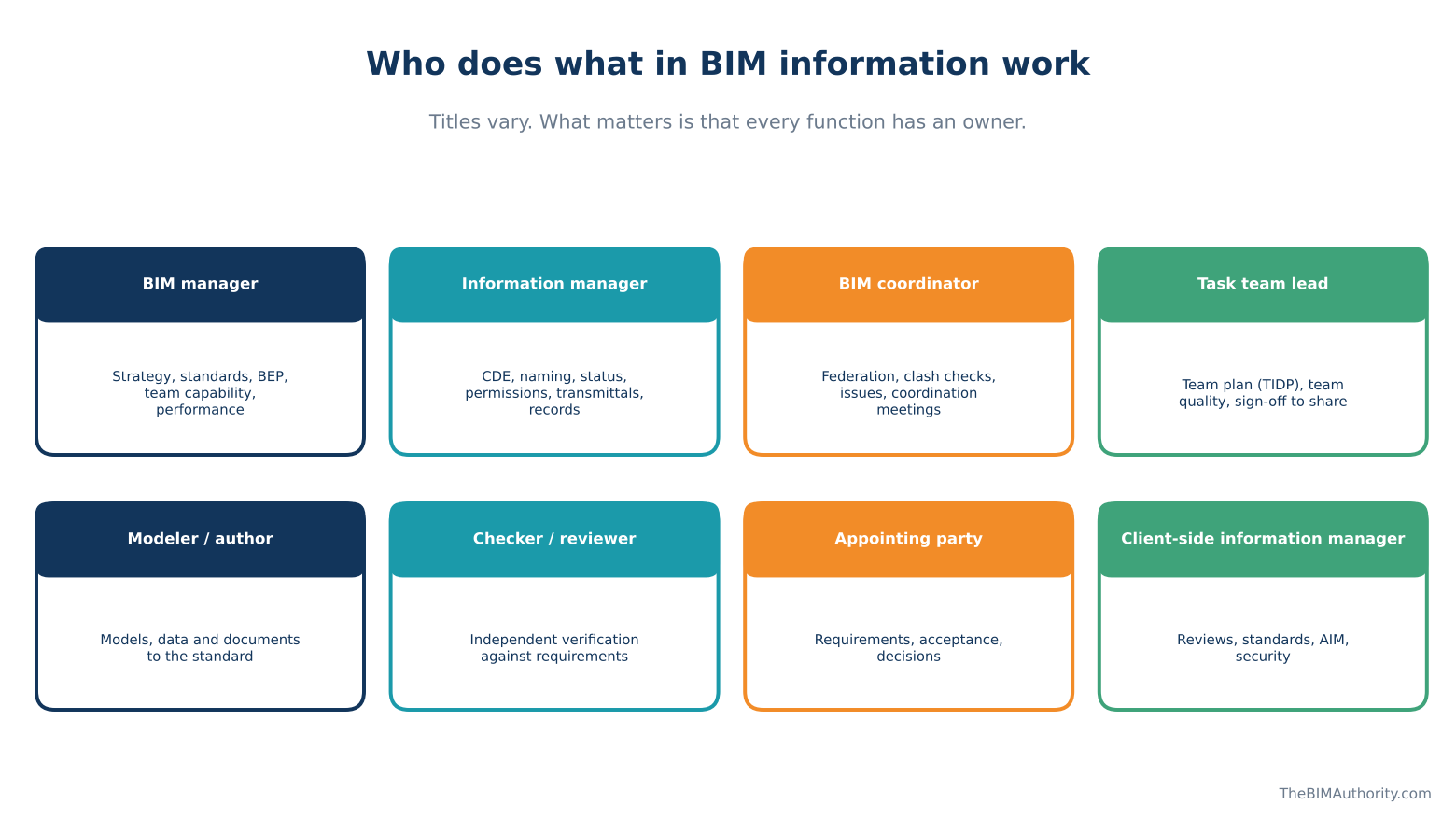
The two layers are connected. The appointment roles decide who has obligations to whom. The function roles decide who actually does the work within each organization. A single person can hold several functions, and a single function can be shared, but every function must have an owner.
In one sentence:
A role is a bundle of responsibilities with an owner and some authority. A title is just a label. Write down the bundle, not the label.
Layer 1: Appointment Roles in ISO 19650
ISO 19650 uses a small vocabulary for the parties in an information management process. Learn it, because EIR, BEPs and contracts use it.
| Role | Definition (in plain words) | Example |
|---|---|---|
| Appointing party | The party that receives information from, and provides requirements to, a lead appointed party | The client or the main contractor, depending on the appointment |
| Lead appointed party | The party that coordinates the information management of the delivery team and is appointed by the appointing party | The lead designer, or the main contractor |
| Appointed party | A party that provides information concerning works, goods or services | A structural consultant, a subcontractor |
| Task team | A group of individuals assigned a specific task | The MEP design team within an engineering consultancy |
| Delivery team | The lead appointed party and all its appointed parties | The design team, or the construction team |
A key feature: the roles are relative to an appointment. A main contractor is a lead appointed party in relation to the client, and an appointing party in relation to its subcontractors. That recursion is what lets requirements cascade down the supply chain. See ISO 19650-2: BIM Information Management During Project Delivery and BIM Procurement and Appointments Under ISO 19650.
The Information Management Function
Within this structure, ISO 19650 defines the information management function: the set of activities required to establish and run the information management process. It exists on both sides of an appointment.
- On the appointing party’s side, the function covers defining requirements, setting standards and methods, establishing or approving the CDE, reviewing and accepting information.
- On the delivery team’s side, the function covers the BEP, the responsibility matrix, the MIDP, the CDE workflow, quality, exchange and records.
The standard does not name people or titles. It lists activities and expects the parties to assign them. The BEP shows who carries each activity, with names, organizations and competence. The UK BIM Framework’s BEP guidance, for instance, includes a table of the individuals that will undertake the information management function, and a detailed responsibility matrix for the delivery team’s activities.
Layer 2: Practical Project Roles
Here are the roles that most projects need. For each, I give a purpose, typical responsibilities, skills, authority and interfaces. Adapt them to your organization.
BIM Manager (or BIM Lead)
Purpose: ensure BIM is planned, standardized and controlled, on a project or across an organization.
| Aspect | Description |
|---|---|
| Typical responsibilities | Develop and maintain the BEP and standards; define roles and the responsibility matrix; plan information delivery with the MIDP; set quality and risk procedures; support and train teams; report to project management and the client; drive improvement |
| Skills | Standards knowledge, planning, communication, leadership, technical fluency, risk thinking |
| Authority | To define and enforce the project’s BIM standards and procedures; to escalate non-compliance |
| Interfaces | Project manager, information manager, coordinators, task team leads, client |
| Typical outputs | BEP, responsibility matrix, MIDP, quality reports, performance reports |
See BIM Management: The Complete Guide for Professionals.
Information Manager
Purpose: operate the information management process and the CDE, so that information is correctly identified, controlled and recorded.
| Aspect | Description |
|---|---|
| Typical responsibilities | Configure and administer the CDE; enforce naming, metadata and status; manage permissions and access reviews; run gates and transmittals; keep records; support audits; manage the information standard and code lists |
| Skills | Document control, CDE platforms, data management, attention to detail, security awareness |
| Authority | To accept, reject or return containers that do not comply; to grant and remove access |
| Interfaces | BIM manager, task team leads, IT, security adviser, appointing party’s information manager |
| Typical outputs | CDE configuration, transmittal records, compliance reports, access reviews |
The information manager role is the one most often forgotten and most often missed when things go wrong. See Common Data Environment (CDE): The Complete Guide and How to Set Up a Common Data Environment for BIM Projects.
BIM Coordinator
Purpose: integrate the work of disciplines by federating and checking models, and managing coordination issues.
| Aspect | Description |
|---|---|
| Typical responsibilities | Federate models; run clash detection and rule checks; prepare and issue coordination reports; manage issues (typically in BCF); chair or support coordination meetings; verify coordinates and alignment; track resolution |
| Skills | Coordination tools, clash analysis, model checking, communication, patience, a reasonable understanding of building systems |
| Authority | To request corrections from disciplines; to reject models that fail agreed checks; to escalate unresolved conflicts |
| Interfaces | Task team leads, modelers, BIM manager, project manager |
| Typical outputs | Federated models, clash and issue reports, meeting minutes, issue logs |
See BIM Coordination: The Complete Guide, BIM Clash Detection: The Complete Guide and BIM Collaboration Format (BCF): The Complete Guide.
Task Team Lead (Discipline Lead)
Purpose: be accountable for the information produced by one task team, and for its plan.
| Aspect | Description |
|---|---|
| Typical responsibilities | Prepare and maintain the team’s TIDP; assign work; ensure the team follows the BEP; approve information for sharing after checks; resolve issues assigned to the team; report progress and risks |
| Skills | Discipline expertise, planning, leadership, understanding of standards |
| Authority | To approve the team’s information for sharing; to allocate team resources |
| Interfaces | Coordinator, BIM manager, other task team leads |
| Typical outputs | TIDP, authorization to share, issue responses |
See Task Information Delivery Plan (TIDP): Complete Guide.
Modeler or Information Author
Purpose: produce the models, data and documents to the agreed standard.
| Aspect | Description |
|---|---|
| Typical responsibilities | Create and maintain models and documents; follow templates, naming and modeling rules; fill in required properties; run self-checks before submitting; respond to issues; export information as specified |
| Skills | Authoring tools, discipline knowledge, attention to detail, willingness to follow standards |
| Authority | Over the quality of their own work within the standards |
| Interfaces | Task team lead, coordinator |
| Typical outputs | Models, drawings, schedules, data, exports |
Titles include BIM modeler, BIM technician, BIM author or discipline designer. Remember that designers are information authors too: the engineer who calculates and specifies is producing information even if someone else models it.
Checker or Reviewer
Purpose: verify information against requirements independently of its author.
| Aspect | Description |
|---|---|
| Typical responsibilities | Run checks (model, data, documents); review against EIR and standards; report non-conformities; verify corrections |
| Skills | Checking tools, standards, discipline understanding, rigor |
| Authority | To reject information that fails criteria |
| Interfaces | Task team leads, BIM manager, information manager |
Independence matters. A person who checks their own work will miss what they always miss. See BIM Quality Management: Processes, Metrics, and Best Practices.
CDE Administrator
Purpose: run the technical side of the CDE platform. Often part of the information manager role, or shared with IT.
| Aspect | Description |
|---|---|
| Typical responsibilities | Configure areas, workflows and permissions; manage users; monitor storage, backups and security; support users |
| Skills | Platform administration, security awareness |
Client-Side Roles
The appointing party also needs people.
| Role | Responsibilities |
|---|---|
| Client project manager or sponsor | Own the PIR and decisions; approve milestones; allocate resources for review |
| Client information manager (or BIM lead) | Write or review the EIR and requirements; define standards; approve or provide the CDE; review and accept information; link to the asset information model |
| Asset or facility manager | Contribute to the AIR; accept handover data; operate the AIM |
| Security adviser | Carry out the sensitivity triage; advise on controls |
Many projects fail because the client cannot review what it asked for. Plan client-side capacity from the start. See Exchange Information Requirements (EIR): Complete Guide and Asset Information Requirements (AIR): Complete Guide.
Other Roles You May Meet
| Role | Typical focus |
|---|---|
| Project manager | Programme, cost, risk, people. Works with BIM manager on delivery |
| Design manager | Design process, coordination of design deliverables |
| BIM champion | A respected team member who helps colleagues adopt standards |
| Computational designer or automation specialist | Scripts, parametric tools, data automation. See BIM Automation: The Complete Guide |
| Visualization or VDC specialist | Visualization, 4D, virtual construction |
| Scanning and survey specialist | Reality capture and as-built data. See Scan-to-BIM: Converting Point Clouds into Intelligent Models |
| Facility information specialist | Asset data and CAFM integration |
Combining Roles on Small Projects
Few projects have all of these as separate people. The principle: combine functions deliberately, and avoid conflicts of interest.
| Project size | Typical combination |
|---|---|
| Small project, small team | One person as BIM manager, information manager and coordinator; modelers produce and self-check; task team leads are the discipline principals |
| Medium project | A BIM manager; a separate coordinator; the information manager function shared with document control; discipline leads as task team leads |
| Large project | Dedicated BIM manager, information manager team, several coordinators (by zone or system), separate checkers, a CDE administrator, and client-side information management |
Conflicts to Avoid
- Author and sole checker of the same information.
- Coordinator who also models the main discipline models being coordinated, without a second pair of eyes.
- Administrator with unreviewed power over permissions and the audit trail.
How to Define Roles in a Project
Step 1: List the Functions
Start from the activities, not the titles: set standards, write the BEP, operate the CDE, federate models, run checks, produce models, approve sharing, accept deliverables, manage security. The ISO 19650-2 activities and your BEP sections give a ready list.
Step 2: Assign Owners
For each function, name a person and a deputy. If it is done by an organization, name the organization and the contact.
Step 3: Write Role Descriptions
One page each: purpose, responsibilities, authority, interfaces, deliverables, competence required.
Step 4: Create the Responsibility Matrix
Map functions to roles with a responsibility matrix, so each activity has a single accountable party. See How to Create a BIM Responsibility Matrix.
Step 5: Check Competence
Ask for evidence of the skills required, and plan training where there are gaps. See Best BIM Courses and Training Programs.
Step 6: Define Authority and Escalation
State what each role can decide and how disagreements escalate. A BIM manager without authority becomes a messenger.
Step 7: Put It in the BEP and Contracts
Include the roles, names and matrix in the BEP, and make sure appointments reflect the obligations. See BIM Execution Plan (BEP): How to Create and Implement One and BIM Contracts and Legal Considerations.
Step 8: Review
Update when people or scope change.
A Role Card Template
Use this template for each role in your project or office standards.
| Field | Content |
|---|---|
| Role | Name |
| Purpose | One sentence |
| Reports to / works with | Interfaces |
| Responsibilities | Five to ten bullet points |
| Authority | What this role may decide or reject |
| Deliverables | Outputs |
| Competence required | Skills and experience |
| Performance indicators | How performance is judged |
| Deputy | Cover arrangement |
Typical Problems and Remedies
| Problem | Cause | Remedy |
|---|---|---|
| Nobody owns the CDE | Information manager function not assigned | Name an information manager; put it in the BEP |
| Coordinator blamed for model quality | Authors’ responsibility unclear | Define authors’ and task team leads’ responsibility for quality before sharing |
| BIM manager overloaded | Doing everything personally | Delegate to coordinators and champions; build capability |
| Titles differ between companies | No common vocabulary | Use a project glossary and the responsibility matrix |
| Client cannot review | Client-side roles missing | Plan client-side information management |
| Subcontractors unclear about duties | Requirements not cascaded | Include role expectations in appointment documents |
| Conflicts of interest | One person both authors and checks | Separate or add independent review |
| Roles forgotten when people leave | No deputies | Name deputies; keep role cards current |
Common Mistakes
- Defining roles by title instead of by function.
- No information manager.
- No authority given to the BIM manager or coordinator.
- Assuming modelers carry coordination responsibility.
- Ignoring client-side roles.
- No deputies.
- No competence check of nominated people.
- Roles in the BEP but not in the contracts.
- One person checking their own work.
- Never updating roles after changes.
See also Common BIM Mistakes Beginners Should Avoid.
A Short Checklist
- Have we listed functions before assigning titles?
- Does every function have an owner and a deputy?
- Are the information management functions for both client and delivery team named?
- Does each role have a description, authority and interfaces?
- Is there a responsibility matrix with one accountable party per activity?
- Have we avoided conflicts of interest?
- Have we checked competence and planned training?
- Are roles in the BEP and appointment documents?
- Is client-side capacity planned?
- Are roles reviewed when the project changes?
Frequently Asked Questions
What are the main BIM roles?
BIM manager, information manager, BIM coordinator, task team lead, modeler or information author, checker, CDE administrator and client-side information roles.
What is the difference between a BIM manager and a BIM coordinator?
The manager sets and controls standards, plans and performance. The coordinator integrates models, runs checks and manages issues.
What does an information manager do?
Operates the information management process and the CDE: identification, status, permissions, gates, transmittals and records.
What are appointing party, lead appointed party and appointed party?
ISO 19650 roles relative to an appointment: the party that requires information, the party that coordinates a delivery team’s information and the parties that supply it.
Is “BIM manager” a formal ISO 19650 role?
No. ISO 19650 defines an information management function and appointment roles, not job titles. BIM manager is a common practical title.
Can one person hold several BIM roles?
Yes, on small projects, as long as conflicts of interest are avoided and every function has an owner.
Who is responsible for model quality?
The author and the task team lead are responsible for quality before sharing. The coordinator and checkers verify. The BIM manager owns the quality procedures.
How do I write roles into a contract?
Through the BEP, responsibility matrix and appointment documents, with legal advice on contractual language.
Do clients need BIM roles?
Yes: at least someone responsible for requirements, review and acceptance, and, for owners, the asset information model.
Final Thoughts
Back to the project where four people thought they owned the federated model. We fixed it in one afternoon with a sheet of paper and a pen. We wrote the functions in a column: set standards, operate CDE, federate, check, authorize sharing, accept. Then we wrote names next to them, and argued in good humor about two rows. By the end, every function had one owner, and the confusion disappeared.
That is all role definition is: a small act of honesty about who is doing what. Do it early, put it in writing and review it when things change. The titles can stay as inconsistent as they like. The functions must not.
Where to go next: to turn roles into a working matrix, read How to Create a BIM Responsibility Matrix. For the manager’s perspective, continue with BIM Management: The Complete Guide for Professionals, and for the team plans, Task Information Delivery Plan (TIDP): Complete Guide.