
I once worked on a project where the client was American, the lead designer was British, the structural engineers were Canadian, the contractor was Australian and the fabricator was in Italy. In the kickoff meeting, within the first twenty minutes, I heard four different words for the document that describes how the team will manage information, three different words for the person responsible for it and two completely different opinions about what “LOD 350” meant. Nobody was wrong. Everyone was simply using the vocabulary of the country where they had learned to do BIM.
By the end of that project, I had built a one-page translation table that I now give to every international team I work with. It started as a survival tool, and it became a conviction: the BIM world is not divided by technology. It is divided by dialects of the same underlying framework. The framework is increasingly ISO 19650. The dialects are the national standards, annexes, classification systems and contract documents that each country wraps around it.
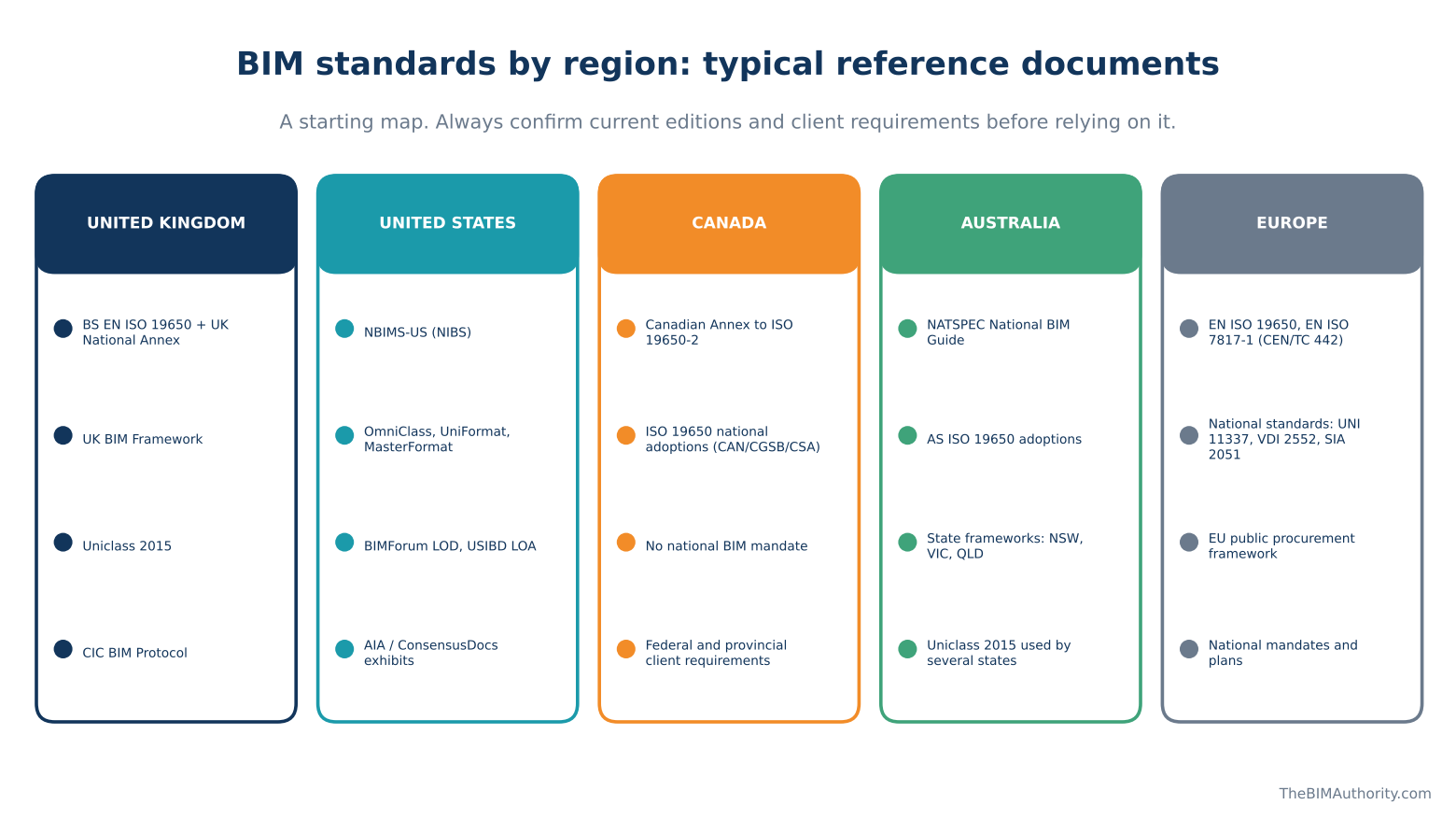
This guide maps those dialects for five major markets: the United States, the United Kingdom, Canada, Australia and Europe. For each, I will show what the main reference documents are, how they relate to the international standards, and what to watch for when you work across borders. I checked the main facts against current public sources before writing, but this is an area that changes every year, so treat the guide as a map for orientation and verify the current edition of any document before you cite it in a contract.
The Short Answer
Almost everywhere, the picture has the same four layers:
- International standards (ISO 19650, ISO 16739-1 for IFC, ISO 7817-1 for level of information need) form the common core.
- National adoptions and annexes adapt the international standards to local terminology, classification and naming conventions.
- National guides, strategies and mandates tell public and private clients how to use BIM locally.
- Contract documents and client requirements make it all binding on a specific project.
The differences between countries are mostly in layers 2 to 4. If you master the international layer, you can read any national system with a little translation.
Why National Annexes Exist
To understand the differences between countries, you need to know one design decision in ISO 19650. The international working group could not reach consensus on certain detailed conventions, notably how information containers are named and which classification system to use. The solution was to let each country add a National Annex: a supplementary document that specifies those local conventions without changing the requirements of the standard.
A well-known example given by the people involved: ISO 19650-2 requires information to be classified. The UK National Annex names Uniclass 2015 as the system to use, and a US National Annex was expected to name OmniClass. Annexes should not add requirements or modify the standard; they provide local clarifications and conventions.
So when two teams say “we both follow ISO 19650”, they may still use different file naming rules and different classification codes. That is not a contradiction. It is the design.
The United Kingdom
The Position
The UK is where much of the thinking behind ISO 19650 started. It deserves to be first not because it is “best”, but because its history explains the vocabulary that has spread everywhere else.
Key Reference Documents
| Document | What it is |
|---|---|
| BS EN ISO 19650 series (with UK National Annex) | The national adoption of the process standards. It replaced BS 1192 and PAS 1192-2 (withdrawn when the ISO parts were adopted), with later parts replacing the other PAS documents |
| UK BIM Framework | The overarching approach to implementing BIM in the UK, formally launched in October 2019, which integrates the ISO 19650 series into UK practice with guidance and templates |
| Information protocol for ISO 19650-2 | A contract document published in May 2020 by the UK BIM Framework with the Construction Industry Council, to support contracts using ISO 19650 |
| Uniclass 2015 | The UK classification system, led by NBS, launched in April 2015 and updated quarterly. Its structure follows ISO 12006-2 |
| Information Management Mandate | The government policy that evolved from the 2016 BIM mandate, set out in the Transforming Infrastructure Performance: Roadmap to 2030 published in September 2021 |
Things Worth Knowing
- The mandate evolved. The 2011 Government Construction Strategy led to the requirement for collaborative 3D BIM on centrally procured projects from April 2016. The 2021 roadmap redefined it as an information management mandate based on the UK BIM Framework and ISO 19650. Documents that still say “BIM Level 2” are historical. See BIM Maturity Levels (Level 0 to 3) and the Shift to ISO 19650.
- ISO 19650 conformance equals alignment with the mandate. Public bodies in the UK typically ask for ISO 19650-aligned information management, not for a level.
- Building safety legislation in England has introduced the idea of a golden thread of information for higher-risk buildings, which raises the importance of structured, maintained information. Seek legal advice for the details.
- Terminology from the UK documents (EIR, BEP, MIDP, TIDP, CDE) has become the international vocabulary. See BIM Terminology: The Essential Glossary for Beginners.
The United States
The Position
The US has a more decentralized landscape. There is no single national process standard that plays the role of the UK framework. Instead, you meet a mix of national standards, industry specifications, contract documents, federal agency requirements and classification systems.
Key Reference Documents
| Document | What it is |
|---|---|
| National BIM Standard-United States (NBIMS-US) | A consensus-based national standard from the National Institute of Building Sciences. Version 2 (2012) was the first consensus-based BIM standard in the US, Version 3 (2015) was free to download, and later versions have followed. It is a “standard of standards” that references others and documents exchanges and best practices |
| Project BIM Requirements (NIBS) | A standard defining the topics that an owner should include in its project requirements; it uses the ISO 19650-2 terms appointing party and appointed party |
| OmniClass, UniFormat, MasterFormat | Classification and specification systems from the Construction Specifications Institute (CSI), with MasterFormat also produced jointly with Construction Specifications Canada. The most recent MasterFormat edition is 2026, and CSI changed its licensing and delivery model in 2026 through a digital platform. Check the current licensing |
| BIMForum LOD Specification | The widely used reference for level of development, by element and discipline |
| USIBD Level of Accuracy specification | A reference for describing the accuracy of captured data in building documentation and scan-to-BIM |
| United States National CAD Standard | A consensus standard combining layer guidelines, the Uniform Drawing System and BIM plotting guidelines |
| AIA and ConsensusDocs contract documents | Contract exhibits and addenda that set out BIM and digital data obligations in project agreements |
| Federal and state agency requirements | Agencies such as the General Services Administration and the Army Corps of Engineers have required BIM on major projects, with their own guides |
Things Worth Knowing
- Vocabulary differs. In the US, you will meet Owner’s Project Requirements, BIM Project Execution Plan (often based on the Penn State planning guide) and LOD much more than EIR, BEP and LOIN. The concepts map closely, though not one-to-one.
- ISO 19650 adoption is growing. A US National Annex was discussed from the early days of the standard, and NIBS has aligned some of its documents with ISO 19650 terminology. I could not confirm the current status of any final US annex, so check with NIBS before you assume one exists.
- Contracts matter. Because the US relies heavily on contract documents to define BIM obligations, read the BIM exhibit as carefully as you read the technical standard.
- No national mandate. Requirements are set by individual federal agencies, state agencies and private owners. See BIM Mandates Around the World: A Country-by-Country Overview.
Canada
The Position
Canada shares much of the US classification and contract tradition, and increasingly looks toward ISO 19650. Its constitutional structure, with responsibilities shared between federal, provincial and territorial governments, means there is no national BIM mandate. Industry voices have been calling for one for years.
Key Reference Documents
| Document | What it is |
|---|---|
| Canadian National Annex to ISO 19650-2 | An annex prepared by buildingSMART Canada, version 1.0 published in 2023. It addresses container identification, status and revision, and discusses language-independent coding |
| National adoptions of ISO 19650 | The Canadian General Standards Board and the Canadian Standards Association have been working on adopting parts of ISO 19650 as national standards (for example a notice for Part 5) |
| buildingSMART Canada resources | Roadmaps, guidance, a professional certification program and contract appendices aligned with ISO 19650 |
| OmniClass, UniFormat, MasterFormat | Classification and specification systems in common use, with Canadian input through Construction Specifications Canada |
| Client requirements | Federal departments and agencies (for example for certain federal real property projects), provinces, hospitals, universities and private owners set their own BIM requirements |
Things Worth Knowing
- Bilingual and multi-jurisdictional. The Canadian annex discusses language-independent codes, a thoughtful solution for a bilingual country.
- Adoption is client-driven. Expect different expectations from different clients, even for similar projects.
- Security matters on federal work. Federal projects can involve classified information, so ISO 19650-5 thinking is relevant. See ISO 19650-5: Security-Minded BIM Information Management.
Australia
The Position
Australia has no federal BIM mandate. Requirements are driven by state governments and major public clients, with national guidance from industry bodies and standards organizations.
Key Reference Documents
| Document | What it is |
|---|---|
| NATSPEC National BIM Guide | A suite of documents for implementing BIM on a project, first released in 2011 and updated in 2016. It includes a Project BIM Brief template, a BIM Management Plan approach, a reference schedule and an Object/Element Matrix |
| National Digital Engineering Policy Principles | Principles agreed by Australian governments (2016) to support consistent application of digital engineering in public infrastructure |
| State frameworks | For example Transport for NSW’s Digital Engineering Framework, the Victorian Government’s digital build and asset information approach and Queensland’s digital enablement approach for infrastructure |
| Australian adoptions of international standards | Standards Australia publishes adopted versions of international standards, including ISO 7817-1 as AS ISO 7817.1:2024 (December 2024) and the ISO 19650 parts in the AS ISO 19650 series. Check the catalog for the current editions |
| Uniclass 2015 | Recommended for use by several state governments, including Victoria, Transport for NSW and Queensland |
| Asset information guidance | Asset information requirements guidance from the national BIM advisory body (ABAB) and state agencies |
Things Worth Knowing
- The term “digital engineering” is common, especially in infrastructure, and overlaps with information management in ISO 19650.
- State differences. Requirements in New South Wales, Victoria and Queensland differ in detail. Always check the specific agency.
- BIM Management Plan is the typical term for what ISO 19650 calls the BIM Execution Plan. The NATSPEC guide treats it as a key requirement.
- Classification choice varies. Some states recommend Uniclass 2015, giving Australia a different default from North America.
Europe
The Position
Europe is a mosaic. At the European level, CEN (through its BIM technical committee) adopts international standards as EN ISO versions, and the EU public procurement framework encourages Member States to use BIM in public works. At the national level, each country has its own standards, strategies and mandates.
European-Level Documents
| Document | What it is |
|---|---|
| EN ISO 19650 series | European adoptions of ISO 19650 parts, including Part 6 on health and safety (EN ISO 19650-6:2025) |
| EN ISO 7817-1:2024 | The European adoption of the level of information need standard, which replaced EN 17412-1:2020 |
| EN ISO 16739-1 | The European adoption of the IFC schema standard |
| EU public procurement directive | A 2014 directive that allows contracting authorities to require electronic modeling tools such as BIM in public works contracts, and encourages Member States to promote their use |
Selected National Examples
This list is illustrative, not exhaustive.
| Country | Typical references (examples) |
|---|---|
| Germany | A federal step-by-step plan for digital planning and construction (2015), a master plan for BIM in federal highways (2021) and one for federal buildings, plus the VDI 2552 series of guidelines; DIN adoptions of the EN ISO standards |
| Italy | The UNI 11337 series, which is regarded as integral to the UNI EN ISO 19650 framework, and the public procurement code with provisions on digital information management |
| Spain | A state plan for incorporating BIM in public procurement (approved in 2023), following the creation of an interministerial BIM commission in 2018 |
| France | A national digital transition plan for the building sector (to 2022) and standards bodies’ adoption of the EN ISO series |
| Ireland | Government construction procurement requirements for BIM introduced in January 2024, building on earlier industry adoption |
| Switzerland | The SIA 2051 guideline on the application of the BIM method |
| Nordic countries | Early public-client adopters, with national common BIM requirements such as the Finnish COBIM series |
For the mandates in detail, see BIM Mandates Around the World: A Country-by-Country Overview.
Things Worth Knowing
- CEN adoption can bring national withdrawal. When an EN ISO standard is adopted, conflicting national standards must be withdrawn. This is how EN 17412-1 gave way to EN ISO 7817-1.
- Language is a real issue. National standards, annexes and client documents may be in the local language. Use the official translations.
- Classification varies. Many countries use national or sectoral systems, while Uniclass 2015 and OmniClass also appear on international projects.
A Side-by-Side Comparison
| Topic | UK | USA | Canada | Australia | Europe |
|---|---|---|---|---|---|
| Process standard | BS EN ISO 19650 + National Annex | ISO 19650 with NBIMS-US and agency documents | ISO 19650 with Canadian Annex (Part 2) and national adoptions in progress | AS ISO 19650 and NATSPEC guide | EN ISO 19650 plus national documents |
| Typical classification | Uniclass 2015 | OmniClass, UniFormat, MasterFormat | OmniClass, UniFormat, MasterFormat | Uniclass 2015 often recommended by states | National or sector systems; Uniclass or OmniClass on international work |
| Level of detail or information | LOIN thinking, LOD still used | LOD (BIMForum), LOA for scanning | LOD common, ISO-based specifications emerging | NATSPEC element matrix; LOIN adoption growing | EN ISO 7817-1; national LOD tables also used |
| Contract tool | Information protocol and CIC BIM protocol | AIA and ConsensusDocs BIM exhibits | Standard contract appendices, client-specific | Client contracts and BIM management plans | National contract frameworks and client documents |
| Public requirement | Information Management Mandate for central government | Agency-by-agency | Client-by-client | State-by-state | Country-by-country |
| Main bodies | UK BIM Framework, BSI, NBS | NIBS, CSI, BIMForum, AIA | buildingSMART Canada, CGSB, CSA | NATSPEC, Standards Australia, ABAB | CEN, national standards bodies |
A Translation Table for International Teams
This is the one-page table I give to multinational teams. Treat it as a guide, since terms never map perfectly.
| Concept | ISO 19650 term | Typical UK term | Typical US term | Typical Australian term |
|---|---|---|---|---|
| The client | Appointing party | Employer / client | Owner | Client / principal |
| Client’s requirements for the project | EIR / PIR | EIR | Owner’s Project Requirements, Project BIM Requirements | Project BIM Brief |
| Delivery team’s plan | BEP | BEP | BIM Project Execution Plan | BIM Management Plan |
| Shared information platform | CDE | CDE | Project collaboration platform, CDE | CDE |
| Development level of elements | Level of information need | LOD / LOIN | LOD | Element matrix / LOD |
| Handover model | AIM | AIM / as-built model | Record model | As-built / asset information |
| Classification | Classification system | Uniclass 2015 | OmniClass / UniFormat / MasterFormat | Uniclass 2015 (often) |
Working Across Borders: Practical Advice
Here is what I have learned from international projects, in the order I would apply it.
- Write a one-page glossary at kickoff. Agree what each key term means for this project, and write it in the BEP. It takes an hour and saves weeks.
- Pick one process standard as the baseline. Usually ISO 19650, with the national annex of the project’s country.
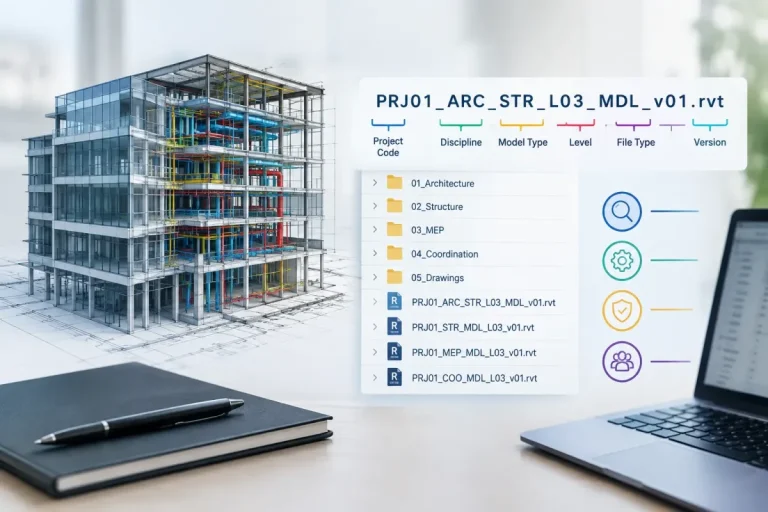
- Fix the classification system and the container naming convention early. These are the places where national annexes differ most.
- State edition numbers. “ISO 19650” is not a reference; “ISO 19650-2:2018 with the Canadian Annex, version 1.0” is.
- Be explicit about level of detail and information. If the client speaks LOD and the team speaks LOIN, say so and bridge them. See Level of Information Need vs. LOD vs. LOI: Key Differences and ISO 7817-1: Level of Information Need Explained.
- Agree the exchange format and view. IFC version and model view, not just “IFC”. See ISO 16739 and the IFC Standard Explained.
- Check local legal and security requirements. BIM obligations, data protection and sensitive information rules vary. See BIM Contracts and Legal Considerations.
- Test the exchange early, with real files and real software, across time zones.
- Keep a standards register for the project: document, edition, status, where it applies.
- Respect local practice. A team that tries to impose its home dialect everywhere loses goodwill quickly.
Common Mistakes When Dealing With Multiple Standards
- Citing a standard without an edition. Editions differ, and withdrawn documents remain on the internet.
- Assuming one country’s mandate applies elsewhere.
- Mixing vocabularies silently. The same abbreviation can mean different things. EIR is the classic example: Exchange Information Requirements in ISO 19650, Employer’s Information Requirements in older UK documents.
- Ignoring the national annex. It often decides naming and classification.
- Believing translation is trivial. Legal and technical terms need careful translation.
- Forgetting that guides are not standards. Many national documents are guidance, not binding rules.
- Over-trusting summaries, including this one. Always check the official text.
- Not recording decisions. Without a standards register, the team forgets what was agreed.
See also Common BIM Mistakes Beginners Should Avoid.
Frequently Asked Questions
Is ISO 19650 used worldwide?
It is an international standard, adopted or adapted in many countries, often with a national annex. The degree of adoption and enforcement varies.
What is a National Annex to ISO 19650?
A supplementary document that provides country-specific conventions, such as container identification and classification, without adding requirements to the standard. The UK and Canada have published annexes for ISO 19650-2.
Which classification system should I use?
Use the one required by the client, the national annex or the local market. Uniclass 2015 is common in the UK and used in parts of Australia. OmniClass, UniFormat and MasterFormat are common in North America.
Is there a US national BIM standard?
Yes. NBIMS-US, from the National Institute of Building Sciences, is the national standard, alongside many agency and industry documents. It is not a single process standard like ISO 19650.
Does Canada have a BIM mandate?
There is no national mandate. Requirements are set by individual federal, provincial and private clients. Industry bodies have proposed a national approach.
Does Australia have a federal BIM mandate?
No. Requirements are set mainly by state governments and major clients, supported by national guidance such as the NATSPEC National BIM Guide.
What replaced EN 17412-1?
EN ISO 7817-1:2024, the European adoption of the ISO standard on level of information need.
How do I know a standard is current?
Check the catalog of the publishing body (ISO, CEN, your national standards body or the relevant association) for the current edition and status, and ask your client which edition applies.
Where do I find the full list of mandates?
See BIM Mandates Around the World: A Country-by-Country Overview, and verify against official government sources.
Final Thoughts
At the end of that multinational project, the American client told me that the thing he valued most was not the model. It was the one-page translation table. “For the first time,” he said, “I understood what my own team was saying to each other.”
That is the reality of international BIM. The technology is largely common, and the standards are converging, slowly but visibly, around ISO 19650, IFC and the level of information need. What remains is a matter of language and local convention, and both are solvable with attention and a little humility. Learn the international core, learn the dialect of your market, and keep a translation table in your pocket.
Where to go next: for the policy side, read BIM Mandates Around the World: A Country-by-Country Overview. For the international core, continue with BIM Standards: The Complete International Guide and ISO 19650 Explained: A Complete Guide for BIM Professionals, and for classification, BIM Classification Systems Compared: Uniclass, OmniClass, Uniformat, and MasterFormat.