



Many years ago, I attended a handover meeting for a large commercial building. The architect, the contractor and the engineers all described their BIM models with justified pride. The owner‘s representative listened politely, and then asked a question that silenced the room: “That is very impressive. But what do I do with it on Monday?” There was no answer. The models were excellent. The information the owner needed to run the building, which pumps, which fire doors, which warranties, which maintenance intervals, was not in a form the owner could use, because nobody had ever told the project team what the owner actually needed.
That episode taught me the most important thing I know about BIM from the owner’s point of view: owners do not benefit from models. They benefit from decisions made with reliable information, and from assets that are cheaper and safer to operate because their information is good. A model is one means to that end, and often not the most important one. The owner who understands this uses BIM as a lever: to make better investment decisions, to buy better, to receive what it needs and to operate efficiently for decades.
The owner holds an unusual position in the BIM world. It is the party with the most to gain and the most power to shape outcomes, because requirements, procurement and acceptance are in its hands. It is also the party that often has the least BIM capability in-house, and the longest time horizon. This guide explains how owners and developers can use BIM effectively: what to ask for, how to organize themselves, how to procure, how to oversee delivery and how to turn project information into operational value. It addresses long-term owners (public authorities, hospital trusts, universities, infrastructure operators, investors) and developers, whose interests differ in important ways.
The Short Answer
For owners and developers, BIM is a way to specify, buy, check and use information across the asset’s life.
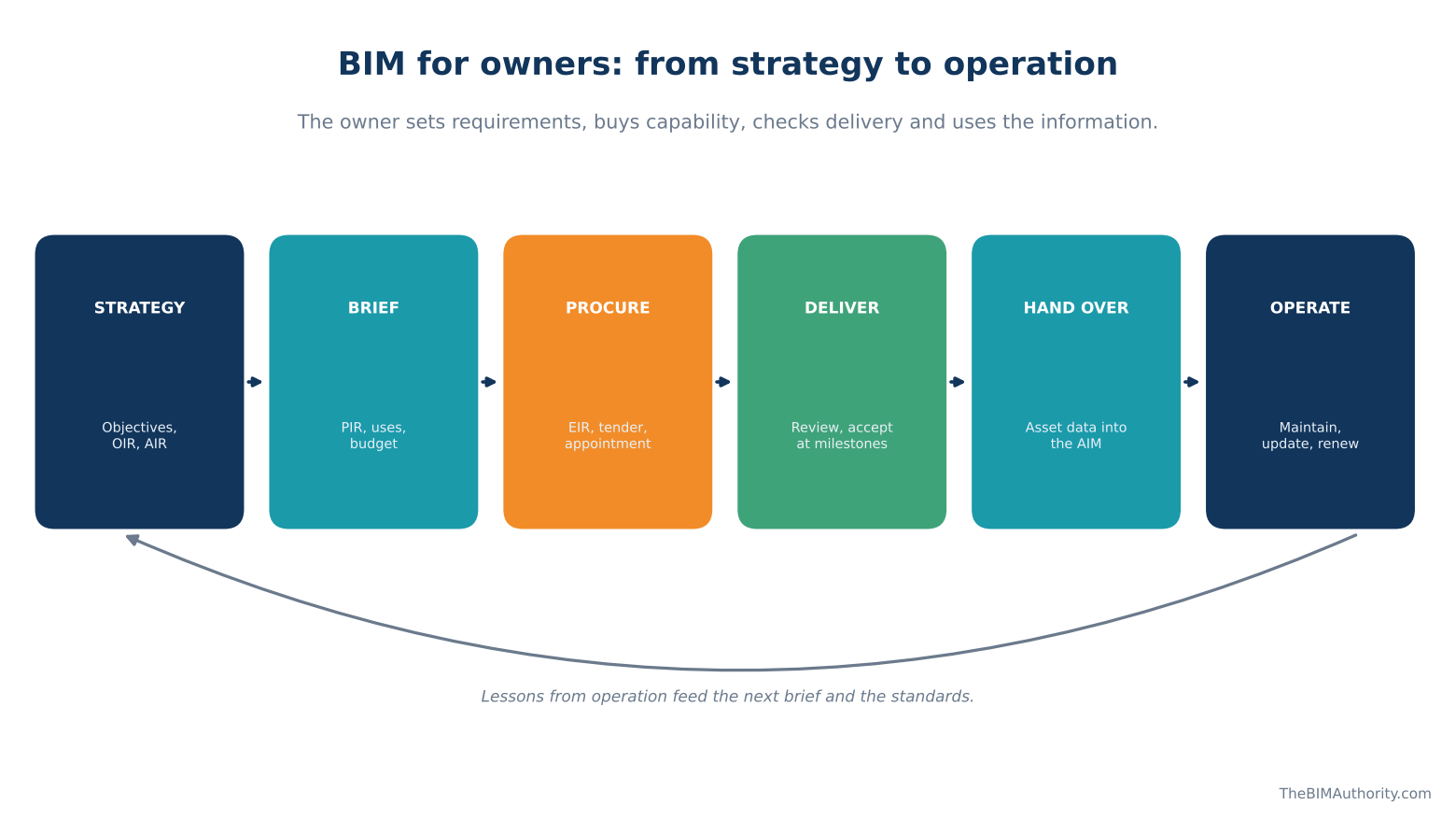
| Stage | Owner’s job | Key documents |
|---|---|---|
| Strategy | Decide what the organization needs to know about its assets | OIR, AIR. See Organizational Information Requirements (OIR): Complete Guide and Asset Information Requirements (AIR): Complete Guide |
| Brief | Define the information needed to make project decisions | PIR. See Project Information Requirements (PIR): Complete Guide |
| Procure | Write requirements, assess capability, appoint | EIR, information protocol. See Exchange Information Requirements (EIR): Complete Guide and BIM Procurement and Appointments Under ISO 19650 |
| Deliver | Review and accept information at milestones | Acceptance criteria, checks |
| Hand over | Receive asset data into the asset information model | AIR, handover checks |
| Operate | Use and maintain the information; update after trigger events | AIM. See ISO 19650-3: Information Management During Asset Operations |
In one sentence:
The owner’s role in BIM is to ask for the right information, buy the capability to produce it, check what arrives and use it.
Why Owners Should Care
| Owner concern | How BIM information helps |
|---|---|
| Cost certainty | Reliable quantities and early cost feedback; fewer late changes |
| Programme | Coordinated design and planned construction sequences; fewer delays from conflicts |
| Quality | Better design review and checking; fewer defects |
| Safety | Early identification of hazards; safer construction and operation. See ISO 19650-6: Health and Safety Information Management |
| Risk and disputes | A clearer record of information and decisions |
| Operating cost | Structured asset data for maintenance planning, compliance and renewal |
| Portfolio decisions | Consistent information across assets |
| Sustainability reporting | Reliable data on materials, energy and performance |
| Long-term value | Information that outlives suppliers and software |
Remember that the largest share of an asset’s life-cycle cost is usually incurred in operation. The information that supports operation is therefore among the owner’s most valuable outputs from a project.
Owners vs. Developers: Different Interests
The word “owner” covers different situations.
| Type | Time horizon | Typical priorities for BIM |
|---|---|---|
| Long-term owner-operator (public authority, hospital, university, infrastructure operator, corporate occupier) | Decades | Asset information model, operating cost, compliance, portfolio consistency, long-term data standards |
| Investor (holding long-term) | Years to decades | Asset performance, valuation, ESG data, transaction readiness |
| Developer (build to sell or let) | Project length, plus warranty | Programme, cost control, design quality for sales and letting, risk management, due diligence information for purchasers |
| Developer (build to hold) | Long | Combination of the above |
| Public client for infrastructure | Decades | Alignment, geospatial data, asset condition, interoperability with national systems |
A developer who will sell has less reason to invest in operational data for its own use, but the purchaser’s due diligence and the building’s warranty period create value in good information. Increasingly, buyers and lenders ask for it. A developer who holds long-term has every incentive to behave like an owner-operator.
Step 1: Know What You Need: OIR and AIR
Start inside your own organization.
- Run a short workshop to list the ten questions you wish you could answer about your assets: condition, cost, compliance, utilization, risk. These are the seeds of the OIR.
- For each main asset type, work with operations to define the AIR: the asset data you need at handover, in the form that loads into your systems.
- Check your existing systems (asset register, CAFM, financial systems) so that requirements match what you can use.
See Organizational Information Requirements (OIR): Complete Guide and Asset Information Requirements (AIR): Complete Guide.
A Practical Test
Take a recent project. Ask: which of the information we received did we actually use in the first year? The answer often shows that large volumes of delivered data are unused, while the data you needed is missing. That is the case for writing the AIR.
Step 2: Organize Yourself
Owners need a client-side information management function: people who write requirements, manage the process and accept information.
| Role | Responsibilities |
|---|---|
| Sponsor / executive | Owns the information strategy and resources it |
| Client information manager (or BIM lead) | Writes EIR, sets standards, runs the tender assessment, manages the CDE or its approval, reviews and accepts information |
| Project managers | Own PIR and decisions; use the information in governance |
| Asset and facility managers | Contribute to the AIR; accept handover data; operate the AIM |
| IT and data teams | Systems, integration, security |
| Procurement and legal | Appointments, protocols, contracts |
| Security adviser | Sensitivity triage and controls |
If you lack the capability in-house, you can appoint an independent adviser or information manager. Whoever does it, give them authority. See BIM Roles and Responsibilities: Manager, Coordinator, Modeler, and Information Manager.
An Owner’s BIM Policy
A short BIM or information policy (one to three pages) sets the organization’s position. Typical contents:
| Section | Content |
|---|---|
| Purpose | Why the organization uses BIM and structured information |
| Standards | ISO 19650 and the national annex; classification; formats; open standards |
| Requirements | OIR, AIR, project requirement templates |
| Roles | Who is responsible on the client side |
| Procurement | Capability assessment, information protocol, EIR templates |
| CDE and data | Platform approach; ownership of data; archive |
| Security | Triage and controls |
| Handover and AIM | Standards for asset data and its use |
| Review | How the policy is updated |
Step 3: Procure With Information in Mind
Use the procurement pattern in BIM Procurement and Appointments Under ISO 19650.
- Write an EIR for each appointment, derived from the PIR and AIR, with verifiable requirements.
- Ask bidders for a pre-appointment BEP, capability evidence, a draft MIDP, a mobilization plan and a risk register.
- Assess capability with evidence and, if possible, a sample deliverable, and weight it properly against price.
- Include an information protocol and clear acceptance criteria. See BIM Contracts and Legal Considerations.
- Require flow-down to subcontractors.
- Require mobilization and review the test results.
Be Careful What You Ask For
Owners sometimes request “a LOD 500 model” or “everything in IFC”. Neither says what the information is for. Ask for information for purposes, using the level of information need, and let the delivery team propose how to meet it. See ISO 7817-1: Level of Information Need Explained.
Step 4: Oversee Delivery
Review and Accept at Milestones
Plan reviews as part of the process.
| Activity | Practice |
|---|---|
| Plan review time | Allow realistic periods in the MIDP; have named reviewers |
| Check against the EIR | Use checklists, model checks and IDS. See How to Validate IFC Models for Data Quality and Compliance |
| Use the CDE | Review in the platform; record decisions and comments |
| Accept or reject clearly | State reasons and required corrections |
| Track progress | Monitor delivery against the MIDP; ask for the dashboard |
| Track risks | Review the delivery team’s risk register |
Use Information for Governance
Make the information visible to decision-makers: area and cost reports tied to the brief, programme dashboards, risk summaries, compliance status. The PIR show what each decision needs. See Project Information Requirements (PIR): Complete Guide.
Be a Good Client
- Make decisions on time. Late client decisions are a leading cause of rework.
- Provide reference information (surveys, existing models) with its status.
- Keep requirements stable; manage changes formally.
- Respond to questions within agreed times.
Step 5: Hand Over and Operate
Plan Handover From the Start
Asset data should be built during the project, not assembled at the end.
- Specify the asset data in the AIR, with identification, location, technical, maintenance and document fields.
- Require draft deliveries at design and construction milestones, and verification at completion.
- Define the structure: asset register template, COBie or IFC property sets, document links. See COBie Explained: The Complete Guide to BIM Asset Data Handover.
- Test loading into your systems before final acceptance.
- Verify on site a sample of assets.
See BIM Model Handover Checklist and Requirements.
The Asset Information Model
The AIM is the owner’s maintained set of information about the asset. After handover:
- Load project information into the AIM.
- Maintain it through trigger events: planned (refurbishment, replacement) and unplanned (failures).
- Link it to operational systems: asset register, CAFM, energy management, compliance tracking.
- Govern it: ownership, quality, access, security.
- Use it for planning: maintenance, renewals, space, sustainability.
See Asset Information Models (AIM): Creation and Management and BIM for Building Operations and Maintenance.
Digital Twins
Some owners go further, connecting asset information to live data (sensors, building management systems) in a digital twin. The value rests on good asset information and clear use cases, not on technology alone. See BIM vs. Digital Twins: Differences, Connections, and Applications.
Owner Use Cases: What to Ask BIM to Do
| Use | Owner benefit |
|---|---|
| Design review and stakeholder engagement | Users and decision-makers understand and approve designs earlier |
| Cost and quantity information | Earlier, more reliable cost feedback |
| Coordination and clash detection | Fewer conflicts on site |
| Construction planning (4D) | Better programme confidence. See 4D BIM Explained: Construction Scheduling and Simulation |
| Safety planning | Earlier hazard identification |
| Compliance checking | Automated checks of selected rules |
| Asset data for operation | Faster setup of maintenance and lower operating cost |
| Space and portfolio management | Better utilization and planning |
| Sustainability data | Evidence for reporting and certification |
| Existing asset information | Surveys and models of existing buildings for refurbishment. See Scan-to-BIM: Converting Point Clouds into Intelligent Models |
Select three to five uses that match your objectives. See How to Define BIM Goals, Uses, and Project Deliverables.
Developers: Specific Considerations
| Consideration | Practice |
|---|---|
| Programme and cost certainty | Prioritize coordination, quantities and early cost information |
| Design quality and marketing | Use models for visualization, sales and letting where valuable |
| Due diligence and exit | Prepare a clear information package for purchasers, lenders and tenants |
| Warranty and defects | Good as-built and asset information supports defect resolution |
| Multiple contractors and packages | Common information standard and CDE across packages |
| Planning and regulatory submissions | Use models for submissions where authorities accept them |
| Portfolio of similar buildings | Standard EIR, templates and libraries across projects to build efficiency |
| ESG reporting | Capture materials and performance data |
Public Owners: Specific Considerations
| Consideration | Practice |
|---|---|
| Policy and mandates | Align with national and regional requirements. See BIM Mandates Around the World: A Country-by-Country Overview |
| Consistency across projects | Standard EIR, protocol and information standard |
| Fair procurement | Open standards (IFC, BCF, IDS) to avoid lock-in. See openBIM Explained: Principles, Standards, and Benefits |
| Transparency and records | Retention and archive requirements |
| Capability building | Support for the supply chain, especially small firms |
| Accountability | Evidence of value for public money |
Measuring Value as an Owner
Track a few indicators over time.
| Indicator | What it shows |
|---|---|
| Change orders and RFIs attributable to information | Design quality and coordination |
| Handover data completeness and defects | Quality of asset information |
| Time to load the asset register | Usability of handover |
| Time to answer common asset questions | Operational value |
| Maintenance and operating cost trends | Long-term benefit |
| Compliance findings | Risk management |
| Supplier performance on information delivery | Quality of procurement |
See How to Measure BIM Performance, ROI, and Project Success.
An Owner’s Maturity Path
| Stage | Typical characteristics | Next step |
|---|---|---|
| Ad hoc | BIM requested occasionally; requirements vary by project | Write a short policy and an EIR template |
| Defined | OIR, AIR and EIR templates exist; CDE specified | Strengthen capability assessment and acceptance |
| Managed | Client information management function; consistent reviews; AIM in use | Integrate with operational systems; measure value |
| Optimized | Data-driven asset decisions; digital twin pilots; supplier development | Share practice; innovate with care |
Common Mistakes
- Asking for “a BIM model” instead of information for purposes.
- No AIR, so the handover has to be reconstructed.
- No client-side information management.
- Over-specifying detail nobody uses.
- Choosing bidders on price alone.
- No acceptance criteria, or no capacity to review.
- Late client decisions and changing requirements.
- Ignoring the supply chain’s capability.
- No plan to load and use the asset data.
- No data ownership or exit terms in platform agreements.
- Treating a digital twin as a technology project.
- Not measuring what BIM delivers.
See also Common BIM Mistakes Beginners Should Avoid.
A Short Checklist for Owners and Developers
- Have we written our ten questions (OIR) and defined asset data needs (AIR)?
- Do we have a client-side information management function?
- Is there a short BIM or information policy?
- Are PIR and EIR written for each project and appointment?
- Do we assess capability and capacity in procurement?
- Do we plan review time and acceptance criteria?
- Are handover requirements and loading tests defined?
- Is there an AIM with trigger events and ownership?
- Are security and data ownership addressed?
- Do we measure value and learn?
Frequently Asked Questions
Why should owners use BIM?
To make better decisions, buy more effectively, reduce rework and risk and, above all, receive and use reliable asset information for operation.
What should an owner require from a BIM project?
Information for defined purposes, specified in the EIR and AIR: the models, data and documents needed at each milestone, in agreed standards and formats, with verifiable acceptance criteria.
What is the difference between OIR, AIR, PIR and EIR for an owner?
OIR describe organizational needs, AIR the asset data for operation, PIR the information for project decisions and EIR the deliverables of each appointment. See ISO 19650 Information Requirements Explained: OIR, AIR, PIR, and EIR.
Do owners need BIM expertise in-house?
They need at least a client-side information management function, in-house or through an adviser, to write requirements and review deliveries.
How do owners use the model after handover?
They use the asset information model, populated with structured asset data and documents, linked to operational systems, and updated through trigger events.
Is BIM worthwhile for developers who sell buildings?
Yes, for coordination, cost and programme control, and for due diligence and warranty. Buyers and lenders increasingly value good information.
Should owners require IFC?
Often for handover and archive, with specified versions and content. See openBIM vs. Closed BIM: Pros, Cons, and When to Use Each.
What is a digital twin?
A digital representation of an asset linked to live data. It depends on good asset information and clear use cases. See BIM vs. Digital Twins: Differences, Connections, and Applications.
How do I start as an owner?
Write your ten questions, draft a one-page policy, produce a simple EIR and AIR template, and apply them on one project with a capable adviser.
Final Thoughts
The owner’s representative who asked what to do on Monday became one of the best BIM clients I have worked with. At the next project, he wrote his own three-page AIR, listing exactly which assets mattered and what he needed to know about each. He sent it with the tender and made it part of the acceptance. At handover, a different team presented the same kind of impressive models. But this time, he asked them to load a sample into his asset system during the meeting. It worked. He smiled and said: “Now that is what I call a model.”
Owners hold the lever. A modest, clear statement of what you need, a few well-chosen questions to bidders and a handover that is tested before it is accepted will do more for the value of your assets than any amount of impressive technology. Start with the questions you cannot answer today, and ask your next project to answer them.
Where to go next: to define your needs, read ISO 19650 Information Requirements Explained: OIR, AIR, PIR, and EIR. For buying capability, continue with BIM Procurement and Appointments Under ISO 19650, and for what happens after handover, Asset Information Models (AIM): Creation and Management.



