



The first time I was handed a copy of ISO 19650, I did what every conscientious professional does: I read it from page one, with a pencil. By page twenty I was lost in a forest of terms, “appointing party”, “lead appointed party”, “information container”, “delivery team”, “task team”, and I remember thinking, with some irritation, “Why did they need to invent a new word for everything?” Several projects later, I changed my mind completely. Those words exist because a project involves a dozen companies, and without precise language, each of them reads the same sentence differently.
I have now used ISO 19650 on real projects, implemented it in design offices that started with a folder on a server and a few naming habits, and trained teams to work with it. I have seen it work beautifully and I have seen it turned into paperwork theater. The difference was never in the standard. It was in whether the team understood what problem each requirement was meant to solve.
This guide gives you that understanding. It is the complete overview of the series, written for working professionals, with pointers to detailed guides on each part. If you read only one article about BIM standards, make it this one.
The Short Answer
ISO 19650 is the international standard series for managing information over the whole life cycle of a built asset using BIM. Its full title describes it well: Organization and digitization of information about buildings and civil engineering works, including building information modelling (BIM), information management using building information modelling.
It tells you:
- Who is responsible for which information (roles and responsibilities).
- What information is needed, and why (information requirements).
- When it is needed (milestones and delivery plans).
- How it is produced, checked, shared and kept (processes and the common data environment).
It does not tell you which software to use, how to model a wall, or what file formats to choose. It is a management framework, not a modeling manual.
In one sentence:
ISO 19650 is the rulebook for how information moves between the people who ask for it, the people who produce it and the people who use it.
Where ISO 19650 Comes From
ISO 19650 did not appear from nowhere. It is the international evolution of a British body of work: BS 1192 and the PAS 1192 series, which defined collaborative working, the common data environment and the information management process for the UK’s “Level 2” BIM requirements. Those documents were tested on real projects for years, then offered to the international community and reworked into ISO form.
Parts 1 and 2 were published in 2018. Part 3 (operation) and Part 5 (security) followed in 2020, Part 4 (information exchange) in 2022, and Part 6 (health and safety) in 2025. European versions were adopted as EN ISO standards, and national standards bodies publish them with national annexes.
For the story of what came before, see BIM Maturity Levels (Level 0 to 3) and the Shift to ISO 19650 and The History and Evolution of BIM.
The Structure of the Series
| Part | Title (short) | What it covers | Dedicated guide |
|---|---|---|---|
| ISO 19650-1 | Concepts and principles | The vocabulary, the information requirements chain, information models, the CDE, the information delivery cycle | ISO 19650-1: Information Management Concepts and Principles |
| ISO 19650-2 | Delivery phase | The eight-activity process for projects, from assessment of need to close-out | ISO 19650-2: BIM Information Management During Project Delivery |
| ISO 19650-3 | Operational phase | Managing the asset information model during operation, with trigger events | ISO 19650-3: Information Management During Asset Operations |
| ISO 19650-4 | Information exchange | Managing the exchange of information between parties | ISO 19650-4: Information Exchange Requirements Explained |
| ISO 19650-5 | Security | A security-minded approach to sensitive information | ISO 19650-5: Security-Minded BIM Information Management |
| ISO 19650-6 | Health and safety | Managing information that supports health and safety | ISO 19650-6: Health and Safety Information Management |
A good way to remember it: Part 1 is the dictionary, Parts 2 and 3 are the two processes (build it, run it), and Parts 4, 5 and 6 are specialist add-ons for exchange, security and safety.
Who Is Involved: The Roles in ISO 19650
The standard uses a precise vocabulary for the parties and functions. Learn these and half of the standard becomes readable.
| Term | Meaning | In plain words |
|---|---|---|
| Appointing party | The party that appoints others to provide information, works, goods or services | The client (or someone acting for the client) |
| Appointed party | A party providing information, works, goods or services | A supplier: designer, contractor, specialist |
| Lead appointed party | The appointed party that coordinates the information of the delivery team and interfaces with the appointing party | The one who answers for the team’s information, such as a lead designer or main contractor |
| Delivery team | The lead appointed party and its appointed parties | Everyone who delivers on the appointment |
| Task team | A group of individuals assigned a specific task | A discipline team, a work package team |
| Information manager | The function that manages the information management process | The person who runs the CDE and the process, not necessarily a full-time job |
These are roles in a given appointment, not job titles. The same company can be the appointed party for one appointment and the appointing party for another, for example a main contractor who appoints subcontractors. See BIM Roles and Responsibilities: Manager, Coordinator, Modeler, and Information Manager.
The Core Concepts
1. Information Requirements: The Chain of Questions
ISO 19650 organizes what people need to know into a chain that runs from the organization’s goals down to the exact deliverables.
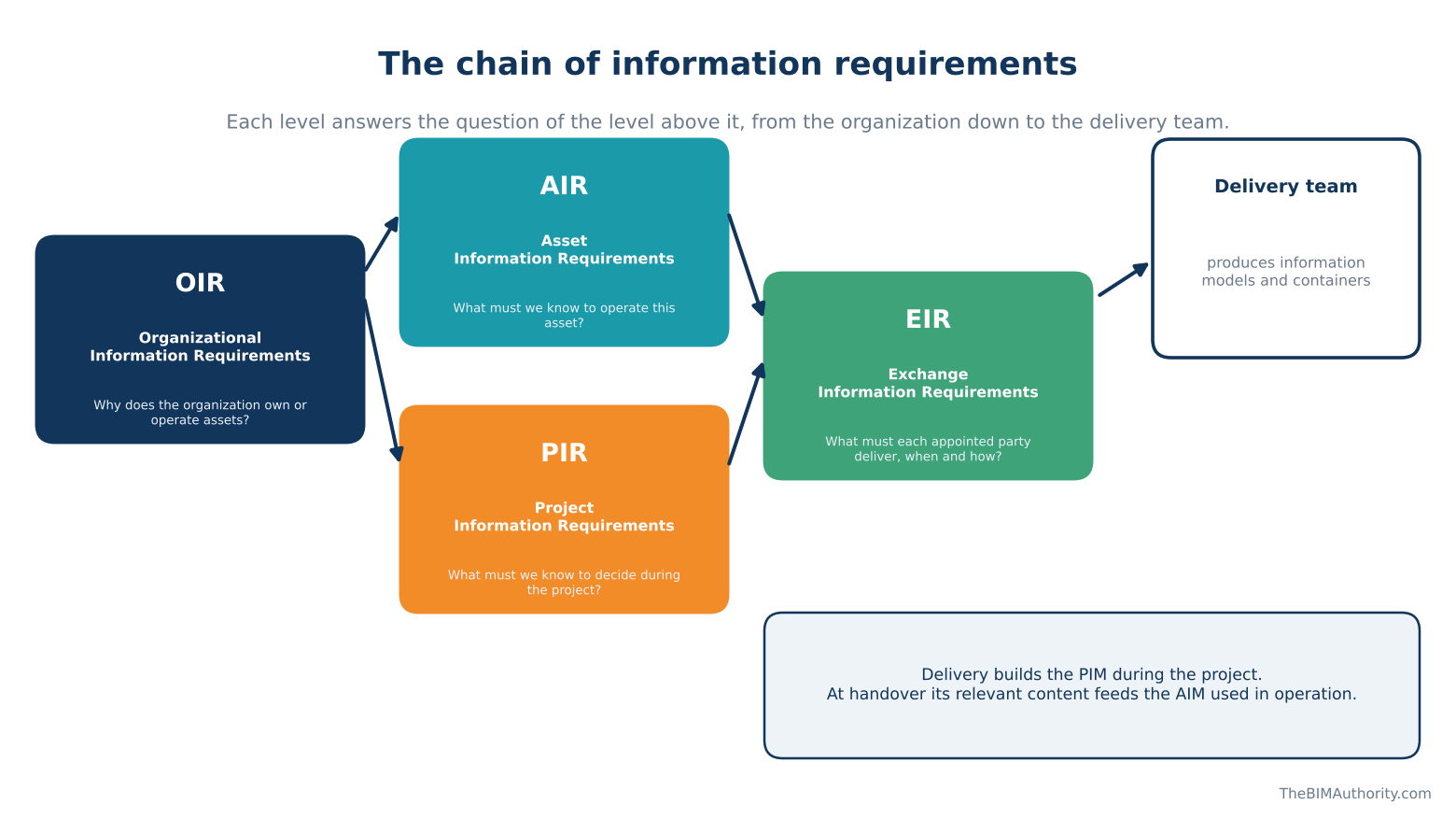
- OIR (Organizational Information Requirements): what the organization needs to know to achieve its objectives as an owner or operator of assets.
- AIR (Asset Information Requirements): what is needed to operate and maintain a particular asset.
- PIR (Project Information Requirements): what is needed to take decisions during a project.
- EIR (Exchange Information Requirements): what each appointed party must deliver, when, in which form and to which quality.
The elegance of this chain is that it forces purpose before production. Nobody should model or collect information that nobody asked for. See ISO 19650 Information Requirements Explained: OIR, AIR, PIR, and EIR and the dedicated guides on each type.
2. Information Models: PIM and AIM
- The Project Information Model (PIM) is the information model developed during the delivery phase (design and construction).
- The Asset Information Model (AIM) is the information model used during operation.
At handover, the relevant content of the PIM feeds the AIM. This continuity is the central promise of BIM. See Project Information Models (PIM) vs. Asset Information Models (AIM).
3. Information Containers
An information container is a named, persistent set of information that can be retrieved from a file, a system or application storage: a model, a drawing, a document, a schedule, a data set. Each container has an identification, a status and a revision. This is how ISO 19650 makes information traceable.
4. The Common Data Environment (CDE)
The CDE is the agreed source of information for a project or asset, used to collect, manage and disseminate information containers through a managed process. It is not just a shared folder. It is a solution (the technology) plus a workflow (the rules).
Information in a CDE moves through defined states.
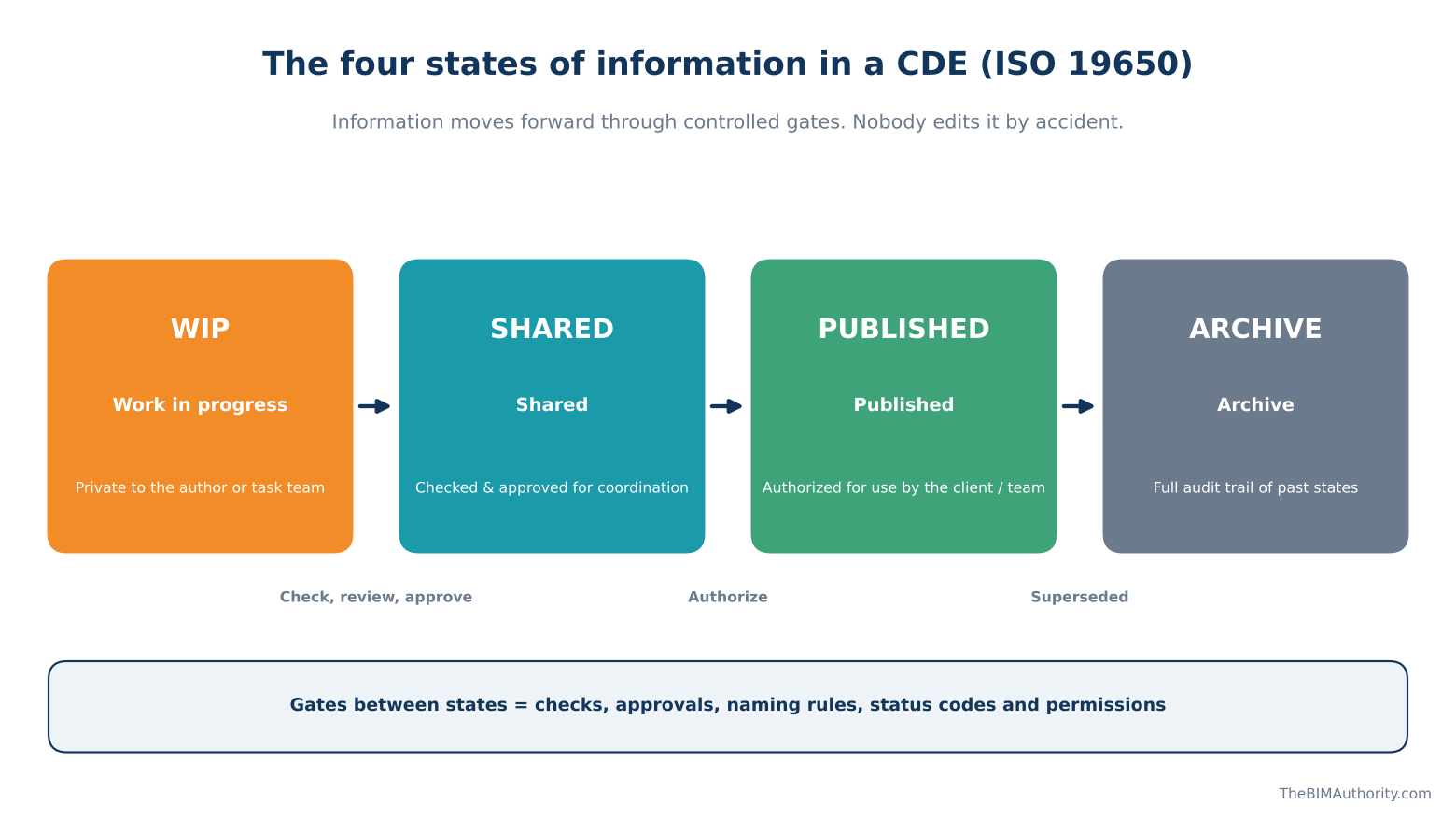
- Work in progress: private to the author or task team.
- Shared: checked and available to the project team for coordination.
- Published: authorized for use, for example for construction or for the client.
- Archive: the record of what was shared and published.
See Common Data Environment (CDE): The Complete Guide.
5. Level of Information Need
ISO 19650-1 introduces the principle that the extent and granularity of information should be defined by what is needed, for what purpose, and no more. The detailed method is in ISO 7817-1 (EN ISO 7817-1 in Europe). See ISO 7817-1: Level of Information Need Explained and Level of Information Need vs. LOD vs. LOI: Key Differences.
6. Delivery Planning Documents
- BEP (BIM Execution Plan): how the delivery team will meet the requirements. There is a pre-appointment BEP (the offer made at tender) and a post-appointment BEP (the confirmed plan). See BIM Execution Plan (BEP): How to Create and Implement One.
- MIDP (Master Information Delivery Plan): the master schedule of what information is delivered, by whom and when. See Master Information Delivery Plan (MIDP): Complete Guide.
- TIDP (Task Information Delivery Plan): each task team’s own plan, which together make the MIDP. See Task Information Delivery Plan (TIDP): Complete Guide.
- Responsibility matrix: who is responsible for producing which information. See How to Create a BIM Responsibility Matrix.
- Federation strategy and volume strategy: how information is divided into models and combined again. See BIM Models vs. Federated Models: What Is the Difference?.
The Information Delivery Cycle
ISO 19650-1 describes how information flows through the life of an asset in a delivery cycle.
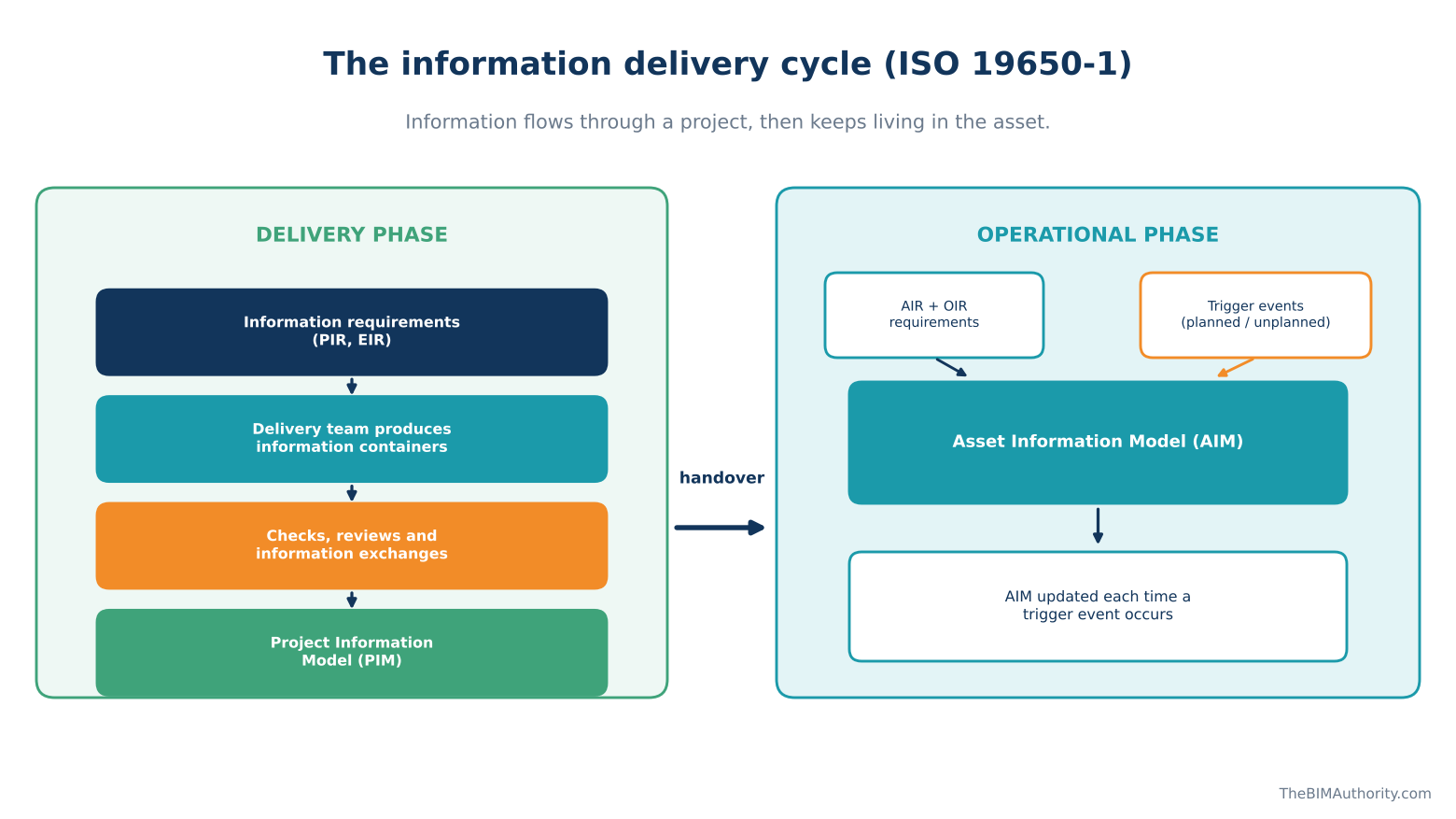
During the delivery phase, requirements flow down to the delivery team, which produces information containers, checks and exchanges them and builds the PIM. At handover, the information passes to the AIM. During the operational phase, trigger events (planned or unplanned) cause the AIM to be updated. When a new project starts on the same asset, the AIM becomes an input to the new project’s requirements.
This is why the standard calls for continuity: information should not be recreated at every stage.
The Delivery Phase Process (ISO 19650-2) in Brief
Part 2 organizes the delivery phase into eight activities.
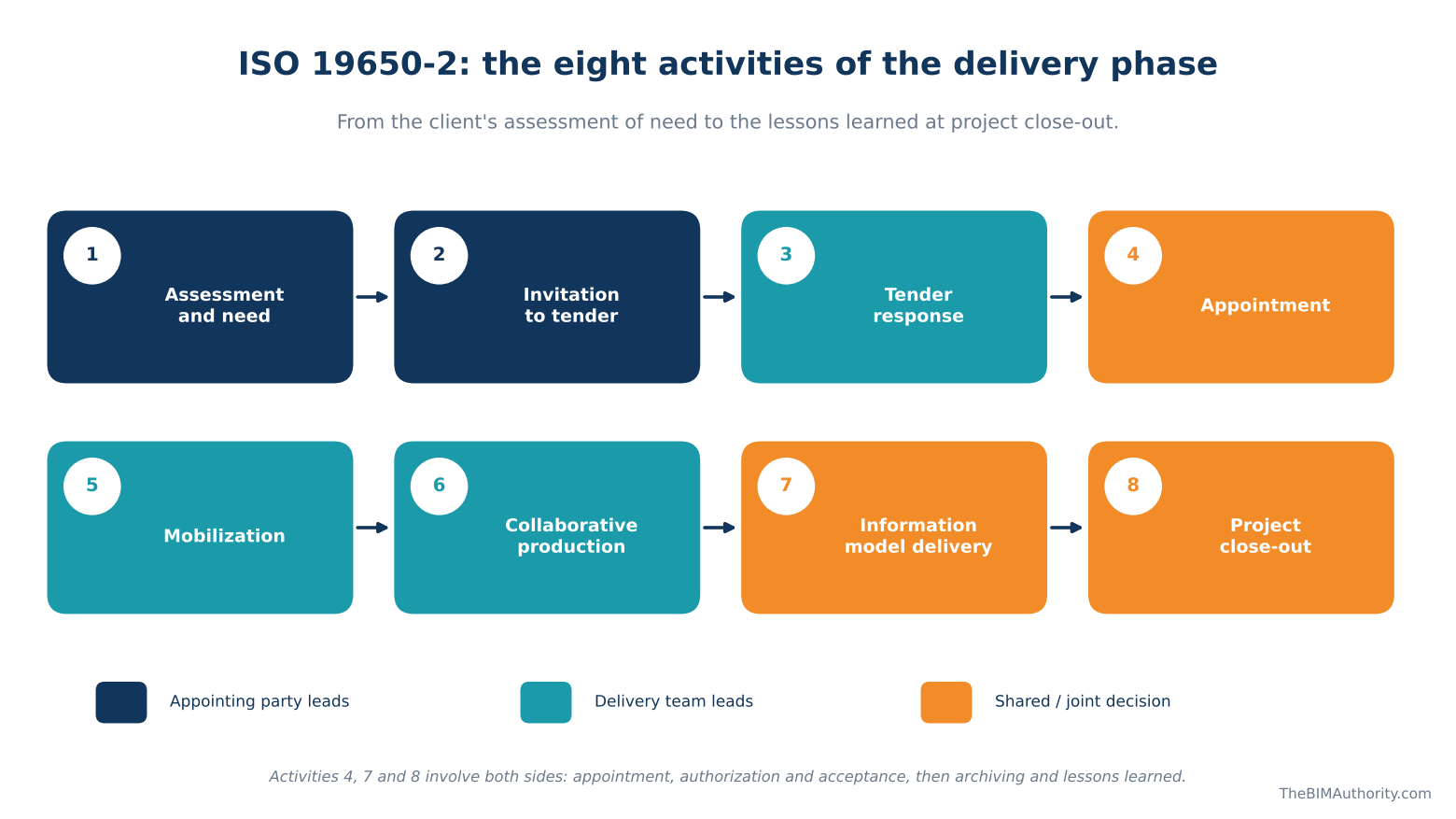
| # | Activity | Led by | Headline content |
|---|---|---|---|
| 1 | Assessment and need | Appointing party | Define information requirements, milestones, standards, methods, the CDE and the protocol |
| 2 | Invitation to tender | Appointing party | Compile tender information and evaluation criteria |
| 3 | Tender response | Delivery team | Demonstrate capability and capacity; offer the pre-appointment BEP, MIDP and risk register |
| 4 | Appointment | Both | Confirm the post-appointment BEP, responsibility matrix and appointment documents |
| 5 | Mobilization | Delivery team | Mobilize resources and technology, test the production methods |
| 6 | Collaborative production of information | Delivery team | Generate, check, review and approve information for sharing |
| 7 | Information model delivery | Both | Submit, authorize and accept the information model |
| 8 | Project close-out | Both | Archive the PIM and capture lessons learned |
Each activity has detailed sub-activities, inputs and outputs. For a full walkthrough, read ISO 19650-2: BIM Information Management During Project Delivery.
The Operational Phase Process (ISO 19650-3) in Brief
In operation, there is no project end date. Part 3 therefore centers on the asset information model and on trigger events that cause information to be created or updated.
- Planned events include handover from a project, periodic reviews, planned maintenance or refurbishment.
- Unplanned events include equipment failure, incidents or regulatory changes.
The process mirrors Part 2 in spirit, with adaptations for continuous operation. See ISO 19650-3: Information Management During Asset Operations and Asset Information Models (AIM): Creation and Management.
Naming, Status and Metadata
ISO 19650 requires information containers to be identified, versioned and given a status, and it leaves the exact conventions to the project, the client or a national annex.
A common approach, illustrated in the UK National Annex, uses a structured file name with fields such as project, originator, volume or system, level or location, type, role and number, plus status codes that express suitability, for example “suitable for coordination” or “for information”. Other countries adapt similar logic.
The principle matters more than the exact code: anyone should be able to understand what a container is, who produced it and what it may be used for, without opening it. See BIM File Naming Conventions and ISO 19650 and BIM Model Naming Convention Template and Guidelines.
ISO 19650 and Other Standards
ISO 19650 sits at the process layer of the standards landscape and works with others.
| Need | Companion standard or tool |
|---|---|
| Open model exchange | IFC (ISO 16739-1) |
| Issue exchange | BCF |
| Machine-readable requirements | IDS |
| Level of information need | ISO 7817-1 / EN ISO 7817-1 |
| Shared properties and definitions | bSDD, ISO 23386, ISO 23387 |
| Asset management | ISO 55000 series |
| Information security management | ISO/IEC 27001 |
| Quality management | ISO 9001 |
For the full map, see BIM Standards: The Complete International Guide.
How to Comply With ISO 19650
This is the question I hear most often, so let me be direct.
There Is No Single “Compliance Switch”
ISO 19650 is a framework of requirements applied to appointments and information management processes. You do not “install” it. You implement its processes, document them, and be able to demonstrate them.
Practical Compliance Steps for a Delivery Team
- Learn the vocabulary and the process. Everyone involved should understand the roles and the eight activities.
- Prepare standard documents: pre- and post-appointment BEP templates, a MIDP and TIDP template, a responsibility matrix, a risk register, a capability and capacity assessment.
- Set up a CDE with the four states, permissions and metadata.
- Adopt a naming convention and status codes that meet the client’s requirements.
- Define information management roles and appoint an information manager.
- Establish quality checks before information is shared and published. See BIM Quality Assurance vs. Quality Control: Processes and Checklists.
- Respond to the client’s EIR with a clear plan.
- Capture records so you can prove what you did.
Practical Compliance Steps for a Client
- Define your OIR and AIR (what you need to know about your assets).
- Write the PIR and EIR for each project.
- Set milestones, standards, methods, reference information and the CDE.
- Include requirements in the tender and evaluate capability and capacity.
- Appoint an information management function on your side.
- Plan how the information will be used after handover, feeding the AIM.
Certification
Third-party bodies offer certification schemes against the ISO 19650 series, in which organizations demonstrate that their processes meet the standard. Whether you need certification depends on your market and clients. Always check what the tender asks for before investing.
Benefits of Working With ISO 19650
When it is applied with sense, the standard brings real advantages.
- Shared vocabulary: fewer misunderstandings between parties.
- Clear responsibilities: it is known who produces, checks and approves each piece of information.
- Information with a purpose: the requirements chain reduces useless data.
- Traceability: controlled versions, statuses and records.
- Reuse over the life cycle: the PIM feeds the AIM.
- Comparable offers in tenders: clients can evaluate capability using common criteria.
- A basis for automation: structured requirements can be checked by software.
For the broader business case, see Benefits of BIM for Owners, Architects, Engineers, and Contractors.
Common Misunderstandings About ISO 19650
- “It is a modeling standard.” It is not. It does not tell you how to model.
- “It requires specific software.” It is software-neutral.
- “It is only for large projects.” The principles scale. A small project can use a lightweight BEP and a simple CDE.
- “It is only for the UK.” It is international, with national adaptations.
- “Being compliant means producing a lot of documents.” Compliance is about working properly and being able to show it, not about volume of paperwork.
- “It replaces contracts.” It does not. Legal obligations belong to the appointment documents. See BIM Contracts and Legal Considerations.
- “A CDE is a cloud folder.” It is a managed workflow with states, rules and responsibilities.
- “LOD is part of ISO 19650.” The standard uses the concept of level of information need rather than prescribing LOD levels.
Common Mistakes When Implementing ISO 19650
- Copying templates without adapting them. A BEP written for a hospital does not fit a house extension.
- Writing requirements nobody can verify. If it cannot be checked, it is a wish. See BIM Model Checking: Geometric and Information Validation.
- Creating the CDE after the project starts, leaving early information scattered.
- Not appointing an information manager. Someone must run the process.
- Ignoring the operational phase. Defining no AIR means the owner receives data nobody can use.
- Skipping training. The standard’s language needs to be taught.
- Treating the pre-appointment BEP as marketing. It is a commitment.
- Not reviewing lessons learned at close-out.
For other typical errors, see Common BIM Mistakes Beginners Should Avoid.
A Simple Implementation Roadmap for an Office
If your office is starting from scratch, here is a realistic sequence.
| Step | Action | Result |
|---|---|---|
| 1 | Train key people in the concepts and vocabulary | Shared understanding |
| 2 | Adopt a naming convention and status codes | Traceable information |
| 3 | Set up a CDE with the four states | Controlled workflow |
| 4 | Create templates: BEP (pre and post), responsibility matrix, MIDP and TIDP | Repeatable documents |
| 5 | Define roles, including information manager | Clear ownership |
| 6 | Pilot on one project and record lessons | Real feedback |
| 7 | Add model checking and automated verification | Quality evidence |
| 8 | Consider certification if your market demands it | External recognition |
| 9 | Review and improve annually | Continuous maturity |
See also How to Implement BIM in Your Company: A Step-by-Step Roadmap.
Frequently Asked Questions
What is ISO 19650 in simple terms?
An international standard that sets out how information about buildings and infrastructure should be managed across the life of an asset, using BIM. It defines roles, processes, requirements and the common data environment.
What are the parts of ISO 19650?
Part 1 concepts and principles, Part 2 delivery phase, Part 3 operational phase, Part 4 information exchange, Part 5 security-minded approach, Part 6 health and safety.
Is ISO 19650 a software standard?
No. It is software-neutral and focuses on information management processes and responsibilities.
What replaced BIM Level 2?
The ISO 19650 series replaced the British standards that supported Level 2. See BIM Maturity Levels (Level 0 to 3) and the Shift to ISO 19650.
What is the difference between ISO 19650-1 and ISO 19650-2?
Part 1 explains concepts and defines the vocabulary. Part 2 specifies the process for the delivery phase of a project.
What is a CDE under ISO 19650?
The agreed source of information for a project or asset, combining a technical solution and a workflow that moves information through the states of work in progress, shared, published and archive.
Do I need ISO 19650 certification?
Only if your client or market requires it. Certification is a way of demonstrating compliance, not a legal obligation in itself.
Does ISO 19650 apply to infrastructure?
Yes. It applies to buildings and civil engineering works, including roads, rail, bridges and utilities. See Infrastructure BIM: The Complete Guide.
Where should a beginner start with ISO 19650?
With the concepts of Part 1, then the process of Part 2, using the dedicated guides on this site. Learn the roles and the information requirements chain first.
Final Thoughts
When I think about my first reading of ISO 19650, pencil in hand, I realize that my irritation at the new vocabulary was actually a symptom of the problem the standard solves. In my CAD days, a “final” drawing could mean four different things to four different people, and every project had a story about the wrong file reaching the wrong person at the wrong time. ISO 19650 does not eliminate human error, but it gives everyone the same words and the same rules, and that is a remarkable amount of value for a document.
Approach it as a practitioner, not as a lawyer. Ask of every requirement: “What problem does this prevent?” When you can answer, you are implementing the standard. When you cannot, you are filling in forms.
Where to go next: read the part-by-part guides, starting with ISO 19650-1: Information Management Concepts and Principles and ISO 19650-2: BIM Information Management During Project Delivery. For the practical tools, continue with Common Data Environment (CDE): The Complete Guide and BIM Execution Plan (BEP): How to Create and Implement One.



