

I have sat on both sides of the interview table many times, and I can report that the most common reason strong BIM candidates fail interviews is not lack of knowledge. It is that they answer the wrong question. Asked “How would you handle a thousand clashes?”, they describe how clash detection software works. Asked “Tell me about a time you disagreed with a colleague,” they explain why they were right. Asked “What is a CDE?”, they recite a definition and stop, as if the interviewer wanted a glossary entry rather than evidence of understanding. Interviewers are rarely testing whether you can define terms. They are testing whether you can think, communicate, take responsibility and work with people in the situations the job will present.
This guide helps you prepare for BIM interviews at every level: modeler, coordinator, manager, information manager and specialist. It explains how interviews work, what interviewers look for, how to structure answers, how to prepare stories and evidence, and then offers a large bank of questions with model answers across eight categories: general and motivation, fundamentals and standards, modeling and documentation, coordination, information management and data, technology and automation, management and leadership and behavioral and scenario questions. It also covers technical tasks, questions to ask the interviewer, remote interviews, red flags and the mistakes to avoid. It supports How to Build a Professional BIM Portfolio, BIM Skills Matrix: Competencies Required for Every Professional Level and BIM Salaries Around the World. The model answers are examples, not scripts. Use your own experience, be honest about what you know, and adapt to the role, the tools and the standards in your market.
The Short Answer
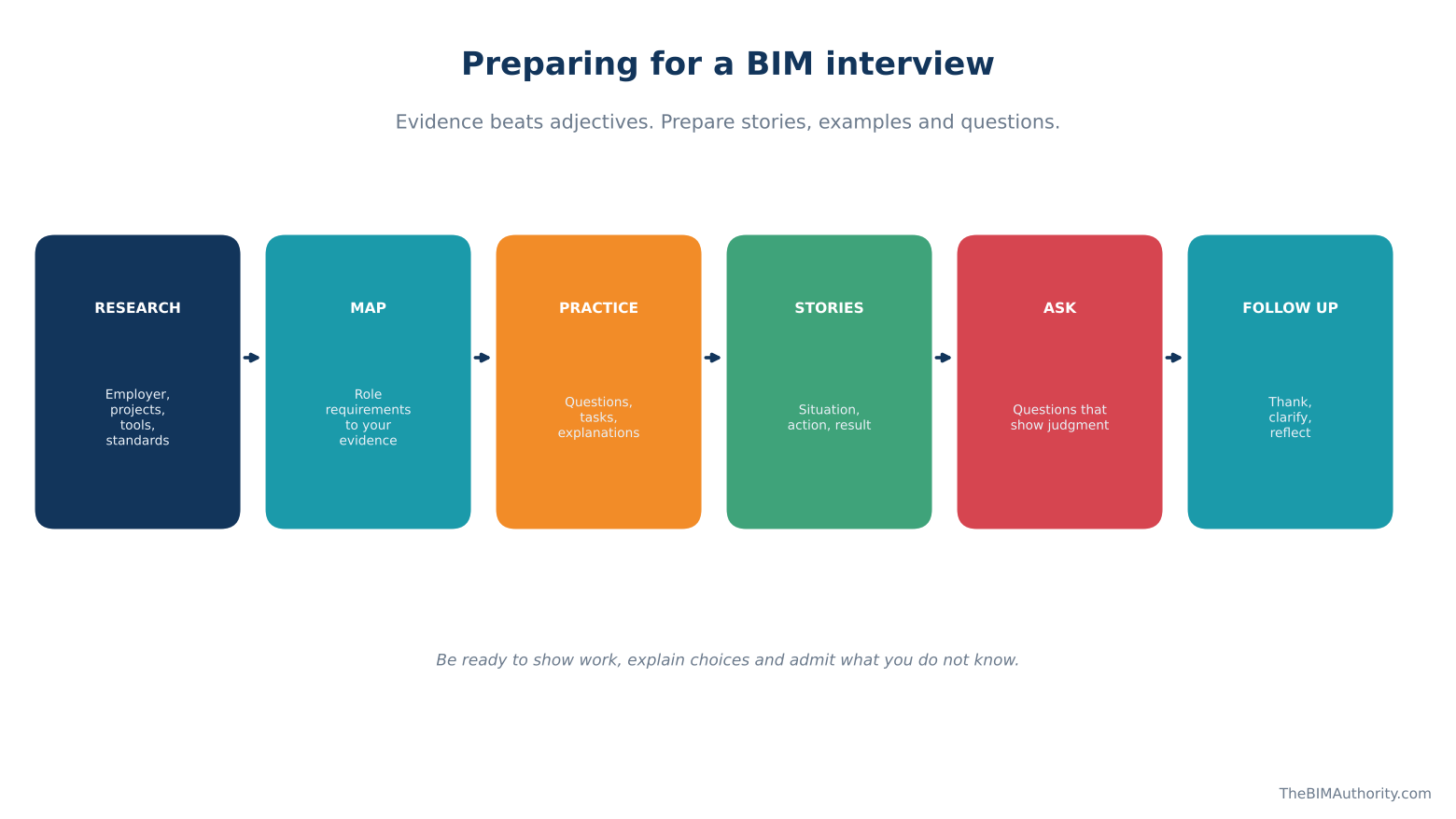
| Step | What to do |
|---|---|
| Research | Employer, projects, tools and standards |
| Map | Role requirements to your evidence |
| Practice | Questions, tasks and explanations |
| Stories | Situation, action, result |
| Ask | Questions that show judgment |
| Follow up | Thank, clarify, reflect |
In one sentence:
Prepare evidence, not adjectives: know the role, map it to your work, rehearse concrete stories and answer the question being asked with reasoning, not recitation.
How BIM Interviews Work
| Stage | Typical content |
|---|---|
| Screening call | Motivation, basic experience, availability, salary expectations |
| Technical interview | Questions on tools, standards, workflows; sometimes a modeling or coordination exercise |
| Practical task | A modeling test, a model checking task, a coordination scenario or a data exercise |
| Competency or behavioral interview | Past behavior, teamwork, conflict, leadership |
| Presentation | Of a portfolio or case study |
| Meeting with the team or director | Fit, vision, expectations |
| Offer and negotiation | See BIM Salaries Around the World |
Formats vary by company and country; ask the recruiter what to expect.
What Interviewers Look For
| Quality | Evidence |
|---|---|
| Competence | Correct, practical answers; ability to do the work |
| Understanding | Explaining why, not just what |
| Judgment | Trade-offs, priorities, risk awareness |
| Communication | Clear, structured, concise answers |
| Ownership | “I did”, with accurate credit to others |
| Collaboration | Handling disagreements, helping others |
| Learning | Curiosity, reflection, adaptability |
| Integrity | Honesty about limits and mistakes |
| Fit and motivation | Interest in the role and organization |
How to Structure Answers
The STAR Pattern for Experience Questions
| Element | Content |
|---|---|
| Situation | Brief context |
| Task | What you were responsible for |
| Action | What you did, and why |
| Result | What changed, with evidence; what you learned |
A Pattern for Technical Questions
| Step | Practice |
|---|---|
| 1. Define briefly | One sentence |
| 2. Explain why it matters | Purpose |
| 3. Give an example | From your experience |
| 4. Note limits or trade-offs | Shows maturity |
General Tips
| Tip | Why |
|---|---|
| Answer in one to two minutes | Longer answers lose the listener |
| Pause before answering | Thinking is allowed |
| Ask for clarification | If a question is ambiguous |
| Be honest about gaps | “I have not done that; here is how I would approach it” |
| Use specific numbers and examples | Credibility |
| Avoid blaming | Show learning |
| Link answers to the role | Relevance |
Questions and Model Answers
A. General and Motivation
1. Why do you want to work in BIM?
Model answer: “I like that BIM treats a building as information, not just drawings. On my last project, I saw a schedule update itself when we changed a door type, and a coordination meeting find a problem that would have cost days on site. I want to be the person who makes that reliable. I am especially interested in the data and standards side, because that is where I think projects succeed or fail.”
2. Why this company or role?
Model answer: (Use specifics from your research.) “I read about your hospital projects and your use of IFC and BCF with consultants. I am interested in working in an openBIM environment, and the role’s mix of coordination and standards fits where I want to grow.”
3. What is your greatest strength in BIM?
Model answer: “Keeping models clean and data consistent. On my last project, I built a one-page check that authors ran before each exchange; the share of deliveries that passed our checks on the first attempt went from about half to nearly all over three months. (Replace with your own results.)”
4. What is a weakness, and what are you doing about it?
Model answer: “I have limited experience with automation. I started learning Python for schedule exports and have automated two weekly reports. I want to deepen that, ideally with guidance from someone more experienced.”
5. Where do you see yourself in five years?
Model answer: “Leading BIM delivery on complex projects, with strong skills in standards and information management. I would like to mentor others. I am open to the path, whether coordination leadership or management, depending on where I add most value.”
B. Fundamentals and Standards
6. What is BIM?
Model answer: “Building information modeling is the use of structured digital representations of an asset, models plus data and processes, to support decisions across design, construction and operation. The key idea is information that is reliable, shared and reusable, not only 3D geometry.”
7. What is the difference between BIM and CAD?
Model answer: “CAD produces drawings made of lines; BIM models objects with properties and relationships, and drawings are views of the model. A change in the model updates views, schedules and quantities. That makes data, coordination and analysis possible.”
8. What is a Common Data Environment, and why does it matter?
Model answer: “A CDE is the agreed source of information for a project, with controlled workflows for producing, sharing, publishing and archiving information. It matters because it gives everyone one place for the current, approved version, with permissions and an audit trail. In ISO 19650 terms, information moves through states such as work in progress, shared, published and archived. A CDE is a process as much as a platform.” See Common Data Environment (CDE): The Complete Guide.
9. What are OIR, AIR, PIR and EIR?
Model answer: “OIR are the organizational information requirements: what the owner needs to know to run the organization. AIR are the asset information requirements: what is needed about the asset in operation. PIR are project information requirements. EIR are exchange information requirements: what the appointing party requires from appointed parties on a project. The EIR is derived from the other requirements, and the delivery team answers it with a BIM execution plan.” See Exchange Information Requirements (EIR): Complete Guide and Asset Information Requirements (AIR): Complete Guide.
10. What is a BIM Execution Plan?
Model answer: “The BEP is the plan for how information will be managed on a project: roles, responsibilities, standards, processes, schedules of information delivery and tools. Under ISO 19650, there is a pre-appointment BEP produced during tender and a post-appointment BEP confirmed after appointment. It should be a living document that people actually use.” See BIM Execution Plan (BEP): How to Create and Implement One.
11. What is the difference between LOD and level of information need?
Model answer: “LOD traditionally means level of development or detail, a way of describing how developed model elements are, with specifications such as the US BIMForum one. ISO 19650 uses the broader idea of level of information need, which defines the geometric, alphanumeric and documentation information needed for a purpose, and ISO 7817-1 standardizes that concept. The practical point is the same: define what information is needed for each purpose, instead of asking for ‘LOD 400 everywhere’.” See BIM Levels of Development (LOD) Explained and ISO 7817-1: Level of Information Need Explained.
12. What is IFC, and why use it?
Model answer: “Industry Foundation Classes is an open, vendor-neutral schema for exchanging building information, standardized as ISO 16739. It lets teams using different tools exchange geometry and data. Quality depends on export settings and mappings, so you test exchanges with real receivers.” See IFC Files Explained: Structure, Classes, and Properties.
13. What are BCF, COBie and IDS?
Model answer: “BCF is an open format for exchanging issues with viewpoints and element references. COBie is a structured data format for delivering asset information at handover. IDS is an open standard for expressing information requirements in a machine-readable way so models can be checked automatically.” See BIM Collaboration Format (BCF): The Complete Guide, COBie Explained: The Complete Guide to BIM Asset Data Handover and Information Delivery Specification (IDS): The Complete Guide.
C. Modeling and Documentation
14. How do you start a new project model?
Model answer: “From the project template and BEP, not a blank file. I confirm the coordinate system, levels and grids with the BIM lead, set up worksharing if needed, link the other disciplines’ models and check naming, units and parameters. Then I plan the model breakdown and level of information by stage.”
15. What is the difference between a type and an instance parameter? (Revit)
Model answer: “Type parameters are shared by all elements of a type, such as a door’s width and fire rating from a specification. Instance parameters belong to each placed element, such as its mark or level. Product and specification data belong on types, location-specific data on instances.”
16. How do you keep a large model healthy?
Model answer: “I review warnings regularly, avoid imported CAD and in-place families, purge unused content, manage links, keep worksets simple and synchronize often. I watch file size and open time as warning signs.” See Revit Model Health and Optimization: File Size, Warnings, Links, and Performance.
17. How do you ensure your model data is correct before exchange?
Model answer: “I run a checklist: required parameters filled, naming and classification per the standard, no duplicates or warnings that matter, rooms bounded, correct levels and coordinates. Then I export IFC with the agreed settings and inspect it in an independent viewer.”
18. How do you decide how much detail to model?
Model answer: “By the information needed at the stage and purpose, not by habit. I check the EIR and BEP for the level of information need, model what decisions require and avoid over-modeling that slows models without adding value.”
19. Tell me about a family you built and why.
Model answer: (Describe a specific family: purpose, parameters, types, testing, performance, documentation.) “I built a parametric door family for a fire-rated assembly with type parameters for rating and hardware set, tested it in a schedule and with IFC export, and documented its use.”
D. Coordination
20. What is the difference between a hard clash and a soft clash?
Model answer: “A hard clash is a geometric intersection of two elements. A soft clash, or clearance clash, is a violation of required clearance, such as maintenance space around equipment. There are also workflow clashes, where tasks conflict in time or responsibility. Different tests need different tolerances and owners.” See Hard Clashes vs. Soft Clashes vs. Workflow Clashes.
21. You run a clash test and get 5,000 clashes. What do you do?
Model answer: “I do not report 5,000. First I check alignment, model versions and the test setup, because large counts usually mean misaligned models, no tolerances or immature models. Then I apply tolerances and rules, group results by cause, location and owner, prioritize by system and stage and turn them into a small number of decisions. I fix the process as well, such as clean exports and a clash matrix.” See BIM Clash Detection: The Complete Guide.
22. How do you run a coordination meeting?
Model answer: “I prepare an agenda around the few decisions needed, circulate viewpoints in advance, keep the meeting to the issue list, assign an owner and a date to every action and record decisions in the tracker. The tracker, not a document, is the record.” See BIM Coordination Meetings: Planning, Reporting, and Best Practices.
23. How do you make sure all models share the same coordinates?
Model answer: “By agreeing the coordinate system, origin, rotation and height reference in the BEP, providing a reference model with control points and checking every model against it before each cycle, by looking at known points in all models, not by aligning by eye.” See BIM Georeferencing: Coordinate Systems and Model Positioning.
24. How do you handle a team that ignores issues?
Model answer: “I make the issue clear and owned, with a viewpoint and the decision needed, and ask what is blocking them. If it persists, I raise it with the discipline lead and the BIM manager, showing impact on the program. I try to help first, then escalate.”
E. Information Management and Data
25. How would you set up a CDE for a new project?
Model answer: “I start from the requirements and the BEP: define the information containers, naming convention, metadata, states and roles, then configure folders, permissions and workflows to enforce them. I test with a pilot, train users with a one-page guide and review permissions regularly.”
26. How do you check that information meets requirements?
Model answer: “I turn the EIR into testable rules: entity, property, value rule and stage. I use IDS and rule-based checks run by authors before exchange and automatically after upload, group results and send them as issues, and track pass rates over time.” See Automated BIM Model Checking and Data Validation.
27. What is the difference between a PIM and an AIM?
Model answer: “The project information model supports delivery; the asset information model supports operation. The AIM is seeded from the PIM at handover by selecting, validating and transforming information, and then maintained through trigger events.” See Project Information Models (PIM) vs. Asset Information Models (AIM).
28. How do you handle sensitive information?
Model answer: “By role-based access, least privilege, regular permission reviews, controlled external access and clear policies. For sensitive assets, I follow the security-minded approach in ISO 19650-5 and the client’s rules.” See BIM Information Security, Access Control, and Data Governance.
F. Technology and Automation
29. How have you used automation in your work?
Model answer: (Give a specific example.) “I wrote a script that reads exported door schedules, finds missing fire ratings and produces a report. It cut a three-hour weekly task to a minute of supervision. I tested it on copies, documented it and registered it with the team.”
30. Dynamo, Python or the API: how do you choose?
Model answer: “I start with native features. For visual, Revit-centered workflows I use Dynamo; for data processing, IFC and testing I use Python; for robust team tools with a user interface I would use the API. I choose the lowest option that solves the problem and that I can maintain.” See BIM Automation: The Complete Guide.
31. How would you use AI tools in BIM work?
Model answer: “As aids: learning tools, drafting scripts and summaries, exploring options. I treat outputs as drafts, test generated code on copies, protect confidential data and keep responsibility for results. I keep rule-based checks as the dependable core.” See Artificial Intelligence in BIM: Applications, Benefits, and Limitations.
32. How do you keep up with new tools and standards?
Model answer: “I follow vendor release notes and standards bodies, attend webinars and local groups, practice new features on test models and share what I learn with colleagues.”
G. Management and Leadership
33. How would you improve BIM maturity in an organization?
Model answer: “I would listen first: review recent projects, interview users, check templates, standards, training and tools. Then I would find a few visible pain points, fix them, measure results and propose a roadmap tied to business goals. I would involve people, because adoption matters more than documents.” See How to Develop a BIM Implementation Strategy.
34. How do you measure BIM success?
Model answer: “By outcomes linked to goals: information quality, first-time check pass rates, issue age and closure, rework avoided, delivery on time, handover acceptance and adoption. I define each metric, automate collection and use it to improve, not to blame.” See How to Measure BIM Performance, ROI, and Project Success.
35. How do you train a team?
Model answer: “I assess gaps with a skills matrix, prioritize those that affect delivery, use short role-based sessions plus practice on real work, provide quick guides and a champion network, and measure results.” See BIM Training Plan for Your Team.
36. How do you respond to a client’s EIR in a tender?
Model answer: “I read it for what is testable and what is vague, map requirements to our capability and processes, propose realistic commitments, state assumptions and clarifications, and avoid overpromising. I involve the delivery team early.” See How to Respond to BIM Requirements in Tenders.
H. Behavioral and Scenario Questions
37. Tell me about a time you made a mistake.
Model answer: “On one project I published a model with the wrong shared coordinates; the coordinator caught it. I fixed it the same day, then added an alignment check to my pre-publication checklist and shared it with the team. The mistake cost us an afternoon; the checklist has prevented the same issue since.”
37b. Tell me about a conflict with a colleague.
Model answer: (Use a real example.) “A structural engineer and I disagreed about who should resolve a recurring clash. I asked for a short conversation, laid out the viewpoints and the options, and we agreed a decision rule in the clash matrix. The issue closed, and the rule helped later.”
38. You discover a serious error in a model just before a milestone. What do you do?
Model answer: “Tell the right people immediately with facts, assess impact and fix options, agree who fixes what and by when, record the decision and verify the fix. Then look at why the check missed it and improve the process.”
39. How do you prioritize when everything is urgent?
Model answer: “I ask what matters most to the project: safety, cost, program and client requirements. I clarify deadlines and dependencies, delegate or defer the rest and communicate clearly about trade-offs.”
40. Tell me about a time you taught someone.
Model answer: (Concrete example, how you assessed the learner’s needs, what you did, what changed.)
Technical Tasks and Exercises
| Task | What it tests | How to prepare |
|---|---|---|
| Modeling test | Tool skill, speed, accuracy, standards | Practice complete small models; know the tool’s key workflows; read the brief carefully; ask about standards |
| Model checking exercise | Attention to detail, systematic thinking | Practice with checklists; know typical errors |
| Coordination scenario | Judgment, prioritization, communication | Practice grouping clashes into decisions; explain your approach |
| Data or script exercise | Logic, data handling | Practice with spreadsheet exports; explain your reasoning aloud |
| Case study | Strategy, process design | Structure: context, goals, constraints, options, recommendation, risks |
| Presentation | Communication | Practice a 10-minute walk through a case study. See How to Build a Professional BIM Portfolio |
Tips for Tasks
| Tip | Why |
|---|---|
| Read the brief twice | Misreading is the commonest failure |
| Ask clarifying questions | Shows professionalism |
| State assumptions | Avoids silent errors |
| Think aloud | Lets interviewers see your reasoning |
| Prioritize correctness over cosmetics | Data first |
| Check your work | Run your own checks |
| Manage time | Deliver something complete |
| Explain trade-offs | Judgment |
Questions to Ask the Interviewer
| Question | Why it helps |
|---|---|
| What does a typical week look like in this role? | Reality behind the title |
| How does the company standardize BIM: templates, libraries, BEPs? | Maturity |
| Which tools, versions and standards do you use? | Fit |
| How are BIM roles defined and how do they progress? | Career path. See BIM Specialist vs. BIM Coordinator vs. BIM Manager |
| How do you train and support people? | Development |
| What are the biggest BIM challenges on your projects? | Honest picture |
| How is quality measured? | Culture |
| How do clients specify BIM requirements here? | Context |
| What would success look like in the first year? | Expectations |
| Who would I work with, and who would I report to? | Team |
Avoid asking only about salary or holidays in first interviews; raise them at the appropriate stage.
Remote and Online Interviews
| Tip | Why |
|---|---|
| Test your connection, camera and audio | Avoid technical failures |
| Prepare your screen | Close irrelevant windows; have your portfolio ready |
| Have a backup plan | Phone number; alternative link |
| Practice screen sharing | For portfolio and tasks |
| Keep notes visible but not read-aloud | Natural delivery |
| Look at the camera and speak clearly | Rapport |
| Be mindful of confidential material on screen | Privacy |
Red Flags (for You and for Interviewers)
| For candidates to avoid | For candidates to notice in employers |
|---|---|
| Exaggerating experience | Vague answers about standards and tools |
| Blaming former employers | No clear role definition |
| No questions | Responsibility without authority |
| Reciting jargon without understanding | No training or mentoring |
| Not knowing the company | Unrealistic expectations |
| Ignoring confidentiality | Dismissive attitude to quality |
Common Mistakes
- Answering definitions instead of demonstrating understanding.
- No concrete examples.
- Saying “we” for everything, or “I” for team work.
- Blaming others.
- Not researching the employer.
- No questions at the end.
- Rambling answers.
- Pretending to know what you do not.
- Ignoring the role’s level and tools.
- Not practicing tasks.
- Revealing confidential details from past projects.
- Not following up.
See also Common BIM Mistakes Beginners Should Avoid.
A Short Checklist
- Have I researched the employer, projects, tools and standards?
- Have I mapped the role to my evidence?
- Do I have five to seven STAR stories (success, mistake, conflict, teaching, improvement, pressure, initiative)?
- Can I explain core concepts (BIM, CDE, EIR, BEP, IFC, BCF, IDS, LOD versus level of information need) with examples?
- Have I practiced tasks and explained my thinking aloud?
- Is my portfolio ready and confidential material protected?
- Do I have questions to ask?
- Have I prepared for remote logistics?
- Do I know my salary research and priorities? See BIM Salaries Around the World.
- Will I follow up with a thank-you and any promised materials?
Frequently Asked Questions
What are the most common BIM interview questions?
Why BIM; the difference between BIM and CAD; what a CDE and a BEP are; how you handle clashes; how you keep models and data correct; and behavioral questions about conflict, mistakes and teamwork.
How should I prepare for a BIM modeling test?
Practice complete small models with correct data and documentation, know your tool’s key workflows, read the brief carefully and check your work.
How do I answer questions about experience I do not have?
Be honest, describe related experience and explain how you would approach and learn it.
Should I bring a portfolio?
Yes, in an easy-to-share form, with confidential material handled properly. See How to Build a Professional BIM Portfolio.
What should I ask at the end?
Questions about the role’s reality, standards, training, progression and expectations.
How long should my answers be?
One to two minutes for most questions, with details offered on request.
How do I handle salary questions?
Know your range from research, discuss the whole package and follow local norms. See BIM Salaries Around the World.
What if I do not know an answer?
Say so, explain how you would find out or reason it through and move on calmly.
Final Thoughts
I once interviewed a candidate who, asked how she would handle a model with thousands of clashes, said something that stayed with me. “First,” she said, “I would not report them.” She then took two minutes to describe checking alignment, tuning tolerances, grouping by cause and turning the result into decisions, with the unmistakable calm of someone who had done it before. She did not mention a single software feature. She did not need to. She showed me how she thinks, and I wanted her on my team.
That is the purpose of an interview, and of preparing for one: not to recite what you know, but to demonstrate how you work. Know your evidence, rehearse your stories, explain your reasoning, be honest about limits, ask good questions and treat the conversation as the beginning of a working relationship. The right job is one where the person across the table is already imagining you on the project.
Where to go next: for evidence, read How to Build a Professional BIM Portfolio. For skills and growth, continue with BIM Skills Matrix: Competencies Required for Every Professional Level and BIM Certifications: The Complete Guide to Professional Credentials, and for pay, BIM Salaries Around the World.