


I have lost count of the number of BIM projects whose problems I traced, after a long investigation, to a single missing sentence at the very beginning: nobody had said what information was actually needed. The design team produced what it thought was useful. The contractor produced what was convenient. The owner received something and discovered, six months after handover, that it could not answer the questions its maintenance team asked every day. When I raised this in a post-project review, the client’s project manager said something that I have never forgotten: “But nobody asked us.”
He was right, and the failure was not his alone. In traditional practice, the question “what information do you need from us?” was almost never asked in a structured way. Clients assumed that designers knew. Designers assumed that clients would say. And the result was an industry in which information requirements lived in people’s heads, and were discovered, too late, by their absence.
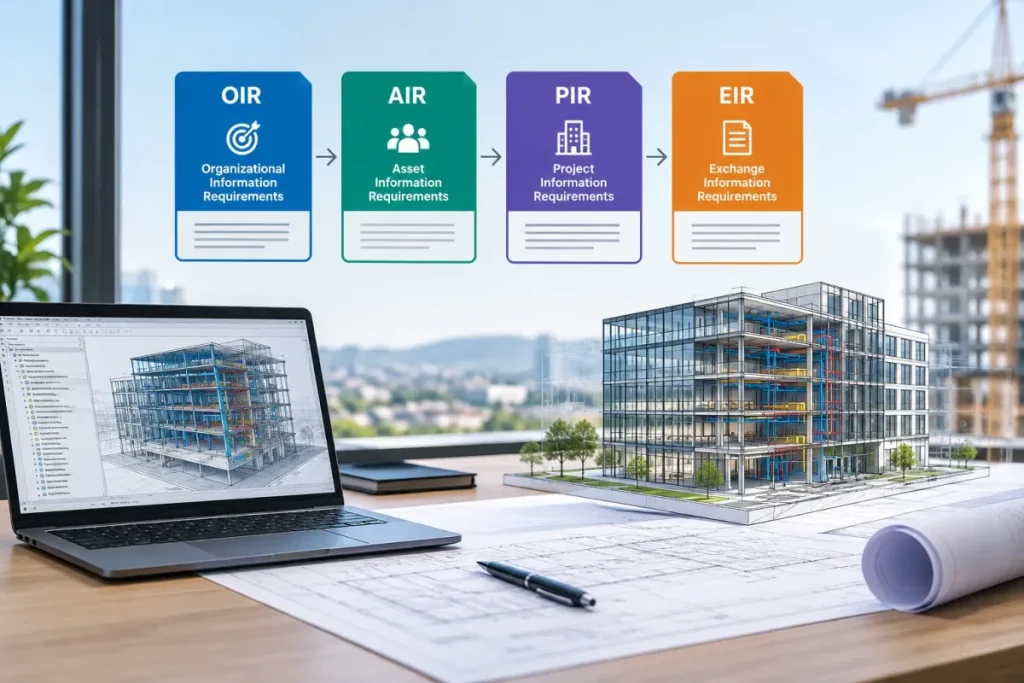
ISO 19650 fixes this with a simple, powerful idea: information requirements should be written down, organized in a chain from the organization’s goals to the individual deliverable, and given owners. The four links of that chain have four acronyms that cause endless confusion: OIR, AIR, PIR and EIR. This guide explains what each one is, who writes it, how they connect, what each contains, how they flow into the rest of the information management process and where projects typically go wrong. It is the hub for four dedicated guides that go deeper on each type, and for the guides on delivery planning that follow from them.
The Short Answer
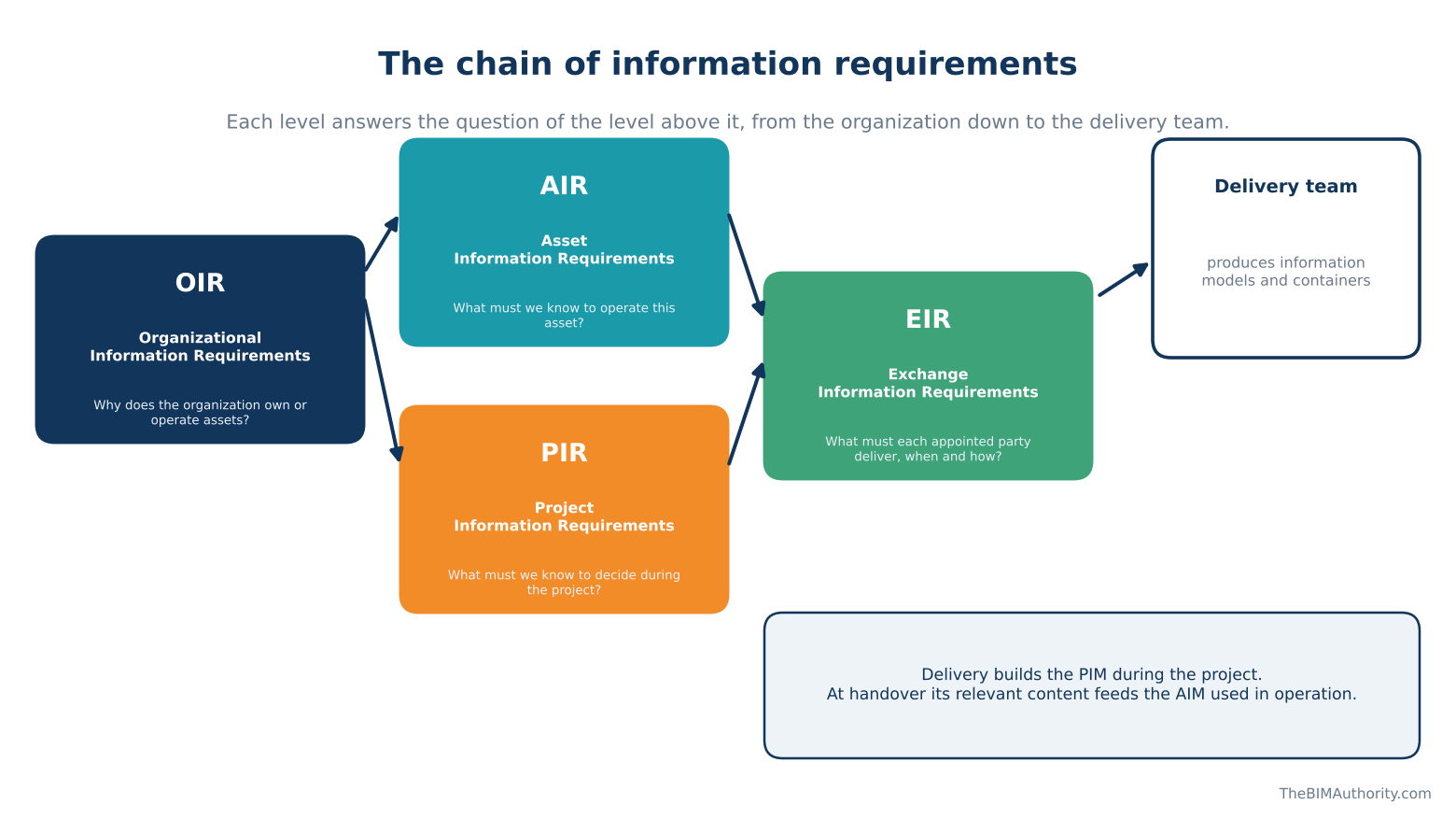
ISO 19650 organizes information requirements into four levels, each answering a different question.
| Requirement | Level | Question it answers | Typically written by |
|---|---|---|---|
| OIR (Organizational Information Requirements) | Organization | What does the organization need to know about its assets to achieve its business objectives? | Asset owner or operator |
| AIR (Asset Information Requirements) | Asset | What do we need to know to operate and maintain this asset? | Asset owner or operator |
| PIR (Project Information Requirements) | Project | What do we need to know to make decisions during this project? | Appointing party |
| EIR (Exchange Information Requirements) | Appointment | What must each appointed party deliver, when, in what form and to what standard? | Appointing party, and lead appointed parties for their own appointments |
In one sentence:
OIR and AIR describe what the owner needs to run the asset. PIR describes what the project needs to decide. EIR turns all of it into deliverables someone can be held to.
Each level informs the next. A weakness at the top, such as an organization that never thought about what it needs to know, flows all the way down, in the form of vague EIR and disappointing deliverables.
Why a Chain, and Not a Single Document?
You might ask: why not one “client requirements” document? Because the questions come from different people and different horizons.
| Horizon | Who cares | Time frame | What changes it |
|---|---|---|---|
| Organization | The board, asset management, finance | Years to decades | Strategy, regulation, portfolio change |
| Asset | Operators, facility managers | The life of the asset | Asset type, systems, operation model |
| Project | The project sponsor, designers | The life of the project | Brief, budget, stage gates |
| Appointment | The supplier delivering a scope | The life of the appointment | Scope, milestones, contract |
A single document would either be too general to guide a supplier or too specific to survive a change of project. The chain lets each level be written by the people who know the answers, and reused across projects: the OIR and AIR stay stable for years, while PIR and EIR are written afresh for each project and appointment.
OIR: Organizational Information Requirements
What They Are
OIR express the information an organization needs about its assets to meet its business objectives: strategic planning, asset management, risk and compliance, financial planning, portfolio decisions. They apply across all assets and projects of the organization.
What They Contain (Typically)
- The business questions the organization needs to answer about its assets.
- The information categories needed: identification, location, condition, performance, cost, risk, compliance, ownership.
- Links to asset management policy and strategy, and to relevant standards such as the ISO 55000 family.
- Reporting needs: regulatory returns, financial reporting, sustainability disclosures.
Example
A hospital trust may need to know, for every site, the condition and age of critical plant, the compliance status of fire and safety systems, the energy consumption by building and the cost of maintenance by asset class. Those needs, written once, become the OIR.
See Organizational Information Requirements (OIR): Complete Guide.
AIR: Asset Information Requirements
What They Are
AIR express the information needed to operate and maintain a specific asset (or type of asset), supporting the OIR. They define the asset data that the owner expects to receive and keep: equipment, locations, specifications, maintenance requirements, warranties, documents.
What They Contain (Typically)
- Asset types to be covered (critical plant, building fabric, safety systems, spaces).
- Information per asset type: identification, location, technical data, maintenance data, documents.
- Format and structure: the fields of the asset register, the schema for exchange (for example IFC or COBie), document linkage.
- Quality criteria and how information will be verified.
- Use: which operational processes consume it.
Example
For air handling units: a unique asset identifier, room location, manufacturer, model, serial number, capacity, installation date, maintenance interval, warranty end date and a link to the manufacturer’s manual, delivered as structured data matching the owner’s asset register.
See Asset Information Requirements (AIR): Complete Guide and COBie Explained: The Complete Guide to BIM Asset Data Handover.
PIR: Project Information Requirements
What They Are
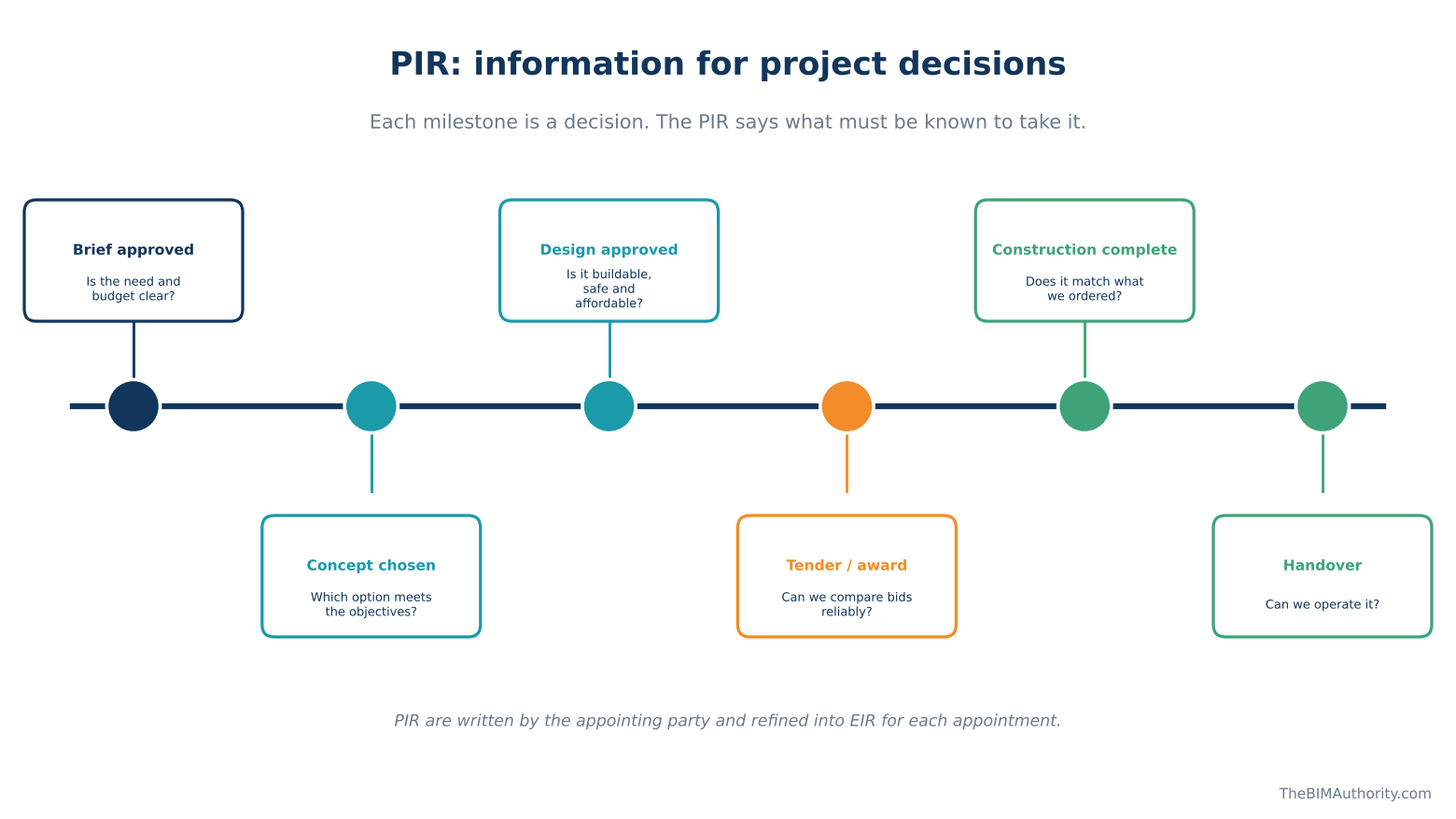
PIR express the information needed at project level to make decisions during the project and to support the organization’s objectives. They are tied to project milestones and stage decisions.
What They Contain (Typically)
- Decision points: what the client must decide at each stage (approve the brief, select a concept, approve the design, award a contract, accept completion).
- Information needed for each decision: costs, areas, performance, programme, risk, compliance.
- Links to the OIR and AIR: which organizational and asset needs the project must serve.
- Information for regulators and funders, where relevant.
Example
At the end of technical design, the sponsor needs to know the cost plan against budget, the area schedule against the brief, the energy performance against targets and the compliance status. Those needs, tied to that milestone, are part of the PIR.
See Project Information Requirements (PIR): Complete Guide.
EIR: Exchange Information Requirements
What They Are
EIR are the specific requirements for information to be delivered under an appointment: what, when, in what form and to what standard. They translate PIR, AIR and OIR into deliverables for a supplier.
A terminology note, because it trips up many readers. In ISO 19650, EIR means Exchange Information Requirements. In older UK documentation, the same abbreviation meant Employer’s Information Requirements. They serve similar purposes, but the ISO term is more precise.
What They Contain (Typically)
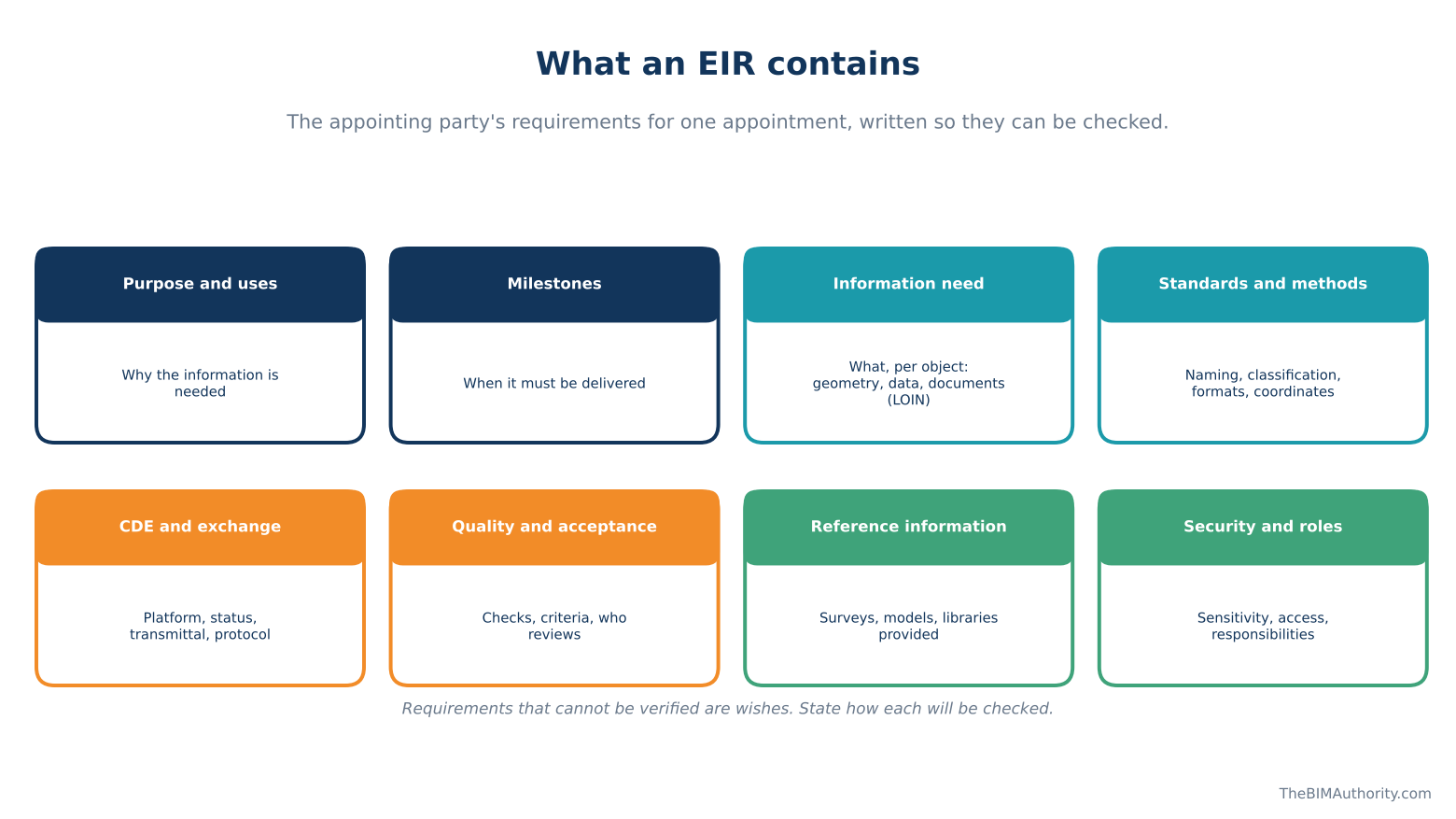
- Purposes and uses of the information.
- Information delivery milestones.
- Level of information need: geometry, data and documents per object, purpose and milestone.
- Standards and methods: naming, classification, file formats, coordinates.
- CDE and exchange arrangements: platform, status codes, transmittals, information protocol.
- Quality criteria and acceptance: checks and who performs them.
- Reference information provided to the delivery team.
- Security and responsibilities.
Who Writes Which EIR
- The appointing party writes the EIR for each appointment it makes (for example for the lead designer, or the main contractor).
- The lead appointed party writes EIR for the appointed parties it appoints (for example subcontractors and specialists), flowing the requirements down the supply chain.
See Exchange Information Requirements (EIR): Complete Guide and Exchange Information Requirements (EIR) Template and Example.
How the Four Levels Connect: A Worked Example
Let me follow one thread through the whole chain.
| Level | Statement |
|---|---|
| OIR | “We must demonstrate that all fire safety systems in our estate are inspected and compliant, and report this to the regulator annually.” |
| AIR | “For every fire damper and fire door in a building, we need an asset identifier, location, fire resistance rating, installation date, inspection interval and the latest inspection record, in our asset register.” |
| PIR | “At handover, the project must demonstrate that every fire door and damper installed meets the fire strategy, and give us the data to populate the asset register.” |
| EIR (for the lead designer) | “At the end of technical design, provide for every fire door: identifier, location, fire rating (from the agreed list), type reference and manufacturer, as properties in the IFC model delivered to the agreed specification, with the fire strategy report linked.” |
| EIR (for the fire door subcontractor, issued by the main contractor) | “Provide, for every fire door supplied: product certificate, installation date, serial number and maintenance manual, in the agreed format, by practical completion.” |
Notice how each statement is narrower and more specific than the one above, and traces back to it. That traceability is the whole point: any deliverable can be justified by a need, and any need can be followed to the deliverable that satisfies it.
Where Requirements Fit in the ISO 19650 Process
| Activity (ISO 19650-2) | Role of the requirements |
|---|---|
| Assessment and need | The appointing party establishes the PIR, drawing on OIR and AIR, and defines milestones, standards, methods and the CDE |
| Invitation to tender | The EIR and supporting information are compiled into the tender |
| Tender response | The delivery team responds with a pre-appointment BEP, capability evidence, a draft MIDP and a risk register |
| Appointment | The BEP is confirmed; the responsibility matrix, MIDP and lower-tier EIR are completed |
| Mobilization and production | Information is produced and checked against the requirements |
| Delivery | The information model is submitted, authorized and accepted against the EIR |
| Close-out and handover | Information passes to the asset information model, in the structure the AIR specified |
See ISO 19650-2: BIM Information Management During Project Delivery, ISO 19650-3: Information Management During Asset Operations and BIM Execution Plan (BEP): How to Create and Implement One.
Qualities of Good Requirements
Whatever the level, good requirements share characteristics. I use this checklist when reviewing them.
| Quality | What it means |
|---|---|
| Purposeful | Each requirement exists because someone needs the information for a stated purpose |
| Specific | It says what, not “good quality” or “complete” |
| Verifiable | You can say how it will be checked, ideally automatically |
| Proportionate | It asks for what is needed, no more. See ISO 7817-1: Level of Information Need Explained |
| Timed | It is tied to a milestone |
| Owned | Someone is responsible for providing it, and someone for receiving it |
| Traceable | It can be traced to a higher-level need |
| Consistent | It does not contradict other requirements or contract documents |
| Stable | It changes only through a controlled process |
Typical Problems and How to Avoid Them
| Problem | Cause | Remedy |
|---|---|---|
| No OIR or AIR exist | The owner has never articulated what it needs to run assets | Start with a workshop on the questions the owner asks of its assets; write a first version, however short |
| PIR confused with the brief | The brief says what to build; PIR says what to know | Write PIR around decisions and milestones |
| EIR copied from another project | Convenience | Adapt to purposes, milestones and objects of this project |
| EIR that cannot be checked | Requirements written in vague prose | Rewrite as verifiable statements, with IDS where possible. See Information Delivery Specification (IDS): The Complete Guide |
| Requirements stop at the first tier | No cascade to subcontractors | The lead appointed party writes EIR for each appointment |
| Everything asked for “just in case” | Fear of missing something | Apply the level of information need; justify each item |
| Requirements change without control | No change process | Version the documents and manage changes through the information manager |
| Handover data nobody uses | AIR never connected to operations | Involve facility managers in writing the AIR |
| Contradictions between EIR, BEP and contract | Documents written by different people | Cross-check before tender and appointment |
Who Is Involved in Writing Requirements
| Level | Typical contributors |
|---|---|
| OIR | Senior management, asset managers, finance, risk and compliance, sustainability, IT |
| AIR | Facility and maintenance managers, asset managers, operations staff, specialist engineers |
| PIR | Project sponsor, project manager, client representatives, cost and programme advisers |
| EIR | Information manager (appointing party), project manager, design and technical advisers, legal and procurement |
The most valuable contributors are often the people who will use the information: the maintenance technician, the space planner, the finance analyst. Their questions are the best source of real requirements.
A Starter Method for Organizations New to Requirements
If you have never written any of these, here is a pragmatic path.
- Start from questions. List the ten questions your organization most often asks about its assets, and cannot answer easily.
- Group them. Organization-wide questions go to the OIR; asset-specific ones go to the AIR.
- Write a one-page OIR and a one-page AIR for your main asset type.
- For each new project, list the decisions and milestones, and write a one-page PIR.
- For each appointment, write an EIR that responds to the PIR and AIR, with verifiable requirements.
- Review after each project: which information was used, which was not, what was missing? Update the OIR and AIR.
Do not wait for perfect documents. A short, honest set of requirements beats an ambitious one that never gets written.
Common Mistakes
- Skipping OIR and AIR and writing only EIR, losing the link to operation.
- Treating the four levels as one document.
- Writing requirements nobody can verify.
- Asking for information nobody will use.
- Not involving the people who operate the asset.
- Copying requirements between projects.
- Using EIR to mean Employer’s in an ISO 19650 context without clarifying.
- Failing to cascade requirements down the supply chain.
- No change control.
- Never reviewing requirements after handover.
See also Common BIM Mistakes Beginners Should Avoid.
Frequently Asked Questions
What are OIR, AIR, PIR and EIR?
The four levels of information requirement in ISO 19650: Organizational, Asset, Project and Exchange information requirements.
What is the difference between OIR and AIR?
OIR concern the organization’s needs across all its assets. AIR concern the information needed to operate and maintain a specific asset or asset type.
What is the difference between PIR and EIR?
PIR state what is needed at project level to make decisions. EIR state what each appointed party must deliver, in what form and when.
Who writes the EIR?
The appointing party for its appointment, and lead appointed parties for the appointments they make.
Do small projects need all four?
The thinking applies to all, but the documents can be short. A small owner might have a one-page OIR and AIR, and a one-page PIR and EIR per project.
Is EIR the same as Employer’s Information Requirements?
In older UK documents, yes. In ISO 19650, EIR stands for Exchange Information Requirements.
Where do requirements go in the process?
They are established in the assessment and need and invitation to tender activities, answered in the tender response and BEP, and checked at delivery.
How do requirements relate to LOIN?
The level of information need is the method for specifying the content of requirements: what geometry, data and documents are needed for which purpose, milestone and actor.
How do I make requirements checkable?
Write them as specific statements, state the verification method and, where possible, express alphanumerical requirements as IDS.
Final Thoughts
When I tell the story of “nobody asked us” in training sessions, people sometimes laugh nervously, because they recognize it. And yet the cure is not complicated. It is a habit of asking, in writing, at each level: What do we need to know? Who needs it? When? How will we check it? Four acronyms, four levels, four sets of answers.
The industry’s biggest information failures are not technical. They are requirements that were never articulated. If you take only one action after reading this guide, make it this: before the next project starts, write down ten questions you wish you could answer about your assets or your project, and ask who has the information to answer them. You will have written the first draft of your requirements chain.
Where to go next: go deeper on each level with Organizational Information Requirements (OIR): Complete Guide, Asset Information Requirements (AIR): Complete Guide, Project Information Requirements (PIR): Complete Guide and Exchange Information Requirements (EIR): Complete Guide. Then see how requirements become plans in Master Information Delivery Plan (MIDP): Complete Guide.



