
At a conference, I once watched a vendor present a slide that read, in large letters: “BIM is dead. Long live the digital twin.” The audience, made up largely of BIM managers, laughed politely. The vendor did not seem to be joking. And there, in a single slide, lay the confusion that a great many organizations are now trying to resolve: are BIM and digital twins competitors, successors or partners?
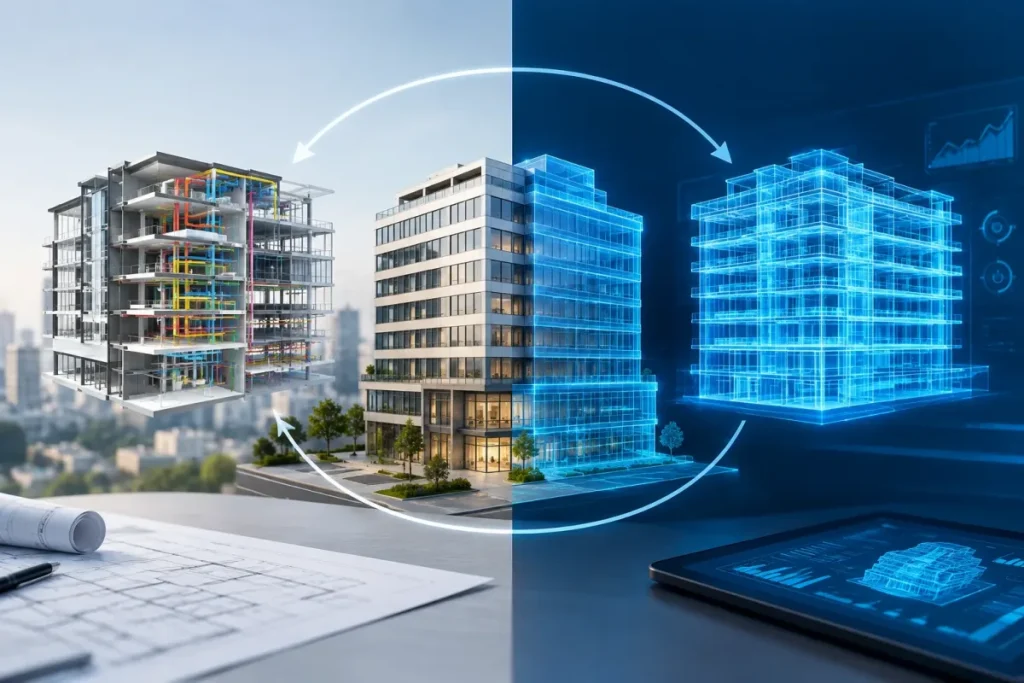
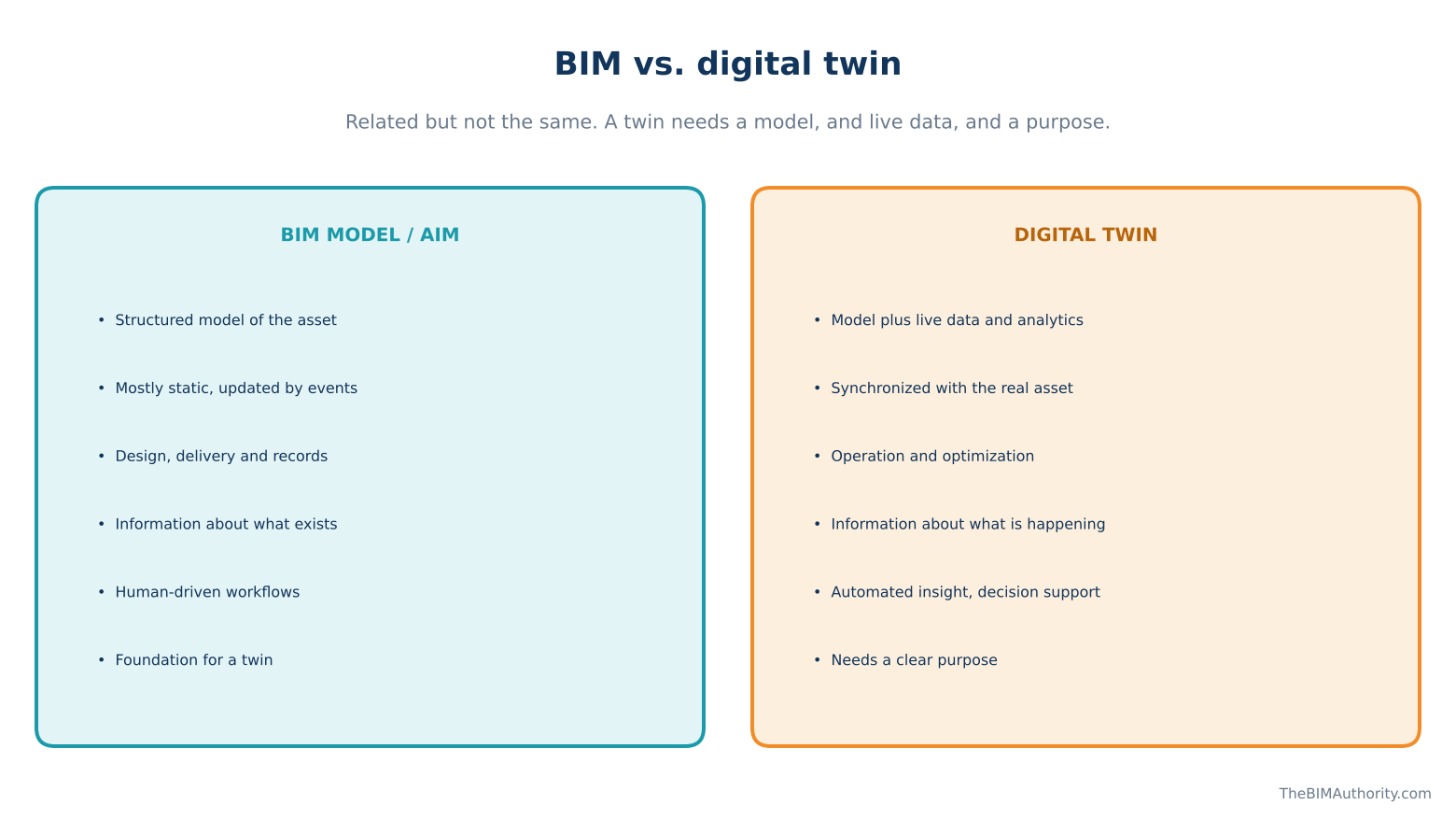
The honest answer is the last. BIM and digital twins are different things that depend on each other. BIM is a way of creating and managing structured information about a built asset, primarily during its design and construction and, increasingly, through its operation. A digital twin is a digital representation of an asset that is connected to it by data and used for a purpose such as understanding, predicting or optimizing its behavior. A digital twin of a building needs a model of the building: its spaces, systems and assets, with their relationships. BIM, and especially a well-managed asset information model, is the best source of that. And BIM, in turn, benefits from the operational data and insights that twins generate, which can inform future design and keep the model honest. They are layers of the same stack, not rival technologies.
The practical consequences are considerable. An organization that treats the two as alternatives may abandon the careful information management that a twin will need, or may expect a model to behave like a twin when no data flows into it. An organization that understands the relationship will invest in the foundation (identifiers, structure, quality), connect data where it pays, and apply analytics to decisions that matter. This guide explains the differences and the connections: definitions, a side-by-side comparison, what each does well, how they fit together, the role of the asset information model, applications by lifecycle stage, common misconceptions, how to decide what you need and the mistakes to avoid. It complements Digital Twins in Construction: The Complete Guide and Asset Information Models (AIM): Creation and Management.
The Short Answer
| BIM model / AIM | Digital twin | |
|---|---|---|
| Core idea | Structured model and information about the asset | Representation synchronized with the asset by data, used for decisions |
| Time | Mostly static; updated by events and projects | Dynamic; updated by data streams |
| Data | Design, construction and asset information | Plus live or frequent operational data |
| Purpose | Design, delivery, handover, asset records | Operation, optimization, prediction, scenario testing |
| Primary question | What is the asset and how is it made? | What is the asset doing now, and what will it do? |
| Users | Project teams, asset managers, operators | Operators, managers, analysts |
| Typical lifecycle focus | Design to handover, extended into operation as the AIM | Operation, with links to design and construction |
| Dependency | Stand-alone | Needs a model, data, analytics and a purpose |
In one sentence:
BIM describes the asset; a digital twin adds the asset’s living data and uses both to support decisions. BIM is a foundation of a twin, not a rival.
Definitions
BIM
BIM is the use of shared digital representations of a built asset to facilitate design, construction and operation processes, forming a reliable basis for decisions. In practice, BIM covers models (3D geometry with data), information management processes (such as ISO 19650), data standards (such as IFC and COBie) and collaboration practices. For operation, the relevant concept is the asset information model. See Asset Information Models (AIM): Creation and Management and Project Information Models (PIM) vs. Asset Information Models (AIM).
Digital Twin
International terminology work (ISO/IEC 30173:2023, Digital twin: Concepts and terminology) establishes terminology and describes concepts including types of digital twin (component, asset, system and process twins) and the digital twin system context. In practical terms for buildings and infrastructure: a digital twin is a digital representation of an asset or system, linked to the real asset by data, used for a defined purpose.
Model, Shadow and Twin
| Term | Data flow | Comment |
|---|---|---|
| Digital model | None automated | A BIM model is a digital model |
| Digital shadow | Physical to digital, automatic | A model plus live data feeding it; many building “twins” are shadows with analytics |
| Digital twin | Bidirectional or closed loop with decisions | Insight leads to action on the asset, by people or control systems |
Use precise language in requirements and contracts: say what data flows, how often, to what purpose and with what actions. See Digital Twins in Construction: The Complete Guide.
What Each Does Well
BIM Does Well
| Strength | Explanation |
|---|---|
| Structured design and construction information | Coordinated geometry, specifications, quantities |
| Collaboration and coordination | Federated models, clash detection, issue management |
| Standardized information management | ISO 19650 processes, CDE, requirements |
| Handover of asset information | COBie, IFC, registers; the AIM |
| Open exchange | IFC and related standards |
| Documentation | Drawings, schedules, records |
| Quantities and analysis inputs | Energy, carbon, cost |
Digital Twins Do Well
| Strength | Explanation |
|---|---|
| Showing current state | Live conditions in context |
| Detecting anomalies and faults | Comparing behavior with expectation |
| Predicting | Forecasting performance or failures |
| Testing scenarios | Simulating options on a representation grounded in real data |
| Optimizing operation | Tuning controls and schedules |
| Supporting operational decisions at scale | Across portfolios and networks |
| Closing the loop | Feeding operational experience back to design |
Where Each Is Weak
| BIM alone | Digital twin alone |
|---|---|
| Does not know what the asset is doing now | Without a good model, data lack context and structure |
| Becomes stale if not updated | Without governance, data and models decay |
| Not designed for time series and analytics | Without foundations, becomes a bespoke integration project |
| Needs people to act | Needs purpose and users to create value |
How They Fit Together
A layered view:
| Layer | Role | Source |
|---|---|---|
| Physical asset | The real building or infrastructure | |
| Devices and systems | Sensors, meters, controllers | Installed equipment |
| Data platform | Ingestion, storage, quality, harmonization | Integration |
| Model and context | Spaces, assets, systems, relationships, location | BIM, AIM, GIS |
| Analytics and simulation | Insight, prediction, scenarios | Analytics tools |
| Applications | Dashboards, alerts, work orders, control | Software |
| People and processes | Decisions and actions | Organization |
BIM and the AIM supply the context that gives data meaning: which sensor is in which room, which equipment serves which zone, what the design intent was, what the asset’s specification and maintenance requirements are. See Connecting BIM Models to IoT Sensors and Building Management Systems.
What the AIM Contributes to a Twin
| AIM content | Use in the twin |
|---|---|
| Asset register with persistent identifiers | Key for joining data from different systems |
| Spatial hierarchy | Aggregation of data by room, floor, building |
| System relationships | Impact analysis; fault propagation; diagnostics |
| Design data and intent | Baselines for comparison |
| Product and maintenance data | Maintenance triggers; remaining life models |
| Documents | Procedures linked to alerts |
| Geometry | Visualization; spatial queries |
| Classification | Semantic structure |
What the Twin Contributes Back to BIM
| Twin output | Use in BIM and the AIM |
|---|---|
| Verified performance data | Feedback to designers; benchmark data |
| Discrepancies between records and reality | Corrections to the AIM |
| Asset condition and history | Updates to asset records |
| Usage patterns | Inputs for design briefs and space planning |
| Commissioning and operational insight | Lessons for future projects. See BIM for Building Performance Monitoring and Energy Optimization |
Applications by Lifecycle Stage
| Stage | BIM focus | Twin focus |
|---|---|---|
| Planning and design | Model-based design, analysis, coordination | Using data from comparable assets in operation to inform design; context twins at city scale |
| Construction | Coordination, 4D/5D, fabrication, progress records | Live site data, progress monitoring, logistics. See BIM for Construction Progress Monitoring and Reporting |
| Handover | PIM to AIM; asset data; as-built | Connecting commissioning data and sensors to the model |
| Operation | AIM maintenance; space and asset management | Monitoring, analytics, optimization, predictive maintenance |
| Renewal and decommissioning | Updated models and records; material information | Condition-driven renewal; end-of-life planning |
Common Misconceptions
| Misconception | Reality |
|---|---|
| “A BIM model is a digital twin.” | A BIM model is a digital model. It becomes part of a twin when connected to live data and used for decisions |
| “A digital twin replaces BIM.” | A twin of a building needs a model and structured information; BIM and the AIM provide them |
| “A twin is a 3D model with sensors.” | A twin also needs data quality, analytics, users, decisions and governance |
| “More sensors mean a better twin.” | Value depends on questions, data quality and action |
| “A twin must be real-time and autonomous.” | Many valuable twins update periodically and support human decisions |
| “BIM is only for design and construction.” | BIM information is used in operation through the AIM |
| “A twin is a product you buy.” | It is a capability built from models, data, platforms, processes and people |
| “A twin needs one big platform.” | Open, modular architectures often work better |
| “A twin is only for new buildings.” | Existing buildings can have twins if the foundation (an AIM) is built incrementally |
Deciding What You Need
| Question | If yes… |
|---|---|
| Do we lack a reliable record of what we own and where it is? | Start with an asset information model |
| Do we know what we have, but not what it is doing? | Add monitoring: connect meters and sensors to the AIM (a digital shadow with dashboards) |
| Do we need to detect faults, forecast or test scenarios? | Add analytics and simulation (an analytical twin) |
| Do we want automated optimization? | Add closed-loop control with safety assurance, oversight and governance |
| Do we have decisions and users that will act on the results? | If not, do not build it yet |
A sensible path: AIM first; connect data where decisions justify; add analytics where value is clear; automate only with assurance.
Applications: Examples of Questions
| Question | Needs BIM/AIM? | Needs live data? | Name |
|---|---|---|---|
| Where is every fire damper and when was it last tested? | Yes | No | AIM and register |
| Which rooms are overheating this week? | Yes (spaces) | Yes | Digital shadow |
| Which air handling unit is likely to fail next month? | Yes | Yes, plus analytics | Analytical twin |
| What if we change the schedule of this zone? | Yes | Yes, plus simulation | Scenario twin |
| Should the building adjust its set points automatically? | Yes | Yes, plus closed-loop control | Autonomous twin (with oversight) |
Notice that the first question, which many organizations cannot yet answer, needs no live data at all.
Foundations That Serve Both
| Foundation | Why |
|---|---|
| Requirements (OIR, AIR, EIR) | Define information for BIM and twin use. See Asset Information Requirements (AIR): Complete Guide |
| Persistent identifiers | Join model, register and data |
| Classification and semantic structure | Consistent meaning. See MEP BIM Systems Classification and Asset Data Requirements |
| Spatial hierarchy | Aggregation and context |
| Data quality processes | Trust |
| Information management (ISO 19650) | Governance. See ISO 19650-3: Information Management During Asset Operations |
| Security and privacy | Protect data and systems. See BIM Information Security, Access Control, and Data Governance |
| Open standards | Interoperability. See openBIM Explained: Principles, Standards, and Benefits |
Common Mistakes
- Treating BIM and twins as alternatives.
- Calling any model a twin.
- Buying a twin platform before building the AIM.
- Ignoring identifiers and structure.
- Expecting live data from a static model.
- Measuring sensors, not decisions.
- No owner for model and data maintenance.
- Proprietary lock-in.
- Ignoring security and privacy.
- Dropping BIM information management when “moving to twins.”
- Overpromising autonomy.
- Not feeding operational insight back to design.
See also Common BIM Mistakes Beginners Should Avoid.
A Short Checklist
- Do we use precise language: model, shadow, twin, AIM?
- Do we have a reliable AIM (identifiers, hierarchy, classification, data)?
- Have we identified decisions that live data and analytics would improve?
- Have we chosen the minimum capability (record, monitor, analyze, automate) that fits?
- Are sensors and data mapped to the model by identifiers?
- Is the architecture open and modular?
- Are governance, security and privacy in place?
- Do we measure outcomes?
- Do operational insights feed back into the AIM and into future briefs?
- Is information management (ISO 19650) maintained across both?
Frequently Asked Questions
Is BIM the same as a digital twin?
No. BIM is a structured model and information management approach; a digital twin is connected to the real asset by data and used for decisions. BIM and the AIM are foundations of a twin.
Does a digital twin replace BIM?
No. A twin of a building needs a model, and BIM and the AIM provide it. Twins add live data and analytics.
What is the relationship between the AIM and a digital twin?
The AIM is the static information backbone of the twin: assets, spaces, systems, relationships, documents and identifiers.
What is a digital shadow?
A digital representation that receives data automatically from the physical asset but does not act back on it. Many building twins are digital shadows with analytics.
Do I need real-time data?
Not necessarily. Choose the data frequency that serves the decision.
Where should I start: BIM or a twin?
With the asset information model and the decisions you want to improve; add data connections and analytics as value justifies.
Can existing buildings have digital twins?
Yes, by building an AIM incrementally and connecting data where it pays.
What standard defines digital twins?
ISO/IEC 30173:2023 provides concepts and terminology; other standards address information management, building data, communications and asset management.
Final Thoughts
After the “BIM is dead” slide, a woman in the audience stood up and asked the vendor a single question: “When your twin shows me a temperature in room 4.12, how does it know that room 4.12 exists?” The vendor paused. The answer, of course, was that somebody had built a model, assigned the room a number and mapped the sensor to it. That somebody was doing BIM. The twin was standing on a foundation that its marketing had declared obsolete.
BIM and digital twins are partners across the life of an asset. BIM creates and structures the information; the AIM keeps it true; sensors and systems supply the living data; analytics turn both into insight; people and processes turn insight into action; and operational experience flows back into the next design. Treat them as layers, build the foundation first, connect data where it pays and choose words precisely. The result will be less exciting than a slogan, and a good deal more useful.
Where to go next: for the wider view, read Digital Twins in Construction: The Complete Guide. For the foundation, continue with Asset Information Models (AIM): Creation and Management, and for the data connection, Connecting BIM Models to IoT Sensors and Building Management Systems.