

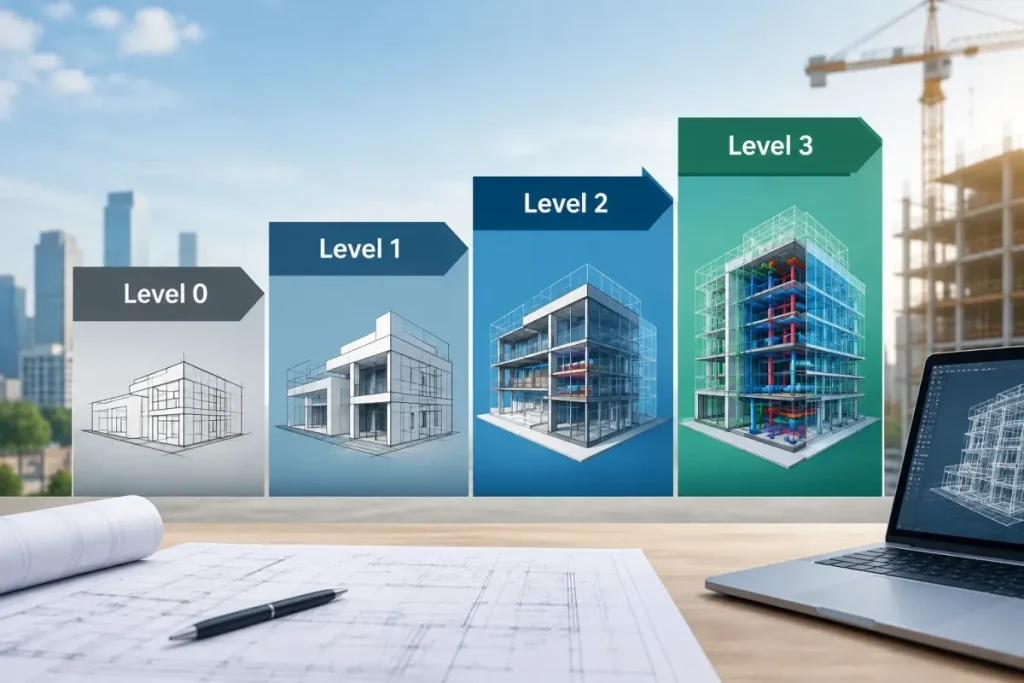

In 2015, I sat in a tender briefing where the client announced, with great solemnity, that all bidders must demonstrate “BIM Level 2 capability”. I counted the faces around the table. About a third of the people nodded confidently. Another third nodded less confidently. The last third looked at their shoes. When I asked afterward what “Level 2” meant to each of them, I received at least five different answers, ranging from “we use Revit” to “we send IFC files” to “we have a certificate”.
That is the problem with BIM maturity levels: the idea was brilliant, the diagram was memorable, and the interpretation was chaotic. A decade later, the phrase “BIM Level 2” is still used in job advertisements and tenders, even though the standards behind it have been replaced by ISO 19650. Many professionals feel they are caught between two vocabularies and do not know which one to use.
In this guide, I will explain what the maturity levels were, where they came from, what each level meant in practice, why ISO 19650 replaced the old framework, and how to translate from one language to the other. I have lived through the whole transition, first as a CAD manager helping offices reach “Level 2”, then as a consultant helping them move to ISO 19650, and I will share what I learned along the way.
The Short Answer
BIM maturity levels (Level 0 to Level 3) were a classification, popularized in the UK around 2008 and 2011, that described the degree of collaboration and data integration in a project, from unmanaged CAD (Level 0) to a fully integrated, open-data vision (Level 3).
ISO 19650 is the international standard series, published from 2018 onward, that defines how information should be managed across the life cycle of a built asset using BIM. It was built on the UK experience of “Level 2”, and it replaced the national standards that supported it.
In one sentence:
Level 2 was a destination described by a diagram; ISO 19650 is the road map, with rules, roles and processes, that you can actually follow and verify.
If a client asks for “Level 2” today, they almost always mean “work according to ISO 19650”. But you should confirm it in writing.
Where the Levels Came From: The Bew-Richards Diagram
The maturity levels were illustrated by a famous diagram, often called the BIM maturity wedge or the Bew-Richards model, after Mark Bew and Mervyn Richards, two British experts who developed it around 2008. It was used by the UK government’s BIM Task Group to explain the path the industry should follow.
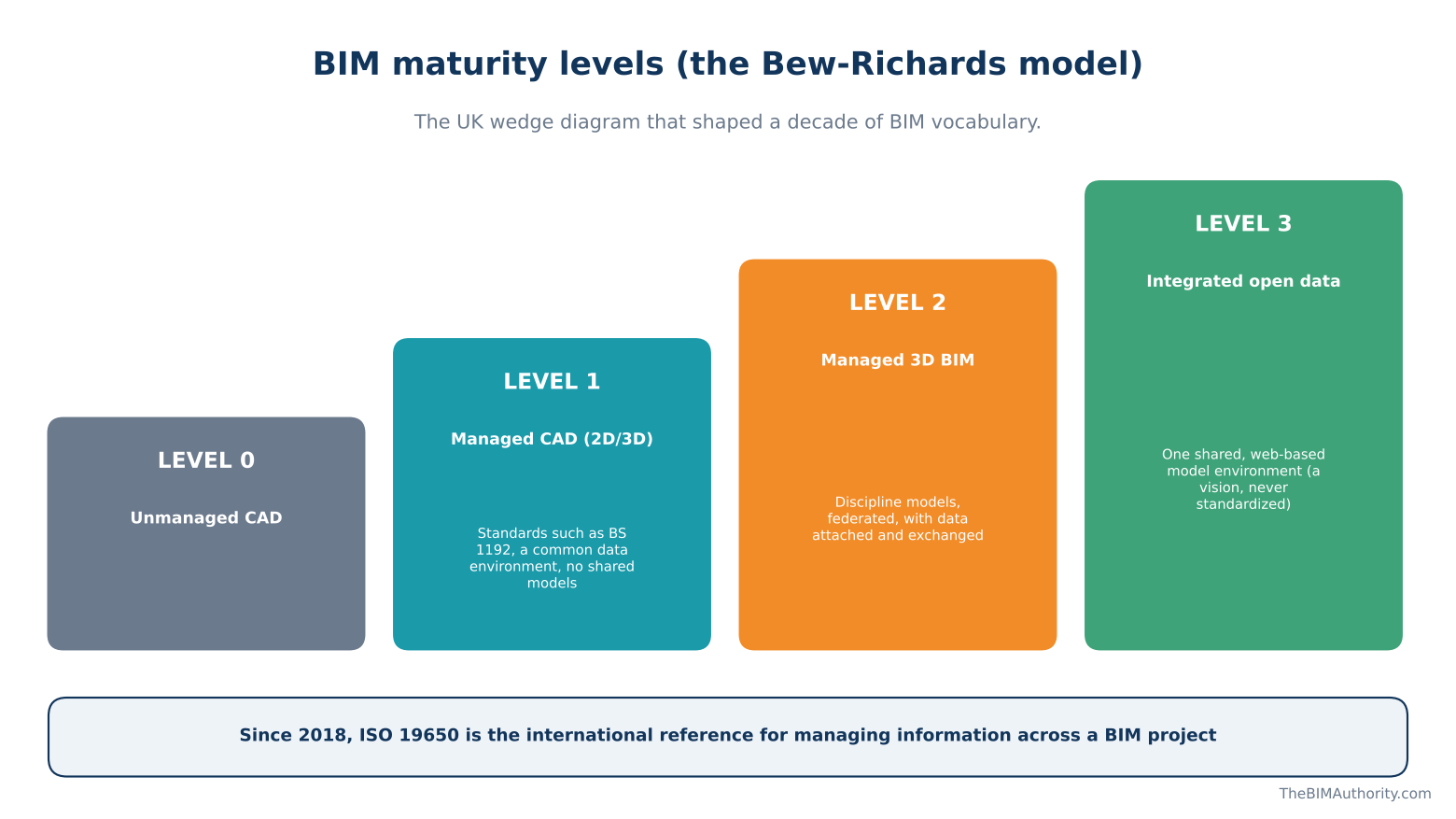
The diagram presented a simple message: the industry could move step by step from isolated, drawing-based work to integrated, data-based collaboration. Each level was a milestone, not a software category. That idea, that BIM is about how you work together and not only about the tool, was a major contribution.
The Four Levels Explained
Level 0: Unmanaged CAD
What it was: 2D drawings, produced in CAD or by hand, exchanged on paper or as electronic files with no structured collaboration.
Typical characteristics:
- Drawings are the main deliverable.
- Each party keeps its own files.
- Coordination happens by overlaying drawings and by meetings.
- There is no common standard for naming or data.
Reality check: This was the situation I knew in my first decade in the profession. It worked, in the sense that buildings were built. But errors and omissions were an accepted part of the process.
Level 1: Managed CAD in 2D or 3D
What it was: CAD, in 2D or 3D, with a managed process: standards for naming and layering, and a shared place for exchanging information. In the UK, this was supported by the standard BS 1192:2007, which introduced the idea of a Common Data Environment.
Typical characteristics:
- Information is managed through a CDE with defined states.
- Standards exist for file naming and data structure.
- Models may be 3D, but they are often used for design concepts, not for coordination.
- Teams still produce and exchange their own separate data, with no shared model.
Reality check: Many CAD managers, including me, implemented Level 1 without calling it that. Layer standards, naming conventions and structured folders were exactly this.
Level 2: Managed 3D BIM
What it was: a collaborative, managed 3D environment, in which each discipline produces its own 3D model with data attached, and the models are combined, or federated, for coordination. This was the level mandated by the UK government for centrally procured projects from 2016.
Typical characteristics:
- Separate discipline-based 3D models, each with structured information.
- Information managed in a CDE following defined rules.
- Information exchange through formats such as IFC or COBie, and native files.
- Possible use of 4D (time) and 5D (cost) information.
- Clear information requirements, delivery plans and roles.
Supporting documents (UK): PAS 1192-2 (information management for the delivery phase), PAS 1192-3 (operational phase), BS 1192-4 (COBie), PAS 1192-5 (security), along with other guides and protocols.
Reality check: Level 2 is the stage most organizations talk about, because it was the pragmatic target. It did not require a single shared model: it required good discipline in separate models and good information management. That is why it was achievable, and why it worked.
Level 3: Fully Integrated, Open Data (iBIM)
What it was: a vision of fully open process and data integration, with a single, shared project model held in a collaborative environment, accessible by all parties through web services, including support for 4D, 5D and 6D information.
Typical characteristics (as imagined):
- One shared model, or tightly integrated models, in a central environment.
- Fully open data standards.
- Real-time collaboration.
- Integration with asset management and operations.
Reality check: Level 3 was never defined as a formal standard. It remained a vision, and the UK later shifted its strategy toward broader digital built Britain and information management concepts. In practice, many of the ideas associated with Level 3, such as open data, interoperability, digital twins and cloud collaboration, continue to develop under other names.
A Summary Table of the Four Levels
| Level | Name | Main idea | Information | Typical output |
|---|---|---|---|---|
| 0 | Unmanaged CAD | Drawings | Mostly graphical, unmanaged | 2D drawings |
| 1 | Managed CAD | Standards and a CDE | Structured exchange of CAD data | 2D or 3D CAD, managed files |
| 2 | Managed 3D BIM | Federated discipline models | Data attached to objects; formal exchange | Coordinated 3D models, COBie, documents |
| 3 | Integrated open data | Single shared environment | Fully open, integrated data | Vision: shared model and web services |
Why the Levels Became a Problem
The maturity wedge was a powerful communication tool, but over time it created some real difficulties.
- People interpreted the levels as software categories. “We are Level 2 because we use Revit” was a very common, and wrong, conclusion.
- “Level 2 compliant” was not a formal status. There was no universal certification. It was a self-declared label, interpreted differently by each client.
- The levels described national standards. They were meaningful in the UK, but less so for international projects.
- Level 3 never materialized as a standard. The diagram promised a destination that was never defined.
- The vocabulary was too coarse. Real projects needed more precise statements about roles, information requirements, delivery plans and responsibilities.
The industry needed a more precise, international and verifiable framework. That is where ISO 19650 came in.
The Shift to ISO 19650
What ISO 19650 Is
ISO 19650 is a series of international standards on the organization and digitization of information about buildings and civil engineering works, including BIM, with information management using BIM. It does not define software or file formats. It defines processes, roles and requirements for managing information.
The series includes:
| Part | Subject |
|---|---|
| ISO 19650-1 | Concepts and principles |
| ISO 19650-2 | Delivery phase of assets |
| ISO 19650-3 | Operational phase of assets |
| ISO 19650-4 | Information exchange |
| ISO 19650-5 | Security-minded approach |
| ISO 19650-6 | Health and safety information |
Parts 1 and 2 were published in 2018, and the others followed in the years after. For a complete overview, see ISO 19650 Explained: A Complete Guide for BIM Professionals, and for individual parts, ISO 19650-1: Information Management Concepts and Principles, ISO 19650-2: BIM Information Management During Project Delivery and ISO 19650-3: Information Management During Asset Operations.
How It Relates to the UK Level 2 Documents
The UK experience was the foundation of ISO 19650. The standards that supported Level 2, such as BS 1192 and PAS 1192-2 and PAS 1192-3, were superseded by the BS EN ISO 19650 series, with a UK National Annex to adapt it locally. Many of the core ideas survived:
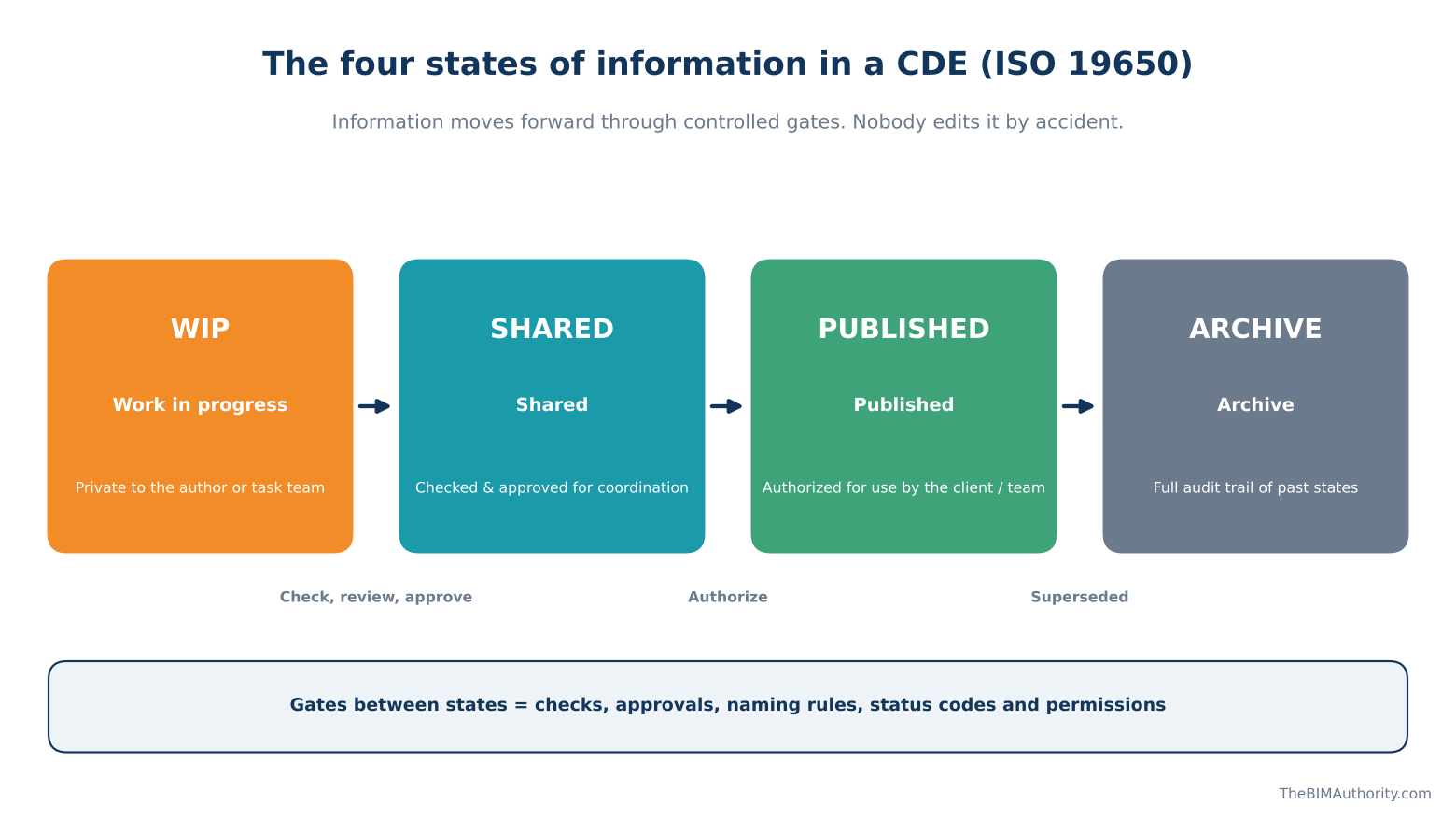
- The Common Data Environment and its states (work in progress, shared, published, archive).
- The idea of information requirements driving delivery.
- The BIM Execution Plan, now in pre-appointment and post-appointment forms.
- Delivery plans, now called Task Information Delivery Plans and the Master Information Delivery Plan.
- Federated, discipline-based models.
What changed was precision, vocabulary and internationalization.
Level 2 vs. ISO 19650: A Direct Comparison
| Topic | BIM Level 2 (UK documents) | ISO 19650 |
|---|---|---|
| Nature | A maturity level supported by UK standards | An international standard series |
| Scope | Mostly UK, projects in delivery phase, with an operational companion | International, delivery and operational phases and more |
| Terminology | Employer, supply chain, EIR (Employer’s Information Requirements) | Appointing party, appointed party, lead appointed party, EIR (Exchange Information Requirements) |
| Information requirements | Mainly employer-driven | A structured chain: OIR, AIR, PIR, EIR |
| Asset information | Operational documents covered separately | Integrated concept of Project Information Model and Asset Information Model |
| Level of definition | Level of detail and level of information | Level of information need, defined by purpose |
| Security | Separate specification | Dedicated part, ISO 19650-5 |
| Verification | Self-declared “Level 2” | Possible third-party certification against the standard |
| Future development | Frozen | Actively maintained and extended |
A Terminology Cheat Sheet
| Old UK term | ISO 19650 term |
|---|---|
| Employer | Appointing party |
| Supplier or supply chain | Appointed party |
| Lead designer or main contractor in charge of information | Lead appointed party |
| Employer’s Information Requirements | Exchange Information Requirements (EIR) |
| Project BIM Execution Plan | BIM Execution Plan, pre-appointment and post-appointment |
| Level of Detail and Level of Information | Level of Information Need (see below) |
| As-built model for operations | Asset Information Model (AIM) |
For definitions of these terms, see BIM Terminology: The Essential Glossary for Beginners.
The Concepts That ISO 19650 Added or Clarified
1. A Complete Chain of Information Requirements
Instead of one document from the client, ISO 19650 describes a chain: the organization’s needs (OIR), the asset’s needs (AIR), the project’s needs (PIR) and the delivery requirements (EIR). See ISO 19650 Information Requirements Explained: OIR, AIR, PIR, and EIR.
2. The Appointment Process
ISO 19650-2 describes the activities from assessment and need through invitation to tender, tender response, appointment, mobilization, collaborative production and project close-out. It brings structure to what had been informal practice. See BIM Procurement and Appointments Under ISO 19650.
3. Information Containers and Status
Information is organized into information containers, with unique identification, status and revision. This supports traceability and controlled sharing. See BIM File Naming Conventions and ISO 19650.
4. The Level of Information Need
The framework moved away from fixed development levels toward the idea of defining the information required for a purpose. See Level of Information Need vs. LOD vs. LOI: Key Differences.
5. A Lifecycle View
Through the PIM and AIM concepts and ISO 19650-3, the standard connects design and construction with operation. See Project Information Models (PIM) vs. Asset Information Models (AIM).
6. Security and Safety
The addition of a security-minded part and a health-and-safety part shows that information management also involves risk. See ISO 19650-5: Security-Minded BIM Information Management and ISO 19650-6: Health and Safety Information Management.
What the Transition Means in Practice
If you have been working at “Level 2”, you are in a good position. Most of your habits carry over. Here is how I explain the transition to teams.
What You Keep
- A CDE with controlled workflow.
- Discipline-based, federated models.
- Naming conventions and information structure.
- A BIM Execution Plan and delivery plans.
- Information exchange in open and native formats.
What You Update
- Vocabulary: adopt the ISO 19650 terms in your documents.
- Information requirements: structure them as OIR, AIR, PIR and EIR.
- Level of detail: move from “which LOD?” to “what information is needed, for what purpose?”.
- BEP structure: produce the pre-appointment and post-appointment versions.
- Delivery plans: use TIDPs and an MIDP.
- Operational handover: align with the AIM concept and ISO 19650-3.
- Roles: define the appointing, lead appointed and appointed parties, and the information manager function.
What You Add
- Evidence. Many clients now ask you to demonstrate compliance, through documentation, processes and sometimes certification by an accredited body.
- Security considerations, where relevant.
See BIM Execution Plan (BEP): How to Create and Implement One, Master Information Delivery Plan (MIDP): Complete Guide and Task Information Delivery Plan (TIDP): Complete Guide.
Other Ways of Measuring BIM Maturity
The Bew-Richards wedge is not the only maturity framework. Some are still very useful, especially for assessing an organization rather than a project.
- Bilal Succar’s BIM Maturity Matrix: describes organizational maturity through stages such as initial, defined, managed, integrated and optimized, across several competency areas.
- The US National BIM Standard Capability Maturity Model: a tool to assess how well a BIM-based process or project performs against defined areas.
- Company self-assessments: many consultancies and owners offer questionnaires that rate capability in areas such as process, technology, people and data.
These models have a different purpose from ISO 19650. They help you measure and improve your capability, whereas ISO 19650 gives you a standard to follow. They are complementary.
A Quick Self-Assessment: Where Are You Today?
Answer honestly. This is not a certification, only a conversation starter.
| Question | Yes / No |
|---|---|
| Do we manage our files in a CDE with defined statuses? | |
| Do we follow a documented naming convention? | |
| Do our disciplines produce separate 3D models with data? | |
| Do we federate models and run coordination regularly? | |
| Do we write a BEP for each project? | |
| Do we respond to information requirements from the client? | |
| Do we use IFC or other open formats for exchange? | |
| Do we define what information is needed for each purpose and milestone? | |
| Do we have defined roles for information management? | |
| Do we hand over structured information for operation? | |
| Can we demonstrate our process with documentation? |
If you answered yes to most, you are operating at what used to be called Level 2, and you are close to ISO 19650 alignment. If you answered no to the first few, start there: standards, CDE and naming come first. See How to Implement BIM in Your Company: A Step-by-Step Roadmap.
What to Say When a Client Asks for “Level 2”
This is a practical situation, and one I have faced many times.
- Ask what they mean. “Do you mean compliance with the ISO 19650 series?”
- Request the EIR. The real requirements are in the Exchange Information Requirements, not in a label.
- Respond with your approach using ISO 19650 terminology: pre-appointment BEP, capability and capacity, delivery plan.
- Confirm in writing the standards, the format of deliverables and the verification method.
- Avoid claiming “Level 2 certified” unless the client defines it and you can prove it.
See How to Respond to BIM Requirements in Tenders.
Common Mistakes About Maturity Levels
- Believing that using BIM software equals a maturity level. It does not.
- Claiming a level without documentation. Clients increasingly ask for evidence.
- Aiming for Level 3 as a goal. It was never a standard. Aim for good information management instead.
- Ignoring the shift to ISO 19650. Documents referring to PAS 1192 are outdated.
- Treating the shift as a pure vocabulary change. The structure of requirements and responsibilities has also changed.
- Applying everything at once. Mature gradually, project after project.
See Common BIM Mistakes Beginners Should Avoid.
Frequently Asked Questions
What were BIM Levels 0, 1, 2 and 3?
They were maturity levels from the UK: Level 0 unmanaged CAD, Level 1 managed CAD with a common data environment, Level 2 collaborative 3D BIM with discipline models and managed information, and Level 3 a vision of fully integrated open data.
Is BIM Level 2 still used?
The term is still widely used informally, but the supporting UK standards have been replaced by ISO 19650. Today, “Level 2” usually means working in line with ISO 19650.
What is the difference between BIM Level 2 and ISO 19650?
Level 2 was a maturity level supported by British standards. ISO 19650 is an international standard series that defines processes, roles and information requirements, and extends the earlier approach.
Did Level 3 ever happen?
Not as a formal standard. It remained a vision of open data and integration, and many of its ideas continue to develop through digital twins, open standards and cloud collaboration.
Does ISO 19650 replace PAS 1192?
Yes. The BS EN ISO 19650 series, with the UK National Annex, replaced the earlier BS 1192 and PAS 1192 documents for the delivery and operational phases.
Do I need to be certified to say I follow ISO 19650?
Not necessarily, but clients may ask for evidence or third-party certification. Check the requirements of each tender.
Is ISO 19650 only for the UK?
No. It is an international standard, adopted or adapted by many countries. See BIM Standards Around the World: USA, UK, Canada, Australia, and Europe.
Where should I start if I want to align with ISO 19650?
Start with the concepts and the information requirements, set up a CDE and a naming convention, write a BEP, and learn the roles. Then refine with practice.
Final Thoughts
The maturity levels did something remarkable for our industry: they made an entire profession talk about collaboration and information in a common language. That was a real achievement, and I do not think the shift to ISO 19650 would have been possible without it.
But a diagram is a starting point, not an operating manual. ISO 19650 provides the operating manual: roles, processes, requirements and evidence. If you have worked toward Level 2, you have already done most of the hard work. The next step is not to start again. It is to translate your habits into the international vocabulary, and to keep improving.
Where to go next: continue with ISO 19650 Explained: A Complete Guide for BIM Professionals for the full framework, then ISO 19650 Information Requirements Explained: OIR, AIR, PIR, and EIR to understand how requirements flow. For the broader context, read BIM Standards: The Complete International Guide and The History and Evolution of BIM.



