



The most expensive sentence in my early consulting career was a casual one: “BIM coordination? Sure, we can include that in the fee.” I said it to a client over coffee, on a project that looked straightforward. Eighteen months later, we had run forty-one coordination cycles, produced several hundred pages of issue reports, administered a CDE for eleven companies, checked asset data for six hundred items and attended every meeting the client could invent. The fee we had “included” would not have covered the first six months. The client was not acting in bad faith. They simply had no idea how much work “BIM coordination” involved, because we had never told them, and had never told ourselves.
Pricing BIM services is hard for good reasons. The work is partly new, so there is little history to estimate from. The scope is elastic: coordination can be one meeting a month or a daily discipline. The deliverables are information, which clients often assume is free once the model exists. And the benefits fall on other parties: when you coordinate well, the contractor’s site runs smoothly, and you are rarely thanked for the clash that never happened.
This guide gives you a method. It explains what counts as a BIM service, the main fee models and when each fits, a cost-based pricing method with a worked example, how to define scope so the price means something, how to handle changes, how to structure payments and how to talk about value. It is written for designers, consultants, contractors and specialists who sell BIM-related work. It is not legal or tax advice. For the costs behind your price, see BIM Implementation Costs: Software, Training, and Hardware Budget.
The Short Answer
Price BIM services by defining the scope precisely, estimating the work bottom-up, adding the right loadings and choosing a fee structure that matches how well the scope is known.
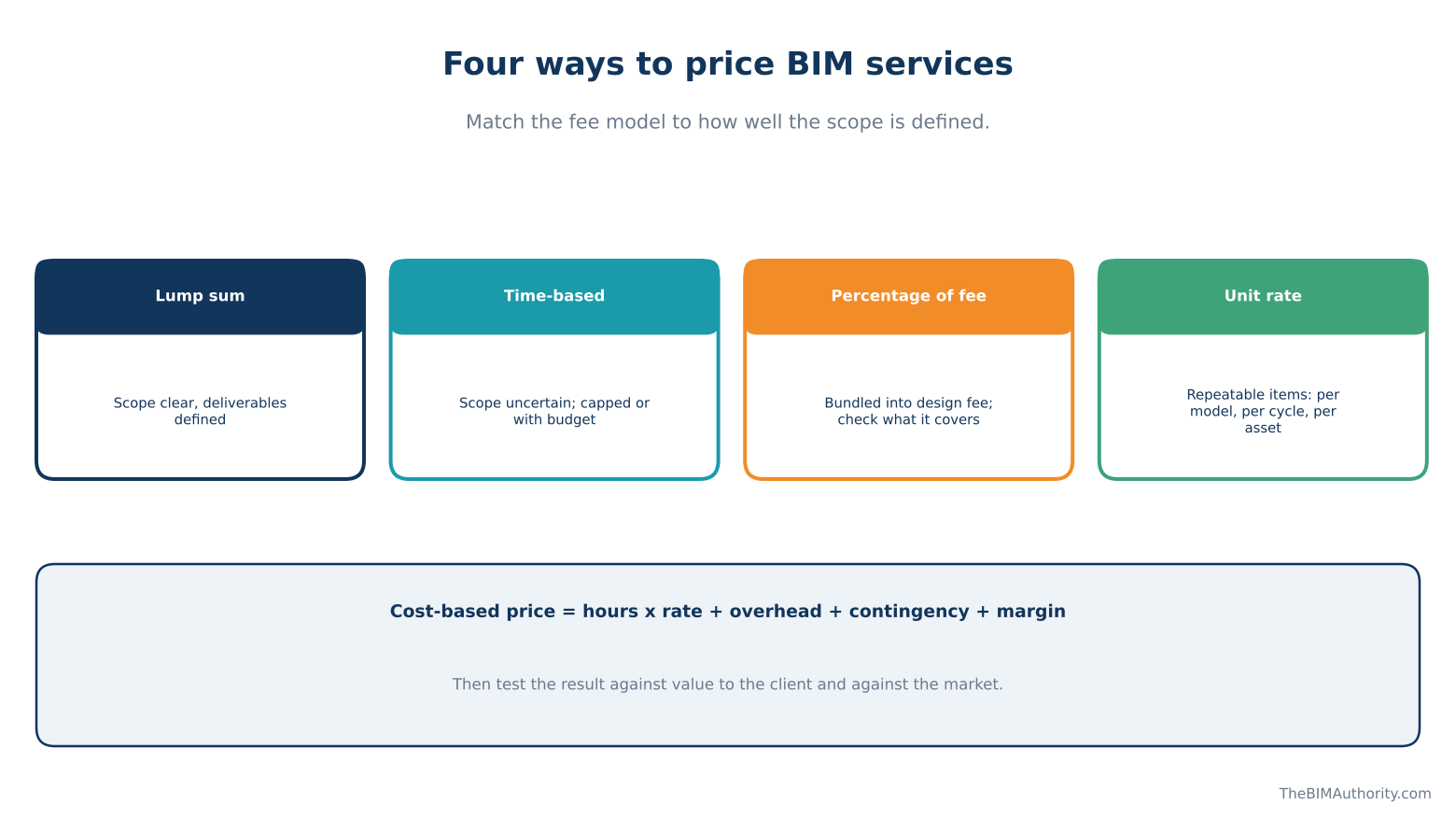
Cost-based price = hours × rate + overhead + contingency + margin, then test it against value to the client and the market.
| Fee model | Best when |
|---|---|
| Lump sum | The scope and deliverables are clear |
| Time-based (with a cap or budget) | The scope is uncertain, or the work is advisory |
| Percentage of construction or design fee | BIM is bundled into design services, with a clear description of what is covered |
| Unit rate | The work is repeatable: per model, per coordination cycle, per asset, per square meter |
In one sentence:
Price what you will actually do, say clearly what is included, and write down how extra work will be charged.
What Counts as a BIM Service?
BIM-related services fall into two groups. Be clear which you are selling.
1. BIM-Enabled Core Services
These are your normal professional services (design, engineering, construction), delivered using BIM. Typically priced within the main fee, but you should state what BIM deliverables are included: models, data, exports, coordination participation.
2. Stand-Alone or Additional BIM Services
| Service | Typical scope |
|---|---|
| Information management | Writing the BEP, administering the CDE, naming and status control, transmittals, audits. See BIM Execution Plan (BEP): How to Create and Implement One |
| BIM coordination | Federating models, clash detection, rule checks, issue management, coordination meetings. See BIM Coordination: The Complete Guide |
| Model checking and quality assurance | Independent checks, validation, reports. See BIM Quality Management: Processes, Metrics, and Best Practices |
| Client-side advisory | EIR and AIR writing, tender assessment, acceptance review. See Exchange Information Requirements (EIR): Complete Guide |
| Scan-to-BIM and existing conditions | Survey processing and modeling. See Scan-to-BIM: Converting Point Clouds into Intelligent Models |
| Quantity and cost services (5D) | Model-based quantities and estimates |
| Construction planning (4D) | Sequencing and visualization |
| Fabrication and shop modeling | Detailed models for manufacture |
| Asset data and handover | Data capture, verification and COBie or asset register delivery. See COBie Explained: The Complete Guide to BIM Asset Data Handover |
| Training and standards development | Courses, templates, office standards |
| Automation and data services | Scripts, dashboards, integrations |
Each has different drivers of effort. Price them separately, even if they are bundled in a proposal.
Fee Models in Detail
Lump Sum
A fixed price for a defined scope.
| Strengths | Risks |
|---|---|
| Client certainty; simple to administer | Scope creep erodes margin; estimating errors fall on you |
Use when: scope, deliverables, milestones and number of cycles are well defined. Protect yourself with explicit inclusions and exclusions, a defined number of cycles and a change mechanism.
Time-Based, With a Budget or Cap
Charged on hours at agreed rates, often with an estimate or a cap.
| Strengths | Risks |
|---|---|
| Fair when scope is uncertain; low risk to you | Client budget anxiety; you must report and manage hours |
Use when: requirements are evolving, the work is advisory or the project scope is unclear. Protect the relationship with regular reporting and early warnings when the estimate will be exceeded.
Percentage of Fee
A percentage of the design fee or construction cost allocated to BIM.
| Strengths | Risks |
|---|---|
| Simple for bundled services; familiar in some markets | Disconnected from the real effort; unclear what is included |
Use cautiously. If used, document what is included, and cross-check against an hours estimate.
Unit Rate
A price per defined unit: per model, per coordination cycle, per level, per asset item, per square meter.
| Strengths | Risks |
|---|---|
| Scales naturally with scope; transparent; easy to price changes | Units must be defined carefully; hidden fixed costs |
Use when: work is repeatable and measurable. Unit rates also make change pricing straightforward.
Combinations
Many proposals combine models: a lump sum for setup and management, unit rates for coordination cycles and time-based work for advisory tasks. This matches each part of the work to the right mechanism.
A Cost-Based Pricing Method
Step 1: Define the Scope
Write what you will do, for whom and when. Use the project’s EIR, milestones and deliverables. Be explicit about:
- Deliverables (models, reports, data, documents) and their level of information need;
- Milestones and durations;
- Number of coordination cycles and meetings;
- Number of parties and models;
- Standards and formats required;
- CDE responsibilities;
- Reference information you receive and its reliability;
- Exclusions (for example fixing other parties’ models, extra cycles, design changes).
Step 2: List the Tasks
Break the scope into tasks. Typical tasks for a coordination and information management service:
| Task | Drivers of effort |
|---|---|
| Setup | BEP, standards, templates, CDE configuration, mobilization test |
| Coordination cycles | Number of cycles; number of models; size and complexity; clash matrix |
| Checks and reporting | Number of checks; reports per cycle; milestone reviews |
| Management and meetings | Meetings; coordination with client and team; progress reports |
| Handover data verification | Number of assets; checks; client loading tests |
| Training and support | Briefings for teams |
| Close-out | Archive, lessons learned |
Step 3: Estimate Hours
Estimate hours per task, bottom-up, using your own history if you have any, and adding a risk factor where you lack data. For unfamiliar work, ask for a second estimate from a colleague and compare.
Step 4: Apply Rates
Use a cost rate per role (salary plus employment costs). Different tasks may use different roles: a coordinator, a modeler, a manager.
Step 5: Add Loadings
| Loading | Purpose |
|---|---|
| Overhead | Cover rent, software, IT, management, administration |
| Contingency | Cover uncertainty in the estimate and in the scope |
| Margin or markup | Profit and risk reward |
Step 6: Review Against Value and Market
Compare the result with:
- Value to the client: what it saves or protects (see below).
- The market: typical fees, competitor positioning (use what you legitimately know; avoid assuming).
- Your strategy: is this work you want, at this price?
Adjust the scope (not the quality) if the price is not acceptable. Cutting price without cutting scope is how margins disappear.
A Worked Example
Here is an illustrative calculation for a coordination and information management service on a twelve-month building project. All numbers are fictional, in currency units. Replace them with your own.
Scope Summary
Information management and BIM coordination for a mid-sized building: BEP and CDE setup, twenty coordination cycles, model and information checks, reports, meetings and handover data verification for critical assets.
Hours
| Task | Basis | Hours |
|---|---|---|
| Setup | BEP, standards, CDE configuration, mobilization test | 60 |
| Coordination cycles | 20 cycles × 14 hours | 280 |
| Checks and reporting | Milestone and quality reviews | 80 |
| Management and meetings | Progress reports, client and team meetings | 60 |
| Handover data verification | Critical asset checks, load test | 40 |
| Total hours | 520 |
Price Build-Up
| Step | Calculation | Amount |
|---|---|---|
| Direct labor | 520 hours × 55 (blended cost rate) | 28,600 |
| Overhead | 25% of direct labor | 7,150 |
| Cost before contingency | 35,750 | |
| Contingency | 10% of cost before contingency | 3,575 |
| Total cost allowance | 39,325 | |
| Markup | 15% of total cost allowance | 5,898.75 |
| Price | 45,223.75, rounded to 45,200 |
Unit Rate for Extra Coordination Cycles
One extra cycle is 14 hours: 14 × 55 = 770 of direct labor. Applying the same loadings (1.25 for overhead × 1.10 for contingency × 1.15 for markup, a combined factor of 1.58125) gives about 1,218 per cycle, rounded to 1,220. Four extra cycles would be about 4,870.
This unit rate belongs in the proposal, so that changes are priced before they happen.
Payment Schedule Aligned to Deliverables
| Milestone | Share | Amount |
|---|---|---|
| BEP, standards and CDE ready; mobilization test passed | 20% | 9,040 |
| Coordination cycles, billed in equal monthly instalments across the project | 60% | 27,120 |
| Acceptance of the design-stage information milestone | 10% | 4,520 |
| Asset data verified and loaded at handover | 10% | 4,520 |
| Total | 100% | 45,200 |
A Sensitivity Check
What if the work takes 20% more hours than estimated (624 instead of 520)? Direct labor becomes 34,320, and with the 25% overhead the actual cost is 42,900. Compare the two outcomes against the price of 45,200:
| Outcome | Actual cost | Profit (price minus cost) |
|---|---|---|
| Estimate holds (520 hours) | 35,750 | 9,450, about 21% of the price |
| 20% overrun (624 hours) | 42,900 | 2,300, about 5% of the price |
The cushion made of contingency and margin (9,450) shrinks to 2,300: more than three quarters of it is gone from a 20% overrun in hours. This is why clear scope and a change mechanism matter.
(If you recompute with your own numbers, run the same check: a plausible overrun, and how much of the margin it consumes.)
Defining Scope So the Price Means Something
Most BIM fee disputes are scope disputes. State, in the proposal and the appointment:
| Scope item | Example wording purposes |
|---|---|
| Deliverables | List models, reports, data and documents, with the level of information need and formats |
| Quantities of work | Number of coordination cycles, meetings, reports, models, assets |
| Standards | Which information standard, formats, schema and view |
| Responsibilities | Responsibility matrix: what you do and what others do. See How to Create a BIM Responsibility Matrix |
| Assumptions | For example reference information is accurate and provided on time; other parties deliver per the MIDP |
| Exclusions | For example correcting other parties’ models; additional cycles; design changes |
| Client dependencies | Decisions and reviews by the client, with response times |
| Change mechanism | How changes in requirements, scope or programme are requested, priced and approved |
| Programme | Milestones and durations; what happens if the programme extends |
Connect it to the contract. See BIM Contracts and Legal Considerations.
Handling Change and Extended Programmes
Projects change. Plan for it.
- Unit rates for extra cycles, models, assets or reports.
- Time-based rates for unplanned advisory work.
- Programme extension clause: how fees adjust if the project runs longer.
- Change requests in writing, with impact on cost and time.
- Early warning: tell the client when work is trending beyond scope, before it is done.
- Records: keep logs of requests, hours and reasons.
A client who understands the cost of change at the start is more disciplined in the middle.
Pricing Value, Not Only Cost
Cost-based pricing sets a floor. Value helps you understand the ceiling.
| Value to the client | Example |
|---|---|
| Avoided rework | Fewer late corrections and site conflicts |
| Programme confidence | Fewer delays from information problems |
| Cost certainty | Reliable quantities earlier |
| Risk reduction | Better records, fewer disputes |
| Operational readiness | Asset data that loads and works |
| Win probability | For contractors and developers: meeting requirements that win work |
Where you can credibly show value (for example, a comparison with a previous project, or a clear description of what the service prevents), use it in the conversation. Do not invent numbers. A modest, honest example beats a large claim. See How to Measure BIM Performance, ROI, and Project Success.
The Trap of Undervaluing Your Work
Offering BIM services too cheaply has costs beyond margin: it trains clients to expect it for free, makes quality hard to maintain and undermines the market for everyone. Price what the work is worth, and explain it.
Presenting the Price
| Practice | Why |
|---|---|
| Show a breakdown by task or phase | Builds trust; helps the client compare |
| Separate stand-alone BIM services from the core design fee | Makes scope visible |
| List inclusions and exclusions | Prevents disputes |
| Offer options (basic, standard, extended coordination) | Gives the client choice and shows what each buys |
| Explain the unit rates for changes | Transparent change pricing |
| Link payment to deliverables | Aligns incentives |
| Be prepared to explain value | Moves the discussion from cost to benefit |
In tenders, align the price with the pre-appointment BEP and draft MIDP: if the plan promises weekly coordination, the price should fund it. See How to Respond to BIM Requirements in Tenders.
Pricing Over Time
- Review prices annually. Rates, tools and productivity change.
- Track actual hours against estimates by task, and use the data to improve estimating. A code in the time-sheet system for each BIM task is essential.
- Expect productivity gains as templates and habits mature, and decide whether to pass them on or reinvest.
- Separate learning cost from client price: do not charge clients for your learning curve, but do not hide it from your own business case. See How to Calculate ROI on BIM Implementation.
Common Mistakes
- “We will include it in the fee” with no description.
- No scope definition or number of cycles.
- Pricing on hope instead of hours.
- No loadings: forgetting overhead, contingency or margin.
- No change mechanism.
- Ignoring client dependencies such as late decisions.
- Unpaid work for other parties’ errors.
- Underpricing to win, setting a precedent.
- Not tracking actual hours.
- Inconsistency between the BEP, MIDP and the price.
- Pricing only on cost, never discussing value.
- Never reviewing prices.
See also Common BIM Mistakes Beginners Should Avoid.
A Short Checklist
- Is the scope defined: deliverables, quantities of work, standards, responsibilities, assumptions, exclusions?
- Have we estimated hours bottom-up by task?
- Have we applied rates, overhead, contingency and margin?
- Have we chosen a fee model that matches scope certainty?
- Is there a unit rate or change mechanism for extra work?
- Is payment tied to deliverables?
- Have we tested a 20% overrun to see the effect on margin?
- Does the price match the BEP and MIDP?
- Can we explain the value honestly?
- Do we track actuals and review prices?
Frequently Asked Questions
How do I price BIM services?
Define the scope, estimate hours bottom-up by task, apply rates, overhead, contingency and margin, choose a suitable fee model and test the result against value and the market.
Should BIM be included in the design fee?
BIM-enabled core design can be included if the deliverables are clearly described. Stand-alone services (information management, coordination, data handover) are better priced separately.
How much should I charge for BIM coordination?
It depends on the project size, number of models and cycles, and your costs. Build the price from tasks and hours, and use unit rates for extra cycles.
What is a good fee model for BIM?
A combination: lump sum for setup and management, unit rates for repeatable work such as coordination cycles and time-based for uncertain advisory tasks.
How do I handle scope creep?
Define scope precisely, state assumptions and exclusions, include unit rates and a change procedure and warn the client early.
Should I charge more for IFC or open formats?
Charge for the effort, not the format: the work of setting up, validating and maintaining exports belongs in the scope.
How do I justify my price to a client?
Show a breakdown by task and explain the value in plain language, with honest examples of what the service prevents or enables.
How do I price asset data handover?
By the number of assets and fields in the AIR, with unit rates for data capture and verification, plus setup and loading tests.
How often should I revisit prices?
At least annually, using actual hours by task and the lessons from each project.
Final Thoughts
After the forty-one coordination cycles, I rebuilt how we priced. Every proposal now lists the number of cycles, the models, the reports and the assets. It states what we assume and what we exclude. It shows the unit rate for extra work. Most clients read it carefully, and a surprising number say the same thing: “This is the first time anyone has told us what coordination actually involves.”
That conversation is worth more than any margin. When clients understand the work, they plan for it, value it and treat it as part of the project, rather than a favor. Price from hours, define the scope, protect against change and explain the value. The price will stop being an argument and become what it should be: a clear description of what you will do, and what it is worth.
Where to go next: for your own costs, read BIM Implementation Costs: Software, Training, and Hardware Budget. For the contract side, continue with BIM Contracts and Legal Considerations, and for the tender context, How to Respond to BIM Requirements in Tenders.



