


I have sat on both sides of the tender table: writing BIM responses as a bidder and scoring them as an evaluator. The experience taught me something that I now tell every team before they start a response. Evaluators read dozens of near-identical answers, and the ones that win are not the longest or the most technical. They are the ones that sound as though the author has read the brief.
The pattern in weak responses is painfully consistent. They open with two pages about the company’s passion for innovation. They paste a generic BIM Execution Plan, complete with references to a different client and a different country. They list software the team owns, as though owning software were evidence of capability. They promise “full compliance with ISO 19650” without saying how. And they say nothing at all about the specific requirement on page 14 of the EIR that, as the evaluators know, has been causing trouble on this client’s projects for years.
Strong responses do the opposite. They answer the EIR directly. They show a named team with relevant experience. They provide evidence: a sample deliverable, a draft delivery plan for the first milestone, an honest account of a risk and how it will be handled. They are shorter than the weak ones, and more specific.
This guide explains how to respond well. It covers how to read the requirements, whether to bid, what ISO 19650-2 asks for in a tender response (the pre-appointment BEP, capability and capacity evidence, a draft MIDP, a mobilization plan and a risk register), how evaluators usually score, how to write each part, how to handle subcontractor responses, how to price the information management effort and the mistakes to avoid. It pairs with BIM Procurement and Appointments Under ISO 19650, which describes the client’s side of the same process.
The Short Answer
A strong BIM tender response answers the client’s requirements directly, shows capability with evidence, proposes a credible plan and is honest about risk.
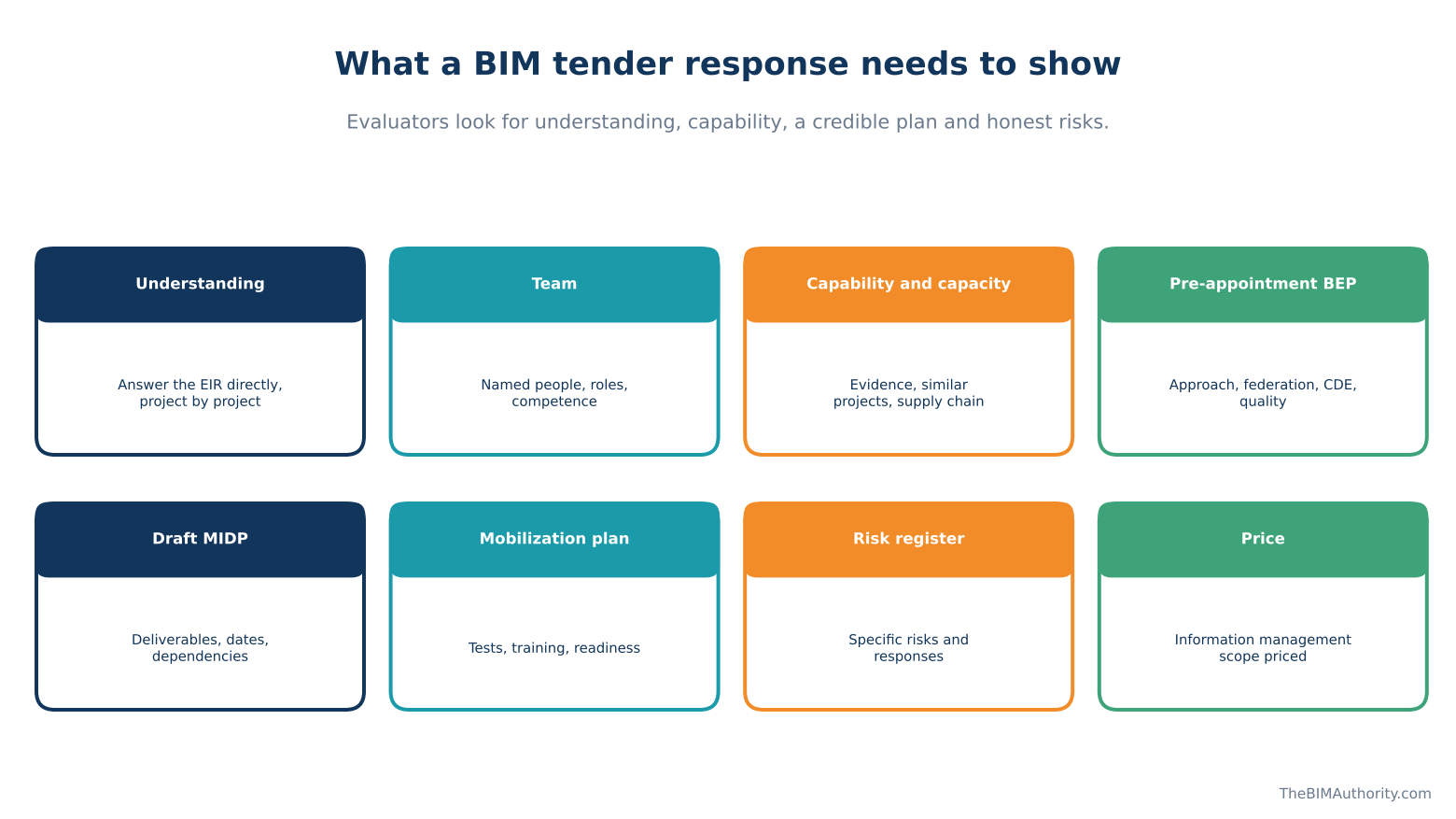
Under ISO 19650-2, the prospective lead appointed party typically submits, with its tender:
| Element | Purpose |
|---|---|
| Pre-appointment BIM Execution Plan (BEP) | Shows how it proposes to meet the EIR. See BIM Execution Plan (BEP): How to Create and Implement One |
| Capability and capacity evidence | Shows that the team has the skills, experience and resources |
| Draft MIDP | Shows what will be delivered, when and by whom. See Master Information Delivery Plan (MIDP): Complete Guide |
| Mobilization plan | Shows how the team will be ready to produce information |
| Risk register | Shows the information delivery risks identified and how they will be managed. See BIM Project Risk Management: Common Risks and Mitigation Strategies |
| Responsibility matrix (high level) | Shows who is responsible for key activities. See How to Create a BIM Responsibility Matrix |
Each lead appointed party also assesses the capability and capacity of the appointed parties it intends to use, and summarizes the evidence.
In one sentence:
Respond to what this client asked, with evidence from this team, about this project.
Step 1: Read the Requirements Properly
Read Everything
Read the EIR, the invitation to tender, the evaluation criteria, the draft contract and information protocol, the project information standard and any reference information. Do not skim. Most responses fail because they misread or skip the requirements.
Make a Requirements Register
List every requirement that affects your response, with its source. For each, note:
| Field | Purpose |
|---|---|
| Requirement | What is asked |
| Source and page | For reference |
| Clear / unclear / unrealistic | Your assessment |
| Our response | How we will meet it |
| Evidence | What proves it |
| Risk | If any |
Spot the Problems
Look for:
- Contradictions between documents (for example the EIR requires one IFC version, an appendix another).
- Unverifiable requirements (“high-quality models”).
- Impossible or disproportionate demands (high detail at an early stage, formats your tools cannot produce).
- Missing information (no reference survey, no CDE stated).
- Contract terms that shift unusual liability to the BIM information.
Ask Clarification Questions
Use the tender clarification process. Ask specific questions, concisely, early. See what other bidders’ questions reveal. A good clarification question can save a week of guessing, and shows the client you read the documents.
Step 2: Decide Whether to Bid
Not every opportunity deserves a bid. Quick criteria:
| Question | Why |
|---|---|
| Do we have the capability for these requirements? | Honest gaps are risks, not only weaknesses |
| Do we have capacity at the time? | Overstretched teams fail |
| Can we price the information management work profitably? | See How to Price BIM Services |
| Are the requirements clear and reasonable? | Vague demands are risks |
| Is the contract acceptable? | Liability and information obligations. See BIM Contracts and Legal Considerations |
| Who are we competing with, and what do we offer that they do not? | Differentiation |
| What does it cost to bid, and is it worth it? | Bidding is not free |
Be willing to say no, or to team up with a partner who fills a capability gap.
Step 3: Understand How Responses Are Evaluated
Clients usually score BIM responses using criteria in the tender documents. Typical approaches:
| Method | How it works |
|---|---|
| Weighted scoring | Each criterion receives a score, multiplied by a weight; totals compared |
| Pass / fail gates | Minimum requirements must be met (for example evidence of ISO 19650 capability); then weighted scoring applies |
| Capability and capacity assessment | A structured questionnaire; the UK BIM Framework publishes a template with yes/no questions and requests for evidence, for instance on whether the team can comply with a security management plan |
| Interview or presentation | Clarification with the proposed team |
| Sample deliverable or exercise | Bidders produce a small deliverable to show method |
Read the evaluation criteria and weights carefully, and put your effort where the points are. A response that spends half its pages on a criterion worth five percent has misjudged the scoring.
Step 4: Assemble the Team and the Evidence
Named People
Evaluators want to know who will do the work. Provide:
- Names, roles and relevant experience for the information manager, BIM manager, coordinators and task team leads.
- Competence evidence: relevant projects, training, certifications. See BIM Certifications: The Complete Guide to Professional Credentials.
- Availability: percentage of time on the project.
- Continuity: what happens if someone leaves.
Do not propose people you cannot commit.
Capability and Capacity Evidence
For the organization and the main appointed parties, show:
| Evidence | Examples |
|---|---|
| Relevant projects | Similar scale, type and requirements, with a short description of the BIM approach and results |
| Standards and procedures | Office standards, templates, quality procedures |
| Training | Level of ISO 19650 and BIM training |
| Certification | Third-party certification of ISO 19650-aligned practice, where held. Certification bodies offer such schemes, which can reduce the time clients spend assessing capability, though they do not replace project-specific evidence |
| Technology | Tools and CDE experience, and IT security |
| Capacity | Staff availability, resourcing plan and how you will cover peaks |
| Supply chain | How you assess and support subcontractors |
Be honest. If a subcontractor has limited experience, say so and explain the support you will provide. Clients value realism, and they check.
Step 5: Write the Pre-Appointment BEP
The pre-appointment BEP is the core of the response. See BIM Execution Plan (BEP): How to Create and Implement One for the full structure. For a tender, focus on credibility.
Principles
- Answer the EIR directly. Use the client’s headings and reference each requirement. For each, say how you will meet it.
- Be specific to this project: its milestones, disciplines, constraints and risks.
- Show, do not claim. Include a diagram of the federation strategy, an extract of the responsibility matrix, a draft MIDP for the first milestone.
- Explain your information management approach: roles, CDE workflow, quality checks, security.
- Respect page limits and format requested.
- Use plain language, tables and diagrams.
- Be honest about what you do not yet know, and say how you will resolve it.
What to Cover
| Topic | What evaluators want to see |
|---|---|
| Understanding | The project, its information needs and the main challenges |
| Information management team | Named people, roles, escalation |
| Delivery strategy | Federation and volume strategy, milestones and how each will be met |
| Standards and methods | Naming, classification, formats, coordinates, templates; how they match the client’s standards |
| CDE and exchange | Workflow, states, status codes, how you will work with the client’s CDE |
| Quality | Checks, validation, how acceptance will be managed. See BIM Quality Management: Processes, Metrics, and Best Practices |
| Security | How you will meet the client’s security requirements. See BIM Information Security, Access Control, and Data Governance |
| Supply chain | How requirements are cascaded and capability checked |
| Handover | How asset data will meet the AIR |
| Innovation (if asked) | Relevant, practical improvements, not gimmicks |
Step 6: Prepare the Draft MIDP, Responsibility Matrix and Mobilization Plan
Draft MIDP
A draft MIDP shows that you have thought about what, when and who. For the tender, include:
- the client’s milestones;
- the major deliverable groups per task team;
- dates and key dependencies, including the client’s decisions and reference information;
- review time.
Even a one-page draft, built from the task teams’ input, is persuasive. See Task Information Delivery Plan (TIDP): Complete Guide.
High-Level Responsibility Matrix
A short matrix of information management activities and roles, with named leads for the key functions. See How to Create a BIM Responsibility Matrix.
Mobilization Plan
Describe how the team will be ready to start production: standards and templates, IT and CDE setup, a test exchange, training, a first-month schedule. A short, concrete plan shows professionalism. See How to Set Up a Successful BIM Project from Day One.
Step 7: Present a Real Risk Register
A risk register tells evaluators how you think. Provide eight to twelve specific risks, with likelihood, impact, response and owner. Include risks that originate with the client (late decisions, unclear requirements) tactfully and constructively.
| Weak | Strong |
|---|---|
| “Software compatibility issues.” | “Subcontractor A uses an older version of the coordination tool. Response: agree versions in the BEP; test exchange in week 3; provide a validated export setup.” |
| “Delays.” | “Layouts are not yet fixed. Response: freeze dates in the MIDP; early client decision workshop; change control with impact record.” |
See BIM Project Risk Management: Common Risks and Mitigation Strategies.
Step 8: Manage Subcontractor and Partner Responses
If you are a lead appointed party, you depend on others’ capability.
- Send the relevant EIR and requirements to each prospective appointed party early.
- Ask each for a capability and capacity summary, with evidence.
- Review what they send and verify key claims.
- Provide templates for their response: TIDP, responsibility matrix extract, risk list.
- Consolidate into your response, with honest notes on support needed.
- Align pricing with the tasks.
If you are a subcontractor responding to a lead’s invitation, answer their requirements specifically, and provide the evidence they asked for. See BIM Procurement and Appointments Under ISO 19650.
Step 9: Price the Information Management Work
Information management has real effort: BEP, standards, CDE administration, coordination, checking, reporting, handover data. If it is not priced, it is either absorbed (reducing margin) or done poorly.
- List the tasks and estimate hours per task and per phase.
- Include the information management function, the coordinator, quality checks and meetings.
- Include supply chain support and handover data verification.
- Show a separate line where the tender format allows, so evaluators see it is understood.
- Check consistency between the BEP, MIDP and price. Evaluators notice when a plan promises weekly coordination and the price funds monthly.
See How to Price BIM Services.
Step 10: Review Before Submission
Run a review with someone who did not write the response. Use this checklist.
| Check | Question |
|---|---|
| Compliance | Does it answer every required item in the format requested? |
| Specificity | Could this response only be for this project? |
| Evidence | Is every claim supported (project, person, document, sample)? |
| Consistency | Do BEP, MIDP, matrix, risk register and price agree? |
| Clarity | Can an evaluator find the answer to each criterion in under a minute? |
| Honesty | Are risks and gaps stated? |
| Length and layout | Within limits; plain; good use of tables and diagrams |
| Contract | Have we checked obligations and liabilities? |
| Names | Are the named people committed? |
Proofread. Remove references to previous clients.
What Evaluators Complain About
From my own evaluator experience, the recurring complaints:
- Generic text that could have been written for any project.
- No evidence, only claims.
- Software lists instead of capability.
- “Fully compliant” with no explanation.
- No named people, or people who turn out not to be available.
- Ignoring the evaluation criteria.
- Contradictions between documents.
- Unrealistic promises that experienced evaluators spot immediately.
- No risks, or only trivial ones.
- No link to handover and operation.
- Too long, with the key information buried.
- Late or incomplete submission.
Common Mistakes
- Not reading the EIR carefully.
- Pasting a generic BEP.
- Claiming capability without evidence.
- Proposing people who are not available.
- Ignoring subcontractor capability.
- No draft MIDP or mobilization plan.
- A token risk register.
- Not pricing information management.
- Ignoring the weights in the evaluation.
- Not asking clarification questions.
- Accepting unreasonable contract terms without noting them.
- No internal review.
See also Common BIM Mistakes Beginners Should Avoid.
A Tender Response Outline You Can Adapt
- Summary: our understanding and our approach in one page.
- Team: named people, roles, availability, competence.
- Capability and capacity: relevant projects, standards, certification, resources, supply chain.
- Pre-appointment BEP: answering the EIR section by section.
- Draft MIDP and high-level responsibility matrix.
- Mobilization plan: first month.
- Risk register.
- Handover approach: asset data and the AIR.
- Price and assumptions: information management scope and fees.
- Appendices: CVs, sample deliverables, templates, evidence.
Frequently Asked Questions
How do I respond to BIM requirements in a tender?
Read the EIR and criteria, decide whether to bid, assemble named people and evidence, write a project-specific pre-appointment BEP, prepare a draft MIDP, responsibility matrix, mobilization plan and risk register, price the information management work and review before submission.
What is a pre-appointment BEP?
The BEP submitted with a tender response, showing how the bidder proposes to meet the client’s exchange information requirements. See BIM Execution Plan (BEP): How to Create and Implement One.
What is a capability and capacity assessment?
A structured assessment of whether a team has the skills, experience, resources and procedures to deliver the required information. Frameworks provide templates with questions and requests for evidence.
Do I need ISO 19650 certification to win tenders?
Not always, but it can help demonstrate alignment and reduce assessment effort. Check the tender requirements. Certification does not replace project-specific evidence.
How long should a BIM tender response be?
As short as the criteria and page limits allow. Specific, evidence-based answers beat long generic text.
What if I cannot meet a requirement?
Say so, explain why and propose an alternative, a partner or a support plan. Honesty is better than an unrealistic promise.
Should I ask clarification questions?
Yes, early and specifically, especially about unclear, contradictory or unrealistic requirements.
How do I price BIM information management?
List the tasks and hours (setup, CDE administration, coordination, checks, reporting, handover), add overhead and risk and align it with the plan. See How to Price BIM Services.
What do evaluators look for?
Understanding of the requirements, credible people and capability, a realistic plan, honest risk management and consistency across documents.
Final Thoughts
When I coach teams on tender responses, I give them one test to apply before submission. I ask them to cover the cover page, the company name and every reference to a previous project, and to hand the document to a colleague. “Can you tell which project this is for?” If the answer is no, the response is not ready. The projects that win are the ones where an evaluator can read two pages and say: “These people have studied our project.”
Studying the project is the whole craft. Read the requirements, put the right people in the room, show evidence and plan honestly. A good BIM response is less a marketing piece than a small, credible preview of how the project will be run. If it reads like one, you will win more often, and the project you win will start well.
Where to go next: for the client’s side of the process, read BIM Procurement and Appointments Under ISO 19650. For the contract that follows, continue with BIM Contracts and Legal Considerations, and for the plan at the heart of the response, BIM Execution Plan (BEP): How to Create and Implement One.



