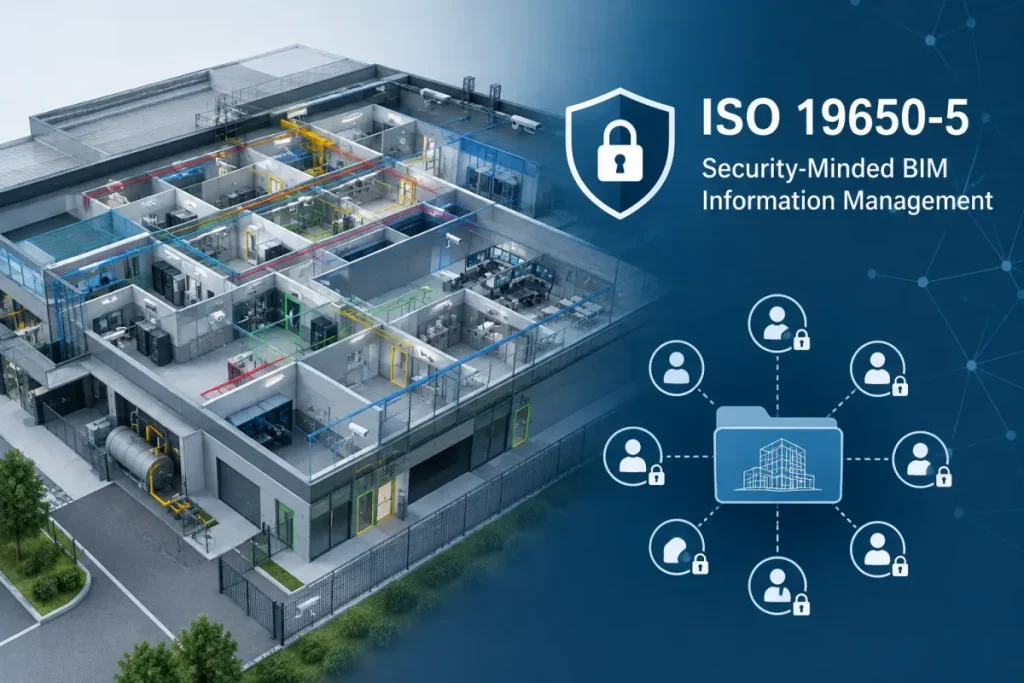

Some years ago, I was asked to review the information management setup of a project for a facility that, let us say, had good reasons to keep some of its details private. When I opened the shared project folder, I found a complete, beautifully coordinated 3D model of the building, including the exact position of every security door, every camera, every control room and every utility shut-off. The folder was shared with forty-three people from nine companies, including a catering contractor who needed only the kitchen layout. Nothing malicious had happened. Nothing needed to. The information was simply out there, with no thought given to who should see what.
The project team was not careless. They were doing what every BIM team is taught to do: share information openly to improve collaboration. And that is exactly the problem. The same culture that makes BIM so productive, open sharing, federated models, cloud platforms, supply chains of dozens of companies, creates risks that traditional paper-based projects rarely had. A single file can now contain everything an adversary would want to know about a building.
ISO 19650-5 is the part of the series that addresses this tension. It provides a security-minded approach to information management: proportionate, risk-based and integrated with the rest of the process. As a former CAD manager responsible for office data and a BIM manager who has worked on sensitive projects, I consider it one of the most important and least understood parts of the series. In this guide, I will explain what it asks for, how to apply it without paralyzing collaboration and what to do on projects that do not seem sensitive at all.
The Short Answer
ISO 19650-5 specifies a security-minded approach to the management of information in the context of BIM, for assets and projects where sensitive information may exist. It applies to the entire life cycle: planning, design, construction, operation and disposal. Its goal is to protect sensitive information from loss, misuse or unauthorized access, without unnecessarily obstructing the sharing of information that is needed.
The central ideas are:
- Proportionality. The measures should match the sensitivity and the risk, not be applied blindly everywhere.
- A triage at the start to decide whether and how much security is needed.
- A risk-based approach, with a security strategy and a management plan for the project or asset.
- Responsibility across the supply chain, from the appointing party to the smallest subcontractor.
- Attention to aggregation: harmless pieces of information can combine into something sensitive.
- Integration with the ordinary information management process, not a separate world.
It was published in 2020 and builds on earlier UK work on security-minded BIM, which it extended to an international level. Because it concerns security, readers should consult the standard itself, along with national security rules and legal advice, before relying on any summary, including this one.
Why BIM Creates New Security Questions
Traditionally, the information about a building was scattered: paper drawings in an architect’s archive, a few sets at the contractor’s office, a manual in a facility manager’s cabinet. Getting a complete picture meant effort and access.
BIM changes this in several ways.
| Traditional situation | BIM situation | Security consequence |
|---|---|---|
| Information scattered across many paper sets | A federated model contains everything | Concentration: one dataset can reveal the whole asset |
| Distribution was slow and visible | Files are copied instantly | Uncontrolled copying is easy |
| Few parties saw the whole design | Many parties access a shared platform | Wide exposure across supply chains |
| Information stayed on-site or in the office | Cloud platforms hold it | New third parties (platform providers) |
| Information became less relevant after construction | The AIM remains valuable for decades | Long-term exposure |
| Data was mostly drawings | Data includes structured, searchable properties | Easy analysis of large amounts of information |
None of this is an argument against BIM. It is an argument for being deliberate about who gets what.
What Counts as Sensitive Information
ISO 19650-5 focuses on sensitive information: information whose loss, misuse or disclosure could cause harm. Typical categories include:
- National or public security: government buildings, critical infrastructure, defense, prisons, courts, embassies, utilities, transport hubs.
- Commercial sensitivity: proprietary processes, laboratory or manufacturing layouts, intellectual property, financial information, pricing.
- Personal data: information about individuals, such as occupancy, access records and security of vulnerable people.
- Safety-critical information: locations of emergency systems, hazardous materials, structural weaknesses.
- Operational vulnerabilities: how systems are controlled, locations of control rooms, building management system architecture.
Sensitivity Is Not Only for Obvious Projects
It is easy to think “we build offices and houses, security does not apply to us”. But even ordinary assets can involve sensitive elements: a bank branch vault, a data room in an office, a children’s school’s layout, a hospital pharmacy, a residential building’s security systems. A security-minded approach begins by asking the question, which is why the standard starts with a triage.
The Security-Minded Approach in Practice
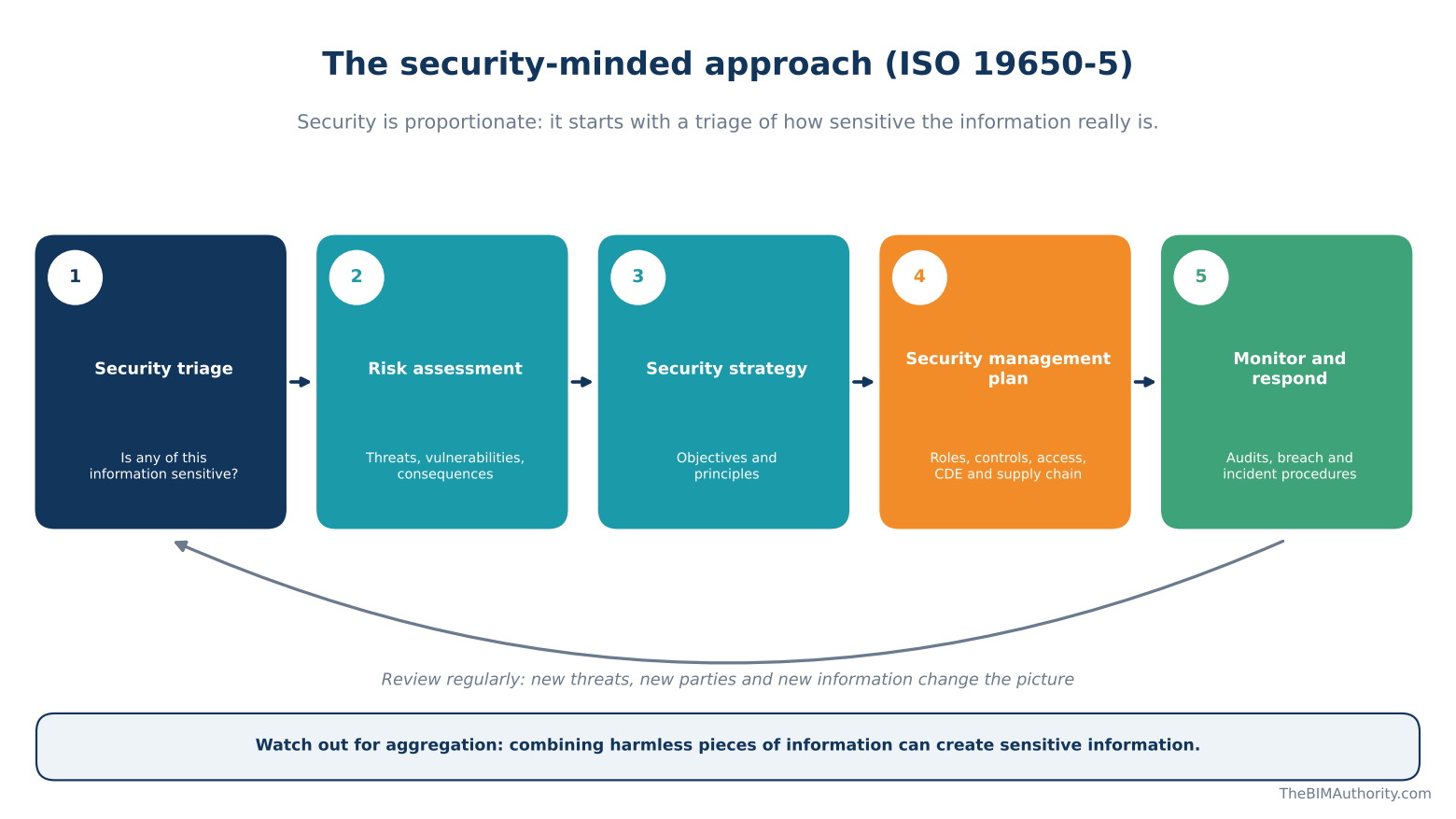
The standard describes a structured sequence. The terms and details are in the standard, but the logic can be summarized in five steps.
Step 1: Security Triage
The security triage is a first assessment of whether the asset, the project or the information involved is sensitive, and to what degree. It asks simple but important questions:
- Does the asset have national security, commercial or personal data implications?
- Could information about it be used to cause harm?
- Is any of the information subject to legal or contractual restrictions?
- What would be the consequences if it were lost, altered or disclosed?
The outcome determines whether a security-minded approach is needed and how extensive it should be. This triage should happen at the very start, before information is created and shared, because it is much harder to protect information that has already spread. It is typically the responsibility of the appointing party, who knows the asset best.
Step 2: Security Risk Assessment
If the triage shows sensitivity, a risk assessment identifies the threats (who might want the information and why), the vulnerabilities (where information could leak) and the consequences. It looks at people, processes, technology and physical aspects.
Step 3: Security Strategy
The risk assessment feeds a security strategy: the objectives, principles and overall approach to protecting the sensitive information. It sets, for example, which categories of information are restricted, what level of vetting or authorization is required and what general measures apply.
Step 4: Security Management Plan
The strategy is turned into a security management plan: the operational measures for the project or asset. It covers roles and responsibilities, access control, how the CDE is configured, requirements for the supply chain, handling of information in different states, rules for devices, transfer and storage, training and incident procedures. In UK terminology inherited from the earlier standard, you may meet the acronyms BASS (built asset security strategy) and BASMP (built asset security management plan), and similar documents may be named differently in other countries.
Step 5: Monitor, Review and Respond
Security is not a one-time document. The approach includes monitoring, audits, review when circumstances change (new parties, new phases, new threats) and procedures for breaches and incidents: how to detect, report, contain and learn.
Aggregation: The Risk Nobody Notices
One of the most valuable ideas in this area is aggregation: the possibility that individually harmless pieces of information, when combined, create sensitive information.
A few examples:
- A single floor plan may be unremarkable. A full set of plans, sections, services and security layouts, combined in a coordinated model, reveals how the entire building works and where its weak points are.
- A list of equipment locations may be harmless. Combined with the building management system architecture and access control details, it reveals vulnerabilities.
- Information from several different suppliers may each be harmless, but a party that collects it all, perhaps the platform provider or a compromised account, can assemble a complete picture.
The practical lesson is that assessing sensitivity file by file is not enough. You must also consider what the collection reveals, and who holds it. This is one reason why the CDE configuration and the federation strategy are security matters, not only technical ones.
Roles and Responsibilities in Security-Minded Information Management
| Party | Typical security responsibilities |
|---|---|
| Appointing party | Performs or commissions the triage, defines security requirements, sets the strategy, includes requirements in the EIR and appointments |
| Lead appointed party | Implements the security management plan for the delivery team, ensures requirements cascade to the supply chain |
| Appointed parties | Comply with the requirements, report incidents, train their staff |
| Information manager | Configures the CDE to enforce access rules, manages permissions and monitors use |
| Security manager or adviser | Provides specialist advice, performs risk assessments, handles incidents (where appointed) |
| Platform and technology providers | Provide secure services under defined conditions |
The principle of responsibility across the supply chain is vital. A security requirement that stops at the lead designer is worth very little if the subcontractor three levels down emails the model to a personal account. See BIM Roles and Responsibilities: Manager, Coordinator, Modeler, and Information Manager and BIM Procurement and Appointments Under ISO 19650.
What a Security-Minded Setup Looks Like
Here are the typical measures that a security management plan may include. They are examples; the real selection depends on the risk assessment.
People
- Need-to-know access: people see only what they need for their task.
- Vetting or screening appropriate to the sensitivity.
- Confidentiality undertakings in appointments.
- Training and awareness for everyone handling information, including subcontractors.
Process
- Classification of information by sensitivity, with handling rules per category.
- Controlled sharing: sensitive information is shared only through the CDE, never by email or private channels.
- Sanitized or reduced models for parties who need only part of the information. For example, a catering contractor gets the kitchen, not the control room.
- Controlled publication and release procedures.
- Secure disposal and archiving at the end of the project.
- Incident and breach procedures, with clear reporting lines.
Technology
- CDE configuration: roles, permissions, folder structure, audit logs, multifactor authentication.
- Secure storage and transfer, including encryption where appropriate.
- Device and network rules for staff handling sensitive data.
- Control of exports, such as limiting who can download full models.
- Supplier assessment for platform providers and tools, including where data is stored and under which jurisdiction.
- Backup and recovery arrangements.
Physical
- Physical access control to offices and servers where sensitive information is held.
- Protection of site and temporary storage of drawings and devices.
See Common Data Environment (CDE): The Complete Guide and BIM Information Security, Access Control, and Data Governance.
Security and the BIM Documents
Security requirements should appear in the same documents that carry all other requirements. This is how the security-minded approach becomes part of the ordinary process rather than an afterthought.
| Document | Security content |
|---|---|
| OIR / AIR | Information the organization considers sensitive across its assets |
| PIR / EIR | Project-specific security requirements and handling rules |
| Tender documents | Security requirements and evaluation of capability |
| BEP | How the delivery team will meet the security requirements |
| Responsibility matrix | Who is responsible for implementing and monitoring measures |
| Appointment and protocol | Contractual obligations, confidentiality and liability |
| CDE specification | Technical enforcement of access and audit |
| Handover documents | What sensitive information passes to the operator and how it is protected |
See Exchange Information Requirements (EIR): Complete Guide and BIM Execution Plan (BEP): How to Create and Implement One.
The Relationship With Other Standards and Rules
ISO 19650-5 is not a general information security standard. It sits alongside others, and it relies on them for detailed technical controls.
| Topic | Relevant frameworks (examples) |
|---|---|
| Organizational information security management | The ISO/IEC 27000 family, including ISO/IEC 27001 |
| Personal data protection | Data protection laws such as GDPR in the European Union and equivalents elsewhere |
| National security rules | Government classification and vetting schemes, which vary by country |
| Critical infrastructure rules | Sector regulations |
| Contracts | Confidentiality and intellectual property clauses |
An important practical point: Part 5 does not replace the law. If your project involves classified or regulated information, national rules apply, and you should seek specialist advice. This article is not legal or security advice.
Security and Other Parts of the Series
Part 5 touches every other part.
- Part 1: the CDE and information containers are the places where security is enforced. See ISO 19650-1: Information Management Concepts and Principles.
- Part 2: security requirements appear in the tender, appointment and mobilization activities, and the information model review should consider aggregation. See ISO 19650-2: BIM Information Management During Project Delivery.
- Part 3: the AIM can be a long-lived, highly sensitive resource. See ISO 19650-3: Information Management During Asset Operations.
- Part 4: exchanges are moments of risk and must follow secure channels. See ISO 19650-4: Information Exchange Requirements Explained.
A Proportionate Approach for Ordinary Projects
Many readers work on projects that are not obviously sensitive. A small design office does not need a government-grade security regime. But the basic hygiene of Part 5 is valuable for everyone, and cheap to implement.
A Minimum Set of Good Habits
- Ask the triage question at the start of every project: “Is any of this information sensitive?” Write down the answer.
- Use the CDE as the only sharing channel, with permissions by role.
- Give people access to what they need, not to everything.
- Keep an up-to-date list of who has access and remove people when they leave the project.
- Use strong authentication on all accounts.
- Include confidentiality terms in appointments with the supply chain.
- Train staff on handling files and recognizing risks.
- Know your incident procedure: who to call, what to do.
- Review access at each milestone.
- Dispose of information properly at the end: archive what is required, delete the rest.
When to Step Up
Escalate your approach, and involve a security specialist, if the triage reveals any of the following: government or critical infrastructure assets, defense or law enforcement facilities, laboratories or industrial processes with valuable intellectual property, facilities holding sensitive personal data, or any client requirement for security-minded processes.
Common Mistakes in Security-Minded BIM
- Skipping the triage. Without it, you either over-protect everything (slowing the project) or protect nothing.
- Treating security as an IT matter. It involves people, process, contracts and technology.
- Sharing everything with everyone “to improve collaboration”.
- Ignoring aggregation. Assessing documents one by one misses what the collection reveals.
- Letting security requirements stop at the first tier of the supply chain.
- Using email and personal cloud tools for convenience.
- Forgetting the operational phase. The AIM remains valuable and vulnerable for decades.
- No incident procedure. When a breach happens, nobody knows what to do.
- Not reviewing permissions when people or phases change.
- Treating the plan as a document, not a living practice.
- Over-engineering. A heavy regime on a low-risk project causes people to bypass it.
See also Common BIM Mistakes Beginners Should Avoid.
A Short Checklist for Project Teams
For the appointing party:
- Has a security triage been completed and recorded?
- Are security requirements in the EIR and tender documents?
- Is there a strategy and a management plan, proportionate to the risk?
- Is the supply chain obliged to comply and to cascade requirements?
- Is there a plan for the information at handover and in operation?
For the delivery team:
- Does the BEP explain how security requirements will be met?
- Is the CDE configured with role-based access and audit logs?
- Are sensitive containers marked and handled according to the rules?
- Are exports and downloads controlled?
- Is everyone, including subcontractors, trained and bound by confidentiality?
- Do we know how to report and handle incidents?
- Do we review access regularly?
Frequently Asked Questions
What is ISO 19650-5?
The part of the series that sets out a security-minded approach to information management in BIM, aimed at protecting sensitive information across the asset life cycle.
Does ISO 19650-5 apply to every project?
The standard’s principles are proportionate. A triage determines whether and how much security is needed. Many projects need only basic good practice.
What is a security triage?
A first assessment of whether information about an asset or project is sensitive, and how much, used to decide the level of security measures.
What is aggregation in this context?
The risk that combining non-sensitive pieces of information produces sensitive information, for example a complete coordinated model of a secure facility.
What is the difference between a security strategy and a security management plan?
The strategy sets objectives and principles based on the risk assessment. The management plan specifies the operational measures, roles and procedures to implement it.
Who is responsible for security in a BIM project?
The appointing party sets requirements, the lead appointed party implements them in the delivery team, and all appointed parties comply. The information manager enforces access through the CDE.
Is ISO 19650-5 the same as ISO/IEC 27001?
No. ISO/IEC 27001 specifies an information security management system for organizations. ISO 19650-5 focuses on the security of information in the context of built assets and BIM, and works alongside general information security frameworks.
Is it safe to use cloud-based CDEs?
It can be, when the platform and its configuration meet the project’s security requirements. Assess the provider, data location, access controls, encryption, audit capabilities and contractual terms, in line with the sensitivity of the information.
Can sensitive information be removed from models before sharing?
Yes. Sanitized or reduced models, which show only what a party needs, are a common measure. The decision should follow the security plan.
Final Thoughts
That day, looking at the folder shared with forty-three people, I felt less alarm than sadness. The team had done nothing wrong by the standards of its own culture. It had simply never been asked the question that Part 5 puts at the beginning of every project: “What could go wrong if this information went to the wrong hands?”
Asking it costs nothing. Answering it honestly takes an hour. And the answer, in most projects, will be “not much”, which is wonderful news that allows everybody to collaborate freely. In the few projects where the answer is “a great deal”, that hour will turn out to be the most valuable one of the whole job.
Where to go next: for the technical side of access and governance, read BIM Information Security, Access Control, and Data Governance and Common Data Environment (CDE): The Complete Guide. For the rest of the series, continue with ISO 19650-6: Health and Safety Information Management and return to ISO 19650 Explained: A Complete Guide for BIM Professionals for the big picture.