
A young engineer once asked me which BIM certification she should get, and I did something that frustrated her: I asked what she wanted it for. She wanted to know whether a certificate would help her get a job. She wanted to know whether employers valued them. She wanted to know whether she should take the exam that her friends were taking. None of those questions, I told her, has a general answer, because “BIM certification” is not one thing. It is a landscape of credentials with different purposes: some prove that you can use a particular program, some prove that you understand an open standard, some prove that you know an information management framework and some are national or professional-body schemes that matter in one country and barely register in another.
Certifications are also the subject of strong opinions. Some people believe they are essential. Others consider them irrelevant, a toll booth on the road to a job. The truth, as usual, lies in specifics. A certification can be useful evidence when it is relevant to your role and recognized in your market, and when it is paired with real experience. It can be a waste of effort when it is chosen because a friend took it, or when it substitutes for the ability to do the work. Employers, in my experience, use certifications as a filter and a signal, not as proof of competence: they get you into the conversation, and your portfolio and interview carry you through it.
This guide explains the landscape of BIM certifications and how to choose among them. It covers the main categories (open standards, information management, vendor, regional and professional-body schemes), what each type demonstrates, descriptions of the main programs based on public information, how to choose by role, region and employer, how to prepare, how to keep credentials current, how certification relates to experience and the portfolio, certification of organizations versus individuals, limits and the mistakes to avoid. It supports How to Become a BIM Manager: The Complete Career Guide and Best BIM Courses and Training Programs. Programs, levels, requirements and costs change. This guide gives no fees; check each provider’s current information, and verify recognition with employers in your market.
The Short Answer
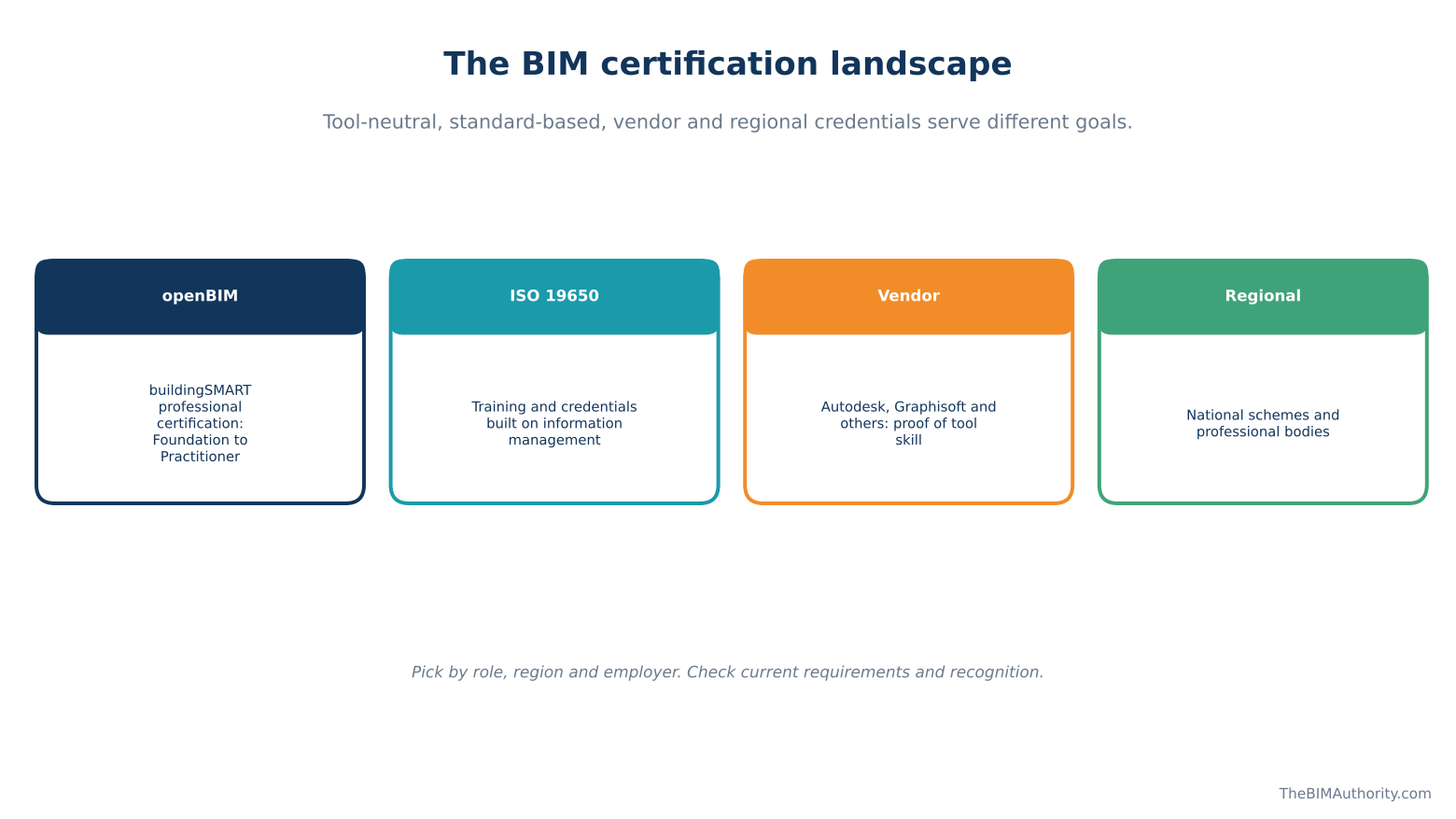
| Category | What it demonstrates |
|---|---|
| openBIM | Understanding of open standards, interoperability and information exchange (tool-neutral) |
| ISO 19650 | Knowledge of information management processes under the standard |
| Vendor | Skill with a particular tool |
| Regional and professional bodies | National or sector-specific recognition |
In one sentence:
Choose a certification for a purpose: to prove tool skill, standards knowledge or regional recognition; pair it with real experience and evidence.
What Certifications Can and Cannot Do
| Can | Cannot |
|---|---|
| Signal knowledge to employers and clients | Prove you can do the job |
| Structure your learning | Replace experience |
| Provide a recognized baseline in a market | Guarantee a job or higher pay |
| Help in tenders where individual credentials are requested | Make you a good coordinator or manager |
| Support career moves between countries or sectors (for standards-based credentials) | Remain valid forever without renewal |
| Build confidence | Replace judgment, communication and leadership |
A useful mindset: certification is a milestone in learning, not the destination.
Category 1: openBIM Certification
buildingSMART Professional Certification
buildingSMART International runs a professional certification program, delivered through its chapters and approved training providers.
| Aspect | Notes (from public information) |
|---|---|
| Purpose | A tool-neutral, internationally recognized credential in openBIM knowledge and practice |
| Levels | The program is described with four levels: Entry, Foundation, Management and Practitioner. Foundation is described as the first step that unlocks Management and Practitioner |
| Foundation | Verifies essential knowledge of openBIM principles and standards, including terminology, information management under ISO 19650 and open standards |
| Practitioner | Focuses on applying openBIM principles in practical project contexts, such as defining information requirements; described as rolling out across chapters, with some chapters still implementing it |
| Delivery | Training from approved providers and exams managed on a qualification platform; availability and language vary by chapter and country |
| Audience | Coordinators, managers, information managers, modelers and others who exchange information across tools |
| Strengths | Tool-neutral; aligned with open standards; recognized internationally to varying degrees |
| Cautions | Recognition varies by market; check your national chapter for what is available and what employers expect |
Because details evolve (levels, curricula, rollout), consult the buildingSMART education and certification pages and your national chapter for current information. See openBIM Explained: Principles, Standards, and Benefits.
Category 2: ISO 19650 and Information Management
| Aspect | Notes |
|---|---|
| Purpose | Demonstrate knowledge of the ISO 19650 information management framework and its application |
| Providers | Several training and certification bodies offer ISO 19650 programs. For example, BRE Academy’s training is described in secondary sources as built around the ISO 19650 series, staged from an essentials level toward delivering information management and practitioner-level credentials. Other bodies offer similar programs |
| Audience | Information managers, BIM managers, coordinators, project managers, clients |
| Strengths | Directly relevant to projects that follow ISO 19650, common in public sector work in several countries |
| Cautions | Program structures and names change; check what the provider currently offers and how it is recognized. See ISO 19650 Explained: A Complete Guide for BIM Professionals |
Related: Organizational Certification
Some bodies certify organizations (their systems and processes) against ISO 19650 or similar frameworks. For example, national standards bodies have offered certification marks for organizations’ BIM processes. Organizational certification is different from individual credentials; it is relevant to companies bidding for work. Check current schemes in your market. See BIM Procurement and Appointments Under ISO 19650.
Category 3: Vendor Certifications
Software vendors certify skill with their tools.
Autodesk
| Aspect | Notes |
|---|---|
| Levels | Autodesk offers a Certified User level for foundational skills (for students and early-career users) and a Certified Professional level validating job-ready proficiency |
| Revit tracks | The Certified Professional in Revit is described as available in discipline-specific tracks, such as architectural design; check the current list |
| Other credentials | Autodesk lists credentials in other products and, in some references, a Certified Professional credential in BIM management for building design; check current availability |
| Preparation | Autodesk recommends hands-on experience before the professional exam; a secondary source mentions roughly 400 to 1,200 hours of hands-on Revit experience; verify the current recommendation |
| Validity | Some sources describe a limited validity period with retesting for renewal; check current rules |
| Strengths | Widely recognized evidence of tool skill; useful for modelers and technicians |
| Cautions | Tool-specific; version changes matter; skills still need project evidence |
Graphisoft
| Aspect | Notes |
|---|---|
| Certified Archicad Professional | A credential for Archicad users; one secondary source states there are no prerequisites, although recommended courses exist |
| Learning programs | Graphisoft’s learning platform lists programs such as a BIM Coordinator Program and a BIM Manager Program, alongside Archicad training courses |
| Strengths | Direct recognition within the Archicad community |
| Cautions | Tool-specific; check current offerings |
Other Vendors
Other software vendors offer certifications and training for their tools, including structural detailing, infrastructure and analysis software. Check the vendor’s learning portal. See Best BIM Software: A Complete Comparison Guide for the tool landscape.
Category 4: Regional and Professional-Body Schemes
| Example (illustrative) | Notes |
|---|---|
| National BIM certification programs | Some countries have national schemes. For example, a Canadian program known as CanBIM has been described in secondary sources with progressive levels combining training, hours of experience in BIM theory, software and management, and assessments |
| Professional institutions | Chartered and professional bodies in surveying, architecture, engineering and construction may offer BIM-related credentials or recognize BIM competence |
| Contractors’ associations | Some contractor associations offer BIM credentials; one secondary source mentions a construction management BIM credential from a US contractors’ association |
| Public-sector requirements | Some public clients require evidence of competence from key staff |
Regional schemes can matter more than international ones in their own market. Ask local employers and professional bodies.
Choosing a Certification
By Purpose
| Purpose | Consider |
|---|---|
| Prove tool skill (modelers, technicians) | Vendor certification in your main tool |
| Show openBIM and interoperability knowledge (coordinators, managers) | buildingSMART certification at the level matching your role |
| Work on ISO 19650 projects (information managers, managers, coordinators) | ISO 19650 credentials |
| Work in a specific country or sector | Regional or professional-body schemes |
| Move into management | Combine standards credentials with management training. See How to Become a BIM Manager: The Complete Career Guide |
| Support a tender or client requirement | The credential the client names |
By Role
| Role | Typical combination (illustrative) |
|---|---|
| Modeler | Vendor certification (tool); optionally a Foundation-level openBIM credential |
| Coordinator | Coordination tool training; openBIM Foundation or Practitioner; ISO 19650 awareness. See How to Become a BIM Coordinator: Responsibilities and Qualifications |
| Manager | ISO 19650 credential; openBIM management-level or practitioner credential; vendor management program; general management training |
| Information manager | ISO 19650 delivery-level credential; openBIM credentials; CDE platform training. See BIM Information Manager: Roles, Skills, and Career Opportunities |
| Specialist | Vendor professional credentials; automation and data training |
Questions Before You Commit
| Question | Why |
|---|---|
| Is it recognized by employers or clients in my market? | Value depends on recognition |
| Does it match my role and level? | Avoid over- or under-shooting |
| What are the prerequisites, training requirements and format? | Time and access |
| What does it cost in total, including training, exam and renewal? | Plan the budget (I give no figures) |
| How long is it valid, and how is it renewed? | Ongoing effort |
| Is the content current (software version, standards edition)? | Relevance |
| Who delivers it and how is it assessed? | Quality and credibility |
| Is it available in my language and country? | Practicality |
| Will my employer support it? | Funding and time |
| What will I be able to do afterward? | Outcome |
Ask three people who hire in your market what they look for; their answer is worth more than any ranking.
Preparing for a Certification
| Step | Practice |
|---|---|
| 1. Read the syllabus or body of knowledge | Know what is assessed |
| 2. Take stock | Compare with your skills; identify gaps |
| 3. Choose training | Approved providers where required; self-study where permitted |
| 4. Study actively | Practice with real or sample projects, not only reading |
| 5. Use sample questions or practice exams | Format and time pressure |
| 6. Form a study group | Discussion improves understanding |
| 7. Plan the schedule | Realistic weeks, with buffers |
| 8. Practice the tool | For vendor exams: hands-on experience matters more than memorization |
| 9. Rest and prepare logistically | Exam rules, identification, equipment |
| 10. Reflect after | Update your CV and portfolio |
Keeping Credentials Current
| Practice | Why |
|---|---|
| Track expiry and renewal rules | Some credentials lapse |
| Keep skills current | Versions and standards change |
| Record continuing learning | Evidence for renewal and employers |
| Update your CV and professional profiles | Show current status |
| Revisit after job changes | New requirements |
Certification, Experience and Portfolio
| Element | Role in your story |
|---|---|
| Experience | Shows you have done the work |
| Portfolio | Shows what you did and how you think. See How to Build a Professional BIM Portfolio |
| Certification | Shows verified knowledge or skill at a point in time |
| Training | Shows learning and commitment |
| References | Show how others experience your work |
Employers weigh them together. A certification without experience looks thin; experience without evidence is hard to verify; a combination is strongest.
Limits and Cautions
| Limit | Explanation |
|---|---|
| Not proof of competence | Exams test knowledge and some skills, not judgment or leadership |
| Recognition varies | A credential valued in one market may be unknown in another |
| Version dependence | Tool exams reflect specific versions |
| Cost and time | Preparation takes effort; weigh against benefit |
| Over-collecting | Many credentials without depth impress few |
| Misleading marketing | Beware promises of guaranteed jobs or pay rises |
| Changing programs | Levels and names evolve |
| Gatekeeping risk | Some employers over-rely on certificates; others ignore them |
Common Mistakes
- Choosing a certification without a purpose.
- Following friends rather than market evidence.
- Believing the certificate replaces experience.
- Ignoring recognition in your region.
- Studying only for the exam, not for the skill.
- Collecting many certificates without depth.
- Not checking validity and renewal.
- Using outdated study materials.
- Ignoring tool-neutral credentials when working across tools.
- Ignoring portfolio and references.
- Not asking employers.
- Paying for unrecognized programs.
See also Common BIM Mistakes Beginners Should Avoid.
A Short Checklist
- Have I defined what I want the certification to do for me?
- Have I checked recognition by employers and clients in my market?
- Does the credential match my role, level and tools?
- Do I know prerequisites, format, validity and renewal?
- Is the provider credible, with current content?
- Have I planned study time and practice on real tasks?
- Will I pair it with a portfolio and experience?
- Have I considered tool-neutral and standards-based credentials alongside vendor ones?
- Do I know how to keep it current?
- Have I asked people who hire?
Frequently Asked Questions
Which BIM certification is best?
There is no single best. Choose by purpose, role, region and employer: vendor certification for tool skill, openBIM for tool-neutral standards knowledge, ISO 19650 for information management, regional schemes where they matter.
Do I need a BIM certification to get a job?
Often not, but it can help as evidence, especially early in a career or for roles in standards-based environments.
What is the buildingSMART professional certification?
A tool-neutral program in openBIM with levels described as Entry, Foundation, Management and Practitioner, delivered through chapters and approved training providers.
What is the Autodesk Certified Professional exam?
A vendor credential validating job-ready proficiency in a product such as Revit, with discipline tracks; Autodesk also offers a Certified User level for foundations.
Are there ISO 19650 certifications?
Yes; several training bodies offer ISO 19650 programs and credentials for individuals, and some certify organizations. Check what is current in your market.
How long do certifications take?
It depends on prior knowledge, program and time available; some are weeks of study, others longer with prerequisites.
Do certifications expire?
Some do; check each program’s validity and renewal rules.
Will a certification raise my salary?
It may help in some markets and roles, but there is no guarantee; experience, skills and scope usually matter more. See BIM Salaries Around the World.
Final Thoughts
The engineer who asked me which certification to get did something wise. She went and asked. She interviewed three hiring managers at companies she admired and asked each: “When you see a certification on a CV, what does it tell you?” The answers were remarkably similar. “That the person cared enough to study,” said one. “That they know the vocabulary,” said another. “Honestly, I look at the portfolio first,” said the third. She chose a tool-neutral foundation credential, completed it while building a portfolio and used both in the interview for the job she wanted. “The certificate got me noticed,” she told me. “The portfolio got me the job.”
That is the right way to use certifications: as one part of a story, chosen for a reason, supported by evidence. Define the purpose, check the market, choose a credible program, prepare through practice, keep it current and never confuse the credential with the skill. The skill is what the project needs. The credential helps people believe you have it.
Where to go next: for learning options, read Best BIM Courses and Training Programs. For competencies, continue with BIM Skills Matrix: Competencies Required for Every Professional Level, and for evidence of your work, How to Build a Professional BIM Portfolio.