
Of all the questions I am asked about careers in BIM, the most common comes from people at the very start: students, draftspeople, junior architects, engineers changing track, technicians in their twenties who have heard that “BIM is where the jobs are.” They want to know where to begin. The honest answer begins with a small correction. A BIM modeler is not someone who knows a program. It is someone who knows how to build information. The program is the instrument. The information is the music.
I have trained many modelers over three decades, and I can tell within the first week who will become excellent. It is almost never the person who knows the most commands. It is the person who asks, unprompted, “What is this element supposed to tell the next person?” That question, what does this element say, and to whom?, is the difference between a model that looks right and a model that works. A wall that is the correct height and the wrong type, a door with no fire rating, a room with no number, a duct on the wrong level: each is invisible in a rendering and expensive on site. The modeler is the person who makes sure it is right at the source.
This guide describes the modeler’s role and how to enter and grow in it. It explains what modelers do, the skills that matter (tools, discipline knowledge, standards and data, collaboration), the training and learning paths, how to build experience and evidence, the first job, the daily work, how to progress (into specialist, coordinator, manager or other roles), the market and pay considerations, common mistakes and a practical plan for the first year. It belongs with BIM Specialist vs. BIM Coordinator vs. BIM Manager, BIM Skills Matrix: Competencies Required for Every Professional Level and How to Build a Professional BIM Portfolio. Job titles, requirements and pay vary widely by country and employer; treat this guide as orientation and check local conditions.
The Short Answer
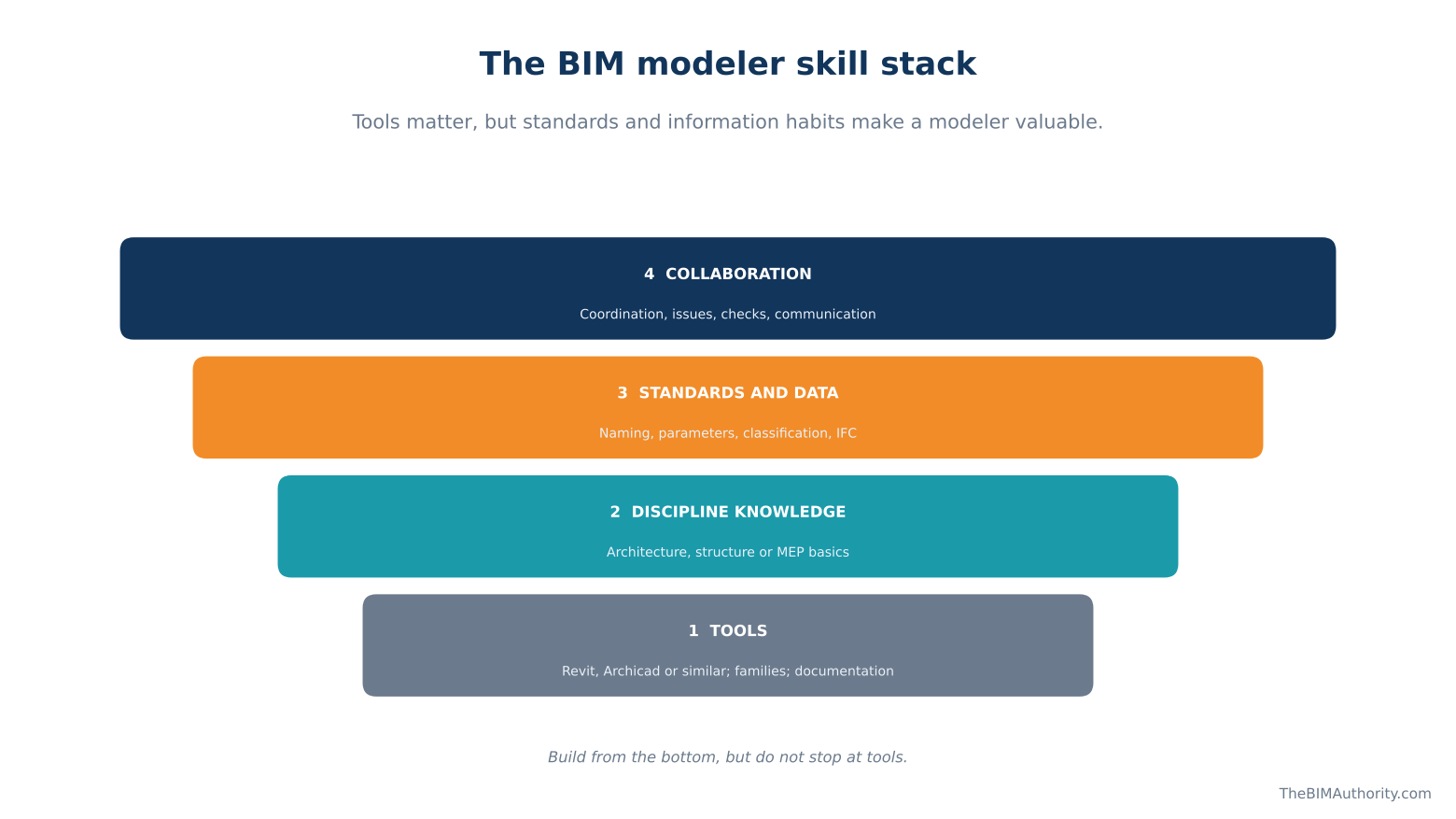
| Layer | What it contains |
|---|---|
| Tools | A main authoring tool (such as Revit or Archicad), families or objects, documentation |
| Discipline knowledge | Architecture, structure or MEP basics: how buildings are put together |
| Standards and data | Naming, parameters, classification, IFC and exchange habits |
| Collaboration | Coordination, issue handling, model checks and clear communication |
In one sentence:
A BIM modeler builds reliable, information-rich models of buildings or infrastructure; start with a tool and a discipline, add standards and data habits early, and build evidence of real work.
What a BIM Modeler Does
| Activity | Examples |
|---|---|
| Create and edit models | Walls, floors, structure, services, spaces, families, according to the project’s standards |
| Produce documentation | Plans, sections, schedules, sheets generated from the model. See Architectural BIM Documentation: Plans, Sections, and Schedules |
| Manage data | Fill and check parameters, classification, identifiers |
| Follow standards | Naming, templates, coordinates, levels, modeling rules from the BEP |
| Collaborate | Link models, respond to issues, join coordination meetings. See BIM Coordination: The Complete Guide |
| Check quality | Warnings, model health, pre-exchange checks. See BIM Model Checking: Geometric and Information Validation |
| Exchange | Export IFC and other formats; manage versions |
| Support others | Share knowledge, create or fix content |
| Learn continuously | New versions, tools and standards |
Modelers may work in architecture, structural engineering, MEP engineering, contracting, fabrication, infrastructure, owner organizations or specialist consultancies. The daily work differs by discipline, but the essence is the same.
Typical Titles and Variations
| Title (varies) | Notes |
|---|---|
| BIM modeler | Builds models to instructions and standards |
| BIM technician or CAD/BIM technician | Often combines drafting and modeling |
| BIM operator or draftsperson | Entry-level modeling and documentation |
| BIM engineer or BIM designer | A modeler with design or engineering responsibility |
| Discipline modeler | Architectural, structural or MEP modeler |
| Revit technician and similar tool-based titles | Named for the tool |
Read responsibilities, not just titles. See BIM Specialist vs. BIM Coordinator vs. BIM Manager.
The Skills That Matter
1. A Primary Authoring Tool
| Skill | Notes |
|---|---|
| Core modeling | Levels, grids, walls, floors, roofs, openings, structure or services |
| Families or objects | Using, adapting and basic creation. See BIM Families and Parametric Components: Best Practices |
| Views, sheets and schedules | Documentation from the model |
| Collaboration features | Worksharing or teamwork, links, shared coordinates |
| Model health | Warnings, file size, performance. See Revit Model Health and Optimization: File Size, Warnings, Links, and Performance |
Choose the tool your target employers use. In many markets Revit is widely used; in others Archicad, Allplan, Tekla or others dominate. See Best BIM Software: A Complete Comparison Guide.
2. Discipline Knowledge
A modeler who understands the discipline models better and errs less.
| Discipline | What to know |
|---|---|
| Architecture | Construction types, wall build-ups, openings, stairs, rooms, drawing conventions |
| Structure | Frames, foundations, slabs, reinforcement basics, steel and concrete conventions |
| MEP | Systems, equipment, routing logic, clearances, connectivity |
| Infrastructure | Alignments, corridors, terrain |
Study how buildings are built: site visits, construction details and talking with site teams are as valuable as software courses.
3. Standards, Data and Information Habits
| Skill | Why |
|---|---|
| Naming and classification | Consistent, findable information |
| Parameters and property sets | Data that schedules and exports depend on. See BIM Metadata, Attributes, and Property Sets Explained |
| Levels of information | Model what the stage needs. See ISO 7817-1: Level of Information Need Explained |
| IFC basics | What exports contain; how to check. See IFC Files Explained: Structure, Classes, and Properties |
| ISO 19650 awareness | CDE, statuses, information containers. See ISO 19650 Explained: A Complete Guide for BIM Professionals |
| Project templates and BEP | Working within agreed rules |
4. Collaboration and Communication
| Skill | Practice |
|---|---|
| Reading issues and acting on them | Understand the decision needed; fix the source |
| Clear communication | Short, precise messages and notes |
| Version discipline | Publish at agreed times; name files correctly |
| Asking questions | Early, with context |
| Teamwork | Respect others’ models; coordinate changes |
5. Helpful Extras
| Skill | Why |
|---|---|
| Basic automation | Visual programming or scripts for repetitive tasks. See Dynamo for BIM Automation: The Complete Guide |
| Visualization basics | Presenting models |
| Point cloud awareness | Working with scans. See BIM and Reality Capture: Laser Scanning, Photogrammetry, and Point Clouds |
| Spreadsheets | Data checks and reports |
| English and local-language professional skills | For international projects and documentation |
Training and Learning Paths
| Path | Strengths | Cautions |
|---|---|---|
| Formal education | Degrees or diplomas in architecture, engineering, construction or technology give discipline knowledge and credentials | Tool training may be limited; check what is taught |
| Vocational and technician programs | Focused on practical skills and employability | Quality varies |
| Vendor and platform learning | Official courses and documentation for the tool; some vendors offer certification (see BIM Certifications: The Complete Guide to Professional Credentials) | Tool-specific |
| Online courses and tutorials | Flexible and affordable | Variable quality; check currency and depth |
| Bootcamps and intensive training | Fast, structured | Check outcomes and prerequisites |
| On-the-job learning | Real standards and projects | Depends on mentors |
| Self-directed practice | Build projects; recreate buildings; replicate real details | Needs discipline and feedback |
See Best BIM Courses and Training Programs.
A Sensible Order
- Basics of construction and drawing conventions (if new to the field).
- One authoring tool, in depth: do a complete small project from concept to sheets.
- Standards and data: learn naming, parameters, classification and IFC.
- Collaboration: link models, use shared coordinates, handle issues.
- Model health and checks.
- Add depth: families, a second discipline, automation.
Building Experience and Evidence
You do not need a job to start building evidence.
| Activity | Why |
|---|---|
| Complete practice projects | Model a small building completely: structure, envelope, interior, documentation |
| Replicate real documents | Take a set of drawings and build the model; check against them |
| Create and document families | Show craft |
| Build a template and standards sheet | Shows information thinking |
| Export IFC and inspect it | Show you understand exchange |
| Document your process | Short write-ups of problems and solutions |
| Contribute to communities | Forums, open projects, local groups |
| Seek mentoring and internships | Real feedback |
| Take a certification if relevant | Evidence of skill in your market |
| Prepare a portfolio | See How to Build a Professional BIM Portfolio |
Respect confidentiality: do not publish client work without permission.
Finding the First Job
| Step | Practice |
|---|---|
| Understand the market | Which sectors and tools dominate locally: design practices, engineering firms, contractors, subcontractors, owners |
| Target roles by title and by responsibility | Modeler, technician, junior BIM engineer, junior coordinator |
| Prepare a portfolio and a clear CV | Evidence over adjectives |
| Prepare for tests and interviews | Modeling tasks are common. See BIM Interview Questions and Answers |
| Use networks | Alumni, communities, professional bodies, recruiters |
| Consider related entry routes | CAD technician, site engineer, architectural assistant, junior engineer, then move into BIM |
| Be flexible about discipline and sector at first | Experience is transferable |
| Ask about standards, mentoring and training in interviews | Choose a place where you will learn |
The First Year: A Plan
| Period | Focus |
|---|---|
| Months 1 to 3 | Learn the office standards; model under supervision; ask many questions; learn the review cycle |
| Months 4 to 6 | Own a small model area; produce documentation; use model checks; join coordination meetings |
| Months 7 to 9 | Build or improve content and templates; learn IFC export and checks; help a colleague |
| Months 10 to 12 | Take on a larger package; propose an improvement; start learning automation or a second discipline; discuss next steps with your manager |
Growing Beyond Modeling
| Direction | Description |
|---|---|
| Senior modeler or discipline lead | Deeper technical and design skills; mentoring |
| BIM specialist | Deep expertise in content, families, tools or a technical area |
| BIM coordinator | Coordination across models. See How to Become a BIM Coordinator: Responsibilities and Qualifications |
| BIM manager | Standards, strategy and leadership. See How to Become a BIM Manager: The Complete Career Guide |
| Information manager | Information processes and CDE. See BIM Information Manager: Roles, Skills, and Career Opportunities |
| Computational or automation specialist | Scripting and tools. See BIM Automation: The Complete Guide |
| Discipline design or engineering career | BIM skills as a foundation for design roles |
| Reality capture or scan-to-BIM specialist | Existing conditions work |
| Digital construction or VDC roles | Construction-side coordination and planning |
| Technology and software roles | Vendors, implementation, training |
Careers are not strictly linear. Many people move across as well as up.
Pay and Market Considerations
Pay varies enormously by country, city, sector, experience and employer. See BIM Salaries Around the World for indicative published figures and how to read them. For entry-level modelers, the best investment is usually skills that employers in your market actually value, a portfolio and a first job with good mentoring, rather than chasing the highest title.
Common Mistakes
- Learning commands without understanding the building.
- Learning one tool and ignoring standards and data.
- No complete project to show.
- Outdated skills: old versions and practices.
- Ignoring IFC, classification and naming.
- Poor communication and unclear questions.
- Modeling everything in detail regardless of stage.
- Ignoring model health and checks.
- Waiting to be taught instead of seeking feedback.
- Publishing confidential work in a portfolio.
- No plan for growth.
- Measuring progress by software hours alone.
See also Common BIM Mistakes Beginners Should Avoid.
A Short Checklist
- Have I chosen a primary tool that fits my target market, and a discipline to learn?
- Can I complete a small project from model to sheets with correct data?
- Do I understand naming, parameters, classification and IFC basics?
- Do I practice model checks and health habits?
- Do I have evidence: a portfolio, practice models, write-ups?
- Have I considered relevant certifications for my market?
- Have I researched local roles, sectors and expectations?
- Can I communicate issues and questions clearly?
- Do I have a first-year plan and mentors?
- Do I know where I want to grow?
Frequently Asked Questions
What does a BIM modeler do?
Creates and maintains information-rich models of buildings or infrastructure according to standards, produces documentation, checks quality and collaborates with other disciplines.
What qualifications do I need?
Requirements vary: many modelers have degrees or diplomas in architecture, engineering or construction, while others come from technician routes. Skills and evidence matter greatly.
Which software should I learn?
The one your target employers use; many markets use Revit, others use Archicad, Allplan, Tekla or others.
Do I need a certification?
Not always. Some employers value them; check your market. See BIM Certifications: The Complete Guide to Professional Credentials.
How long does it take to become a BIM modeler?
With focused study and practice, a few months can build basic competence; real fluency takes a year or more of project work.
Can I become a BIM modeler without an architecture degree?
Yes in many markets, especially via technician routes, but discipline knowledge is important.
What is the difference between a BIM modeler and a BIM coordinator?
A modeler builds models; a coordinator brings models together, tests, reports and facilitates. See BIM Specialist vs. BIM Coordinator vs. BIM Manager.
How do I stand out?
With a clear portfolio, strong standards and data habits, communication skills and evidence of problem solving.
Final Thoughts
The best modeler I ever trained started as a carpenter. She knew nothing about BIM and a great deal about how buildings go together. Her first model was clumsy; her second was careful; by her third, her walls had the layers in the right order, her openings had the right framing and her schedules matched what the site would order. “I just model what I would build,” she said. Within two years, she was coordinating models for a contractor. “The software was the easy part,” she told me. “The hard part was understanding why anyone would want the information.”
That is the heart of the path: learn a tool, learn the building, learn the information and learn to work with others. Build real things, show your work, find mentors, keep your skills current and be curious about what the model tells the next person. The career that follows can go in many directions, and every one of them starts with a model that is right at the source.
Where to go next: for the roles above this one, read How to Become a BIM Coordinator: Responsibilities and Qualifications and BIM Specialist vs. BIM Coordinator vs. BIM Manager. For skills and evidence, continue with BIM Skills Matrix: Competencies Required for Every Professional Level and How to Build a Professional BIM Portfolio, and for learning, Best BIM Courses and Training Programs.