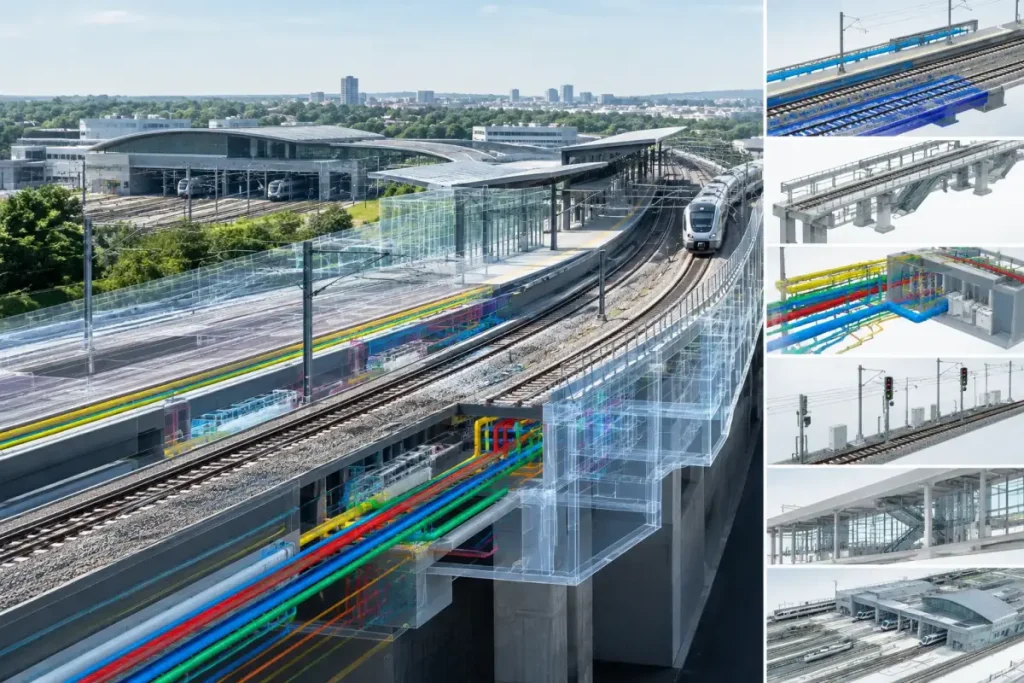

Railways are the most interface-heavy infrastructure I know. A road is, in the end, a surface that vehicles drive on, and most of its systems (drainage, lighting, signs) can be coordinated by looking at a cross-section. A railway is a system of systems, in the most literal sense: track geometry that must be accurate to millimeters, structures that carry it, power that feeds the trains, signaling that keeps them apart, telecommunications that tie it together, stations that serve passengers, depots that maintain the fleet. And every one of these has its own specialists, its own standards, its own approval process and its own view of what the “model” should contain.
The challenge of railway BIM is therefore less about any single discipline than about integration: making the track, the structures, the energy systems, the signaling and the stations fit together, spatially and informationally, on a route that may be hundreds of kilometers long and that must be built and commissioned while trains are, in many cases, still running on the existing line. The information requirements are demanding: clearances (the envelope that trains need) are safety-critical; possession windows (the short periods when a line may be closed) determine what can be built and when; asset data must flow to the maintenance regimes that keep the railway safe for decades.
This guide explains how to apply BIM to railways. It covers the structure of a railway model, track alignment and geometry, civil works, the interfaces with power, signaling and systems, stations and buildings, coordination and clearance management, construction and possession planning, digital delivery and information requirements, asset information for operation, data standards and exchange (including IFC 4.3 and rail-specific data models), the challenges specific to rail and the mistakes to avoid. It builds on Infrastructure BIM: The Complete Guide. Railway design, safety assurance, gauge and clearance assessment, signaling safety cases and compliance with railway regulations are the responsibility of qualified engineers, safety authorities and operators. Models communicate and coordinate; they do not replace safety assurance.
The Short Answer
A railway model is organized around the track alignment, with civil works, systems and buildings positioned relative to it, and it carries information for construction, commissioning and maintenance.
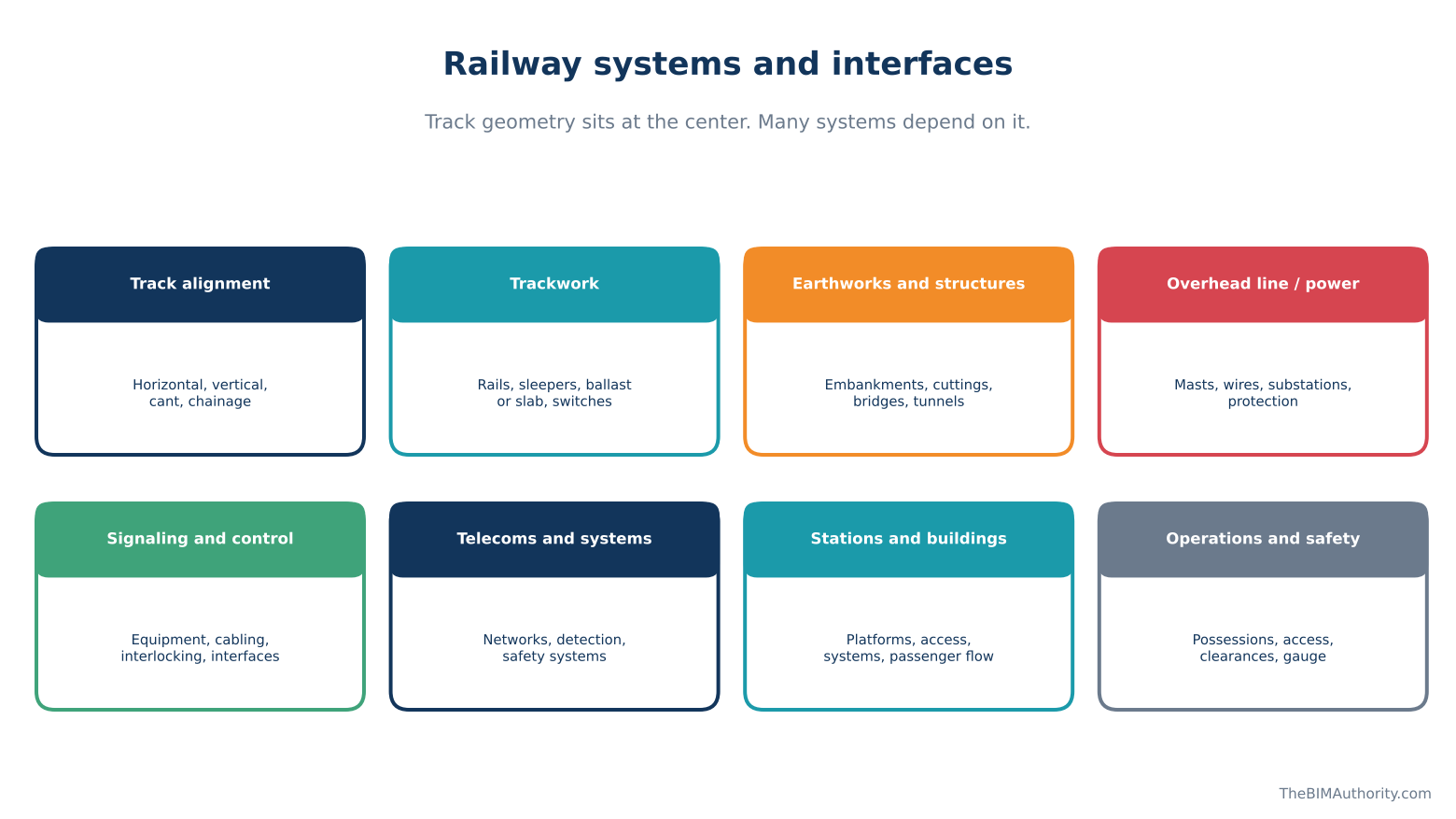
| Group | Typical content |
|---|---|
| Track alignment | Horizontal alignment, vertical alignment, cant (superelevation), chainage or kilometer post |
| Trackwork | Rails, sleepers, ballast or slab track, switches and crossings, track drainage |
| Earthworks and structures | Embankments, cuttings, retaining walls, bridges, tunnels, culverts |
| Overhead line and power | Masts, foundations, wires, substations, feeder lines, protection |
| Signaling and control | Signals, train detection, interlocking, cabling, control rooms |
| Telecommunications and systems | Networks, detection and safety systems |
| Stations and buildings | Platforms, access, buildings, passenger systems |
| Operations and safety | Clearances, gauge, access, possessions, protection |
In one sentence:
Model the railway as a set of systems positioned along the track, managing clearances and interfaces as primary information, and plan the build around operations.
Track Alignment and Geometry
What Is Different About Track
| Feature | Explanation |
|---|---|
| Horizontal and vertical alignment | Like roads, defined by straights, curves, transitions and grades, but with tighter geometric constraints |
| Cant | Superelevation of one rail relative to the other, varying along curves |
| Track geometry accuracy | Tolerances are tight; position relative to structures is critical |
| Multiple tracks | Parallel tracks with defined spacing; junctions with switches and crossings |
| Linear referencing | Kilometer posts and chainage; often multiple, overlapping referencing systems on legacy lines |
| Gauge and clearance envelopes | Defined by rolling stock and infrastructure standards; safety-critical |
IFC 4.3 includes railway facility concepts and alignment definitions with horizontal, vertical and cant components, with linear placement of elements along the alignment. See IFC 4.3 for Infrastructure: Concepts, Capabilities, and Applications.
Working With the Alignment
- Treat the alignment as master geometry, controlled and versioned.
- Define referencing systems and map legacy kilometer posts to the project chainage.
- Record design standards and criteria used for geometry and clearances.
- Manage the existing railway: surveyed track geometry (often by track recording), with accuracy and date recorded.
- Keep existing and proposed alignments clearly distinguished, with phases.
Civil Works and Structures
| Element | Considerations |
|---|---|
| Earthworks | Embankments and cuttings; drainage; slope stability; track formation. See BIM for Roads and Highways: Modeling and Information Management for corridor and earthworks concepts |
| Track drainage | Ditches, drains, culverts, with levels and flows |
| Bridges and viaducts | Structure over and under track; clearance to track. See BIM for Bridges: Structural Modeling and Asset Data |
| Tunnels | Alignment, clearances, ventilation, emergency egress. See BIM for Tunnels and Underground Infrastructure |
| Retaining walls and noise barriers | Position relative to track and clearance |
| Level crossings and road interfaces | Geometry, signaling and road design |
| Utilities | Crossings and diversions |
| Ground and geotechnical | Ground models and track formation design |
Structures near the railway must respect clearance envelopes; models should include these as clearance volumes and tests.
Systems: Power, Signaling, Telecoms
Overhead Line and Power
| Element | Information |
|---|---|
| Masts and portals | Positions by chainage and offset; foundations; heights; loadings |
| Contact and catenary wires | Geometry along the track; height; stagger |
| Substations and feeder stations | Buildings, equipment, cabling |
| Return current and earthing | Connections and bonding |
| Clearances to structures and traffic | Electrical clearances; structural gauges |
Signaling and Train Control
| Element | Information |
|---|---|
| Signals and signs | Positions, visibility, sighting |
| Train detection | Axle counters, track circuits |
| Points and switch machines | Locations, power, communication |
| Interlocking and control equipment | Locations, housings, power |
| Cabling and containment | Routes, cable troughs, ducts, chambers |
| Interfaces with trains and operations | Safety integrity, testing |
Telecommunications and Other Systems
Communication networks, passenger information, CCTV, access control and safety systems need positions, routes and data, usually coordinated with the same cable routes and equipment rooms.
Why the Interfaces Matter
Signaling and power engineers often work in specialist tools and workflows, with detailed schematics; the 3D model gives them location and space to coordinate with civil works and structures. Agree early what the model must contain for these systems (positions, cable routes, equipment envelopes and clearances) and what remains in specialist documents.
Stations and Buildings
| Topic | Notes |
|---|---|
| Platforms and track interfaces | Platform edges, gaps, heights, clearances to trains |
| Station buildings | Building BIM methods apply. See Architectural BIM Modeling: The Complete Guide and MEP BIM Modeling: The Complete Guide |
| Passenger flow and accessibility | Circulation analysis; accessible routes |
| Station systems | Lifts, escalators, ticketing, information, fire and life safety |
| Depots and maintenance facilities | Buildings, track, equipment, services |
| Integration with surrounding development | Urban context, GIS. See BIM and GIS Integration: The Complete Guide |
Stations combine building and infrastructure models. Plan the handover between them: coordinates, levels, naming, classification, asset breakdown.
Clearances and Coordination
Clearance Management
| Clearance | Use |
|---|---|
| Structure gauge / kinematic envelope | The space that must be free of obstruction for trains, including movement and tolerances |
| Electrical clearances | Between live equipment and structures or persons |
| Platform and track clearances | Boarding safety |
| Maintenance and access clearances | Space for workers and equipment |
| Signal sighting | Visibility of signals |
Clearance rules come from national and operator standards. Model clearance envelopes along the alignment as volumes and test structures, equipment and temporary works against them. Treat violations as safety-relevant clashes, not as ordinary clashes. See BIM Clash Detection: The Complete Guide and Hard Clashes vs. Soft Clashes vs. Workflow Clashes.
Coordination Practices
| Practice | Why |
|---|---|
| Federated model by section and discipline | Manageable size and ownership. See How to Create and Manage a Federated BIM Model |
| Clash matrix including clearance envelopes and systems | Safety and integration. See How to Create a BIM Clash Detection Matrix |
| Interface registers | List each interface between systems, owners, status |
| Design reviews with operators and maintainers | Operability and maintainability |
| Cable route and equipment room coordination | Space for systems |
| Utility and third-party coordination | Crossings and impacts |
Construction, Possessions and Commissioning
| Topic | BIM use |
|---|---|
| Possession planning | Closure windows determine what work is possible; link activities to possession times in 4D. See 4D BIM Explained: Construction Scheduling and Simulation |
| Work area and access planning | Access points, work zones, protection of the live railway; temporary works. See BIM for Construction Site Planning and Logistics |
| Sequence and logistics | Material delivery by rail and road; plant movement; track machines |
| Setting out and machine data | Track geometry data for track-laying and tamping machines; coordinates and units verified |
| Quantities | Track, ballast, sleepers, masts, cables |
| Quality and inspection records | Linked to elements and chainage |
| Progress monitoring | By section and system; see BIM for Construction Progress Monitoring and Reporting |
| Testing and commissioning | Systems tested, integrated, certified; records linked to assets |
| As-built survey | Track geometry and structure positions verified |
On live railways, safety management (protection, possession rules, competence) is governed by operator rules; models support planning and communication.
Digital Delivery and Information Requirements
| Topic | Practice |
|---|---|
| Owner requirements | Railway owners and infrastructure managers define requirements for models, data and exchange (OIR, AIR, EIR). See Exchange Information Requirements (EIR): Complete Guide |
| Information management | ISO 19650 processes, CDE, statuses, roles |
| Standards | National rail standards, international railway data standards and IFC 4.3. Railway-specific data models also exist for network topology and engineering data exchange, for example railML and the UIC’s railway topology model on which railML 3 is based |
| Geospatial basis | Coordinate system, datum, survey control. See BIM Georeferencing: Coordinate Systems and Model Positioning |
| Asset breakdown | The railway asset structure used by the infrastructure manager |
| Level of information by stage | Corridor options, alignment and structures, systems detail, construction, as-built. See ISO 7817-1: Level of Information Need Explained |
| Digital handover | Structured data in the owner’s asset system |
| Digital twin and operations | Linking models with operational data. See Digital Twins in Construction: The Complete Guide |
Asset Information for Railways
| Asset group | Examples of information |
|---|---|
| Track | Type, rail section, sleepers, ballast, geometry, installation date, inspection and tamping history |
| Switches and crossings | Type, components, wear and maintenance |
| Structures | Bridges, tunnels, retaining walls, culverts: identity, condition, inspection regimes |
| Earthworks | Cutting and embankment condition, drainage, monitoring |
| Overhead line | Mast IDs, wires, sections, tension, inspection |
| Signaling | Signals, detection, points machines, cabling, test records |
| Telecoms and systems | Equipment, networks, test records |
| Buildings and stations | Building assets and systems. See MEP BIM Systems Classification and Asset Data Requirements |
| Documents and records | As-builts, certificates, test results, safety documentation |
Railway asset management is strongly regulated and data-driven; define asset identification, location referencing and data fields with the infrastructure manager at the start. See Asset Information Requirements (AIR): Complete Guide.
Data Standards and Exchange
| Topic | Notes |
|---|---|
| IFC 4.3 | Railway facility, alignment with cant, linear placement and infrastructure elements (such as track-related elements) are part of IFC 4.3; check tool support and test exports. See IFC 4.3 for Infrastructure: Concepts, Capabilities, and Applications |
| Alignment and survey exchange | Open and native formats for alignments, surfaces and track geometry |
| Rail data models | Network and engineering data exchange formats used by rail infrastructure managers |
| GIS integration | Rail networks and assets in GIS; see BIM and GIS Integration: The Complete Guide |
| Signaling and electrical design data | Specialist formats and documents |
| Asset management systems | Owner-specific schemas |
| Point clouds and survey | Track and structure survey data |
Because railways involve many specialist tools, plan the exchange chain early and test it with representative data.
Challenges Specific to Rail
| Challenge | Approach |
|---|---|
| Live railway constraints | Possession planning, protection, access; model work zones and access |
| Uncertain existing conditions | Track surveys, structure investigations, records of utilities and cables; record reliability |
| Specialist systems and standards | Define the model’s role; keep schematics and safety cases outside the model where appropriate |
| Clearance and gauge safety | Clearance volumes; checks; independent verification |
| Many interfaces and stakeholders | Interface registers; governance; CDE |
| Long linear projects | Segmentation; common referencing; federation by section |
| Legacy asset data | Data cleansing; mapping; open archive |
| Commissioning complexity | Test records linked to assets; integration testing |
| Procurement and contract structures | Multiple contracts; consistent requirements |
Common Problems and Remedies
| Problem | Cause | Remedy |
|---|---|---|
| Structures infringe clearances | Clearance envelopes not modeled | Clearance volumes; tests; independent checks |
| Systems not coordinated spatially | Specialist models missing or late | Define model content for systems; interface register; early engagement |
| Referencing confusion | Legacy kilometer posts versus project chainage | Documented mapping; single reference for the project |
| Machine data errors | Geometry or unit mismatches | Verification; trials; version control |
| Possession plans unrealistic | Not linked to the model | 4D with possessions; constructability reviews |
| Asset data incomplete | Not specified early | AIR; data capture in construction and commissioning |
| Tool exchange failures | Format differences | Test; document mapping |
| Heavy models | Long routes | Segmentation; lightweight views |
Common Mistakes
- Treating rail as roads with rails.
- No clearance envelopes in the model.
- Ignoring possessions in planning.
- No interface register.
- Specialist systems left outside coordination.
- Confused referencing systems.
- No asset breakdown agreed with the infrastructure manager.
- Machine and survey data not verified.
- No exchange testing across the tool chain.
- Underestimating existing-conditions uncertainty.
- No linking of test and commissioning records to assets.
- Assuming the model replaces safety assurance.
See also Common BIM Mistakes Beginners Should Avoid.
A Short Checklist
- Have we agreed owner requirements, asset breakdown and referencing systems?
- Is the track alignment controlled master geometry, with cant and design criteria recorded?
- Are clearance and gauge envelopes modeled and tested?
- Is there an interface register and coordination of civil, power, signaling, telecoms and stations?
- Is the model content for specialist systems defined?
- Are possessions, access and sequence modeled in 4D?
- Is survey of existing track and structures recorded with accuracy?
- Are machine and setting-out data verified?
- Is the asset data set captured through construction and commissioning and delivered in the owner’s format?
- Are formats and exchange chains tested?
Frequently Asked Questions
How is BIM used for railways?
For track alignment and civil design, coordination of structures and systems, clearance management, possession and construction planning, digital delivery and asset information.
What is cant?
The superelevation of one rail relative to the other in a curve. It is part of the railway alignment in IFC 4.3.
Does IFC support railways?
IFC 4.3 includes railway facilities, alignments with horizontal, vertical and cant definitions and linear placement. Tool support varies, so test exchange.
Why are clearances so important?
Because trains need a defined envelope, and infringements are safety-critical. Models should include clearance envelopes and checks.
How do possessions affect BIM?
Possession windows limit what can be built when; link them to the programme in 4D and plan sequences and access around them.
Which data standards are used in rail?
IFC 4.3 for building and infrastructure exchange, plus railway-specific data models such as railML and national standards. Check your owner’s requirements.
How do stations relate to railway BIM?
They combine building and infrastructure models; plan the coordinates, levels, naming and asset breakdown between them.
Does BIM replace the signaling and safety cases?
No. Specialist design and safety assurance remain with qualified engineers and authorities; BIM provides spatial and information coordination.
Final Thoughts
A rail project manager once told me that her team had a saying: “The railway is only as good as its worst interface.” On her project, they made a rule. Every interface, whether between structures and track, between power and signaling or between station and platform, got a one-line entry in a register and a named owner on each side. Each week, the BIM coordinator ran the clearance tests and updated the register with the model’s evidence. At the end of the project, she showed me the register: nine hundred and forty interfaces, all closed, each with a date and a signature. “We still had problems,” she said. “But we never had a problem that nobody owned.”
That is the heart of railway BIM: interfaces owned, clearances protected, systems positioned, operations planned and assets recorded. Anchor the model on the track, coordinate the systems, manage possessions with the same care as geometry, keep specialist safety assurance where it belongs and deliver the information that maintainers will rely on.
Where to go next: for the overall context, read Infrastructure BIM: The Complete Guide. For structures and tunnels, continue with BIM for Bridges: Structural Modeling and Asset Data and BIM for Tunnels and Underground Infrastructure, and for the data standard, IFC 4.3 for Infrastructure: Concepts, Capabilities, and Applications.