



Let me begin with an important statement: I am not a lawyer, and nothing in this guide is legal advice. I am a CAD and BIM professional who has spent thirty years on the receiving end of contract clauses, and who has watched what happens when BIM obligations are written badly, or not written at all. This guide is the view from the project room: what BIM changes about contracts, which issues recur, which questions you should ask your lawyer and how the main protocols and standards deal with them. For any real project, take advice from a construction lawyer who knows your jurisdiction and your contract form.
The reason I think the subject deserves a guide written by a practitioner is that most BIM disputes I have seen were not caused by exotic legal problems. They were caused by ordinary ambiguity. A contract said “the designer shall produce a BIM model” and nothing more, and then everyone discovered, at the worst moment, that they had different ideas about what that meant. Did it include data? What level of detail? Who owned it? Could the contractor rely on it? Who was responsible when the model disagreed with the drawings? Was the federated model a contract document?
Good BIM contracting is mostly about removing ambiguity: stating what information is to be produced, to what standard, by whom, with what rights of use and with what responsibility if it is wrong. This guide explains the main topics, how protocols and ISO 19650 documents fit with contract forms, the typical issues to settle and how to manage them in practice.
The Short Answer
BIM does not require a new kind of contract. It requires that contracts deal explicitly with information: its content, standards, delivery, status, use, ownership, liability and security. Most legal frameworks do this through a BIM protocol or information protocol, a document incorporated into the appointment or contract, supported by the EIR, BEP, responsibility matrix and MIDP.
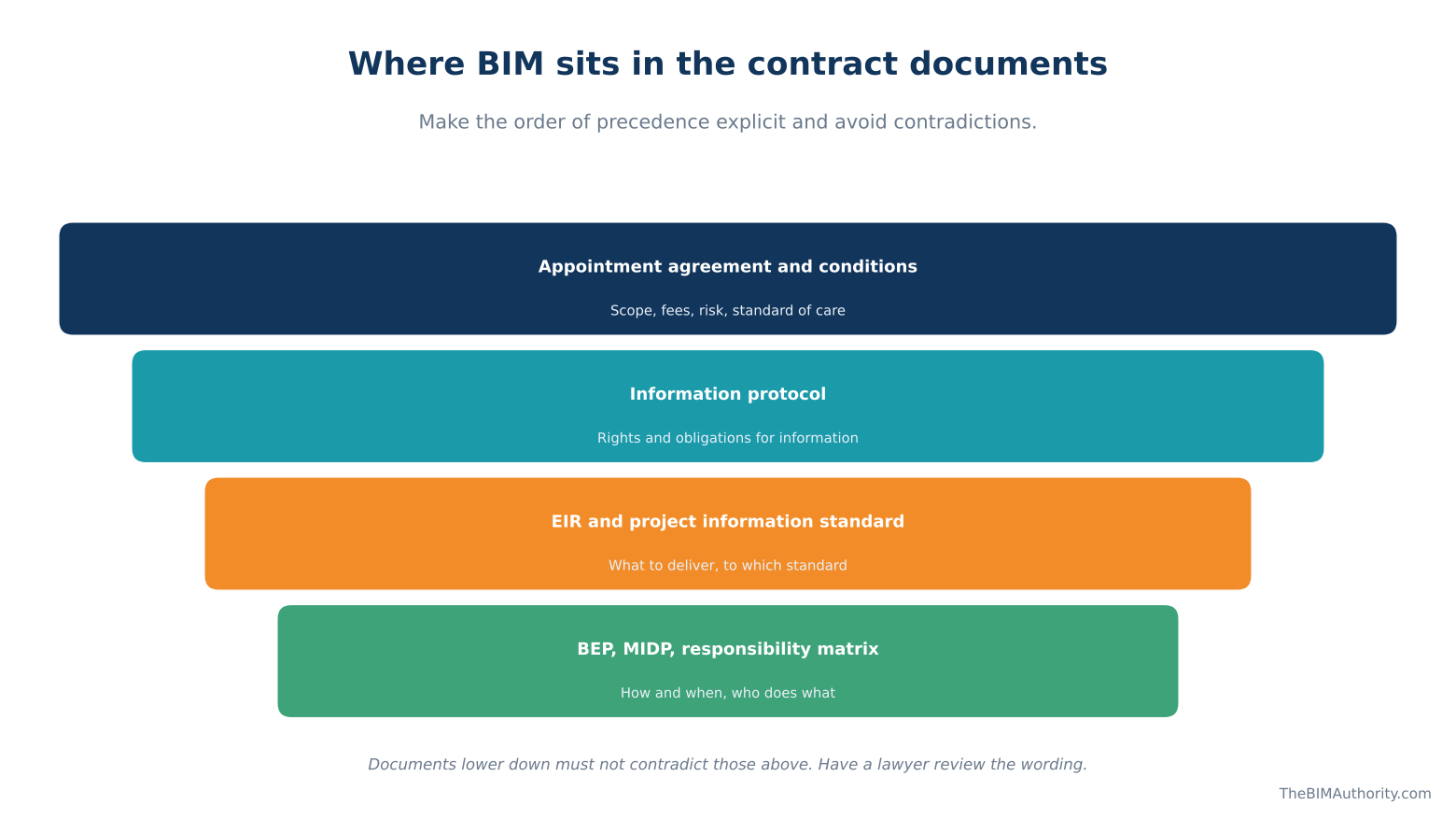
| Layer | What it does |
|---|---|
| Appointment agreement and conditions | Scope, fees, risk allocation, standard of care, insurance |
| Information protocol | Rights, obligations, liabilities and limits concerning information and models |
| EIR and project information standard | What information to deliver and to which standard |
| BEP, MIDP, responsibility matrix | How, when and by whom information will be delivered |
In one sentence:
A BIM contract is a set of clear answers to six questions: what, to what standard, by whom, when, who can use it and who is responsible if it is wrong.
The Main Protocols and Where They Come From
Several standard documents help contracts deal with BIM. Their availability and use differ by country. The facts below come from public publications and commentary; always check the current editions.
The CIC BIM Protocol (United Kingdom)
The Construction Industry Council BIM Protocol was first published in February 2013, commissioned as part of the response to the UK Government’s BIM strategy, and updated in a second edition in April 2018. It is designed to be incorporated into appointments and construction contracts, establishing obligations, liabilities and limitations on the use of building information models.
Points worth knowing:
- The second edition is closely aligned with PAS 1192-2 (and incorporates provisions related to PAS 1192-5 on security) and therefore applies to information, not just models. The first edition’s definition of “model” was removed, and the term “Specified Information” is used instead.
- It includes appendices for a responsibility matrix, information particulars and security requirements.
- It contains a precedence clause that can conflict with standard form contracts, so standard forms (such as JCT and NEC) typically need amendments to accommodate it.
- Commentators noted that it did not resolve ownership of the federated model.
- The CIC Protocol was aligned with the earlier UK standards. In 2021, the UK BIM Framework published an information protocol intended to support work under BS EN ISO 19650, which some commentary describes as replacing the CIC BIM Protocol. Check the current UK BIM Framework guidance and your contract advisers.
The Information Protocol in ISO 19650
ISO 19650-2 and ISO 19650-3 require the appointing party to produce an information protocol as part of the tender and appointment documents. The protocol describes obligations and rights in relation to information. The standard does not supply the legal text, but it makes the protocol a required element of the information management process, alongside the EIR. See ISO 19650-2: BIM Information Management During Project Delivery and ISO 19650-3: Information Management During Asset Operations.
AIA Documents (United States)
The American Institute of Architects publishes contract documents that address digital practice, including the E203 Building Information Modeling and Digital Data Exhibit, and the forms G201 Project Digital Data Protocol Form and G202 Project Building Information Modeling Protocol Form, first issued in 2013. They allow parties to define model elements, levels of development and authorized uses. Other US publishers have comparable BIM addenda, such as one from ConsensusDocs. Check which editions are current and which are used in your market.
Other Frameworks
Many countries have national or professional protocols and annexes. Some public clients publish their own BIM contract requirements. Check your national BIM framework and your client’s documents. See BIM Standards Around the World: USA, UK, Canada, Australia, and Europe.
The Issues Contracts Should Settle
Here are the recurring topics. For each, I describe what the contract should achieve, why it matters and typical questions for your lawyer.
1. What Information Is Required
| Why it matters | What to settle |
|---|---|
| “Produce a BIM model” is ambiguous | Which information (geometry, data, documents), for which purposes, at which milestones, in which formats. Refer to the EIR and level of information need. See ISO 7817-1: Level of Information Need Explained |
2. Order of Precedence
| Why it matters | What to settle |
|---|---|
| Models, drawings, specifications and the BEP can disagree | Which document governs in a conflict. State whether models are contract documents or only information to be delivered, and how discrepancies between model and drawings are resolved |
3. Standards and Procedures
| Why it matters | What to settle |
|---|---|
| Without agreed methods, information cannot be compared or checked | Reference the project information standard, naming, classification, formats and CDE. Say who may change them, and how |
4. Roles, Responsibilities and Authority
| Why it matters | What to settle |
|---|---|
| Duplicated or missing responsibility causes disputes | Attach the responsibility matrix. Identify the information management function on both sides. Clarify who is responsible for coordination and what “coordination” means. See How to Create a BIM Responsibility Matrix |
5. Delivery, Status and Acceptance
| Why it matters | What to settle |
|---|---|
| Disputes over whether information was delivered or acceptable | Milestones, acceptance criteria, procedure for rejection, status codes and what each allows. See Exchange Information Requirements (EIR): Complete Guide |
6. Reliance and Use of Information
| Why it matters | What to settle |
|---|---|
| A model shared for coordination may be used for fabrication or quantities by someone else | State purposes for which information may be relied on. Use status codes to express suitability. Prohibit reliance for other purposes unless agreed |
7. Standard of Care and Liability
| Why it matters | What to settle |
|---|---|
| BIM does not change the standard of care, but can raise questions about responsibility for errors, particularly in other parties’ information | State the standard of care that applies to information. Define responsibility for checking other parties’ information, and the limits. Clarify liability for third-party data and reference information such as surveys |
8. Intellectual Property and Licences
| Why it matters | What to settle |
|---|---|
| Models contain designs, data and libraries owned by different parties | Who owns what; licence to use information for the project and for operation; treatment of pre-existing and third-party content, libraries and software outputs. The ownership of a federated model may need explicit treatment |
9. Data Protection and Confidentiality
| Why it matters | What to settle |
|---|---|
| Models and project data may contain personal data and sensitive information | Obligations under applicable data protection law; confidentiality; restrictions on onward sharing. See BIM Information Security, Access Control, and Data Governance |
10. Security Requirements
| Why it matters | What to settle |
|---|---|
| Sensitive assets need controlled handling | Reference the security triage and plan; access control; incident notification; flow-down to the supply chain. See ISO 19650-5: Security-Minded BIM Information Management |
11. CDE and Technology
| Why it matters | What to settle |
|---|---|
| Information may be locked in a platform; platforms may change or fail | Who provides the CDE; ownership of data; access during and after the project; export rights and formats; retention and deletion; service levels. See Common Data Environment (CDE): The Complete Guide |
12. Payment and Variations
| Why it matters | What to settle |
|---|---|
| BIM deliverables, additional coordination and changes in requirements have costs | Link payment to information milestones where appropriate; define how changes to information requirements are priced. See How to Price BIM Services |
13. Supply Chain Flow-Down
| Why it matters | What to settle |
|---|---|
| Requirements lost down the chain cause failures | Require that information obligations are passed down in subcontracts, with the relevant EIR and protocol terms. Each lead appointed party writes EIR for its appointments. See BIM Procurement and Appointments Under ISO 19650 |
14. Insurance
| Why it matters | What to settle |
|---|---|
| Insurers may have views on BIM roles, models and data | Check professional indemnity and other insurance wording for coverage of BIM-related services and any exclusions. Seek advice from your broker |
15. Handover, Termination and Archive
| Why it matters | What to settle |
|---|---|
| Information must survive the project and any early termination | What information is delivered at handover and in which form; archive obligations; access after termination; transfer to the asset information model. See Asset Information Requirements (AIR): Complete Guide |
How the BIM Documents Fit Together
A frequent source of conflict is contradiction between documents. Use this structure.
| Document | Authored by | Legal status (typical) |
|---|---|---|
| Appointment agreement and conditions | Appointing party and lawyers | Contract |
| Information protocol | Appointing party, from a standard form where possible | Contract document, incorporated by reference |
| EIR and project information standard | Appointing party | Contract document or appended requirement |
| BEP (post-appointment) | Lead appointed party | Often incorporated as a contract document, with agreed change procedure |
| Responsibility matrix | Delivery team | Appendix to the BEP or protocol |
| MIDP and TIDPs | Delivery team | Appendix to the BEP; changes controlled |
Practical rules:
- State the order of precedence among these and the main contract.
- Avoid duplicating the same requirement in several documents with slightly different wording.
- Make sure the BEP does not contradict the EIR, and that changes to the BEP follow a change procedure.
- Where a standard protocol has a precedence clause, check how it interacts with the base contract, and obtain advice on amendments.
Procurement Routes and BIM Contracting
Contract structure affects how BIM obligations work.
| Route | Considerations |
|---|---|
| Traditional (design then build) | Design team information must be usable by the contractor; clarify reliance and novation of consultants |
| Design and build | Contractor responsible for design and construction information; clarify handover to the client’s asset information model |
| Construction management and early contractor involvement | Early appointment of contractors helps information requirements; clarify responsibility for coordination |
| Collaborative and alliance models | Shared risk and reward can simplify some liability issues, while still needing clear information obligations |
| Framework agreements | Standardize requirements across projects, with consistent protocols and information standards |
Choose BIM obligations that fit the route, rather than dropping a standard protocol onto an unsuitable structure. See BIM Procurement and Appointments Under ISO 19650.
International and Jurisdictional Differences
Law differs between countries. Points to be aware of:
- Copyright and database rights vary, as do rules on moral rights and work-for-hire.
- Liability regimes differ between common law and civil law systems, and between countries with decennial liability and others.
- Professional liability and insurance practices differ.
- Data protection law and data residency rules differ.
- Standard contract forms are different, and not every protocol fits every form.
- Language and terminology in the contract and the information requirements must be consistent.
When a project crosses borders, specify the governing law, the language and the standards edition, and use a lawyer who understands both the jurisdiction and the BIM issues.
Practical Steps for Project Teams
- Read the BIM clauses in the contract before you sign. Ask what each means for your work.
- Check consistency between the contract, protocol, EIR, BEP and your own standards.
- Do not accept responsibility for information you cannot control (for example other parties’ models or unverified reference data) without limits.
- Use status codes and the CDE to control what information may be relied on.
- Record decisions, changes and approvals in the CDE.
- Control changes to requirements formally.
- Flow down obligations to subcontractors, with the relevant extracts.
- Check insurance with your broker.
- Get legal advice early, when the tender documents are still being negotiated, not after a dispute.
- Keep records in a form that can be retrieved years later.
Typical Disputes and How to Avoid Them
| Dispute | Typical cause | Prevention |
|---|---|---|
| “The model was wrong” | Unclear reliance; model versus drawings conflict | Precedence; status codes; reliance limits |
| “You did not coordinate” | Coordination responsibility undefined | Responsibility matrix; defined coordination scope and tolerance |
| “The data is incomplete” | Requirements vague | Verifiable EIR; IDS; acceptance criteria |
| “Who owns this?” | IP and licence not addressed | Clear ownership and licence terms; treatment of pre-existing content |
| “We cannot access our information” | Platform control and exit not addressed | Ownership of data; export rights; retention |
| “That was extra work” | Changes in BIM requirements not priced | Change control; fee adjustments linked to requirement changes |
| “Our subcontractor did not know” | No flow-down | Include requirements in subcontracts; cascade EIR |
| “The leak” | Security obligations unclear | Triage; access control; incident clauses |
Common Mistakes
- Writing “BIM model” without defining it.
- No order of precedence among model, drawings and BEP.
- A protocol appended without checking its fit with the contract.
- BEP and EIR that contradict each other or the contract.
- Accepting liability for other parties’ information.
- No reliance limits on information shared for coordination.
- Ignoring IP and licensing.
- No exit plan for the CDE.
- No flow-down to subcontractors.
- Not pricing changes in BIM requirements.
- Not checking insurance.
- Taking legal advice too late.
See also Common BIM Mistakes Beginners Should Avoid.
A Checklist to Take to Your Lawyer
- How does the contract define information and models? Are models contract documents?
- What is the order of precedence among contract, protocol, EIR, BEP and drawings?
- Which protocol applies, and does it fit the contract form?
- What is the standard of care for information, and who checks what?
- What are the reliance rules and status codes?
- How are IP, licences and the federated model treated?
- What are the security and data protection obligations?
- What are the CDE ownership, access, export and retention terms?
- How are changes to BIM requirements handled and priced?
- Are obligations flowed down to subcontractors?
- Is insurance adequate for BIM services?
- What happens to information on handover or termination?
Frequently Asked Questions
What is a BIM protocol?
A document incorporated into a contract or appointment that sets out obligations, rights and limits relating to the production and use of information and models. Examples include the CIC BIM Protocol and protocols aligned with ISO 19650.
Is a BIM model a contract document?
It depends on the contract. Many contracts state that models are not contract documents unless specified, and define precedence among models, drawings and specifications. Check and, if necessary, amend.
What does ISO 19650 say about contracts?
ISO 19650-2 and -3 require the appointing party to produce an information protocol as part of the tender and appointment documents. The standard does not provide the legal wording.
Who owns the BIM model?
Ownership and licence depend on the contract and the law. Contracts should address ownership of information, licences to use it and treatment of pre-existing and third-party content. Federated models may need express treatment.
Who is liable for errors in a BIM model?
Liability follows the contract and the law. Contracts should state the standard of care, the reliance permitted and responsibility for checking others’ information.
Do I need special insurance for BIM?
Check your professional indemnity and other insurance for coverage of BIM-related services and any exclusions. Ask your broker.
Can I use the CIC BIM Protocol today?
The CIC BIM Protocol (second edition, 2018) remains a widely known reference, but newer protocols aligned with ISO 19650 exist, and your contract and client may require a particular one. Check current guidance and take legal advice.
Are there US equivalents?
Yes. The AIA publishes documents such as E203, G201 and G202, and other publishers offer BIM addenda. Check current editions.
When should I get legal advice?
Before signing, and ideally while the tender documents are being prepared.
Final Thoughts
I remember a dispute in which two competent companies spent a year and a great deal of money arguing about a single question: was the model or the drawing the governing document? Both sets of staff had behaved reasonably. Both had acted on what they believed the contract meant. The contract, however, said nothing. A single sentence of precedence, written in week one, would have saved the money, the year and the relationship.
That is why this topic deserves attention before any project starts. BIM contracting is not about exotic law. It is about writing down the answers to ordinary questions while everyone is still friendly. Use the protocols that exist, align the EIR, BEP and contract, define reliance and responsibility, plan for the exit, and ask a lawyer. It is the cheapest risk management available.
Where to go next: for the process that these documents support, read BIM Procurement and Appointments Under ISO 19650. For the requirements they refer to, continue with Exchange Information Requirements (EIR): Complete Guide, and for protecting information, BIM Information Security, Access Control, and Data Governance.



