

I have been called in to rescue failing BIM implementations more often than I have been asked to start new ones, and the opening scene is nearly always the same. A conference room. Someone from leadership, looking tired. A slide with the list of everything that has been bought: software, courses, powerful workstations, a CDE subscription. And then a question that comes in many forms but always means the same thing: “We did everything right. Why is it not working?”
What I have learned is that they did not do everything right. They did everything that is easy to buy. The things that decide success, a clear purpose, an accountable owner, a tested way of working, people who understand why and a way of knowing whether it works, are not on any invoice. They are management work, and management work is easy to postpone when there is a project deadline on Friday.
Failure in implementation/” data-khs-tag=”480″>BIM implementation is rarely dramatic. Nobody cancels the program. It fades. The software licences are renewed, a few enthusiasts keep producing excellent models, and everyone else quietly returns to the old methods when the pressure rises. A year later, the firm has paid for BIM and received a fraction of its value, and the word “BIM” has acquired a faintly embarrassing ring in the office.
This guide describes why it happens: the twelve most common causes, the early warning signs that appear long before failure is visible, a diagnostic you can use on your own organization and a recovery plan if you are already in trouble. It draws on patterns I have seen across design offices, contractors and owners over thirty years. These are observations from practice, not statistics, and the anecdotes are narrative devices rather than case studies. For the positive path, read How to Implement BIM in Your Company: A Step-by-Step Roadmap.
The Short Answer
BIM implementations fail mostly for organizational reasons, not technical ones. What you can see (unused models, idle software, ignored standards, late deliveries, frustrated staff) is the visible part. The causes sit below.
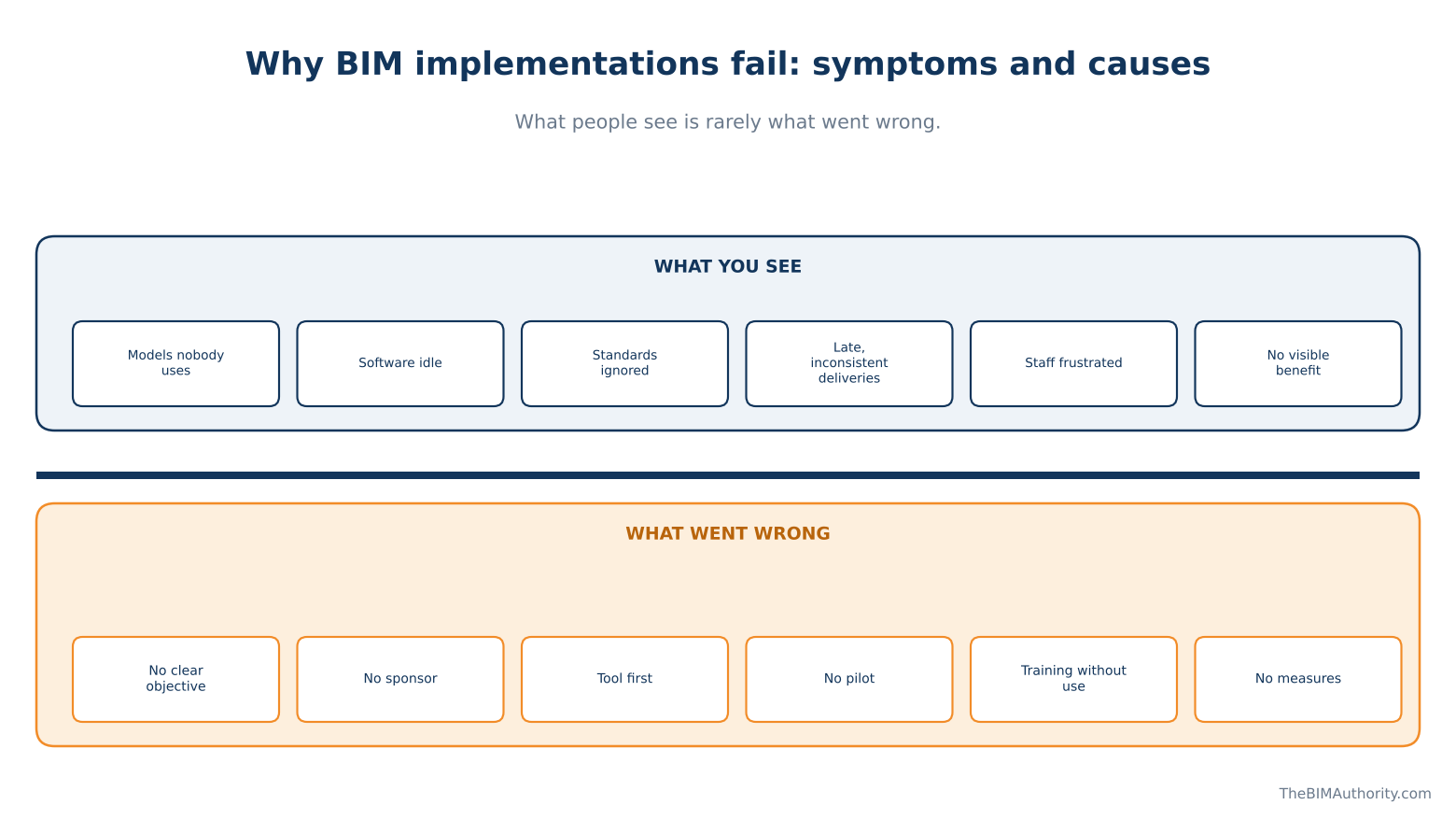
The six most common root causes are:
- No clear objective: nobody can say what BIM is meant to achieve.
- No sponsor and no owner: nobody with authority and time is accountable.
- Tool-first thinking: software is bought before processes are defined.
- No pilot: the approach is never proved on a real project before being imposed.
- Training without application: courses are taken, but not used on real work.
- No measures: nobody can show whether it works.
In one sentence:
BIM implementations fail when they are treated as a purchase instead of a change, and succeed when someone is accountable for the change.
The Twelve Causes in Detail
1. No Clear Objective
What it looks like: “We need to do BIM because everyone is doing it.” Different people have different ideas of success. Decisions about tools, training and projects are made on impulse.
Why it fails: without an objective, nothing can be prioritized or measured, and enthusiasm fades when the first difficulty arrives.
What to do instead: write one page: why BIM, what will be different in two years, three to five measurable objectives. See How to Develop a BIM Implementation Strategy.
2. No Sponsor, No Owner
What it looks like: BIM is “everyone’s job”, which means nobody’s. The enthusiast who leads it has no authority and no time, and is overruled whenever a project needs resources.
Why it fails: implementation competes with billable work, and without a leader’s backing it always loses.
What to do instead: name a sponsor with authority and budget and a BIM lead with time and a mandate. Put both in writing.
3. Tool-First Thinking
What it looks like: a software purchase is the project. The plan consists of installing, training and starting.
Why it fails: tools amplify processes, good or bad. Without agreed standards, workflows and roles, tools produce inconsistent results faster.
What to do instead: define objectives and processes first, test tools in a pilot, then choose.
4. No Pilot, or a Pilot Without Support
What it looks like: the new method is applied to all projects at once, or a pilot is run without coaching, time or measurement.
Why it fails: problems appear on many projects simultaneously, standards are untested, and confidence collapses.
What to do instead: pilot on one or two real projects, with support and measures, and learn before you standardize.
5. Training Without Application
What it looks like: everyone attends a course in the same month. Three months later, few have used the skills.
Why it fails: skills decay without use, and courses do not teach your firm’s standards, templates or workflows.
What to do instead: train by role and at the moment of need; pair courses with coaching on real projects. See BIM Training Plan for Your Team.
6. No Measures
What it looks like: nobody records baselines or results. When leadership asks “is it working?”, the answer is an opinion.
Why it fails: without evidence, support erodes at the first budget review. Without feedback, problems persist.
What to do instead: define a few indicators, record a baseline and report at each gate. See How to Measure BIM Performance, ROI, and Project Success.
7. Standards That Are Missing, Too Heavy or Not Enforced
What it looks like: either each project invents its own conventions, or a 200-page manual exists that nobody reads.
Why it fails: inconsistency makes coordination, exchange and quality unmanageable; heavy standards are ignored.
What to do instead: short standards with examples, tested in the pilot, built into templates and the CDE, with audits and feedback. See How to Build a BIM Project Template.
8. Underestimating the Cost of People’s Time
What it looks like: the budget covers licences, and not training time, template building, pilot support or the productivity dip.
Why it fails: the program runs out of time and money at the same moment, and leadership interprets the dip as proof of failure.
What to do instead: budget people time, explain the dip in advance and track it. See BIM Implementation Costs: Software, Training, and Hardware Budget.
9. Ignoring Culture and Change
What it looks like: the program is announced, not discussed. Staff hear about it in a memo. Concerns are treated as resistance.
Why it fails: people who do not understand why, or who fear losing status or competence, find ways to avoid the new methods.
What to do instead: explain the benefits to their work, involve them in writing standards, support them at the moment of need and recognize early adopters. See Building a BIM-Ready Team: Training and Change Management.
10. Dependence on a Few Enthusiasts
What it looks like: two or three people hold all the knowledge. When one leaves, the program stalls.
Why it fails: knowledge that is not shared is not capability.
What to do instead: build champions in every team, document the way of working, pair people on tasks and train deputies.
11. Ignoring Clients and the Supply Chain
What it looks like: the firm builds excellent internal capability, then finds that clients do not specify information requirements, or that subcontractors cannot exchange data.
Why it fails: BIM value depends on collaboration. Isolated capability produces limited benefit.
What to do instead: engage clients early, offer services, assess and support the supply chain, and use requirements and appointments properly. See BIM Procurement and Appointments Under ISO 19650 and How to Respond to BIM Requirements in Tenders.
12. Treating Implementation as Finished
What it looks like: after rollout, attention moves on. Standards age, templates drift, new starters receive no training, tools update without testing.
Why it fails: capability decays without maintenance.
What to do instead: govern continuously: owners, review rhythm, updates, audits and an annual strategy review.
Early Warning Signs
Failure shows early, if you look. These signals tell you which cause to investigate.
| Sign | What it often means |
|---|---|
| Nobody can state the objective in one sentence | No clear objective (cause 1) |
| Decisions wait for “the enthusiast” | No empowered owner (cause 2) |
| Purchase orders arrive before a plan | Tool-first (cause 3) |
| First projects use new methods with no coaching | No pilot or no support (cause 4) |
| Course certificates but no project use | Training without application (cause 5) |
| “It seems to be going well” is the only report | No measures (cause 6) |
| Every project has a different naming habit | No standards or no enforcement (cause 7) |
| Complaints about workload and being “behind” | Time not budgeted (cause 8) |
| Rumors, jokes about “the BIM people” | Culture neglected (cause 9) |
| Questions go to the same two people | Dependence on enthusiasts (cause 10) |
| Clients never mention BIM; subcontractors send PDFs | Isolation (cause 11) |
| Templates are two software versions old | Neglect (cause 12) |
A Short Diagnostic
Answer each question honestly with yes (2 points), partly (1 point) or no (0 points).
| # | Question |
|---|---|
| 1 | Is there a written objective that leaders and staff can repeat? |
| 2 | Is there a named sponsor and a BIM lead with protected time? |
| 3 | Were processes defined before tools were chosen? |
| 4 | Was (or will) the approach be proven on a supported pilot? |
| 5 | Is training linked to real projects and roles? |
| 6 | Do we have baselines and regular measures? |
| 7 | Are standards short, tested and enforced through templates and the CDE? |
| 8 | Is the full cost, including people time and the dip, budgeted? |
| 9 | Have staff been involved and supported through the change? |
| 10 | Is knowledge shared, with champions and deputies? |
| 11 | Are clients and the supply chain engaged? |
| 12 | Is there continuing governance and maintenance? |
Scoring (total out of 24):
| Score | Reading |
|---|---|
| 20 to 24 | Strong foundations; keep improving |
| 14 to 19 | Reasonable, with gaps; fix the lowest-scoring areas first |
| 8 to 13 | At risk; pause expansion and address the basics |
| 0 to 7 | Likely to fail without a reset |
This is a conversation tool, not a validated instrument. Use it with a small group and discuss the differences in scores. The disagreements are the most informative part.
A Recovery Plan: If You Are Already in Trouble
Many organizations discover failure after a year or two. The good news: it is recoverable, usually faster than starting from nothing. This is the sequence I use.
Step 1: Stabilize (Weeks 1 to 2)
- Stop adding tools, courses and projects to the program.
- Listen: interview a cross-section of staff and clients. Ask what is working, what is not and what they need.
- Protect the people who are doing it well.
- Tell leadership the truth in a short, calm report.
Step 2: Diagnose (Weeks 2 to 4)
- Run the diagnostic with the leadership and the BIM team.
- Review two or three recent projects: what BIM was used, what worked, what failed, what was missing.
- List causes from the twelve above, with evidence.
- Identify quick wins and structural gaps.
Step 3: Reset the Direction (Weeks 4 to 6)
- Write the one-page objective with leadership.
- Appoint or confirm the sponsor and lead, with time.
- Decide scope: where to focus for the next twelve months.
- Agree a small, honest budget including people time.
Step 4: Rebuild on a Real Project (Months 2 to 6)
- Choose a recovery pilot with a supportive team.
- Write minimal standards and templates, and test them.
- Coach the team on real work.
- Measure against a baseline.
Step 5: Standardize and Extend (Months 6 to 12)
- Update standards from the pilot.
- Train by role, with champions.
- Extend in waves, with gates.
- Report results at each gate.
Tone Matters
Recovery fails when it becomes a hunt for blame. The aim is learning. Say clearly that the earlier approach was reasonable with the knowledge available, and that the organization is now adjusting.
What Success Has in Common
When I compare successful implementations, the shared features are modest:
- A short, written objective.
- A leader who protected time for the program.
- A pilot that was allowed to teach lessons.
- Standards that were small and used.
- Training that arrived with the work.
- Honest measures.
- A culture that treated mistakes as information.
None of these requires a large budget. All of them require attention.
Common Mistakes (in Responding to Failure)
- Buying more tools to fix a process problem.
- Blaming the software or the people.
- Mandating compliance without addressing causes.
- Restarting without diagnosis.
- Hiding the problem from leadership.
- Cutting training and support to save money.
- Expanding before fixing the pilot’s lessons.
- Ignoring the successes that already exist.
- Measuring nothing during the recovery.
- Declaring victory early.
A Short Checklist
- Can we state our objective in one sentence?
- Is there a sponsor and a lead with time?
- Did we pilot and learn?
- Are our standards short, owned and enforced?
- Is training applied on real work?
- Do we measure and report honestly?
- Is the full cost budgeted?
- Have we invested in people and culture?
- Do clients and suppliers know what we offer and require?
- Is there ongoing governance?
Frequently Asked Questions
Why do BIM implementations fail?
Mostly for organizational reasons: no clear objective, no accountable owner, tool-first thinking, no pilot, training without application, no measures, weak standards, hidden costs and neglected culture.
What is the most common cause of failure?
Treating implementation as a software purchase rather than a change program with an objective, an owner and a plan.
How can I tell if my implementation is failing?
Warning signs include unused models, inconsistent standards, dependence on a few enthusiasts, no measures, rumors about BIM and clients who never mention it. Use the diagnostic above.
Is it too late to fix a failing implementation?
No. Stabilize, diagnose, reset the objective and ownership, and rebuild on a supported pilot.
Does BIM fail because of the software?
Rarely. Software limits exist, but most failures stem from process, people and management.
How long does recovery take?
Typically six to twelve months to rebuild credible practice, depending on size and starting point.
How do I get leadership support after a bad start?
Present an honest diagnosis, a one-page objective, a small phased plan with gates and a way to measure results.
Can small firms fail at BIM too?
Yes, for the same reasons. Small firms benefit from simplicity: one goal, one pilot, a few standards. See BIM for Small Firms: Where to Start.
Final Thoughts
One of the most hopeful moments in my work was a recovery meeting in a firm that had, by its own admission, wasted two years. The managing partner opened by saying: “I do not want to talk about what went wrong. I want to talk about what we will do differently.” We spent the afternoon on the one-page objective. It took three drafts. By the end, he said something I now repeat to clients: “I thought we were bad at BIM. I think we were just bad at deciding what BIM was for.”
That is nearly always the real diagnosis. The software works. The people are capable. What is missing is a decision about purpose, an owner for the change and a way of learning. Provide those three things, and most failures turn around.
Where to go next: for the positive path, read How to Implement BIM in Your Company: A Step-by-Step Roadmap. For the people side, continue with Building a BIM-Ready Team: Training and Change Management, and for the money side, BIM Implementation Costs: Software, Training, and Hardware Budget.