


There is a document that has settled more arguments on my projects than any contract clause: a table, one page long, with activities down the left side and roles across the top. It is called a responsibility matrix, and it is almost embarrassingly simple. Yet in thirty years I have watched teams spend weeks in disputes that a filled-in matrix would have resolved in minutes. Who creates the shared coordinates? Who models the penetrations through the structure, the architect or the engineer? Who is allowed to publish to the CDE? Who accepts the asset data? Without a matrix, each party answers according to what is convenient. With one, the answer is in writing, agreed in advance.
I remember the specific moment I became a convert. A large project was two months from a milestone when we discovered that the structural engineer, the architect and the MEP engineer had each assumed someone else was modeling the fire-stopping around services penetrations. Nobody had. The cost of finding out late was considerable. The cost of the matrix that would have caught it was an hour of a meeting in week one.
This guide shows you how to build a useful responsibility matrix: what it is, what ISO 19650 expects, the two kinds of matrix you need (activities and information production), how to define the scale of responsibility, how to build it step by step with the team, how to keep it simple and how to use it throughout the project. It includes templates and a worked example. For the roles behind it, see BIM Roles and Responsibilities: Manager, Coordinator, Modeler, and Information Manager.
The Short Answer
A BIM responsibility matrix is a table that assigns responsibility for activities and deliverables to parties and roles, so that every piece of work has a clear owner and everyone knows who to ask.
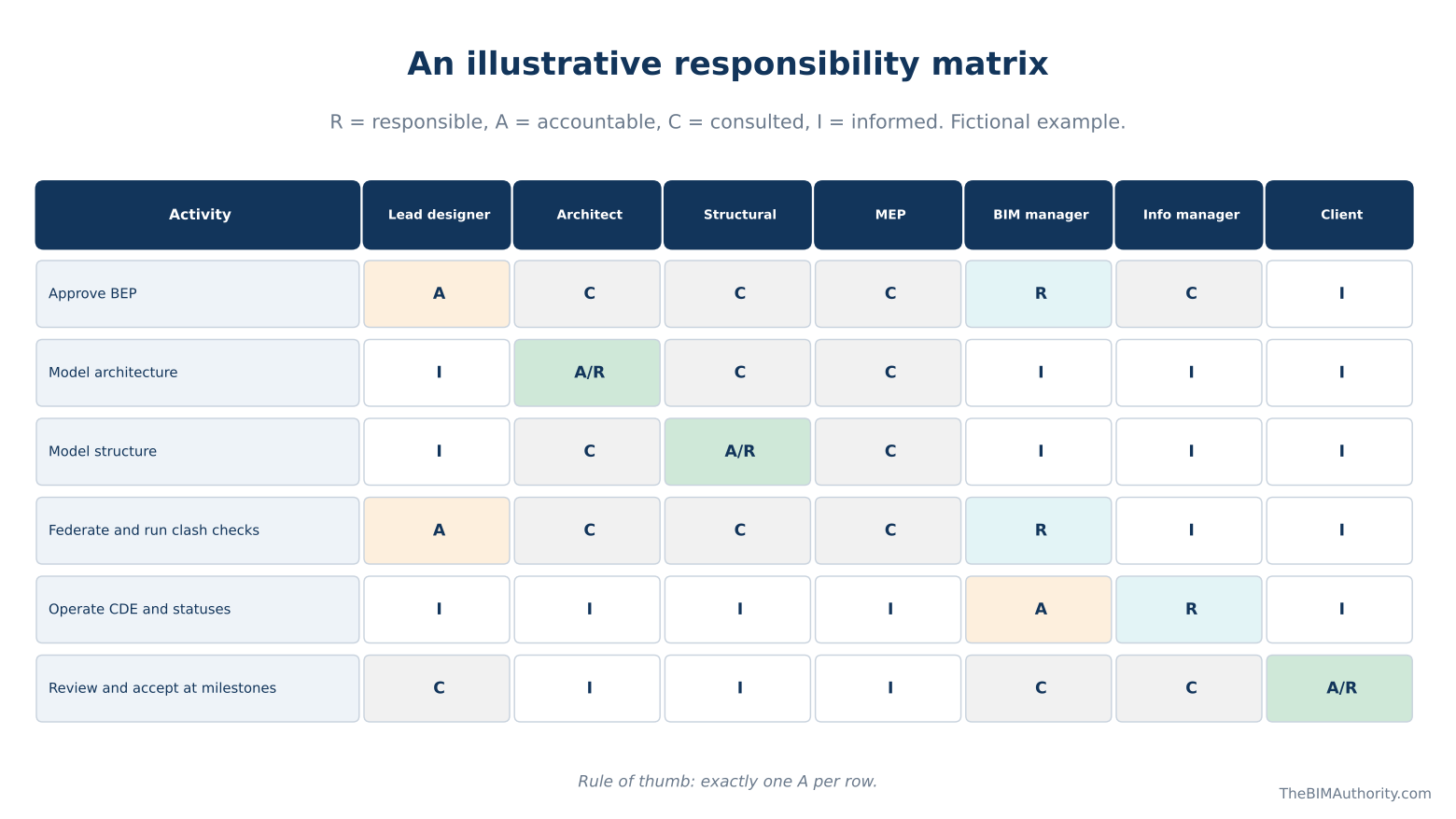
It is often built on a RACI scheme:
| Letter | Meaning |
|---|---|
| R | Responsible: does the work |
| A | Accountable: answers for the result and has the final say; ideally one per row |
| C | Consulted: gives input before the work or decision |
| I | Informed: told after the work or decision |
Variants exist (for example adding S for supports, or using other letters), but the idea is the same. Choose a scheme, define it at the top of the matrix and use it consistently.
In one sentence:
A responsibility matrix answers “who does what, who decides and who needs to know” for every activity, before anyone has to ask.
What ISO 19650 Expects
ISO 19650-2 builds the responsibility matrix into the process.
- In the tender response, the prospective lead appointed party prepares a high-level responsibility matrix for the delivery team’s information management activities, alongside the pre-appointment BEP. It can be limited at this stage to the main functions and individuals.
- After appointment, the lead appointed party establishes the delivery team’s detailed responsibility matrix, which becomes part of the BEP, and writes the exchange information requirements for its appointed parties.
- The standard also includes an informative example of an assignment matrix for information management activities. Check your edition for the current version.
The UK BIM Framework guidance for the BEP shows both: an example high-level responsibility matrix for the pre-appointment stage, and the detailed matrix in the appendix of the delivery team’s BEP. Many national templates and open template packs also provide RACI-style spreadsheets. See BIM Execution Plan (BEP): How to Create and Implement One.
Two Kinds of Matrix You Need
Projects often build one matrix and wonder why it feels incomplete. In practice, you need two, answering different questions.
1. The Information Management Responsibility Matrix
Question: who is responsible for the activities of managing information?
Typical rows (illustrative, grouped by theme):
| Group | Activities |
|---|---|
| Planning and standards | Define project goals and BIM uses; write and maintain the BEP; define the information standard (naming, classification, formats); define the federation and volume strategy; prepare the MIDP; approve changes to standards |
| CDE and workflow | Set up and administer the CDE; manage users and permissions; operate gates and transmittals; maintain records and the audit trail |
| Production | Produce models and documents; maintain templates and libraries; check own information before sharing; approve team information for sharing |
| Coordination and checking | Federate models; run clash detection and model checks; manage issues; verify coordinates and alignment; chair coordination meetings |
| Delivery and acceptance | Authorize information for publication; submit deliverables; review and accept at milestones; handle non-conformities |
| Security and governance | Carry out the sensitivity triage; maintain the security plan; review access; manage incidents |
| Handover and archive | Compile handover information; verify asset data; load the AIM; archive project information |
2. The Information Production Responsibility Matrix
Question: who is responsible for producing which information, at which level and when?
This is the matrix many teams call the model ownership or model element author matrix. It lists building elements, systems or deliverables against disciplines, and answers questions like: who models the beams, who models the steel connections, who models the sleeves, who produces the fire strategy drawings, who owns the room data.
Typical rows:
| Group | Items |
|---|---|
| Spatial and architectural | Levels and grids; rooms and spaces; walls; doors and windows; ceilings; floors and finishes |
| Structural | Foundations; columns, beams and slabs; steel connections; reinforcement; openings in structure |
| MEP | Ducts and pipes; plant and equipment; cable containment; terminals and fixtures; sleeves and penetrations |
| Site and civil | Topography; utilities; drainage; roads |
| Data and documents | Room data; asset data; schedules; specifications; calculations |
| Interfaces | Penetrations; fire stopping; supports; access clearances; builder’s work |
The interface rows are where projects fail. Give them special attention.
Defining the Scale: What Does “Responsible” Mean?
RACI letters are only useful if people agree on their meaning for this project. Spend a few minutes writing definitions.
| Letter | Definition for this project (example) |
|---|---|
| R | Produces the information or performs the activity, to the standard in the BEP, and checks it before sharing |
| A | Accountable for the result, decides when the work is complete and answers to the appointing party; one party per row |
| C | Must be asked before the work is finalized; provides requirements or reviews |
| I | Receives the outcome; no input required |
Tips on the Letters
- One A per row. If two parties are accountable, nobody is.
- Avoid too many Rs. If five parties are responsible, ask who actually does it.
- Use C sparingly. Too many consulted parties slow decisions.
- Use I where it matters, not everywhere.
- A and R can be the same party, shown as A/R.
How to Build the Matrix: A Step-by-Step Method
Step 1: Gather Inputs
Collect the EIR, the BEP draft, the list of appointed parties and task teams, the ISO 19650-2 activities, the goals and BIM uses and the MIDP milestones. See How to Define BIM Goals, Uses, and Project Deliverables.
Step 2: List the Parties and Roles
Columns should be parties or roles, not individuals (names go in a separate table). Keep the number of columns manageable: 8 to 12 is typical.
Step 3: List the Activities and Information Items
Start from the standard lists above, then adapt. Merge trivial rows, and split rows that hide a debate. Aim for thirty to sixty rows for the activities matrix on a medium project, and as many as needed for the production matrix.
Step 4: Draft the Assignments
Fill the letters yourself as a first draft, using the contract, the EIR and your experience. A draft gives people something concrete to correct.
Step 5: Run a Workshop
Bring the task team leads together. Walk through the matrix row by row. For each row, ask: Does anyone disagree? Does anyone think they are not responsible? Is there more than one A? Resolve disagreements in the room, and record the decision. Pay special attention to interfaces.
Step 6: Test With Scenarios
Run three or four scenarios through the matrix: a late structural change; a clash between services and structure; a request from the client for an area schedule; a new subcontractor joining. If the matrix does not tell you what to do, refine it.
Step 7: Add Names and Contact Details
Create a who is who table: for each role, the person, deputy, organization and contact details. Keep it with the matrix.
Step 8: Approve and Publish
Include the matrix in the BEP and publish through the CDE. Confirm it with the appointing party where required.
Step 9: Cascade
Make sure appointed parties and subcontractors receive the relevant parts and confirm them in their TIDPs and EIR. See Task Information Delivery Plan (TIDP): Complete Guide.
Step 10: Maintain
Update the matrix when parties change, scope changes or problems reveal gaps. Version it, and tell people.
A Worked Example: Extract of an Information Production Matrix
Here is an illustrative extract. R: responsible, A: accountable, C: consulted, I: informed. It is fictional.
| Item | Architect | Structural | MEP | Contractor | BIM coordinator | Client |
|---|---|---|---|---|---|---|
| Levels and grids (reference model) | A/R | C | C | I | C | I |
| Rooms and spaces with room data | A/R | I | C | I | I | C |
| Primary structure (columns, beams, slabs) | C | A/R | I | I | I | I |
| Steel connections (fabrication level) | I | A | I | R | I | I |
| Duct and pipe distribution | C | C | A/R | I | I | I |
| Sleeves and penetrations through structure | C | A (structural integrity) | R (positions and sizes) | I | C | I |
| Fire stopping around services | C | I | R | A | I | C |
| Asset data for critical plant | I | I | R | A | C | C |
| Federated model and clash reports | C | C | C | I | A/R | I |
Notice how the sleeves row splits decisions: MEP is responsible for positions and sizes, structure is accountable for the structural integrity. That is a deliberate, written compromise, and it is exactly the type of row that would otherwise be argued over a year later.
Keeping the Matrix Usable
| Principle | How |
|---|---|
| One page where possible | Group rows and use a clear layout; detailed rows can go in an appendix |
| Plain language | Describe activities as verbs: “Run clash detection”, not “Clash management” |
| Consistent roles | Use the same role names as the BEP |
| Visible | Publish in the CDE and on the wall of the coordination room; refer to it in meetings |
| Linked to the TIDP | Each task team’s deliverables match its responsibilities |
| Reviewed | At each milestone and after any change |
Beyond RACI: Related Matrices
| Matrix | Purpose |
|---|---|
| Level of information need matrix | What geometry, data and documents are needed for each object, milestone and purpose. See ISO 7817-1: Level of Information Need Explained |
| Clash detection matrix | Which systems are checked against which, with tolerances. See How to Create a BIM Clash Detection Matrix |
| Permission matrix | Access rights by role and state in the CDE. See How to Set Up a Common Data Environment for BIM Projects |
| Deliverables schedule (MIDP) | When each deliverable arrives. See Master Information Delivery Plan (MIDP): Complete Guide |
| Capability matrix | Skills of parties against requirements |
Each answers a different question. The responsibility matrix connects them by saying who acts in each.
Common Problems and Remedies
| Problem | Cause | Remedy |
|---|---|---|
| Two As in a row | Unresolved disagreement | Decide in the workshop; if needed, escalate to the BIM manager and lead |
| No A in a row | Activity falls between parties | Assign; if no party can, add a role |
| Interfaces ignored | Matrix built by discipline only | Add explicit interface rows (sleeves, supports, clearances) |
| Too many rows | Over-detailing | Group; move detail to appendices |
| Matrix not used | Not launched or linked | Present at kickoff; refer to it in meetings; link to TIDPs |
| Out of date | No owner | Assign an owner; update at milestones |
| Contradicts the contract | Written separately | Cross-check with appointments; seek legal advice if needed |
| Subcontractors unaware | No cascade | Provide relevant extracts in their appointment documents |
Common Mistakes
- Building the matrix alone without the task teams.
- No definition of the letters.
- More than one accountable party per row.
- Ignoring interfaces.
- Listing only models, not documents, data and activities.
- Using individual names instead of roles.
- Too detailed or too vague.
- Never testing it with scenarios.
- Not linking to the BEP, MIDP and TIDPs.
- Never updating it.
See also Common BIM Mistakes Beginners Should Avoid.
A Short Checklist
- Do we have both an information management matrix and an information production matrix?
- Are the letters defined?
- Is there exactly one accountable party per row?
- Are interfaces covered?
- Have the task teams reviewed and agreed it in a workshop?
- Have we tested it with scenarios?
- Is there a who is who table with deputies?
- Is it in the BEP, published and cascaded to subcontractors?
- Is it aligned with the EIR, contracts, MIDP and TIDPs?
- Is there an owner and an update routine?
Frequently Asked Questions
What is a BIM responsibility matrix?
A table that assigns responsibility for activities and deliverables to parties and roles, typically with RACI letters, so everyone knows who does what and who decides.
What does RACI stand for?
Responsible, Accountable, Consulted and Informed.
Does ISO 19650 require a responsibility matrix?
ISO 19650-2 includes it in the process: a high-level matrix in the tender response and a detailed matrix after appointment, as part of the BEP.
What is the difference between a responsibility matrix and a RACI chart?
The responsibility matrix is the document. RACI is a common scheme used to fill it in.
What is the difference between the information management matrix and the production matrix?
The first assigns management activities (CDE, standards, checks). The second assigns production of information (who models or delivers what).
How detailed should it be?
Detailed enough to settle real questions, short enough to be used. Group where you can.
Who prepares it?
The lead appointed party, with the task teams, and confirmed with the appointing party.
Can one person be accountable for several rows?
Yes. Accountability should be concentrated enough to be clear, but a role can hold many rows.
Where do I find a template?
Several national frameworks and open template packs provide spreadsheet templates. You can also build one from the structure in this guide.
Final Thoughts
The fire-stopping discovery I described at the start led to a small ritual that I have kept ever since. In week one of every project, we run a two-hour responsibility workshop. We project the matrix on a wall, we read each row aloud, and people argue. It is not always comfortable. But I have noticed that the arguments are cheaper in week one than in month nine, and that teams who have argued over a matrix tend to trust each other more afterward, because they have already tested the boundaries.
Build yours with the team, define the letters, give every row one owner and pay attention to the interfaces. Then put it where people will see it and use it. It is the most modest document in the BEP, and often the most valuable.
Where to go next: to set the activities in time, read BIM Project Planning: Milestones, Deliverables, and Coordination. For the delivery side, continue with Task Information Delivery Plan (TIDP): Complete Guide and Master Information Delivery Plan (MIDP): Complete Guide, and for the plan that holds the matrix, BIM Execution Plan (BEP): How to Create and Implement One.



