
“Is BIM mandatory in my country?” It is the question I am asked more often than any other, and the one I am least comfortable answering in one word. The honest answer is usually a paragraph that starts with “it depends”: on the country, the type of client, the size of the project, the date of the tender, and what exactly you mean by “mandatory” and by “BIM”. I have seen consultants lose tenders because they believed an outdated blog post, and I have seen others spend months preparing for a mandate that turned out to apply only to a different ministry.
This guide is my attempt to give you a reliable overview, and to teach you how to read the next headline about a BIM mandate. For the facts, I checked official and primary sources wherever I could: government circulars, ministry publications, regulators’ notices and standards bodies. Where I only found secondary sources, I say so. Where several secondary sources disagreed, I give the range and tell you to check the official text. Be aware that this is one of the fastest-changing topics in the whole field. The snapshot below reflects the public information I could verify in November 2026, and by the time you read it, something will have moved.
I write as a former CAD manager and trainer who has had to prepare offices for new requirements more than once, and who has learned that the date on the mandate is never the real deadline: the real deadline is when your client’s tender documents change.
The Short Answer
There is no single global BIM mandate. There is a patchwork of policies, and they fall into four kinds.
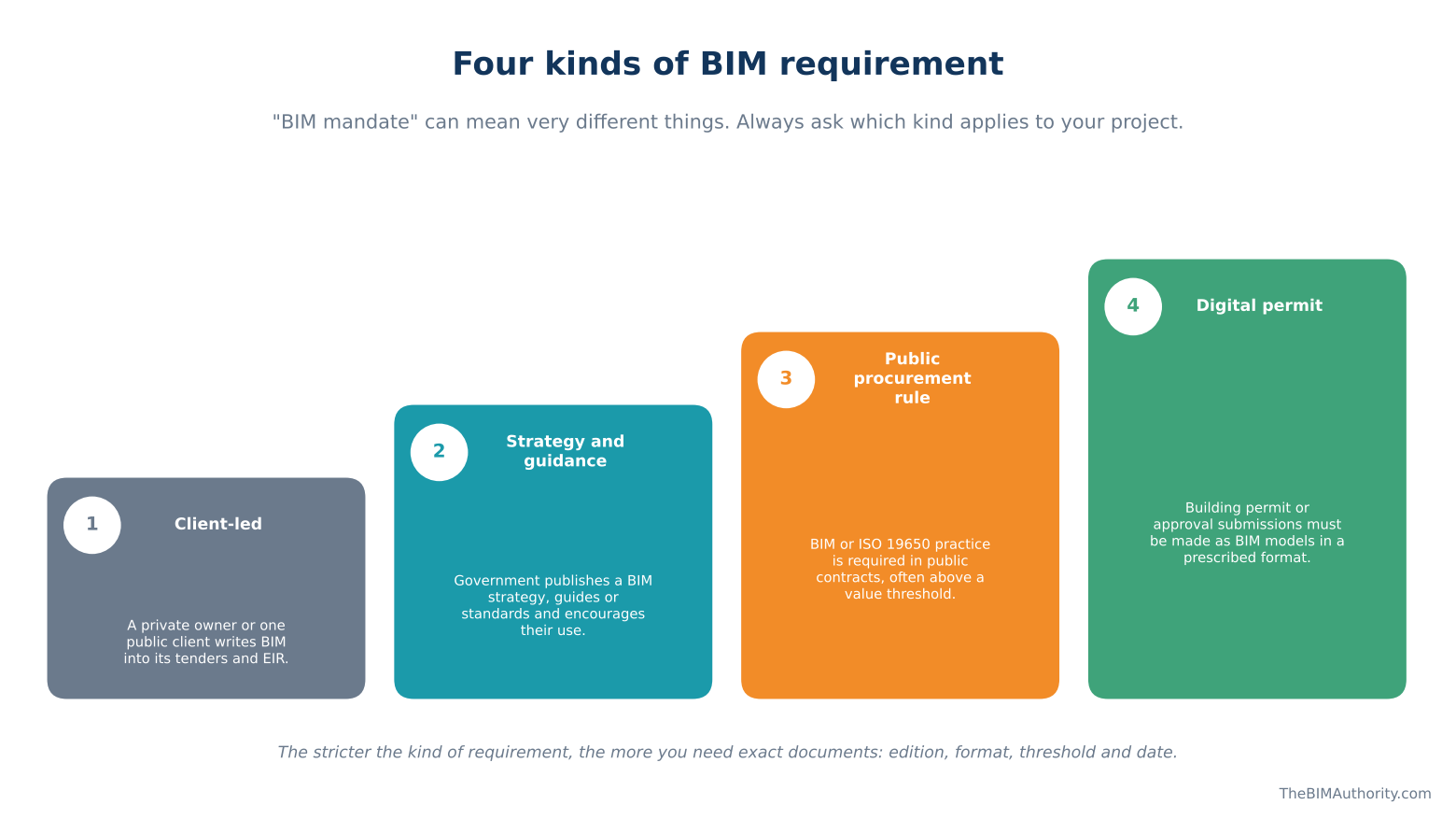
| Kind | What it means | Typical example |
|---|---|---|
| 1. Client-led | An owner writes BIM into its own tenders and information requirements | Private developers; individual public agencies |
| 2. Strategy and guidance | Government publishes a strategy, guides or standards and encourages adoption | National BIM strategies and roadmaps |
| 3. Public procurement rule | BIM or ISO 19650 practice is required in public contracts, often above a value threshold | National procurement codes or agency policies |
| 4. Digital permit | Building permit submissions must be made as BIM models in a prescribed format | Singapore’s CORENET X |
A country can have several kinds at once: a procurement rule for central government, a strategy for the private sector and client-led requirements everywhere else. When someone says “BIM is mandatory in country X”, always ask: which kind, for which clients, above which threshold, from which date?
How to Read a Mandate Without Being Fooled
Before the country list, here are the traps I see most often.
- Thresholds. Many mandates apply only above a contract value or floor area. A mandate “for public works” may exclude most small projects.
- Scope of clients. “Central government” is not “all public bodies”. Regional and municipal clients may follow different rules.
- What “BIM” means. In older mandates, “BIM” meant 3D models. In newer ones, it means information management following ISO 19650. Check the definition.
- Dates. Mandates are phased. “From 2025” may mean a first phase for large projects, with smaller ones later.
- Revisions. Thresholds are revised. Italy’s threshold, for instance, changed in the course of implementation.
- Secondary sources. Many online overviews repeat each other, and some contain outright errors. For example, some summaries claim that the UK would make “Level 3 BIM” mandatory by 2025. That did not happen as a formal requirement: Level 3 was never defined as a standard, and UK policy moved toward information management.
- The distinction between a mandate and an obligation to submit. A rule that says “submit permit applications as BIM models” is a different animal from “use BIM in design”.
Always trace a claim to its primary source: the circular, the law, the ministry document. Then check the date of the source.
Europe
United Kingdom
| Item | Detail |
|---|---|
| 2011 | The Government Construction Strategy stated that government would require fully collaborative 3D BIM, with project and asset information electronic, as a minimum by 2016 |
| April 2016 | The requirement took effect for centrally procured government projects (the “BIM Level 2” mandate) |
| 2019 | The UK BIM Framework was launched to integrate the ISO 19650 series into UK practice |
| September 2021 | The Transforming Infrastructure Performance: Roadmap to 2030 redefined the BIM mandate as the Information Management Mandate, delivered through the UK BIM Framework and ISO 19650 |
| Today | Public clients ask for ISO 19650-aligned information management; certification against ISO 19650 is widespread but not universally mandatory |
For the story of how this evolved, see BIM Maturity Levels (Level 0 to 3) and the Shift to ISO 19650.
Ireland
The government procurement office introduced BIM requirements for public capital works in January 2024, as part of its capital works management framework, following years of industry adoption that largely followed the UK model. Industry bodies have since commented on how the requirements are being applied. Check the current framework documents before a tender.
Germany
| Item | Detail |
|---|---|
| 2015 | The federal transport ministry’s Stufenplan Digitales Planen und Bauen set the goal of introducing BIM in federal transport infrastructure projects, with a target date of 2020 |
| 2021 | A Masterplan BIM Bundesfernstraßen defined a three-phase implementation toward 2025 for federal highways |
| Federal buildings | A separate master plan covers federal building projects. According to an industry statement I consulted, BIM at a basic level has been compulsory for federal buildings since 2023, at a higher level for large projects since 2024, and from 2027 for all federal building projects above a stated cost threshold. Verify the thresholds in the official federal documents |
| 2026 | A federal transport ministry press release in 2026 announced the nationwide application of unified digital standards for federal highway projects |
Germany’s picture is complicated by the federal structure: the federal level, the states and municipalities set different requirements. Check the specific client.
Italy
| Item | Detail |
|---|---|
| 2017 | A ministerial decree introduced a phased approach, starting with the largest public projects |
| 2023 | The new public contracts code (D.Lgs. 36/2023) addressed digital information management, in its article 43 and annex I.9 |
| 1 January 2025 | The obligation to use BIM methods and tools became applicable. According to sources I found, the corrective decree of late 2024 (D.Lgs. 209/2024) set the threshold at works above EUR 2 million, whereas earlier texts and many commentaries spoke of EUR 1 million |
| Standards | The UNI 11337 series is regarded as part of the UNI EN ISO 19650 framework |
Because Italian sources and commentaries disagreed on thresholds and exceptions (for example for certain types of works and for protected buildings), treat this as a case where you must read the current consolidated text of article 43, not a summary.
Spain
| Item | Detail |
|---|---|
| December 2018 | A royal decree created an interministerial commission for incorporating BIM into public procurement |
| February 2019 | The Catalan government approved an agreement requiring BIM in certain public works contracts |
| June 2023 | The Council of Ministers approved a plan for incorporating the BIM methodology into the procurement of the central administration and its public bodies, published by ministerial order in July 2023 |
| 2026 | The plan sets thresholds and a schedule for gradual, progressive implementation. A secondary source reports that the state plan requires BIM on public works from EUR 2 million from 1 January 2026, with a higher level from EUR 5.4 million. Verify against the plan’s calendar |
France, Nordic Countries and Others
- France adopted a digital transition plan for the building sector (to 2022) to encourage BIM adoption, without a general legal mandate for all projects.
- The Nordic countries were early adopters: several state property agencies and infrastructure authorities introduced BIM requirements in the late 2000s and 2010s, supported by national requirement series such as Finland’s COBIM. Current requirements vary by agency.
- European Union: a 2014 public procurement directive allows contracting authorities to require electronic modeling tools such as BIM in public works contracts, and encourages Member States to promote their use. It does not impose a mandate.
Asia-Pacific
Singapore
Singapore is the clearest example of the digital permit kind of requirement, through CORENET X, the joint platform of the Building and Construction Authority and the Urban Redevelopment Authority.
| Date | Requirement (as published in official circulars) |
|---|---|
| 1 October 2025 | Mandatory submission through CORENET X for all new projects with gross floor area of 30,000 m² or more |
| 1 October 2026 | Mandatory submission through CORENET X for all new projects with gross floor area of 5,000 m² or more, according to a circular dated 23 July 2026. An earlier plan had foreseen all new projects regardless of size, so check the latest circulars |
| IFC+SG | BIM submissions in the IFC+SG format (the open IFC standard with Singapore additions) are mandatory for new erections and major alteration and addition projects with new gross floor area of 5,000 m² or more |
| Ongoing projects | A phased onboarding of ongoing projects onto CORENET X is planned, with dates published in the circulars |
Smaller projects follow a streamlined route. The key lesson for the world: here, BIM is not an option about how you design. It is the format of the permit application, and models are checked partly automatically. See ISO 16739 and the IFC Standard Explained.
Hong Kong
The Development Bureau issued a technical circular in 2017 making BIM delivery mandatory for public capital works projects from 1 January 2018, with the scope of mandatory BIM uses revised in later circulars (2018, 2019, 2020, 2021 and 2025). A published commentary notes a cost threshold for some mandatory uses, and a consultation was held until February 2024 on whether to extend a mandate to the private sector by 2029. The Construction Industry Council also publishes BIM standards, including a local annex to ISO 19650-2. Read the current circular for exact requirements.
Japan
The Ministry of Land, Infrastructure, Transport and Tourism made BIM/CIM (construction information modeling) the general principle for public works projects under its direct jurisdiction, except small-scale ones, from fiscal year 2023, applying to bids and contracts starting on or after 1 April 2023. The ministry’s government buildings department has run BIM trials and guidelines for public building projects. As elsewhere, the situation for other public clients and the private sector differs.
Other Asia-Pacific Markets
Several other countries, including Malaysia, South Korea, China and others, have adopted public-sector BIM policies, roadmaps or mandates of varying strength. I could not verify their current details to the standard I set for this guide, so I do not list them. Check your national construction authority.
The Americas
United States
There is no national BIM mandate. Requirements are set by federal agencies (for example the General Services Administration and the Army Corps of Engineers, which have required BIM on major projects), state and local agencies and private owners. Each has its own guide. See BIM Standards Around the World: USA, UK, Canada, Australia, and Europe.
Canada
Canada has no national BIM mandate. The division of responsibilities between federal, provincial and territorial governments makes a single national rule difficult, and industry organizations such as buildingSMART Canada have called for a coordinated framework and published a Canadian national annex to ISO 19650-2. Some federal and provincial clients have their own BIM requirements.
Brazil
The federal government established the adoption of BIM in public works through Decree 10.306 of 2 April 2020, in phases, and the 2021 procurement law gives priority to BIM in tenders. Check the current phases and the public bodies covered.
Peru and Others in Latin America
Peru’s Ministry of Economy and Finance has promoted BIM in public investment projects, with press reports in 2026 announcing obligatory use for certain public works from August 2026 and a first group of public entities implementing the methodology. I could not verify the exact legal text, so consult the official publication. Other countries, including Chile and Colombia, have also developed national BIM plans.
Oceania
Australia
There is no federal BIM mandate. Requirements come from state governments and major public clients, such as Transport for NSW and the Victorian and Queensland governments, within national guidance including the National Digital Engineering Policy Principles and the NATSPEC National BIM Guide. New Zealand has likewise no national mandate, with industry-led programs and agency requirements.
Middle East and Africa
Several Gulf states and cities issued BIM requirements for large or public projects in the 2010s, and requirements continue to evolve, often at municipal or authority level. National-level information in Africa varies widely, with some countries working on adopting ISO 19650 and national annexes. Because requirements in these regions are frequently set by individual authorities and clients, I recommend checking directly with the relevant authority or client rather than relying on a country summary.
A Summary Table
This is a navigation aid, not legal advice. “Type” refers to the four kinds described earlier. Dates and thresholds must be checked in the official documents.
| Country or region | Main instrument (examples) | Type | Notes |
|---|---|---|---|
| United Kingdom | Information Management Mandate (2021), UK BIM Framework, BS EN ISO 19650 | 3 | From the 2016 BIM Level 2 mandate; central government |
| Ireland | Government capital works BIM requirements (2024) | 3 | Public capital works |
| Germany | Stufenplan (2015), master plans for highways and federal buildings | 3 | Federal level; states vary |
| Italy | Public contracts code, article 43 (from 1 Jan 2025) | 3 | Threshold changed; read current text |
| Spain | State BIM plan (2023), regional policies | 3 | Progressive thresholds |
| France | National digital transition plan | 2 | No general mandate |
| Singapore | CORENET X, IFC+SG | 4 | Permit submissions in BIM; area thresholds |
| Hong Kong | Development Bureau circulars (from 2017) | 3 | Public capital works |
| Japan | MLIT BIM/CIM (from fiscal 2023) | 3 | MLIT direct projects |
| United States | Federal agency and state requirements | 1 / 3 | No national mandate |
| Canada | Client requirements; annex to ISO 19650-2 | 1 / 2 | No national mandate |
| Brazil | Federal decree (2020), procurement law (2021) | 3 | Phased |
| Australia | State frameworks; national principles | 1 / 2 / 3 | No federal mandate |
What the Trend Shows
Looking at the whole picture, I see four trends that matter more than any single date.
- From “BIM” to information management. Mandates are increasingly expressed in terms of ISO 19650 and information requirements, not just 3D models. The UK’s change of name is a symbol of this.
- From design to the whole life cycle. Requirements are extending to handover data, asset information and operation.
- From procurement to regulation. Singapore’s digital permit shows where things can go: regulators asking for models in open formats so that compliance checking can be partly automated. Expect others to follow.
- From closed to open. Open formats, especially IFC, appear in more and more requirements. See openBIM Explained: Principles, Standards, and Benefits.
There is also a trend in thresholds: they tend to fall over time. A requirement that applies only to the largest projects today often reaches smaller projects within a few years.
What a Mandate Means for Your Firm
I have helped several offices prepare for new requirements. The checklist is always roughly the same.
- Identify which kind of requirement applies to your clients and projects, from primary sources.
- Note the thresholds and dates, and keep a pipeline view of which of your projects will be affected.
- Translate the requirement into concrete deliverables: information requirements, formats, standards, certification expectations.
- Assess your capability and capacity honestly. See BIM Procurement and Appointments Under ISO 19650.
- Fix the basics first: a CDE, naming, a BEP template, roles. See How to Implement BIM in Your Company: A Step-by-Step Roadmap.
- Train the people who will deliver, including project managers who write fee proposals. See BIM Training Plan for Your Team.
- Test the format requirements early, especially IFC exports and any prescribed schema or portal.
- Consider certification if clients ask for it or if you compete on public tenders.
- Prepare your tender responses. See How to Respond to BIM Requirements in Tenders.
- Set a review date. Revisit mandates every six months.
For the cost side, see BIM Implementation Costs: Software, Training, and Hardware Budget.
How to Keep Track of Changes
- Subscribe to official sources: the relevant ministry, procurement office or construction authority.
- Follow standards bodies: national standards organizations, CEN and ISO committees.
- Follow the national buildingSMART chapter, which often publishes timely summaries and roadmaps.
- Ask your clients. The most important mandate is the one in the tender documents.
- Keep a register of the requirements that apply to your projects, with source, date and next review.
- Treat blogs and market reports with caution. Use them as pointers, then go to the primary source.
Common Mistakes
- Believing a headline. Read the circular.
- Confusing a strategy with a mandate. A roadmap is not an obligation.
- Ignoring thresholds and exceptions.
- Assuming one country’s rules apply in another.
- Preparing for the date, not for the tender. Tender documents often change before the legal date.
- Treating a mandate as a modeling requirement only. Increasingly, it concerns information management and formats.
- Neglecting the supply chain. Subcontractors and consultants must also be ready.
- Forgetting existing contracts. Requirements usually apply to new procurements.
- Not documenting what you checked.
See also Common BIM Mistakes Beginners Should Avoid.
Frequently Asked Questions
Which countries have a BIM mandate?
Several countries require BIM in public procurement or permit processes, including the United Kingdom, Ireland, Germany (federal level), Italy, Spain, Singapore, Hong Kong, Japan (for certain projects) and Brazil, with different scopes and dates. Countries such as the United States, Canada and Australia have no national mandate but have agency or state requirements.
Is BIM mandatory in the UK?
For central government construction projects, yes, since 2016, now framed as the Information Management Mandate based on the UK BIM Framework and ISO 19650. Other clients set their own requirements.
Is BIM mandatory in the United States?
There is no national mandate. Federal agencies, states and private owners set their own requirements.
Is BIM mandatory in the European Union?
The EU does not impose a mandate. A 2014 procurement directive enables Member States to require it, and several have done so nationally.
What is the difference between a BIM mandate and a BIM strategy?
A mandate is a binding requirement, usually for public clients. A strategy is a policy document that sets direction without necessarily imposing obligations.
What is Singapore’s CORENET X?
The government’s digital platform for building regulatory submissions, in which BIM models in the IFC+SG format are required for projects above area thresholds.
Does a BIM mandate apply to private projects?
Usually not directly. But private clients increasingly adopt similar requirements, and some regulators extend requirements to permits.
How often do BIM mandates change?
Frequently: thresholds, dates and scope are revised. Check official sources at least every six months.
Do I need ISO 19650 certification to bid for public projects?
Not always. Some clients ask for evidence or certification of ISO 19650-aligned processes. Check each tender.
Final Thoughts
When I started in this field, “mandate” was a word used by enthusiasts to describe a distant future. Today it is a word used by procurement officers, in tender documents, with dates and thresholds attached. The change in tone is the real story. BIM is moving from something offices choose to something clients and regulators require, and the requirement is shifting from “produce a 3D model” to “manage information properly across the life of the asset”.
For a professional, that is good news. It means that the investment you make in standards, processes and training is not tied to one country’s policy cycle. Learn the international core, keep your documentation honest, and verify the local rules each time a tender arrives. The mandate will change. The discipline will not.
Where to go next: for the standards behind these requirements, read BIM Standards Around the World: USA, UK, Canada, Australia, and Europe and BIM Standards: The Complete International Guide. For how to prepare, continue with How to Respond to BIM Requirements in Tenders and How to Implement BIM in Your Company: A Step-by-Step Roadmap.