

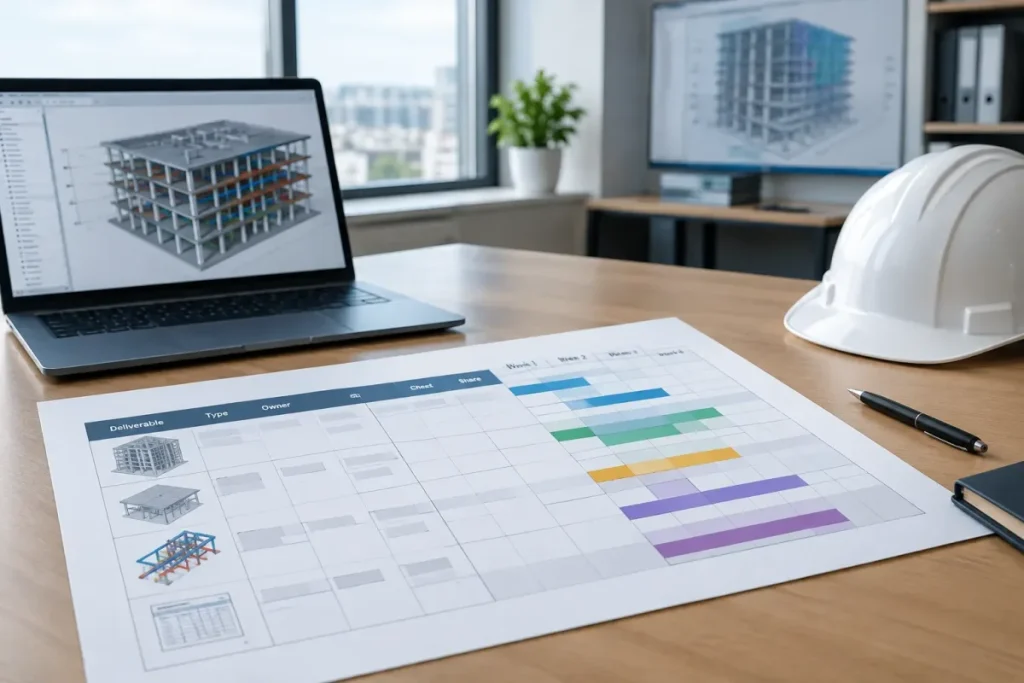

If the MIDP is the master plan, the TIDP is the plan that people actually live by. I learned this from a structural engineering team lead, a calm, methodical man who had never read a line of ISO 19650 but whose weekly planning sheet was the best TIDP I have ever seen. Every Monday morning, he pinned a single page to the wall of his team’s room. It listed the containers his team would deliver that week and the next three: which models, which schedules, which calculations; who was producing each one; what each depended on from the architects and the services engineers; when it would be checked; and when it would be shared. His team never missed a delivery date. When I asked him how, he shrugged. “We just write down what we promised, and then we do it.”
That is exactly what a Task Information Delivery Plan is: a task team writing down what it has promised to deliver, when and in what form. It sounds almost too simple to need a guide. But in my experience, the TIDP is the most neglected of the ISO 19650 planning documents, because it falls between two stools. Project managers think it is a BIM matter. BIM managers think it is a team matter. Teams think it is someone else’s paperwork. As a result, MIDPs are built from vague, inconsistent or invented inputs, and the carefully consolidated master plan rests on sand.
This guide explains what a TIDP is, who writes it, what it contains, how to build one in an afternoon, how it feeds the MIDP, how to keep it alive during delivery and how to avoid the typical failures. I include a template and a worked example. For the consolidated plan, read Master Information Delivery Plan (MIDP): Complete Guide alongside this guide.
The Short Answer
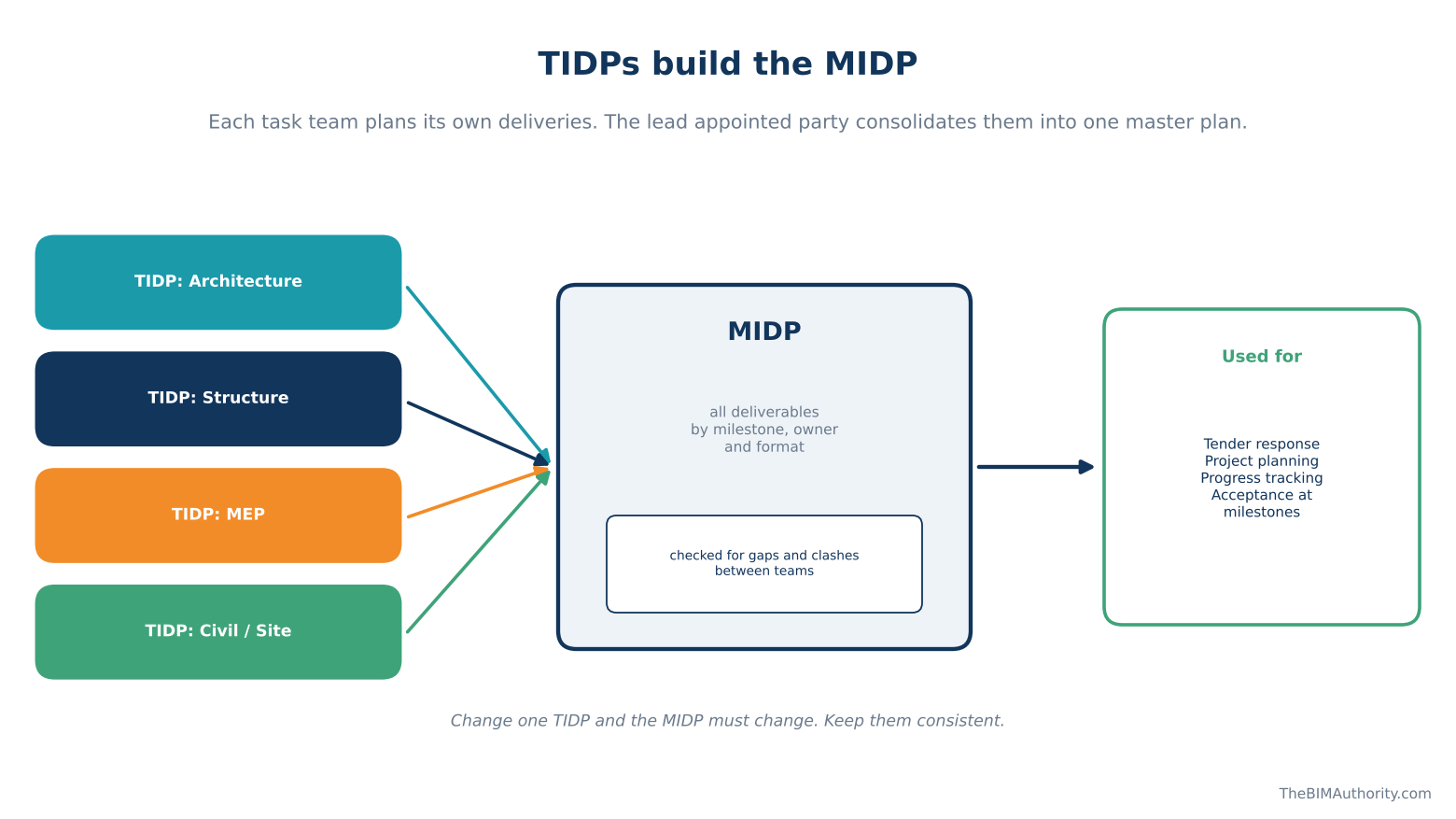
A Task Information Delivery Plan (TIDP) is the plan of a single task team for the information it will deliver: the information containers, the delivery dates, the responsible people, the formats and the dependencies. The TIDPs of all task teams are consolidated into the MIDP of the delivery team.
In ISO 19650 terms:
- A task team is a group of individuals assigned a specific task within the delivery team: a discipline team, a work package team or a specialist.
- Each task team, with its lead, prepares a TIDP for its scope.
- The lead appointed party (or its information manager) consolidates them into the MIDP, checks them for gaps and conflicts and manages the whole.
- The TIDP is maintained by the task team during delivery, and its changes flow into the MIDP.
In one sentence:
The TIDP is a task team’s promise, in writing: these containers, these dates, these people, these formats, these dependencies.
Why TIDPs Matter
| Without TIDPs | With TIDPs |
|---|---|
| Teams plan deliveries in their heads | Each team’s commitments are written and visible |
| The MIDP is built from guesswork | The MIDP is built from the people who will deliver |
| Dependencies between teams are discovered late | Teams state what they need and from whom |
| Milestone deliveries are rushed | Work is paced toward each delivery |
| Capacity problems surface as missed dates | Teams can see overload in advance |
| Responsibility is vague | Each container has a named owner |
| Lessons about estimating are lost | Plan versus actual builds experience |
There is also a quiet benefit. Writing the TIDP forces a task team to think about its own information production: how many models it will really produce, what quality checks it needs, who will do them. Teams often discover problems at this stage that would otherwise have appeared at the milestone.
What a TIDP Contains
A TIDP should be short and practical. These are its typical contents.
Team and Scope
| Item | Description |
|---|---|
| Task team and lead | The team, its organization and the person responsible for the plan |
| Scope | What the team is responsible for, with reference to the responsibility matrix |
| Version and date | For control |
| Reference documents | The EIR, BEP and MIDP to which it responds |
For Each Information Container (or Group)
| Field | Purpose | Example |
|---|---|---|
| Container ID or group | Identification per the naming convention. See BIM File Naming Conventions and ISO 19650 | A group: “Structural models, levels 1 to 4” |
| Title / description | What it is | Structural frame model, levels 1 to 4 |
| Type | Model, drawing, schedule, report, specification, calculation | Model |
| Responsible person | A named individual | Structural BIM coordinator |
| Format | File format; schema version and model view where relevant | Native plus IFC4 Reference View |
| Level of information need | Reference to the EIR or LOIN matrix | Matrix 4.2, milestone 3 |
| Milestone | Which information delivery milestone it supports | M3: design approval |
| Planned dates | Start, internal check, share, delivery | 28 Feb start; 10 Mar internal check; 14 Mar share |
| Status on delivery | The suitability status | S2, or authorized at milestone |
| Dependencies (inputs) | What the team needs from others, and by when | Architectural levels frozen by 28 Feb |
| Dependants (outputs) | Who needs this container, and for what | MEP coordination; steel fabricator |
| Checks | Quality checks before sharing | IDS check; geometry and coordinate check; clash with ARCH |
| Actual dates and status | For tracking | Shared 14 Mar; accepted 18 Mar |
Team-Level Information
- Capacity: the people and time the team assigns, and known constraints (holidays, other projects).
- Risks: risks to delivering on time and how the team will manage them.
- Assumptions: for example “architectural levels frozen by 28 February”.
- Change procedure: how the team will notify the lead of changes to dates or content.
How to Build a TIDP: A Step-by-Step Method
This is the process I teach task team leads. It takes a couple of hours for a typical team.
Step 1: Read the Requirements
Read the EIR (or the lead appointed party’s EIR for your appointment), the BEP sections that concern your team, and the MIDP template or milestones. Identify the milestones and the information your team must deliver at each.
Step 2: List What You Will Produce
List the containers and groups your team will deliver for each milestone. Use the naming convention and the federation and volume strategy to decide how to group them (by building, level, zone or system). Include documents and data, not only models: schedules, calculations, reports, specifications, property data.
Step 3: Define Responsibility
Assign each container to a named person. If it takes more than one person, name the person who answers for it. See How to Create a BIM Responsibility Matrix.
Step 4: Define Formats and Content
For each container, state the format and the level of information need required. Check the EIR for schema versions, views, property sets and classification. See ISO 7817-1: Level of Information Need Explained.
Step 5: Identify Dependencies
For each container, ask: what do we need from others before we can finish this, and by when? Who needs this from us, and when? This is the most valuable part of the TIDP. Write the dependencies down in both directions.
Step 6: Estimate and Schedule
Estimate the time needed to produce, check and share each container. Add review and approval time. Place dates against the milestones, working backward from each milestone. Check your team’s capacity week by week.
Step 7: Plan the Checks
For each container, define the quality checks the team will perform before sharing: model checks, validation, IDS, drawing checks, peer review. See BIM Quality Assurance vs. Quality Control: Processes and Checklists and How to Validate IFC Models for Data Quality and Compliance.
Step 8: Record Risks and Assumptions
Write the risks to your delivery (dependencies that might slip, resource constraints, unclear requirements) and the assumptions on which your dates depend.
Step 9: Review Internally
Walk the plan through with the team. Ask: Is it realistic? Who would be surprised by it? Adjust.
Step 10: Submit to the Lead Appointed Party
Send the TIDP, in the agreed template, for consolidation into the MIDP. Be ready to resolve conflicts of dates and dependencies with other teams.
Step 11: Maintain It
Update the TIDP during delivery: record actual dates, adjust forecasts, flag changes. Review it weekly with the team.
A Worked Example (Extract)
Here is an extract from the TIDP of a fictional MEP task team. It is a teaching example.
Task team: MEP design team, XYZ Engineering. Lead: J. Smith. Version: 1.2, 3 Feb. Responds to: EIR section 5, MIDP v1.0.
| ID / group | Description | Responsible | Format | Milestone | Start | Share date | Inputs needed (from, by when) | Outputs to | Checks |
|---|---|---|---|---|---|---|---|---|---|
| MEP-M-HVAC, levels 1 to 4 | HVAC distribution models | A. Patel | Native + IFC4 RV | M3 | 1 Feb | 14 Mar | ARCH levels and ceilings frozen (Architecture, 28 Feb); STR beam positions (Structure, 7 Mar) | Coordinator; fire engineer; cost consultant | IDS; clearance rules; clash with ARCH, STR |
| MEP-M-ELEC, levels 1 to 4 | Electrical distribution models | R. Moreau | Native + IFC4 RV | M3 | 1 Feb | 14 Mar | ARCH room layouts (Architecture, 28 Feb) | Coordinator; cost consultant | IDS; clash with HVAC |
| MEP-S-LOAD | Load schedules | A. Patel | Spreadsheet | M3 | 15 Feb | 7 Mar | Room data (Architecture, 28 Feb) | Energy assessor; cost consultant | Peer review |
| MEP-R-ENERGY | Energy calculation report | L. Chen | Document | M3 | 15 Feb | 11 Mar | HVAC model (internal, 7 Mar) | Client; planning consultant | Peer review; consistency with model |
| MEP-D-ASSET | Draft asset data: critical plant | R. Moreau | Register template | M3 | 1 Mar | 14 Mar | Plant selections (internal, 10 Mar) | Client’s operations team | Completeness vs AIR |
Risks: dependency on architectural freeze on 28 Feb; if it slips by more than five working days, HVAC and ELEC share dates move. Assumptions: two modelers per discipline throughout; no leave in the weeks of 3 and 10 March. Capacity note: peak load week of 10 March.
Look at how the dependencies column creates a conversation with other teams. When the lead appointed party consolidates this TIDP with the architecture and structure TIDPs, it can immediately check: does the architecture TIDP really deliver the freeze on 28 February?
How the TIDP Feeds the MIDP
The consolidation is where the value multiplies.
- Collect all TIDPs in the same template.
- Merge them into one table, keeping the team and container references.
- Reconcile dependencies: for each input one team lists, confirm that another team lists the matching output, with a compatible date.
- Check coverage against the EIR: is every requirement delivered by someone?
- Check capacity and milestones across teams.
- Resolve conflicts through short meetings between the teams concerned.
- Issue the MIDP and ask teams to confirm their TIDPs against it.
Any change to a TIDP must be notified and reflected in the MIDP. See Master Information Delivery Plan (MIDP): Complete Guide.
TIDPs for Different Types of Task Teams
| Task team | Typical TIDP emphasis |
|---|---|
| Architecture | Early frozen references (levels, grids, core layouts) that others depend on; room data; area schedules; coordination of openings |
| Structure | Structural frame, load data to services and architecture, openings and sleeves, fabrication information |
| MEP | Distribution models, plant data, load schedules, coordination with ceilings and structure, asset data |
| Civil / site / landscape | Survey and site models, utilities, levels, drainage, coordinates and georeferencing |
| Specialist subcontractors | Fabrication models, product data, shop drawings, test certificates |
| Surveyors / scanning providers | Survey data, point clouds, accuracy statements, coordinate systems |
| Cost and planning consultants | Quantity and cost reports dependent on models; schedules and sequencing information |
| Fire, energy and sustainability consultants | Analysis inputs and outputs tied to design milestones |
| Client-side teams | Reference information, decisions, reviews and approvals, which others depend on |
Remember that the client is also a task team in a sense: its decisions and reference information are dependencies for everyone.
Tracking and Using the TIDP During Delivery
A TIDP is not finished when it is submitted. It is a working tool.
- Weekly team review: what was due, what was delivered, what is next, what is blocked.
- Update actual dates in the TIDP and in the CDE, so plan and reality can be compared.
- Flag dependencies early: if you will miss an input, tell the dependant, not only the lead.
- Escalate slippage and capacity problems to the lead appointed party before they become milestone failures.
- Hold a short retrospective at each milestone: what did we estimate well, what not? Use it to improve the next TIDP.
Useful Team-Level Metrics
| Metric | What it shows |
|---|---|
| Delivered on time | Reliability |
| Rework after first submission | Quality of production |
| Inputs received late | Dependencies that need attention |
| Planned versus actual effort | Estimating accuracy |
Scaling the TIDP
| Team size | Approach |
|---|---|
| Small team or single specialist | A one-page table of deliverables, dates and dependencies |
| Medium team | A spreadsheet with container groups, named owners, checks and a weekly review |
| Large team (multiple disciplines, sites) | Detailed schedule by container, linked to CDE tracking, with a dedicated planner |
Never skip it; size it to the team. Even a freelancer delivering one model benefits from a one-page TIDP.
A Template You Can Adapt
Header: project; task team and organization; lead; version and date; references (EIR, BEP, MIDP version).
Table columns:
| Column | Notes |
|---|---|
| Container ID or group | Per naming convention |
| Description | Plain language |
| Type | Model, drawing, schedule, report, data |
| Responsible | Named person |
| Format and view | Native; IFC version and view; document format |
| LOIN reference | EIR matrix and milestone |
| Milestone | M1, M2, M3 |
| Start date | Planned |
| Internal check date | Planned |
| Share / delivery date | Planned |
| Status on delivery | Suitability code |
| Inputs needed (from, date) | Dependencies in |
| Outputs to (who, purpose) | Dependants out |
| Checks | QA steps |
| Actual dates and status | Tracking |
| Notes and risks | Free text |
Footer: capacity note; assumptions; risks; change procedure.
Common Mistakes
- Writing the TIDP in isolation, without reading the EIR and MIDP.
- Listing models but forgetting documents and data.
- No dependencies, or only inputs and no outputs.
- No time for checks and review.
- Over-optimistic dates with no capacity check.
- No named owners.
- Submitting once and never updating.
- Inconsistent templates between teams, making consolidation hard.
- Hiding risks to avoid awkward conversations.
- Ignoring client-side dependencies.
- Not tracking actuals, so nothing is learned.
- Leaving the TIDP to the BIM coordinator alone, without the team lead’s commitment.
See also Common BIM Mistakes Beginners Should Avoid.
A Short Checklist
- Does the TIDP respond to the EIR, BEP and MIDP?
- Does it list all containers, including documents and data?
- Does each have an owner, format, LOIN reference, milestone and dates?
- Are inputs and outputs both stated, with dates?
- Is there time for checks and review?
- Is capacity realistic week by week?
- Are risks and assumptions recorded?
- Has the team reviewed it?
- Is it versioned and submitted for the MIDP?
- Is it reviewed weekly and updated with actuals?
Frequently Asked Questions
What is a TIDP in BIM?
The Task Information Delivery Plan: a task team’s plan for the information containers it will deliver, with dates, responsible people, formats and dependencies.
Who writes the TIDP?
The task team, through its lead, based on the requirements and the BEP.
What is the difference between TIDP and MIDP?
A TIDP is one team’s plan. The MIDP consolidates all TIDPs for the delivery team.
Does every task team need a TIDP?
Yes, in proportion to its scope. Even a small specialist can supply a short one.
What should be in a TIDP?
Containers, owners, formats, level of information need, milestones, dates, dependencies, checks, risks and assumptions.
How often should a TIDP be updated?
Whenever dates or content change, and reviewed weekly during active delivery.
Do TIDPs include documents?
Yes: all information containers, including documents, schedules, reports and data, not only models.
How do TIDPs help coordination?
By making dependencies between teams explicit, so conflicts can be resolved before they cause delays.
Who checks the TIDP?
The lead appointed party reviews TIDPs when consolidating the MIDP, checking coverage, dependencies and capacity.
Final Thoughts
The structural team lead’s pinned page is still my favorite example of information management at the working level. It was not a template from a standard. It had no logo. But it contained the essential things: what we promised, who is doing it, what we need, when we will check it and when it goes out. Everything a TIDP is meant to be.
If you lead a task team, start with that page. Draw a table, fill in your next three weeks, write down what you need from others and what others need from you, and share it. A week later, adapt it to the project template. You will have written your first TIDP, and probably discovered the three problems that would have caused your next missed deadline.
Where to go next: to see how TIDPs combine, read Master Information Delivery Plan (MIDP): Complete Guide. For the responsibilities behind them, continue with How to Create a BIM Responsibility Matrix, and for the requirements they satisfy, Exchange Information Requirements (EIR): Complete Guide.



