

I have a confession about salary guides, including the ones that pretend to be authoritative: I do not trust any single number in them. I have seen a guide claim that BIM managers in one country earn a median of one figure, and another, published the same month, claim a figure thirty percent higher. I have seen “averages” that are actually the midpoints of someone’s guess, ranges copied from older articles and conversions between currencies done on the wrong date. I have also seen people make career decisions, accept offers and negotiate raises on the basis of such numbers. The lesson I draw is not that salary information is useless. It is that it must be read like a weather forecast, not like a train timetable: as a guide to likely conditions, with honest uncertainty.
BIM pay is difficult to pin down for good reasons. The roles themselves are inconsistently defined, as BIM Specialist vs. BIM Coordinator vs. BIM Manager explains: the same title covers quite different jobs. Official statistics rarely have “BIM manager” as a category; salary websites rely on self-reported or advertised figures, with biases of their own. Pay varies enormously with country, city, sector, employer size, experience, scope, benefits and tax. And the market itself moves with demand, mandates and economic cycles.
This guide offers an orientation, not a price list. It explains what shapes BIM pay, summarizes indicative published ranges from several non-official sources as of late 2026 (with their disagreements), shows how to read and compare such figures, explains compensation beyond base salary, gives a method for researching your own market, discusses how to raise your earning power ethically and effectively, covers negotiation basics, remote and international work, and lists the mistakes to avoid. It belongs with How to Become a BIM Manager: The Complete Career Guide, BIM Certifications: The Complete Guide to Professional Credentials and BIM Interview Questions and Answers. The figures below come from commercial salary aggregators and career blogs, not official statistics; they conflict, change quickly and may be wrong for your situation. Verify with current local job advertisements, recruiters, professional bodies and official statistics.
The Short Answer
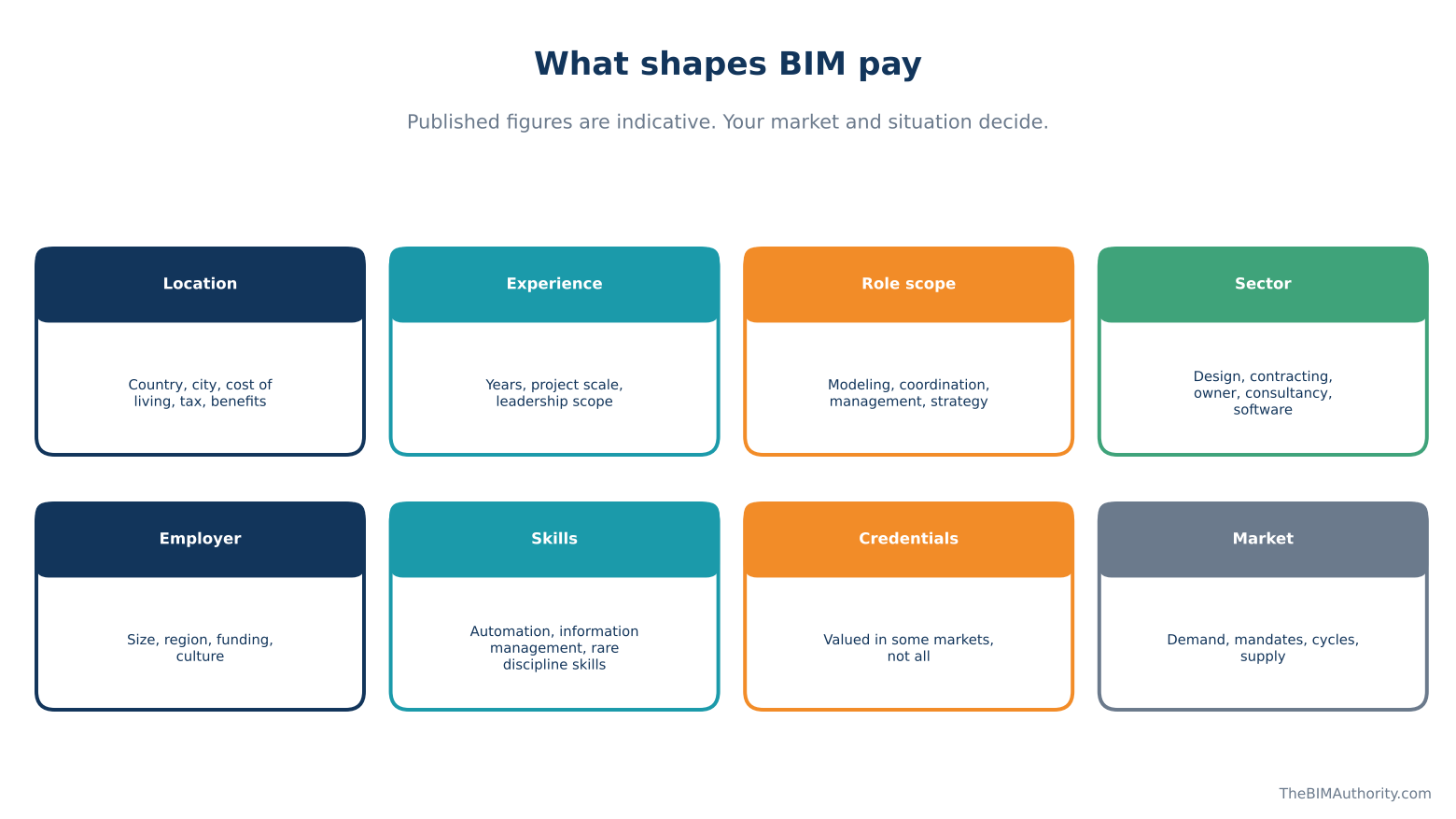
| Factor | Why it matters |
|---|---|
| Location | Country, city, cost of living, tax and benefits |
| Experience | Years, project scale and leadership scope |
| Role scope | Modeling, coordination, management or strategy |
| Sector | Design, contracting, owner, consultancy, software |
| Employer | Size, region, funding and culture |
| Skills | Automation, information management, rare discipline skills |
| Credentials | Valued in some markets, not all |
| Market | Demand, mandates, cycles and supply |
In one sentence:
Published BIM salary figures are wide, inconsistent and indicative; use them to frame questions, then test them against local job advertisements, recruiters and your own experience and scope.
What the Sources Say (Indicative, Late 2026)
The following are ranges reported by commercial sources consulted in 2026. I present them to show order of magnitude and disagreement, not as facts. Currencies are as reported; I do not convert, because exchange rates, taxes and living costs differ.
United States
| Source type | Reported figure (annual) | Notes |
|---|---|---|
| A salary data service | BIM manager average about 82,700 USD; middle range roughly 74,800 to 88,800 USD (October 2026 data) | A relatively narrow, lower-centered estimate |
| An employee salary-sharing platform | BIM manager median total pay about 115,000 USD, with a typical range roughly 91,000 to 147,000 USD | The page I consulted listed submissions through 2026; self-reported data |
| A career-data website citing national occupational wage data | A median around 102,000 USD, with a middle half from about 78,000 to 133,000 USD | Appears to map “BIM manager” onto a broader occupation category; treat as a proxy |
| A career blog | BIM coordinator about 60,000 to 82,000 USD; BIM manager about 90,000 to 125,000 USD | Blog estimate |
| A job-listing aggregator average cited in a 2026 guide | BIM coordinator about 84,000 USD | Average of listings |
Reading: US BIM manager figures in these sources cluster, very roughly, between the low 80,000s and the mid 100,000s, with wide variation by state and city; coordinators sit below managers, often in the 60,000 to 90,000 area.
United Kingdom
| Source type | Reported figure (annual) |
|---|---|
| A career blog | BIM coordinator about 35,000 to 48,000 GBP; BIM manager about 52,000 to 75,000 GBP |
| A job-listing aggregator average cited in a 2026 guide | BIM coordinator about 40,400 GBP |
| Another guide | BIM modeler about 28,000 to 40,000 GBP; BIM manager from about 50,000 GBP |
Germany
| Source type | Reported figure (annual) |
|---|---|
| A career blog | BIM coordinator about 42,000 to 58,000 EUR; BIM manager about 62,000 to 85,000 EUR |
| Another guide | BIM modeler about 30,000 to 50,000 EUR; BIM coordinator about 60,000 EUR; BIM manager up to about 80,000 EUR |
Australia
| Source type | Reported figure (annual) |
|---|---|
| A career blog | BIM coordinator about 75,000 to 100,000 AUD; BIM manager about 110,000 to 145,000 AUD |
| A job-listing aggregator average cited in a 2026 guide | BIM coordinator about 115,600 AUD |
United Arab Emirates
| Source type | Reported figure (annual) |
|---|---|
| A career blog | BIM coordinator about 150,000 to 220,000 AED; BIM manager about 250,000 to 380,000 AED |
| Another guide | BIM modeler about 100,000 AED on average at entry level; coordinator about 220,000 AED; manager about 380,000 AED |
| A third guide | BIM coordinator about 180,000 to 300,000 AED |
Reported figures for the UAE are often described as tax-free; benefits such as housing and flights may be part of packages.
Canada
| Source type | Reported figure (annual) |
|---|---|
| Guides | BIM manager about 75,000 to 130,000 CAD (ranges differ by source); BIM coordinator average about 78,600 CAD in one job-listing aggregator citation |
India
| Source type | Reported figure (annual) |
|---|---|
| Guides | Very wide and inconsistent ranges for BIM roles, for example a modeler to manager spectrum from a few lakh rupees to well over 15 lakh in one guide, and much higher figures for senior managers with international clients in another |
Indian figures vary enormously by city, employer type (domestic versus international clients) and experience; treat any single number with particular caution.
Other Markets
Many countries are not covered by these sources. Use local job advertisements, recruiters and professional networks for markets such as those in Africa, Latin America, the rest of Europe, Asia and the Middle East.
How to Read Published Figures
| Caution | Explanation |
|---|---|
| Source bias | Self-reported platforms attract certain people; job ads show asking, not paying; blogs copy each other |
| Averages hide spread | A 60,000 to 125,000 range may include very different jobs |
| Titles differ | A “BIM manager” may be a modeler with a title or a director |
| Experience mix | Averages combine juniors and seniors |
| Base versus total pay | Some figures include bonuses, others do not |
| Currency and date | Conversions and inflation distort comparisons |
| Tax and benefits | Net pay and benefits differ widely between countries |
| Cost of living | Purchasing power matters more than headline numbers |
| Staleness | Many online guides recycle older figures |
| Outliers | Very high figures may reflect rare senior roles in specific markets |
A good habit: find three independent sources for your country and role, note where they overlap and discount outliers.
Compensation Beyond the Base Salary
| Component | Notes |
|---|---|
| Base salary | The headline figure |
| Bonus or profit share | Common in some firms and sectors |
| Overtime and allowances | Rules and customs vary |
| Pension or retirement contributions | Employer contributions can be a significant part of value |
| Health insurance and other insurance | Value varies by country |
| Housing, relocation and travel allowances | Common in some international packages |
| Paid leave and flexibility | Holidays, remote work and hours |
| Training and certification support | Value for career growth |
| Equipment and software | Hardware, licenses |
| Equity or share schemes | In some companies |
| Job security and development | Harder to price |
A Fictional Offer Comparison
Two offers in the same city. (Figures are invented for illustration.)
| Component | Offer A | Offer B |
|---|---|---|
| Base salary | 60,000 | 64,000 |
| Annual bonus (expected) | 5,000 | 0 |
| Employer pension contribution (3% of base in A; none in B) | 1,800 | 0 |
| Total annual value (before tax) | 66,800 | 64,000 |
Arithmetic: Offer A = 60,000 + 5,000 + 3% × 60,000 (which is 1,800) = 66,800; Offer B = 64,000. Offer A is worth 2,800 more per year on paper, but the bonus may not be guaranteed, taxes and other benefits may differ, and growth and learning opportunities may matter more. Compare total packages, then weigh the non-financial factors.
What Shapes Your Position in the Range
| Factor | Effect |
|---|---|
| Scope of responsibility | Managing people, budgets and clients raises pay more than modeling volume |
| Scale and complexity of projects | Large, complex projects command more |
| Sector | Owner organizations, large contractors, consultancies and software vendors pay differently |
| Rare skill combinations | For example information management with data skills; reality capture with modeling; automation with discipline expertise |
| Standards and information management expertise | In markets with ISO 19650 and owner requirements |
| Leadership and commercial skills | Strategy, tendering, business cases |
| Reputation and track record | Evidence of results |
| Location and willingness to relocate | Markets differ widely |
| Language and international experience | Valuable for global employers |
| Credentials | Sometimes valued; see BIM Certifications: The Complete Guide to Professional Credentials |
| Negotiation | Within the range |
Raising Your Earning Power
| Strategy | Practice |
|---|---|
| Increase scope, not just hours | Take on coordination, standards, training and leadership |
| Build rare combinations | Information management plus data; automation plus discipline knowledge. See BIM Automation: The Complete Guide |
| Document your impact | Metrics and case studies. See How to Build a Professional BIM Portfolio |
| Develop commercial and tender skills | See How to Respond to BIM Requirements in Tenders |
| Learn the standards | ISO 19650 and owner requirements |
| Change employer or sector deliberately | Sometimes the fastest way to move into a higher range |
| Seek mentors and sponsors | Visibility and opportunities |
| Choose employers that invest in people | Growth often matters more than the first offer |
| Consider owner-side and consultancy roles | Different pay structures |
| Keep skills current | AI and automation literacy, data skills, emerging technologies |
| Know your market | Use real data in discussions |
Negotiation Basics
| Step | Practice |
|---|---|
| 1. Research | Local job ads, recruiters, professional networks, multiple sources |
| 2. Know your value | Evidence of impact and scope |
| 3. Know your priorities | Salary, flexibility, development, location, job content |
| 4. Understand the full package | Base, bonus, benefits, leave, development |
| 5. Ask clearly and professionally | State a range grounded in evidence |
| 6. Discuss responsibilities | A higher-scope role justifies higher pay |
| 7. Get it in writing | Offer letters and contracts |
| 8. Consider timing | At offer stage, at review, at promotion |
| 9. Be willing to walk away | If the fit is poor |
| 10. Keep relationships positive | The industry is small |
Be cautious about disclosing your current salary where practice or law discourages it; follow local norms.
Remote and International Work
| Topic | Considerations |
|---|---|
| Remote roles | Some employers pay by their own location, others by yours, others by a global scale; clarify |
| International moves | Compare after-tax income, cost of living, visas, family, career effects |
| Contract and freelance work | Rates are not salaries: they must cover taxes, benefits, downtime and tools |
| Expatriate packages | May include housing, schooling and travel |
| Currency risk | If paid in one currency and spending in another |
| Legal and tax rules | Consult professionals |
A Method for Researching Your Own Market
| Step | Practice |
|---|---|
| 1. Define the role by responsibilities | Modeler, coordinator, manager, information manager, specialist |
| 2. Define your context | Country, city, sector, employer type, experience |
| 3. Collect ten or more current job ads | Note stated ranges, duties and requirements |
| 4. Consult recruiters | Ask for typical ranges for your profile |
| 5. Check at least three published sources | Compare and note disagreements |
| 6. Ask peers and professional bodies | Informal data, with discretion |
| 7. Adjust for scope and benefits | Match your real responsibilities |
| 8. Build a personal range | Low, target and high; refresh regularly |
Common Mistakes
- Trusting a single source.
- Comparing titles instead of responsibilities.
- Ignoring benefits, tax and cost of living.
- Comparing figures across years or currencies carelessly.
- Using old data.
- Not documenting your impact.
- Undervaluing scope and responsibility.
- Accepting the first offer without understanding the package.
- Chasing the highest number over growth.
- Ignoring local market conditions.
- Treating certificates as automatic raises.
- Not revisiting your market position regularly.
See also Common BIM Mistakes Beginners Should Avoid.
A Short Checklist
- Have I defined the role by responsibilities and my context?
- Have I consulted at least three independent sources and local job ads?
- Have I noted where sources disagree and discounted outliers?
- Do I understand base, bonus, benefits, tax and cost of living?
- Can I document my impact and scope?
- Have I considered skills and role changes that raise my range?
- Do I know my priorities beyond salary?
- Do I have a target range and a negotiation plan?
- Do I get offers in writing and compare total packages?
- Do I revisit my market position at least yearly?
Frequently Asked Questions
How much do BIM managers earn?
It varies widely. Commercial sources report ranges, for example in the United States from roughly the low 80,000s to the mid 100,000s USD, in the United Kingdom from the low 50,000s to the 70,000s GBP and in Germany from the low 60,000s to the mid 80,000s EUR. Treat them as indicative and check your market.
Which country pays BIM professionals the most?
It depends on role, benefits, tax and cost of living. Some sources report high headline figures in the Gulf region and North America; purchasing power and taxes change the picture.
Do BIM coordinators earn less than BIM managers?
Usually yes in published figures, though ranges overlap and titles vary.
Do certifications increase salary?
They may help in some markets and roles, but there is no guarantee; scope, experience and impact usually matter more.
Are BIM salaries higher than architects’?
Some sources claim premiums for BIM managers over comparable architects; such claims vary and depend on definitions. Compare real roles and markets.
How do I find reliable salary data?
Use several sources: local job advertisements, recruiters, professional bodies and official statistics where they exist, and compare.
Should I negotiate?
Yes, professionally, with evidence of your market value and the scope of the role, and consider the whole package.
How can I increase my BIM salary?
Increase scope and impact, build rare skill combinations, learn standards and automation, document results and consider moves that match your goals.
Final Thoughts
A coordinator I mentored was offered a manager role and asked me whether the pay was fair. I told her I did not know, and I asked her to do one thing before anything else. She spent a week collecting twelve current advertisements for similar roles, asked two recruiters for typical ranges and talked, discreetly, with three peers. At the end, she had a one-page document: a low, a target and a high, a list of the responsibilities that justified each and a note of the benefits that mattered to her. She negotiated a package slightly above the middle of her range, with a training budget and a review at six months. “I did not get the highest number,” she told me later. “I got a number I could defend, and a role I could grow in.”
That is the best use of salary information: not to find the single true number, but to build a defensible range, grounded in your market, your scope and your evidence. Distrust single figures, compare several sources, count the whole package, remember the cost of living and invest in the skills and impact that make you more valuable. The weather forecast will change. Your preparation will not.
Where to go next: for career moves, read How to Become a BIM Manager: The Complete Career Guide and BIM Specialist vs. BIM Coordinator vs. BIM Manager. For evidence and negotiation, continue with How to Build a Professional BIM Portfolio and BIM Interview Questions and Answers, and for credentials, BIM Certifications: The Complete Guide to Professional Credentials.