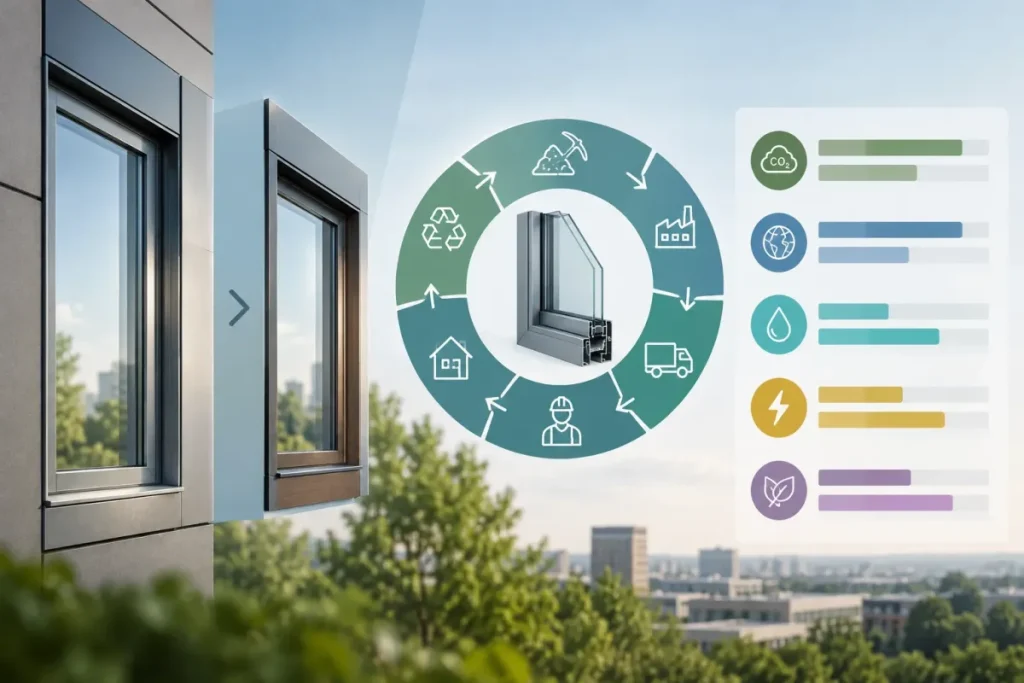

There is a story, told by every life cycle assessment practitioner, about the aluminum window. A design team, keen to reduce environmental impact, replaced aluminum frames with a lower-carbon alternative. The carbon number improved. Then the assessor, who had been asked to check other impacts as well, noticed that the alternative frame contained a coating with a significant effect on another category, and that its service life was shorter, so it would be replaced twice in the study period. When the whole life cycle was assessed across several impact categories, the “greener” window was no longer clearly greener. It was a trade-off, and the design team could now see it.
That is what life cycle assessment (LCA) is for: seeing the whole picture, across the whole life cycle and several kinds of environmental impact, instead of optimizing a single number at a single moment. Carbon is the most visible impact today, and the previous guide, BIM for Carbon Footprint and Embodied Carbon Assessment, treats it in detail. LCA is the broader discipline: a standardized method for compiling and evaluating the inputs, outputs and potential environmental impacts of a product or system through its life cycle. Applied to buildings, it considers materials, energy, water and waste from extraction to end of life, and expresses them in impact categories such as global warming, acidification, eutrophication, ozone depletion, photochemical ozone formation and resource depletion.
BIM matters to LCA because LCA is hungry for inventory data, and the model is the best source of that data in a design process: what materials, in what quantities, in which elements, with what service lives. This guide explains how to use BIM for life cycle assessment. It covers the LCA framework and relevant standards, the goal and scope decisions, the inventory, the role of environmental product declarations, impact assessment and interpretation, how BIM-based LCA workflows operate at different stages, how to prepare the model, how to use LCA in design decisions, links to life cycle costing, uncertainty, verification and reporting, tools and the mistakes to avoid. LCA requires trained practitioners, recognized methods and transparent documentation. The descriptions here are general; follow the methods your regulator, client and scheme require.
The Short Answer
LCA is a four-phase method, and BIM contributes mainly to the inventory, with scenarios and environmental data supplied by specialists.
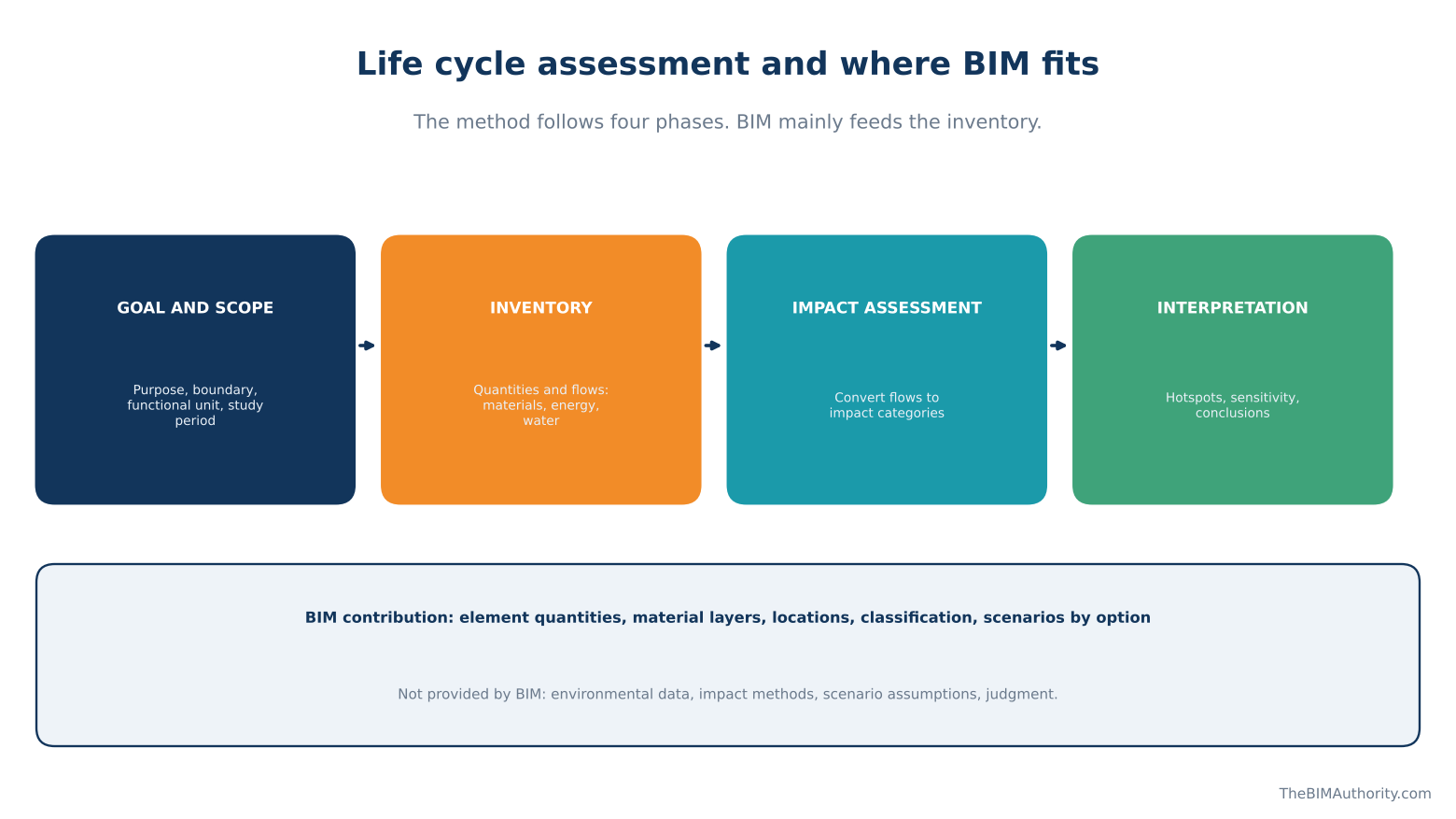
| Phase | What happens | BIM contribution |
|---|---|---|
| Goal and scope | Define purpose, system boundary, functional unit, study period, impact categories | Informs feasible scope: what the model can support |
| Inventory | Compile quantities of materials, energy and water, and associated flows | Element quantities, material layers, locations, classification, options |
| Impact assessment | Convert inventory flows into potential impacts using characterization methods | None directly; uses environmental data |
| Interpretation | Identify hotspots, test sensitivity, draw conclusions | Option comparison with the model; communicating results |
In one sentence:
BIM makes the inventory of a building traceable and updatable; LCA turns that inventory into a picture of environmental impacts across the whole life cycle.
LCA Standards and Frameworks
| Level | Standards and documents | Notes |
|---|---|---|
| General LCA | ISO 14040 (principles and framework) and ISO 14044 (requirements and guidelines) | The foundation of life cycle assessment practice |
| Construction products | EN 15804 core rules for environmental product declarations, in its amended form EN 15804+A2 (with an extended set of indicators, including separate reporting of biogenic carbon) | Source of product data for building LCA; related international rules exist |
| Whole buildings | EN 15978 for the assessment of environmental performance of buildings, with the life cycle modules A1 to D | The framework for building-level assessment |
| Professional and regulatory frameworks | National methods; professional standards for whole life carbon; certification scheme methods | See BIM for Carbon Footprint and Embodied Carbon Assessment and BIM for Green Building Certification: LEED and BREEAM |
| Life cycle costing | Methods for costs over the life cycle | Complements LCA. See below |
Standards are revised; check the current editions and national annexes applicable to your project.
Phase 1: Goal and Scope
The goal and scope decisions determine everything that follows.
| Decision | Considerations |
|---|---|
| Goal | Why is the assessment done? Compare options, demonstrate compliance, support certification, identify hotspots, communicate |
| Audience | Designers, client, regulator, assessor, public |
| Functional unit | What is the building’s function? Typically a building (or floor area) with defined performance over a study period; ensure options compared deliver the same function |
| System boundary | Which building parts and life cycle modules are included |
| Study period | The number of years assessed; methods specify defaults for buildings |
| Impact categories | Which environmental indicators to report |
| Data requirements | Sources, quality, temporal and geographic relevance |
| Allocation, cut-off and exclusions | How shared flows are allocated; what minor items are excluded |
| Assumptions and limitations | Stated up front |
A BIM-based LCA must also fit what the model can provide at the stage: an early model supports an elemental LCA with approximate quantities; a later model supports a detailed one.
Phase 2: Life Cycle Inventory
What the Inventory Contains
| Inventory item | Source |
|---|---|
| Materials and products in the building | BIM quantities by element, layer and type |
| Transport to site | Distances and modes; project data |
| Construction process | Energy, water, waste on site; contractor data |
| Use stage | Maintenance, repair, replacement cycles (from service lives), refrigerant leakage, operational energy and water |
| End of life | Deconstruction, transport, waste processing and disposal scenarios |
| Beyond the boundary | Reuse, recovery and recycling potential (module D, reported separately) |
Linking BIM to the Inventory
| Step | Practice |
|---|---|
| Extract quantities by rule | By element, material, layer, with consistent units. See BIM Quantity Takeoff: Methods, Tools, and Best Practices |
| Map elements to LCA data | By classification, material names or product references |
| Convert units | The declared unit of the data (per kilogram, per cubic meter, per square meter) versus the model quantity unit |
| Apply service lives and replacement cycles | Per element or product; from specifications, data or guidance |
| Add allowances | For unmodeled items; state them |
| Record model version | Traceability |
Environmental Data
| Data type | Notes |
|---|---|
| Environmental product declarations | Verified product-level data under EN 15804 or equivalent rules; include indicators across modules |
| Generic and industry-average data | For early design and gaps |
| Database data for energy, water, transport and processes | Background data for scenarios |
| Scenario libraries | Maintenance, replacement and end-of-life scenarios |
Check version, validity, geography, declared modules, declared unit and indicators for each data source. Declarations under different versions of the rules may include different indicators and treatments; do not mix carelessly.
Phase 3: Impact Assessment
Impact assessment converts inventory flows into potential environmental impacts by characterization factors. The EN 15804+A2 framework for product declarations reports a set of indicators, including those commonly grouped as:
| Impact category (illustrative) | Meaning |
|---|---|
| Climate change (global warming potential) | Greenhouse gas emissions, in carbon dioxide equivalent; with fossil, biogenic and land-use components reported separately |
| Ozone depletion | Emissions affecting the ozone layer |
| Acidification | Emissions causing acidification of soil and water |
| Eutrophication | Nutrient emissions to water and soil |
| Photochemical ozone formation | Emissions leading to ground-level ozone |
| Resource depletion | Use of abiotic resources, including minerals and fossil fuels |
| Water use | Consumption of water resources |
| Other indicators | Energy use (renewable and non-renewable), waste categories, and others, depending on the rules |
Practical guidance:
| Practice | Why |
|---|---|
| Report several categories, not only carbon | Avoid problem shifting |
| Use the characterization method required by the standard or scheme | Comparability |
| Report primary energy and waste indicators where required | Completeness |
| Be cautious with weighting | Combining categories into a single score involves value judgments; follow the scheme’s rules or present categories separately |
Phase 4: Interpretation
| Task | Practice |
|---|---|
| Identify hotspots | Which elements, materials, modules and impact categories dominate |
| Check completeness and consistency | Are boundaries and data consistent across options? |
| Sensitivity analysis | How do results change with key assumptions: service lives, transport distances, end-of-life scenarios, energy mix, data choices |
| Uncertainty analysis | Ranges and qualitative confidence |
| Draw conclusions | In line with the goal and with caution about limits |
| Recommend actions | Reduction measures, data improvements, verification needs |
| Communicate clearly | Results, scope, assumptions, limits |
A strong interpretation says what is robust (true across plausible assumptions) and what is sensitive (depends on an uncertain assumption).
BIM-Based LCA Workflows by Stage
| Stage | Approach | Model use |
|---|---|---|
| Concept | Elemental or benchmark-based LCA with approximate quantities; compare structural, façade and material strategies | Massing and early element models |
| Developed design | Quantities by type and material; generic data; hotspots and option studies | Models with materials and layers |
| Technical design | Specified products with declarations where available; refine scenarios | Types linked to product data |
| Procurement | Requirements for declarations; evaluation of tenders | Quantities by package |
| Construction | Record actual products, transport and construction; update the LCA | Change control; as-built updates |
| As-built | Final LCA with actual data; reporting and verification | As-built model and records |
| Operation | Update with replacements, maintenance and operational data | Asset data; monitoring |
Approaches to the Workflow
| Approach | Description | Comment |
|---|---|---|
| Tool-integrated | LCA software reads BIM models (native or exchange) and applies data | Efficient; check mapping |
| Quantity export to spreadsheets or LCA software | Manual or semi-automatic mapping | Flexible and transparent |
| Parametric and scripted | Scripts connect model parameters to data | Powerful for options; needs skills |
| Hybrid | BIM for main elements; manual for the rest | Practical |
Test any tool-based workflow with a pilot, and verify the tool’s method, data and outputs against the standard you must follow.
Preparing the Model for LCA
| Practice | Why |
|---|---|
| Model materials and layers | Quantities by material |
| Use types and classification consistently | Mapping to data |
| Add parameters for LCA | Service life, product reference, declaration reference, reuse flag |
| Include all disciplines and external works if in scope | Completeness |
| Distinguish existing, demolished and new | Retrofit LCA. See BIM Modeling for Renovation and Existing Buildings |
| Avoid overlaps and duplicates | Quantity accuracy |
| Plan for unmodeled items | Allowances |
| Keep a model-for-LCA protocol | Agreement between modelers and assessors |
| Version control | Reproducibility. See BIM Model Version Comparison and Change Detection |
| Prepare the model for change | Options and updates |
See also BIM Metadata, Attributes, and Property Sets Explained for property structure, and ISO 7817-1: Level of Information Need Explained for stage-appropriate information.
Using LCA in Design Decisions
| Use | Practice |
|---|---|
| Option comparison | Compare alternatives on the same functional unit and boundary; show impact categories side by side |
| Hotspot-driven design | Focus effort on elements and materials that dominate impacts |
| Material and product choice | Use product declarations to differentiate suppliers |
| Durability and replacement | Longer-lived components can reduce lifetime impacts; consider maintenance and replacement |
| Operational versus embodied trade-offs | Compare energy and material effects together. See BIM for Energy Analysis and Building Performance Simulation |
| Design for adaptability and disassembly | End-of-life and reuse potential. See BIM for Construction Waste Reduction and Material Optimization |
| Retrofit versus new build | Compare life cycle impacts of alternatives |
| Communication | Show results to clients and teams in clear visuals |
Life Cycle Costing
LCA’s cost counterpart is life cycle costing (LCC): costs over the life cycle (capital, maintenance, replacement, operation, end of life). Both use similar BIM-derived quantities and service lives, and both are needed for balanced decisions. Link them through shared classification and codes. See BIM-Based Cost Estimation and Budget Management.
Uncertainty, Verification and Reporting
| Topic | Practice |
|---|---|
| Sources of uncertainty | Data quality, model completeness, scenarios (service lives, end of life), energy mix assumptions, method choices |
| Sensitivity and scenario analysis | Test key assumptions; report ranges |
| Data quality assessment | Rate data by relevance, completeness and verification |
| Critical review or verification | Where required for comparative claims or schemes; independent review improves credibility |
| Transparency | Document method, scope, data, assumptions, exclusions, limitations |
| Comparative claims | Compare only like with like, with the same functional unit and boundaries; be cautious with public comparative claims |
| Archive | Keep assessment files, data and model versions |
A Reporting Outline
| Section | Content |
|---|---|
| Goal and scope | Purpose, functional unit, boundary, modules, study period, impact categories |
| Method and standards | With versions |
| Inventory summary | Quantities by element group; data sources and shares of specific versus generic data |
| Results | By impact category, module and element group; biogenic carbon separate; module D separate |
| Interpretation | Hotspots, sensitivity, uncertainty, conclusions |
| Limitations | Exclusions and weaknesses |
| Recommendations | Design and data actions |
| Traceability | Model and data versions |
Common Problems and Remedies
| Problem | Cause | Remedy |
|---|---|---|
| Carbon only | Convenience | Include other categories; explain problem shifting |
| Results not comparable | Different boundaries, data or functional units | Align scope; document |
| Quantities wrong or incomplete | Model issues; unmodeled items | Quantity checks; allowances; protocol |
| Data mismatches | Unit conversion errors; wrong versions | Check declared units, versions and validity |
| Scenarios unrealistic | Default service lives and end-of-life assumptions unchecked | Review and justify; sensitivity |
| Late assessment | No early studies | Start with benchmarks and simplified models |
| Tool black box | Unknown methods | Verify against the standard; document |
| No traceability | Models and data not versioned | Version control; assessment records |
| Overstated claims | Selective reporting | Transparency; verification |
Common Mistakes
- Equating LCA with carbon alone.
- No defined goal, scope or functional unit.
- Comparing options with different boundaries.
- Mixing versions of declarations carelessly.
- Ignoring service lives and replacement.
- No allowance for unmodeled items.
- Ignoring end-of-life scenarios.
- No sensitivity analysis.
- Weighting categories without justification.
- Overclaiming from early-stage results.
- No documentation or verification.
- Assessing only at the end.
See also Common BIM Mistakes Beginners Should Avoid.
A Short Checklist
- Have we defined goal, audience, functional unit, boundary, modules, study period and impact categories?
- Is the model prepared (materials, layers, classification, parameters, all disciplines)?
- Are quantities extracted by rule and verified, with allowances stated?
- Are environmental data sourced, versioned, unit-checked and documented?
- Are service lives, replacement and end-of-life scenarios defined and justified?
- Do we report several impact categories, with biogenic carbon and module D separate?
- Have we done sensitivity and uncertainty analysis and identified hotspots?
- Are options compared on the same basis?
- Is verification or critical review planned where needed?
- Are results and data traceable to model versions?
Frequently Asked Questions
What is life cycle assessment?
A standardized method for compiling and evaluating inputs, outputs and potential environmental impacts of a product or system through its life cycle.
How does BIM support LCA?
By providing the inventory data: quantities of materials by element and layer, with types, classification, locations and options.
What is the difference between LCA and carbon assessment?
Carbon assessment covers greenhouse gases; LCA covers multiple impact categories, such as acidification, eutrophication, ozone depletion and resource use.
What is a functional unit?
The defined function and quantity against which the life cycle assessment is expressed, enabling fair comparison between options.
What are environmental product declarations?
Verified documents reporting the environmental impacts of products over their life cycle, prepared under standardized rules such as EN 15804.
Which life cycle modules does a building LCA cover?
Modules A1 to A5 (product and construction), B1 to B7 (use), C1 to C4 (end of life) and D (beyond the system boundary), according to the scope chosen.
Is LCA mandatory?
Requirements vary: some jurisdictions and schemes require carbon or LCA reporting for new buildings; check your location and client requirements.
How early can LCA be done?
At concept stage with benchmarks and approximate quantities, improving as the model and product information mature.
Final Thoughts
The aluminum window story has a lesson I now put on the first slide of every LCA workshop: a better number is not always a better building. LCA does not tell you what to choose. It shows you what you would be choosing, across the whole life and across more than one kind of impact. The design team with the window ended up keeping the original frame in the façade zones where replacement would be difficult and using the alternative where it could be easily replaced. They would not have made that split without seeing the picture.
BIM gives the picture its data. Define the goal and scope, prepare the model, build the inventory by rule, choose and document environmental data, assess several impacts, interpret with sensitivity and uncertainty, verify what you claim and keep the traceability. Then LCA becomes what it should be: a decision tool that shows the consequences of design choices before they are built.
Where to go next: for the carbon focus, read BIM for Carbon Footprint and Embodied Carbon Assessment. For ratings, continue with BIM for Green Building Certification: LEED and BREEAM, and for the wider context, Sustainable BIM: The Complete Guide to Environmentally Responsible Design.